
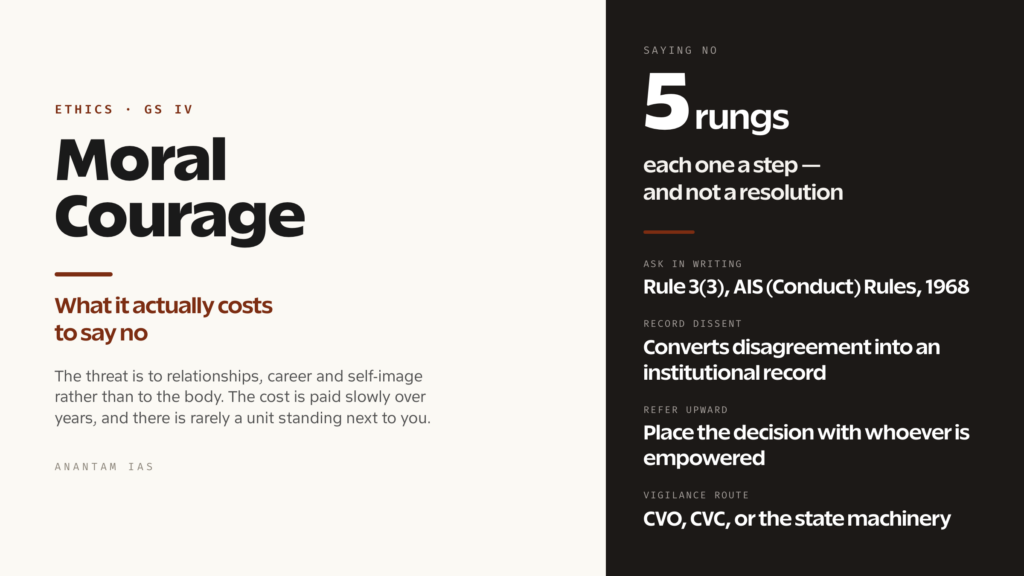
Physical courage and moral courage are usually named in the same breath and treated as two applications of one virtue. They are not. They face different threats, run on different psychology, and are supported by entirely different institutional arrangements. The second is harder, and the reason has nothing to do with it being nobler.
What follows tries to be specific about three things this topic normally leaves vague: what saying no actually looks like in an Indian government office, what it costs in the currency the service really uses, and how to tell moral courage from the obstinacy and grandstanding that imitate it closely enough to fool the person doing it.
Physical and Moral Courage Face Different Threats
Physical courage confronts a threat to the body. It is usually brief, usually witnessed, rewarded afterwards, and heavily supported by training, drill and a unit whose members are watching. Armies invest enormously in exactly those supports, on the correct assumption that individual resolve alone is unreliable.
Moral courage confronts a threat to relationships, career, income and self-image. The adversary is normally not a villain but a superior who is otherwise decent, whose request is framed reasonably, and who has considerable control over the next fifteen years of your life. The act is often invisible — a note on a file nobody outside the chain will read — and the colleagues who agree in the corridor will not say so in the meeting.
Three asymmetries follow. The trigger arrives disguised: moral courage is demanded by a phone call that sounds like an ordinary request, and half the failures happen because the officer never registered that a decision was being taken. The cost is paid slowly, in postings and appraisals over years, which defeats the psychology that makes momentary bravery possible. Identity is attacked directly: an officer who refuses is told, often sincerely, that they are rigid, disloyal, naive or self-righteous, and after enough repetitions that description starts to seem plausible from the inside. Courage is the enforcement mechanism for integrity; without it, integrity is a preference rather than a property.
Courage as a Mean: Recklessness, Cowardice and the Space Between
Aristotle treats andreia in Book III of the Nicomachean Ethics as the mean between rashness and cowardice. Three features of that account are usually lost in summary and are the useful part.
The mean is not the midpoint. Aristotle is explicit that courage lies nearer to rashness, and that for most people, who are disposed to fear, the correction runs toward boldness. An officer calibrating themselves should assume they are erring on the timid side, because almost everyone is.
Courage is defined by its end. The courageous person fears the right things in the right measure for the sake of to kalon, the noble, and acts in knowledge of the risk. That end-condition separates the officer who escalates the one issue that matters from the officer who escalates everything; the second is not braver, the vice is simply different.
And courage is a disposition built by repetition rather than a decision taken once. Someone who has never asked for a small instruction in writing will not manage it when the instruction is large, because the act will be unfamiliar exactly when there is no time to learn it.
The honest limitation is that Aristotle’s courage is battlefield courage, in a citizen class, facing death; the extension to the moral case is later work and it is not obvious the same analysis survives the move. The tradition also has no answer to the question a working officer actually has, which is how much sacrifice is required of them.
Why People Comply: The Experimental Record
The assumption that people who go along with wrongdoing are cowards does not survive the evidence. Ordinary people comply under conditions that are easy to reproduce, and knowing the conditions is more useful than deploring the outcome.
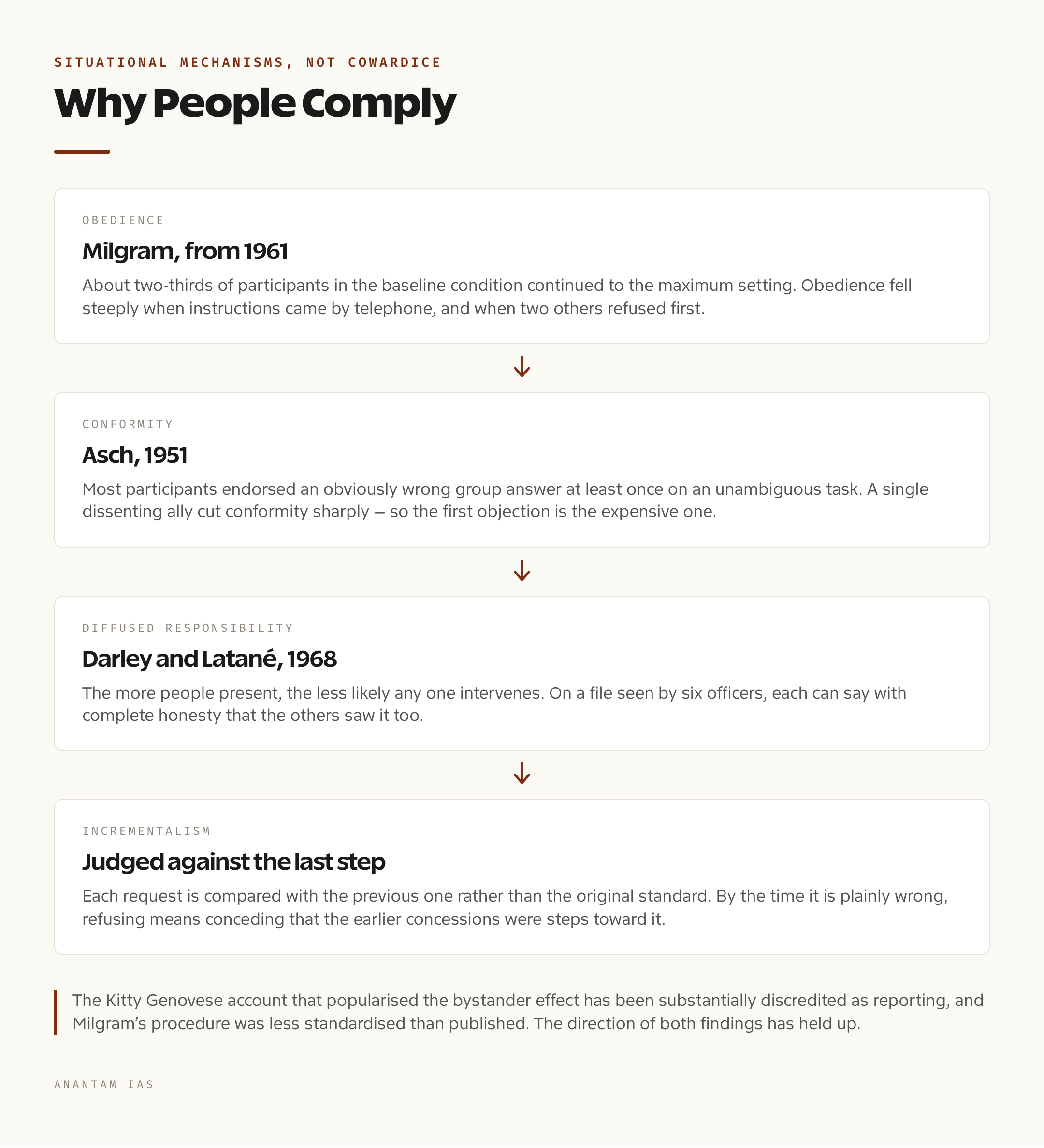
Obedience to authority. In Stanley Milgram’s Yale experiments, begun in 1961 and reported in 1963 and in Obedience to Authority (1974), roughly two-thirds of participants in the baseline condition continued administering what they believed were escalating shocks to the maximum setting. The variations matter more than the headline. Obedience fell steeply when the experimenter instructed by telephone, when the supposed victim was in the same room, and — the finding with the most direct office application — when participants first saw two others refuse. Milgram’s proposed mechanism was the agentic state: the subject stops experiencing himself as the author of the act and becomes the executor of someone else’s intention. Anyone who has heard an official say the orders came from above has heard that state described.
The experiments would not be permitted today, and archival re-examination of Milgram’s own papers shows the procedure was less standardised and the prodding more improvised than published. The direction of the finding holds across replications; the percentage should not be quoted as a constant.
Conformity. Solomon Asch’s line-judgement studies from 1951 used a task with an unambiguously correct answer, and a substantial majority of participants went along with the group’s obviously wrong response at least once. The finding worth carrying is the reverse one: a single dissenting ally cut conformity sharply. The office implication is exact — the second objector pays a fraction of what the first pays, so finding one ally before the meeting is a technique rather than a comfort.
Diffused responsibility. Darley and Latané showed in 1968 that the more people present, the less likely any individual intervenes, because responsibility divides. On a file that has passed six officers, each can say with complete honesty that the others saw it too. The newspaper account of the Kitty Genovese case that popularised the effect has been substantially discredited as reporting; the experimental finding stands without it.
The Slow Version: Incrementalism and Thoughtlessness
Most administrative complicity is not produced by a single capitulation but by a sequence in which every step is small relative to the one before it. Each request is judged against the previous request rather than against the original standard. The first concession is genuinely defensible — an expedited file, a relaxed timeline, a supplier included in a limited tender for reasons that exist. Consistency pressure then supplies the argument for the next: having done the small thing, the cheapest way to avoid admitting it was wrong is to do the slightly larger thing. By the time the request is plainly improper, refusing means conceding that the earlier ones were steps toward it. Officers rarely notice the slope, because the only comparison being made is local.
Hannah Arendt’s contribution here is the part of her work most often misquoted. Reporting the Eichmann trial in 1963, she located the source of bureaucratic atrocity not in sadism or ideology but in thoughtlessness — an inability to think from another’s standpoint, and the substitution of official language and cliché for judgement. The diagnosis is examined in the account of Hannah Arendt’s political ethics. Her portrait of her particular subject has been seriously challenged by later archival work showing a far more ideologically committed man than the figure in the dock. The claim about thoughtlessness in administrative evil is worth keeping even though her chosen illustration was a poor one, and saying so is more honest than repeating the phrase as though nothing had happened to it since.
What Saying No Actually Looks Like: The Graded Ladder
In an Indian office, “no” is almost never a single word delivered once. It is a sequence of moves of rising cost, and an officer who does not know the sequence has only two options, both bad — compliance, or a confrontation they will lose.
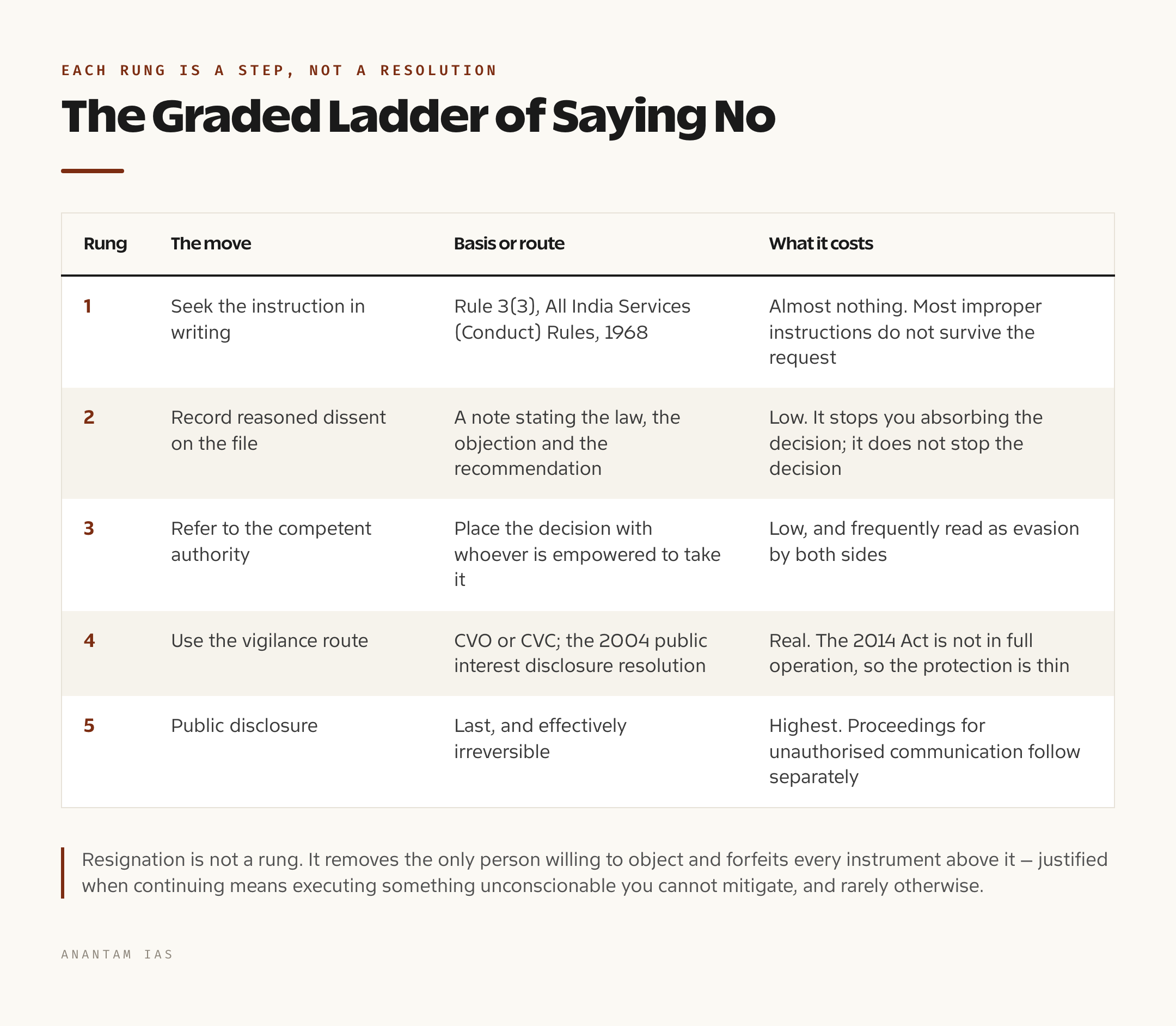
Ask for the instruction in writing. Rule 3(3) of the All India Services (Conduct) Rules, 1968 already provides that a superior’s direction should ordinarily be in writing, that an unavoidable oral direction must be confirmed in writing by the superior immediately, and that the officer receiving one must seek written confirmation. T. S. R. Subramanian v. Union of India (2013) restated the obligation. Most improper instructions do not survive the request, because the person issuing them wants the outcome and not the record.
Record dissent on the file. A reasoned note setting out the legal position, the objection and the recommendation, and then routing the file upward. It is the single most protective act available, because it converts a personal disagreement into a record a successor, an auditor or a court can read. File notings are in principle accessible under the Right to Information Act, 2005, which changes the calculation for everyone else in the chain.
Refer the decision to the competent authority. Where the power to decide is not yours, place the decision with whoever is legally empowered to take it, with your recommendation attached, rather than absorbing the choice.
Use the vigilance route. The Chief Vigilance Officer, the Central Vigilance Commission, or state machinery. The Public Interest Disclosure and Protection of Informers resolution of 2004 designates the Commission for central government matters, and the Whistle Blowers Protection Act, 2014 was enacted to give the channel statutory protection. It has not been brought into full operation, leaving the route real and the protection thin — the gap is set out in the account of whistleblowing in India.
Public disclosure. Last, and effectively irreversible. It forecloses further work on the problem from inside and exposes the officer to proceedings for unauthorised communication, independent of whether the allegation was correct.
The point that makes this usable is that every rung is a step and not a resolution. Asking for the instruction in writing does not settle whether the thing will be done; it changes who owns it. Recording dissent does not stop the decision; it stops you absorbing it. An officer expecting any single move to end the pressure will read each rung as a failure. The solved situations in ethics case studies on political pressure turn on exactly this, separating the legitimate concern in a request from the illegitimate route proposed.
Why Resignation Is Almost Never the Answer
Resignation feels more like courage than anything else on the list and usually accomplishes least. It removes the only person in the room willing to object, and the successor is generally chosen with that in mind. It forfeits every instrument on the ladder at once, since you cannot record a note on a file you no longer see. And it converts a specific, documentable objection into a general gesture that can be read as pique, which is how it will be read.
The counter-case is real. Resignation is correct when continuing means personally executing something you consider unconscionable and you have no capacity to mitigate it, or when your presence is being used as cover for the thing you object to. The distinguishing question is narrow: does staying still let you affect anything. There is also a lesser move frequently available and frequently sensible — seeking a transfer out of the post, which ends the specific pressure without ending the career.
What Makes Courage Possible: The Institutional Supports
Moral courage is normally discussed as an individual quality, which is convenient for institutions. The observable variation runs mostly with conditions.
Security of tenure. Article 311(2) makes dismissal, removal and reduction in rank expensive for the state. Fixed minimum tenure, Civil Services Boards advising on postings, and recorded reasons for premature transfer address the instrument actually used.
A functioning grievance route that does not run through the person complained of and produces an outcome within a period the complainant can survive. A route that exists and never concludes is worse than none, because it absorbs the complaint.
Collegiate decision-making. A tender committee is harder to lean on than a single officer, and — the underrated half — it distributes the cost of refusing. Concentrating a decision in one signature is an ethical design choice, not merely an administrative one.
Documentation practice. Where noting is thorough and files complete, recording an objection is unremarkable. Where decisions are oral and files thin, the same note is an act of aggression.
A superior who backs subordinates. The largest single variable and the least amenable to rule. An officer once supported after an unpopular position will take another; one left exposed will not.
The Second Administrative Reforms Commission’s fourth report, Ethics in Governance (2007), framed all of this as a systems question rather than a character one, recommending reduced discretion, simpler procedures and fewer points at which a decision can be extracted — the argument is summarised in the account of the Second ARC on ethics in governance. The implication for a junior officer is uncomfortable: courage should be spent where the structure will hold and conserved where it will not. That sounds like a rationalisation for cowardice and is closer to a budget.
The Costs, Stated Without Softening
Transfer, usually to a post with a title and no work, because it requires no charge, inquiry or reasons. Adverse entries in the appraisal, which must be communicated and can be represented against — a genuine remedy and a slow one. Non-empanelment for senior posts is worse in its way: not a punishment, needing no reason, and never contestable.
Isolation. Colleagues who agree in private and are absent in the meeting, and a reputation for being difficult that circulates through the informal channel which actually determines postings and outlives the episode by a decade.
Family strain. A mid-term transfer breaks a school year, a spouse’s job does not move, elderly parents are in the city the officer is being moved away from. A large part of the cost is paid by people who did not take the decision and were not consulted.
Delayed promotion and the loop line — a sequence of postings that are formally equivalent and substantively empty.
In the extreme, physical danger. Satyendra Dubey was murdered in 2003 after writing about corruption in a highway project; Manjunath Shanmugam was murdered in 2005 after acting against fuel adulteration. A significant number of citizens using the Right to Information Act have been attacked or killed.
One point the inspirational literature omits: these costs are not equally available to everyone to absorb. An officer with private means, a working spouse and no dependants can take a bad posting for three years. An officer supporting parents on one income cannot make the same choice at the same price. Any account treating moral courage as uniformly available is describing a narrower group of people than it thinks.
When It Is Not Courage: Obstinacy, Ego and Grandstanding
Genuine moral courage and its counterfeits look identical from outside and often from inside. One question separates them: is the object the outcome or the stance? Several diagnostics follow.
Is a partial win acceptable? Someone pursuing an outcome takes seventy per cent and moves on. Someone pursuing a position needs the other side to concede, and will refuse a settlement that fixes the problem without acknowledging them.
Has the internal route been exhausted first? Going public first is frequently evidence that attention rather than remedy is the objective. It is not conclusive, but the burden sits with the person who skipped it.
Is the target the transaction or the person? Objections that migrate from the file to the character of the superior have usually changed subject.
Is the standard applied symmetrically? The most reliable single tell: an officer rigorous with strangers and accommodating with friends is not courageous but selectively aggressive.
Who bears the cost? A refusal that stalls wage payments to labourers to make a point about procedure has transferred the cost to people with no part in the dispute.
Two honest complications. These are exactly the accusations a system levels at a genuine objector — “he is rigid”, “he wants publicity”, “he has a grudge” is the standard vocabulary used against officers who turn out to have been right. The tests are for self-examination, not for judging someone else from a distance, and using them to dismiss an inconvenient colleague is itself one of the mechanisms described above. And the opposite failure attracts no scrutiny at all: the officer who is invariably reasonable, who always finds an accommodation, who has never in twenty-five years recorded a dissenting note, is not exercising judgement. That is compliance with a good vocabulary, and it is far more common than obstinacy.
FAQ
Why is moral courage harder than physical courage? The threat is to relationships, career, income and self-image rather than to the body; the cost is paid slowly over years; the adversary is usually a decent person with power over your future; and there is rarely a group standing beside you.
What does Aristotle’s account of courage add to administrative ethics? Courage is the mean between recklessness and cowardice, sitting nearer the bold end, defined by the end it serves and built by repetition. So the officer who escalates everything is not braver, and small habits of documentation make a large refusal possible.
What is the practical lesson from Milgram’s and Asch’s findings? Compliance is situational rather than a character defect. Obedience fell sharply when participants saw others refuse and conformity collapsed with a single dissenting ally, so the first objection is the expensive one and securing one supporter beforehand is a method.
What is the first step when an officer receives an improper oral instruction? Seek written confirmation. Rule 3(3) of the All India Services (Conduct) Rules, 1968 requires the superior to confirm an unavoidable oral direction in writing and requires the recipient to ask for it. Most improper instructions do not survive the request.
Should an officer resign rather than carry out an improper order? Rarely. Resignation removes the only person willing to object, forfeits the ability to record dissent, and reads as pique. It is justified when continuing means personally executing something unconscionable you cannot mitigate, or when your presence is being used as cover.
How can moral courage be distinguished from obstinacy? By asking whether the object is the outcome or the stance. Willingness to accept a partial win, exhaustion of internal routes first, focus on the transaction rather than the person, and symmetry of standards between friends and strangers are the workable tests.
Practice Questions
Prelims MCQs
- In Aristotle’s account, courage is the mean between: (a) rashness and cowardice (b) pride and humility (c) anger and indifference (d) prudence and justice — Answer: (a) he also holds the mean lies nearer to rashness, so the usual correction for most people runs toward boldness.
- In the baseline condition of Milgram’s obedience experiments, the proportion of participants who continued to the maximum shock setting was approximately: (a) one-tenth (b) one-third (c) two-thirds (d) all participants — Answer: (c) about sixty-five per cent, though the variations, especially the collapse of obedience when others refused first, matter more than the figure.
- Asch’s line-judgement experiments primarily demonstrated: (a) obedience to legitimate authority (b) conformity to a group’s clearly incorrect judgement (c) diffusion of responsibility among bystanders (d) reduction of cognitive dissonance — Answer: (b) and the crucial secondary finding was that one dissenting ally sharply reduced conformity.
- Rule 3(3) of the All India Services (Conduct) Rules, 1968 provides that: (a) officers may not associate with political parties (b) an unavoidable oral direction must be confirmed in writing and the recipient must seek such confirmation (c) all assets must be declared annually (d) gifts above a prescribed value may not be accepted — Answer: (b) which makes seeking the instruction in writing an existing obligation rather than an act of defiance.
- For most central government matters, protected disclosures by public servants are designated to be made to: (a) the Central Bureau of Investigation (b) the Central Vigilance Commission (c) the Comptroller and Auditor General (d) the State Lokayukta — Answer: (b) under the 2004 public interest disclosure resolution, and the Whistle Blowers Protection Act, 2014 was enacted to strengthen this channel but has not been brought into full operation.
Mains Practice Questions
- “Moral courage is harder than physical courage because the institutions that support the first are largely absent.” Examine. (150 words)
- Compliance with improper instructions is better explained by situational mechanisms than by individual cowardice. Discuss with reference to the experimental evidence, and state what follows for administrative design. (250 words)
- Describe the graded sequence of responses available to a civil servant who receives an improper instruction, and explain why resignation is rarely the appropriate one. (250 words)
- “The costs of moral courage are not equally available to every officer to absorb.” Critically examine this claim and its implications for how we judge officers who comply. (150 words)
- How would you distinguish genuine moral courage from obstinacy, ego or grandstanding in a subordinate officer? Give the tests you would apply and their limitations. (250 words)
Tell Google you want more of this.
Add Anantam IAS as a preferred sourceOne tap, and this site shows up more often in your own Top Stories, AI Overviews and AI Mode. Remove it any time.