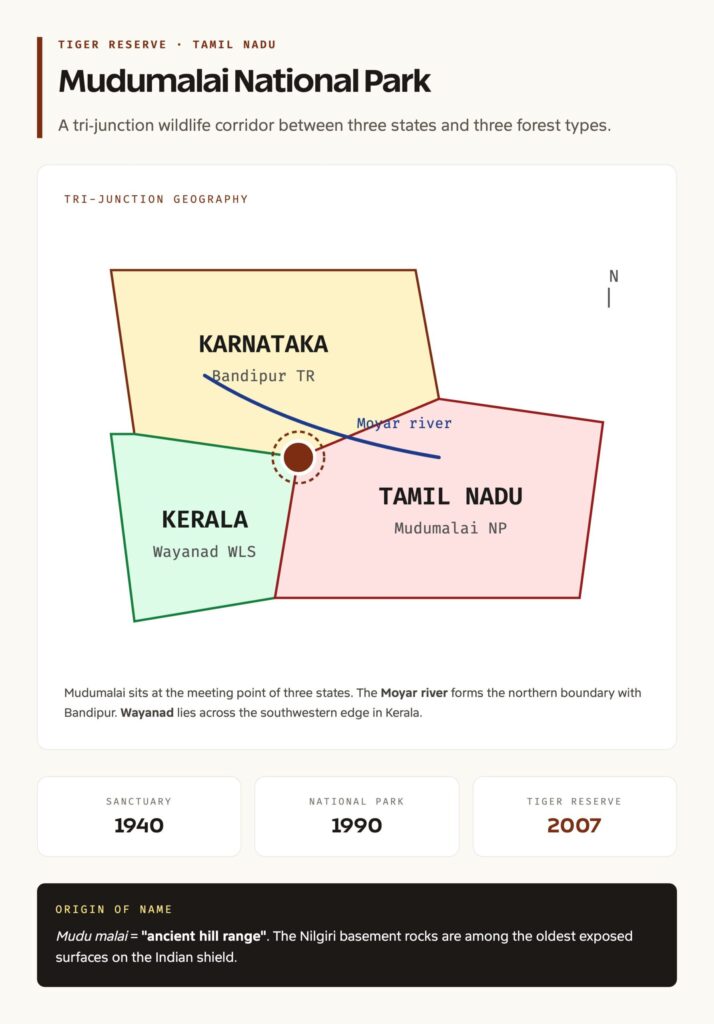
Mudumalai National Park is a tiger reserve in the Nilgiris district of Tamil Nadu, covering about 321 sq km at the tri-junction of Tamil Nadu, Karnataka and Kerala. It was notified a wildlife sanctuary in 1940, declared a national park in 1990 and a tiger reserve in 2007, and forms the eastern flank of the Nilgiri Biosphere Reserve — India’s first biosphere reserve. The park is a critical elephant and tiger corridor linking Bandipur, Wayanad and Nagarhole into one contiguous habitat.
Where the Western Ghats descend toward the Deccan plateau and the Eastern Ghats edge in from the north, the forests of the Nilgiris fold into one another at a single tri-state corner. Mudumalai National Park occupies that corner. It is one of the oldest wildlife sanctuaries of southern India, a tiger reserve, and a critical wildlife corridor that knits together the elephant landscapes of Tamil Nadu, Karnataka, and Kerala into a single functional ecosystem.
The name itself carries the weight of geological time. Mudu means ancient and malai means hill in Tamil, so Mudumalai is literally the “ancient hill range.” That is not poetic licence. The basement rocks of the Nilgiris are among the oldest exposed surfaces on the Indian shield, and the forests draped over them have evolved with the elephants, tigers, and tribal communities that still inhabit them today. The Oscar-winning documentary The Elephant Whisperers was filmed inside the Theppakadu elephant camp here, drawing global attention to the deep cultural relationship between the Kattunayakan family and the orphaned calves they raise.
For UPSC aspirants, Mudumalai is one of the highest-yield single-park topics in environment and ecology. It bundles the Western Ghats biodiversity hotspot, the Nilgiri Biosphere Reserve, Project Tiger, and a tribal-cultural dimension into one geography. This guide expands every layer of the park, its history, and its conservation policy.
Quick Facts
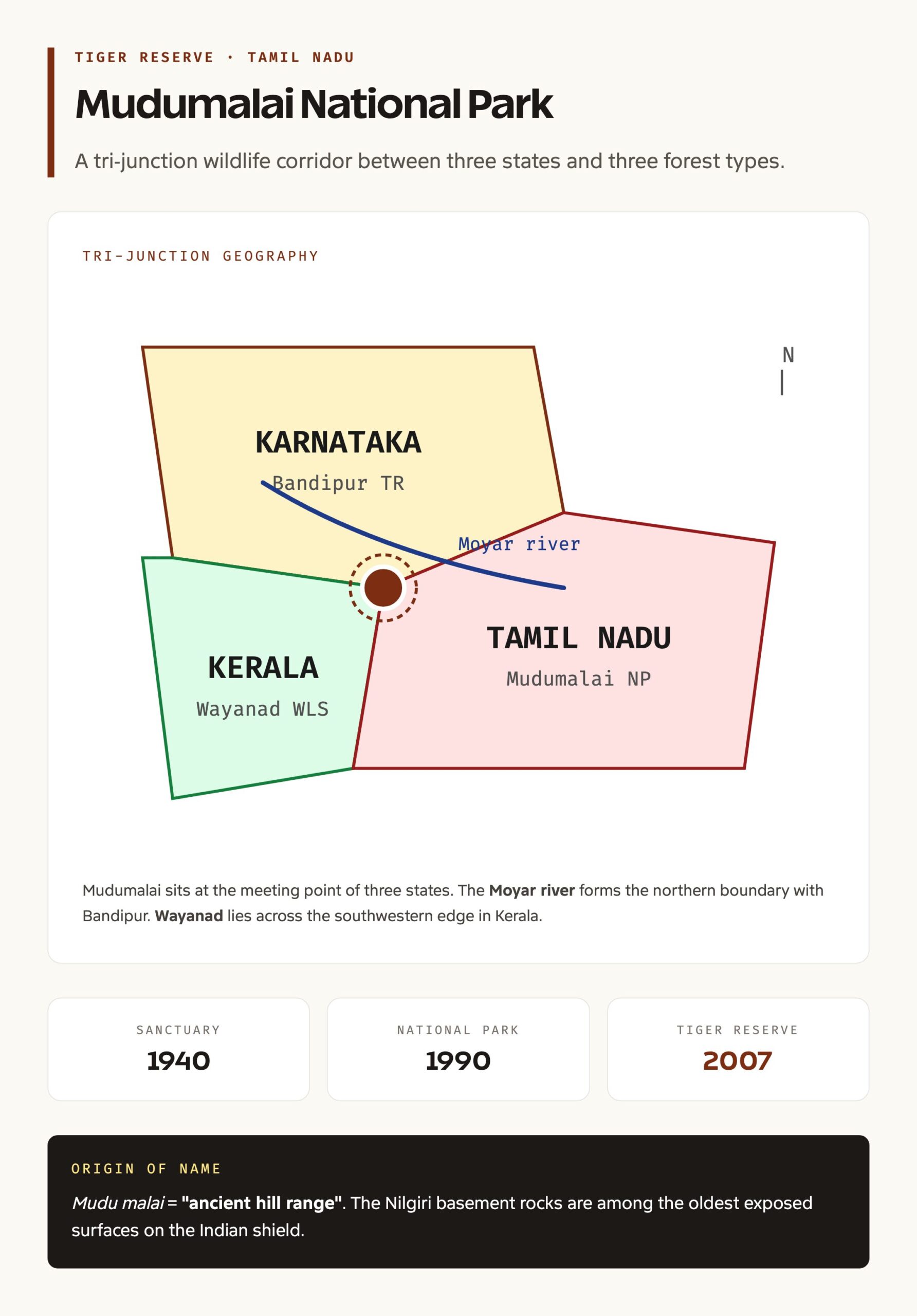
- Location: Nilgiris district, Tamil Nadu; tri-junction of Tamil Nadu, Karnataka, and Kerala
- Origin of name: Mudu malai, meaning “ancient hill range”
- Wildlife Sanctuary status: 1940 (one of the earliest in India)
- National Park status: 1990
- Tiger Reserve status: 2007 (38th tiger reserve)
- Wider landscape: Forms the eastern flank of the Nilgiri Biosphere Reserve, India’s first biosphere reserve, designated in 1986
- Major river: Moyar, which carves the Moyar Gorge, popularly called the “Grand Canyon of the South”
- Forest types: Tropical moist deciduous (Kerala side) and dry deciduous (Karnataka and Tamil Nadu side)
- Flagship species: Asian Elephant, Royal Bengal Tiger, Indian Vulture, White-rumped Vulture, Gaur, Leopard, Sloth Bear
- Tribes: Irulas, Kurumbas, Todas, and Kattunayakans
- Cultural icon: The Elephant Whisperers (2023), filmed at Theppakadu Elephant Camp
- Adjoining reserves: Bandipur (Karnataka), Wayanad (Kerala), and Nagarhole (Karnataka)
What Is Mudumalai National Park
Mudumalai National Park is a protected area of roughly 321 square kilometres on the northern slopes of the Nilgiris, where the high plateau drops sharply to the Mysuru plain. It is part of a much larger protected landscape that stretches across three states. To the west lies Wayanad Wildlife Sanctuary in Kerala. To the north, across the Moyar river, sits Bandipur Tiger Reserve in Karnataka. Together with Nagarhole, these four units form one of the largest contiguous wildlife habitats in southern Asia.
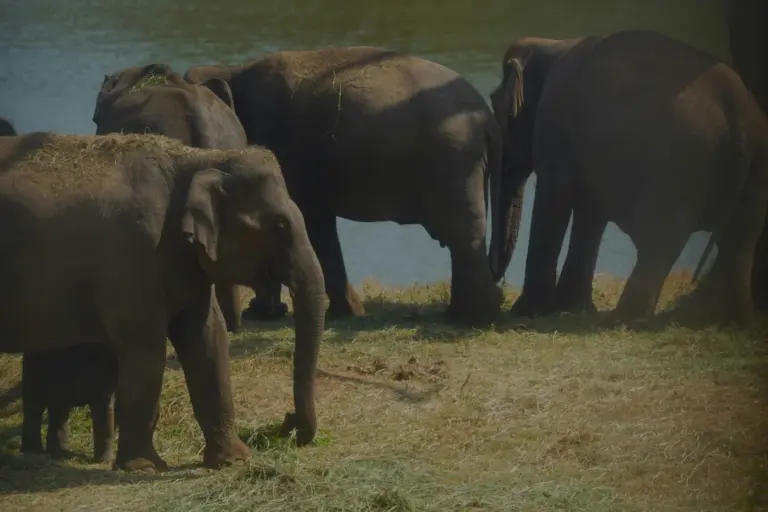
The park’s location is what gives it its disproportionate ecological value. Elephants migrate through Mudumalai in seasonal cycles, moving from the wetter Wayanad forests in the southwest monsoon to the drier Bandipur side as water sources shift. Tigers, gaur, and dholes use the same corridor. Without Mudumalai, the connecting tissue between three state-managed reserves would fray, and each block would become an isolated island. This is why the park is described first as a corridor and only second as a destination.
The forests grade from moist deciduous in the south, where Kerala’s rain shadow is gentler, into open dry deciduous and scrub in the north, where the rain runs out before reaching the Deccan plain. This gradient supports a remarkable variety of birds and ungulates within a relatively small area. The Moyar Gorge, with its near-vertical cliff faces, is one of the most reliable nesting sites for the critically endangered Indian Vulture and the long-billed and white-rumped vulture species that have collapsed across the rest of South Asia.
Background and Historical Context
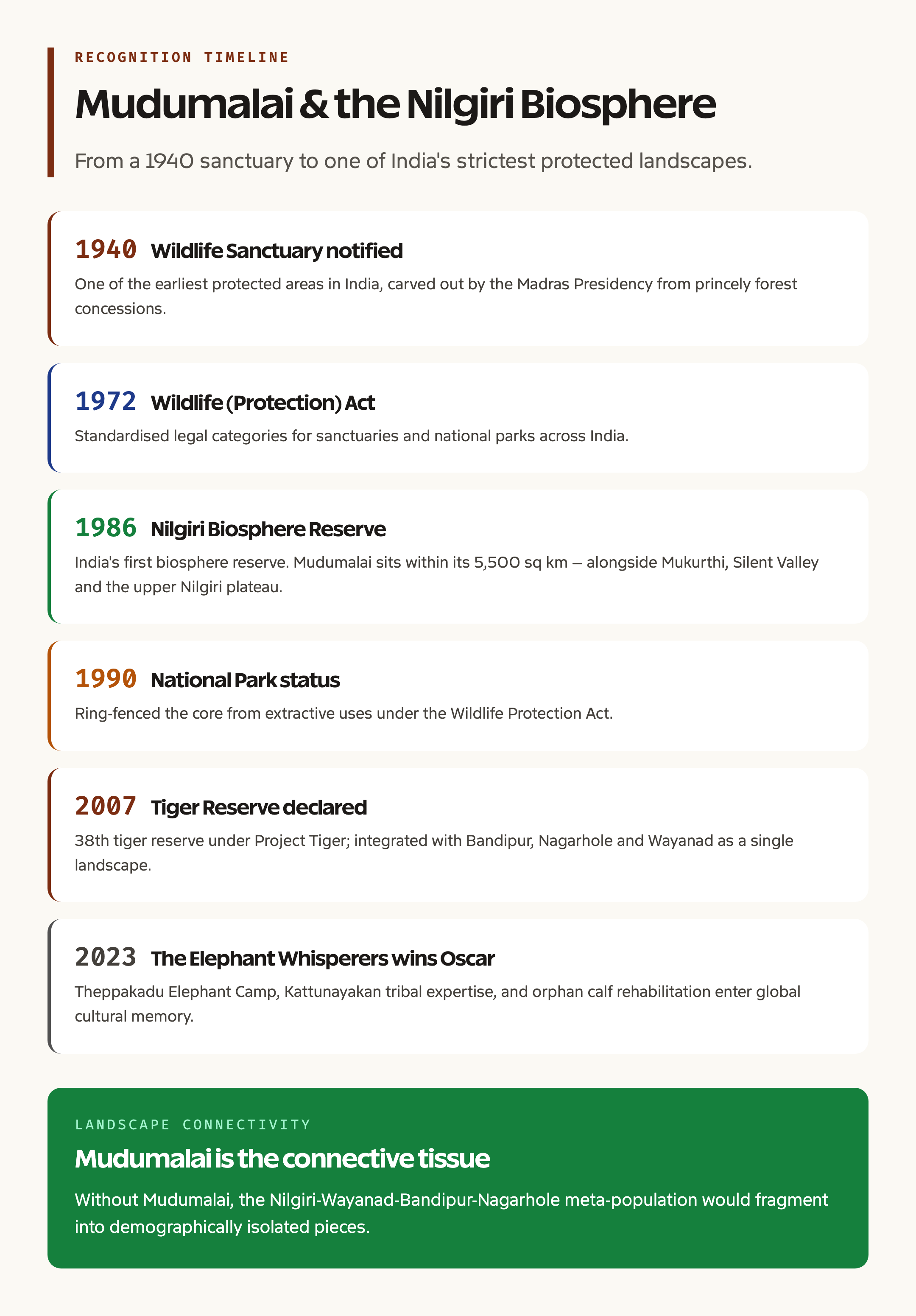
Mudumalai is one of the oldest wildlife sanctuaries in India. It was first notified in 1940, when the Madras Presidency carved out the area from princely forest concessions and reserved forests of the Nilgiri-Wayanad belt. At the time, the science of protected areas was barely a generation old anywhere in the world. Bombay Natural History Society members and forest officers had been documenting the Nilgiri elephant herds for decades, and the 1940 declaration was a recognition of that long lineage of fieldwork.
The park’s status evolved alongside India’s national conservation framework. After independence, the Wildlife (Protection) Act, 1972 standardised legal categories for protected areas. Mudumalai’s national park status came in 1990, ring-fencing the core from extractive uses. Tiger Reserve status under Project Tiger followed in 2007, formally acknowledging that the reserve, in combination with Bandipur, Wayanad, and Nagarhole, supported one of the densest tiger populations in the country.
The Nilgiri Biosphere Reserve, declared in 1986, gave the wider landscape an international profile. It was the first biosphere reserve in India and is now part of UNESCO’s Man and the Biosphere Programme. Mudumalai sits inside this biosphere, which spreads across roughly 5,500 square kilometres of forest and includes Mukurthi National Park, Silent Valley National Park, and the upper Nilgiri plateau. The biosphere framework is what allows the various state parks and sanctuaries to be planned as a single landscape rather than competing fragments.
Key Provisions and Legal Architecture
Mudumalai National Park is governed by overlapping legal frameworks. At the national core, the Wildlife Protection Act, 1972 provides the strictest legal status: no commercial activity, restricted human entry, and zero tolerance for hunting. The 2007 Tiger Reserve notification adds another layer through the National Tiger Conservation Authority, which sets management standards, audits performance, and channels Project Tiger funding.
Buffer zones around the core are managed under the Forest Conservation Act, 1980, which prevents the diversion of forest land for non-forest purposes without central government clearance. The Eco-Sensitive Zone notification under the Environment Protection Act, 1986 governs activity in a 5–10 kilometre belt around the park. Mining, polluting industries, and large construction projects are prohibited or strictly regulated within the ESZ. The Forest Rights Act, 2006 recognises the customary rights of forest-dwelling communities, including the Kattunayakans of Theppakadu, allowing them to live and access the forest without losing legal protection.
A specific feature of Mudumalai is the elephant camp at Theppakadu, one of the oldest in India. Captive elephants used in forest department operations are housed and cared for here under the supervision of the Mahout and Cavadi system. The camp is also where rescued and orphaned wild calves are reared, often by tribal families whose generations of expertise inform the rehabilitation work.
Why It Matters
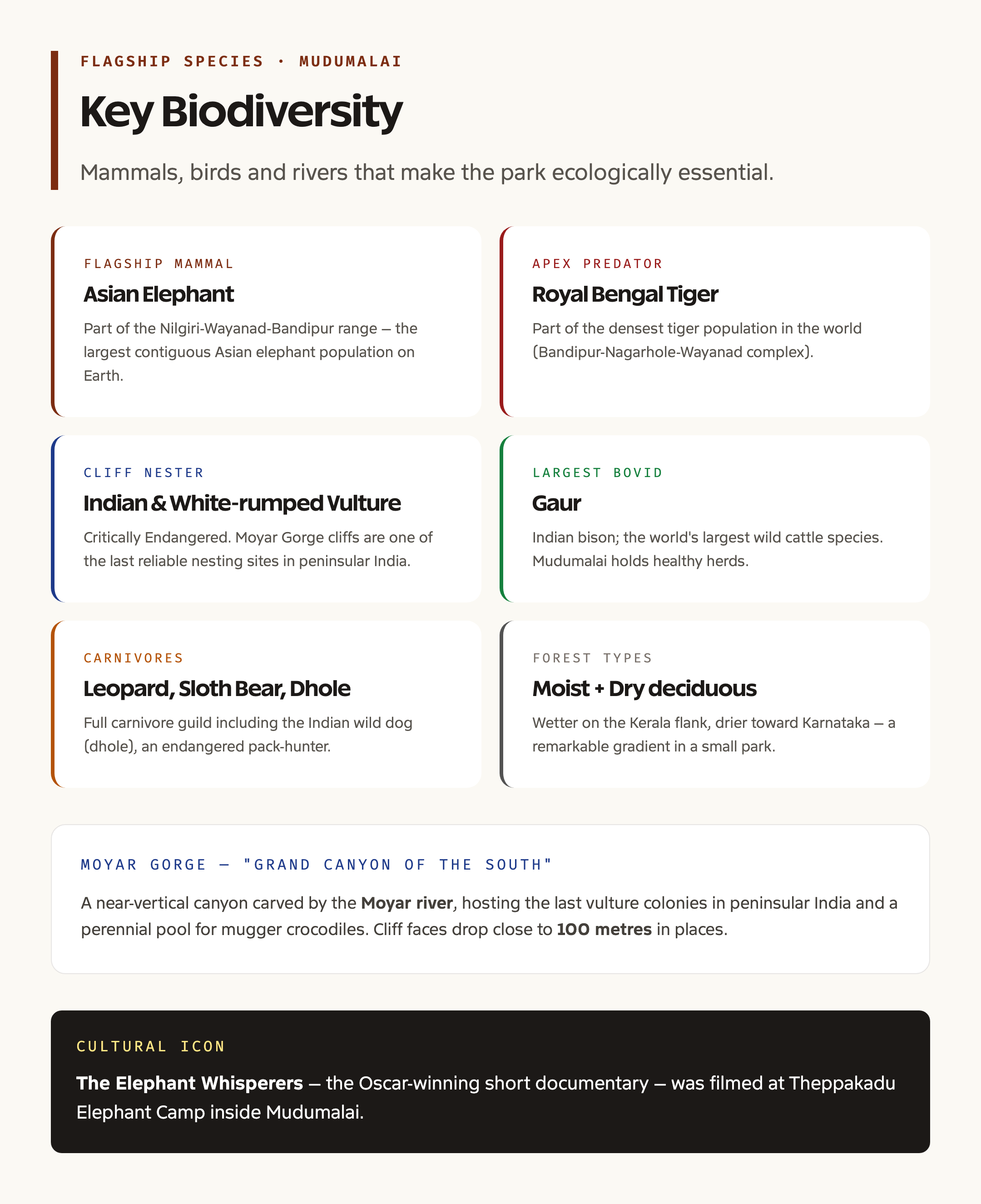
Mudumalai matters because it is the connective tissue of the southern Indian elephant range. The Nilgiri-Wayanad-Bandipur landscape supports more than 6,000 wild elephants, the single largest contiguous Asian elephant population in the world. If you remove Mudumalai, the meta-population fragments into smaller demographic units, each more vulnerable to disease, drought, and inbreeding. Corridor function is therefore not optional: it is what keeps the larger system viable.
The park is equally critical for tigers. The Nilgiri-Wayanad-Bandipur tiger landscape holds the highest density of wild tigers anywhere in the world, exceeding even the Sundarbans and Corbett. Mudumalai contributes prime habitat and breeding grounds, and the inter-state movement of tigers across its boundaries is documented in every Project Tiger census.
For local communities, the park’s economy is woven around responsible tourism, forest department employment, and traditional honey collection. The Irulas, Kurumbas, and Todas have lived in and around these forests for generations, and their ecological knowledge is preserved in everything from elephant handling to the location of medicinal plants. The Oscar-winning documentary The Elephant Whisperers offered the world a glimpse of this knowledge system and put Mudumalai on the global cultural map.
Detailed Analysis: Geography, Climate, and Ecology
Geographically, Mudumalai occupies the northern flank of the Nilgiri massif, where the plateau crashes down to the Deccan in a series of steep ridges and gorges. Elevations range from about 850 metres at the Moyar valley floor to over 1,250 metres on the southern hills. The Moyar river, which forms the northern boundary, cuts the spectacular Moyar Gorge — a canyon a hundred metres deep in places, with cliff faces hosting some of the last vulture colonies in peninsular India.
Climate is monsoonal but bimodal. The southwest monsoon brings rain to the western edge of the park from June to September, while the northeast monsoon delivers its share to the eastern fringe from October to December. This double rainfall regime, combined with the elevation gradient, produces a mosaic of forest types within short distances. Sandalwood, teak, rosewood, and Anogeissus latifolia are dominant in the dry deciduous zone. Bamboo brakes occupy the drainage lines. Patches of moist deciduous forest hold Terminalia, Lagerstroemia, and giant Adina trees.
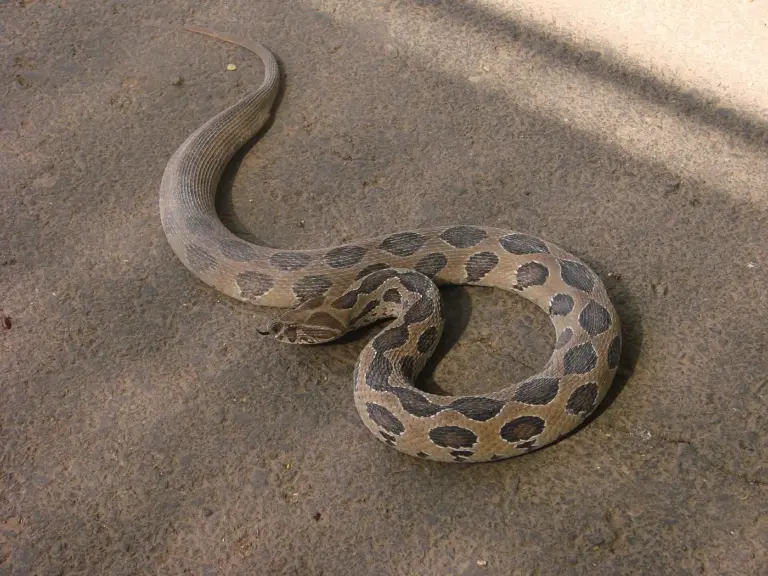
The fauna list is long and ecologically deep. Apart from the flagship Asian elephant and Bengal tiger, Mudumalai holds gaur, sambar, chital, sloth bear, leopard, dhole (Indian wild dog), wild boar, four-horned antelope, and the occasional lone cheetal-stalking jungle cat. Bird diversity exceeds 260 species, including Malabar pied hornbill, crested serpent eagle, and the four critically endangered vulture species (white-rumped, Indian, slender-billed, and red-headed) that nest on the Moyar cliffs. Reptiles include mugger crocodiles in the Moyar pools, monitor lizards, and a healthy snake assemblage.
Comparative Perspective: Mudumalai vs Other Southern Reserves
Mudumalai is best understood in comparison with the other reserves of the Western Ghats. Bandipur, just across the Moyar river in Karnataka, is larger and slightly drier. Wayanad, to the southwest in Kerala, is wetter and richer in moist deciduous flora. Periyar Tiger Reserve in Kerala, further south, is dominated by an artificial lake and supports a different elephant migration cycle. Nagarhole, north of Bandipur, has the highest predator density.
What sets Mudumalai apart is its tri-junction location. No other southern reserve sits at such a precise meeting point of three states, three forest department jurisdictions, and three slightly different ecosystem types. This hands the park both an outsized ecological role and a complex coordination challenge: tigers and elephants do not respect state boundaries, but management plans, budgets, and personnel do. The success of Mudumalai is therefore as much an administrative achievement as an ecological one.
The Moyar Gorge, often called the “Grand Canyon of the South,” is another distinguishing feature. No other tiger reserve in India has a comparable canyon ecosystem. The cliffs provide micro-habitats unavailable elsewhere: dry rock faces for vultures, perennial pools for crocodiles, and drought-refugia for a host of invertebrates and reptiles found nowhere else in southern India.
Challenges and Threats
Despite its protected status, Mudumalai faces serious pressures. Highway traffic on NH-181, which cuts through the park between Mysuru and Ooty, has been a chronic issue. Night driving is now banned in many stretches because of repeated wildlife collisions. Even with the ban, vehicular pressure during the day fragments elephant movement and disrupts the diurnal rhythms of mammals.
Invasive species are a slow-burning crisis. Lantana camara, Parthenium hysterophorus, and Senna spectabilis have colonised significant portions of the park. They displace native grasses and herbs that ungulates depend on, and they alter fire regimes by either suppressing fire (in the case of dense lantana thickets) or feeding it. The forest department has been running invasive removal programmes, but the scale of the problem outstrips the budget.
Human-wildlife conflict is ever-present on the park edges. Elephants raid sugarcane and banana fields in the surrounding villages. Tigers and leopards occasionally take livestock and rare human victims. Compensation systems and community early-warning networks help, but they are imperfect. Forest fires, often originating in the eastern dry deciduous belt during summer, are an additional and growing threat as climate change extends the dry season.
Prelims Pointers
- Mudumalai National Park lies at the tri-junction of Tamil Nadu, Karnataka, and Kerala
- Located in the Nilgiris district of Tamil Nadu
- The name Mudumalai means “ancient hill range”
- Declared a Wildlife Sanctuary in 1940, National Park in 1990, Tiger Reserve in 2007
- Forms part of the Nilgiri Biosphere Reserve, India’s first biosphere reserve (1986)
- The Moyar river flows through the park; Moyar Gorge is the “Grand Canyon of the South”
- Forest types: Tropical moist deciduous (Kerala side) and dry deciduous (Karnataka and Tamil Nadu side)
- Tribes: Irulas, Kurumbas, Todas, and Kattunayakans
- Adjoining reserves: Bandipur, Wayanad, Nagarhole
- The Elephant Whisperers (2023 Oscar winner) was filmed at Theppakadu Elephant Camp
- Note: The Barasingha sub-species on hard ground is conserved in Kanha National Park, not Mudumalai (a frequent UPSC trap)
Mains Practice Questions
- Discuss the role of Mudumalai National Park as a wildlife corridor in the Western Ghats and the implications of its tri-junction location for inter-state coordination in conservation. (250 words)
- Examine the layered legal framework that governs protected areas in India with reference to Mudumalai National Park, covering the Wildlife Protection Act, the Project Tiger framework, and the Forest Rights Act. (250 words)
- Analyse the principal threats to the Nilgiri elephant range and suggest a comprehensive landscape-level conservation strategy. (150 words)
- The Nilgiri Biosphere Reserve is a model for integrated ecosystem management in India. Critically evaluate. (150 words)
Way Forward
A landscape approach is now widely accepted as the right unit of analysis for Mudumalai. The Nilgiri-Wayanad-Bandipur-Nagarhole complex needs a single, coordinated management plan that overrides state-level fragmentation. The Project Tiger framework provides one model. The Asian Elephant Conservation Authority, proposed in recent policy discussions, would provide another.
Highway management is a near-term priority. Underpasses for elephants, overhead canopy bridges for arboreal species, and night traffic restrictions need to be standardised across the entire NH-181 stretch through the Nilgiri Biosphere Reserve. Karnataka’s experience with Bandipur night-driving bans offers useful lessons.
Tourism revenue should flow more directly to the local tribal communities. The Theppakadu camp model, where Kattunayakan families are formally employed in elephant care and rehabilitation, can be extended to other communities. This builds local stewardship and reduces the antagonism between conservation goals and livelihood pressures.
Climate adaptation is the long-term frame. The Moyar valley vulture colonies, the tiger meta-population, and the elephant migration cycle are all shaped by rainfall patterns that are now shifting. Long-term ecological monitoring, currently conducted in patches by research institutions like the Bombay Natural History Society and the Wildlife Institute of India, needs systematic state support.
Frequently Asked Questions
Where is Mudumalai National Park located?
Mudumalai National Park is located in the Nilgiris district of Tamil Nadu, at the tri-junction of Tamil Nadu, Karnataka, and Kerala. It sits on the northern slopes of the Nilgiri massif and forms part of the Nilgiri Biosphere Reserve.
When was Mudumalai declared a Tiger Reserve?
Mudumalai was declared the 38th Tiger Reserve of India in 2007 under the Project Tiger framework, more than three decades after it received Wildlife Sanctuary status in 1940.
What is the Moyar Gorge?
The Moyar Gorge is a deep canyon carved by the Moyar river through Mudumalai. Often called the u0022Grand Canyon of the South,u0022 its cliff faces host critically endangered vulture species including the white-rumped, long-billed, and red-headed vultures.
Which Oscar-winning documentary was filmed at Mudumalai?
The Elephant Whisperers (2023), which won the Academy Award for Best Documentary Short Film, was filmed at the Theppakadu Elephant Camp inside Mudumalai National Park.
Which tribes live in and around Mudumalai?
The principal tribal communities are the Irulas, Kurumbas, Todas, and Kattunayakans. The Kattunayakans are particularly associated with the Theppakadu Elephant Camp and the rehabilitation of orphaned wild elephant calves.
How is Mudumalai connected to other tiger reserves?
Mudumalai shares boundaries with Bandipur Tiger Reserve in Karnataka (across the Moyar river) and Wayanad Wildlife Sanctuary in Kerala. Together with Nagarhole in Karnataka, these reserves form one of the largest contiguous wildlife habitats in South Asia and the densest known tiger population in the world.
What are the main threats to Mudumalai?
The principal threats are highway traffic on NH-181, invasive species like Lantana camara, forest fires that intensify with climate change, human-wildlife conflict on the park edges, and insufficient inter-state coordination across the larger landscape.
Is the Barasingha (swamp deer) found in Mudumalai?
No. The hard-ground sub-species of Barasingha is conserved in Kanha National Park in Madhya Pradesh, not in Mudumalai. This is a frequent UPSC prelims trap.
What is the significance of the Nilgiri Biosphere Reserve?
The Nilgiri Biosphere Reserve, declared in 1986, was the first biosphere reserve of India and is part of UNESCO’s Man and the Biosphere Programme. It includes Mudumalai, Mukurthi, Silent Valley, and other protected areas across Tamil Nadu, Karnataka, and Kerala.
How does Mudumalai support elephant conservation?
Mudumalai is part of the Nilgiri-Wayanad-Bandipur landscape that supports more than 6,000 wild Asian elephants, the largest contiguous Asian elephant population on Earth. Without Mudumalai’s corridor function, the meta-population would fragment into demographically isolated pieces. The Theppakadu Elephant Camp also rehabilitates orphaned and injured elephants with tribal expertise.
Tell Google you want more of this.
Add Anantam IAS as a preferred sourceOne tap, and this site shows up more often in your own Top Stories, AI Overviews and AI Mode. Remove it any time.