Introduction
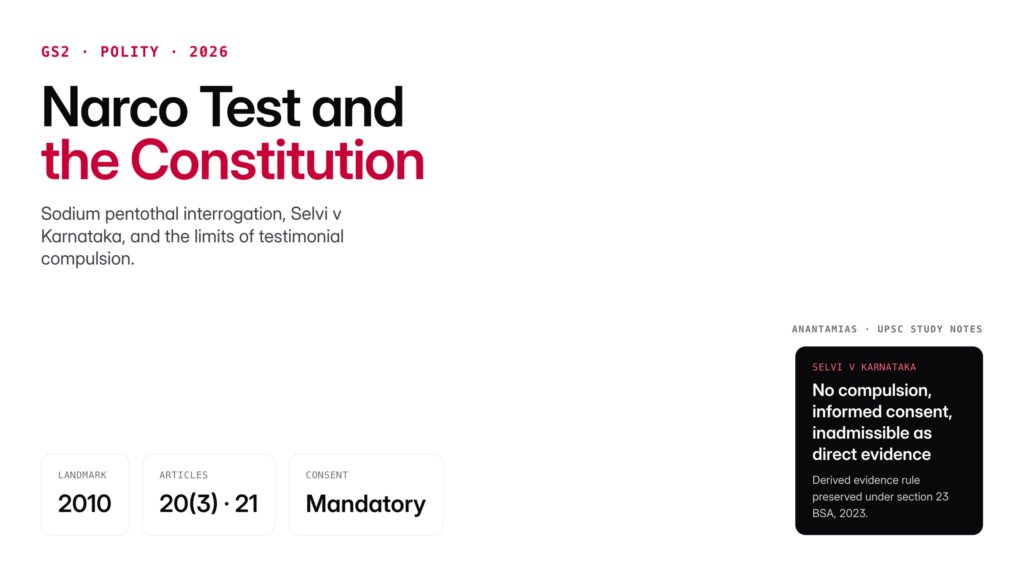
A narco test, short for narcoanalysis, is a scientific interrogation technique in which a suspect is injected with a barbiturate such as sodium pentothal to induce a semi-conscious hypnotic state in which the subject’s inhibitions are lowered. The method, controversial in democracies and banned in several jurisdictions, occupies an uneasy space in Indian criminal investigation. It is not admissible as evidence, cannot be conducted without consent, and yet continues to appear in headline-grabbing cases, from the Aarushi Talwar investigation to the Shraddha Walkar murder to sensational 2024 political cases.
For UPSC aspirants, the narco test sits at the intersection of Article 20(3) of the Constitution (the right against self-incrimination), Article 21 (the right to life and personal liberty, including mental privacy), the Code of Criminal Procedure (now the Bharatiya Nagarik Suraksha Sanhita), and the landmark Supreme Court ruling in Selvi v State of Karnataka (2010). Understanding the procedure, the legal framework and the ongoing debates is essential for GS2 questions on fundamental rights and criminal justice reform.
Quick Facts at a Glance
| Attribute | Detail |
|---|---|
| Technique | Narcoanalysis (truth serum interrogation) |
| Drug used | Sodium pentothal (thiopental sodium), occasionally scopolamine |
| Dosage basis | Weight, age, gender, health of subject |
| Landmark case | Selvi v State of Karnataka, 2010 |
| Consent rule | Mandatory informed consent before test |
| Evidentiary value | Not admissible as direct evidence in court |
| Related tests | Polygraph (lie detector), Brain Electrical Oscillations Signature (BEOS), Brain mapping |
| Key rights involved | Article 20(3), Article 21, Article 14 |
| Administered by | Forensic psychologists and anesthetists at government forensic science laboratories |
| Current legal position | Permitted with consent; inadmissible without consent; derived evidence admissible under section 27 Indian Evidence Act / BSA 2023 |
Background and Historical Context
Narcoanalysis grew out of early-twentieth-century anaesthesia research. American obstetrician Robert House is credited with coining the term “truth serum” in 1922, after observing that women under scopolamine during childbirth volunteered information freely. During the World Wars, American and German intelligence agencies experimented with barbiturates such as sodium amytal and sodium pentothal for interrogation. The CIA’s MK-Ultra programme in the 1950s and 60s explored similar agents, but concluded that the results were unreliable.
In India, narco tests entered the public imagination in the 2000s. The Forensic Science Laboratory at Bangalore, under the leadership of Dr S Malini, emerged as the main centre for conducting the test. High-profile cases in which narco was conducted, or attempted, include the 2002 Telgi stamp-paper scam, the 2006 Nithari killings, the 2008 Aarushi Talwar case, the 26/11 Mumbai attacks investigation of Ajmal Kasab, and more recent investigations in the 2022 Shraddha Walkar case and the 2024 Kolkata RG Kar Medical College case. In several of these, the tests were conducted before the legal position was fully settled.
The constitutional question reached the Supreme Court in the early 2000s through a cluster of petitions. The court delivered its landmark ruling in Selvi v State of Karnataka (2010), a 251-page judgment authored by Chief Justice K G Balakrishnan. The bench, comprising the CJI, Justice R V Raveendran and Justice J M Panchal, held that compulsory administration of narcoanalysis, polygraph and brain-mapping tests violates Articles 20(3) and 21 of the Constitution. It laid down that these tests can be administered only with the subject’s informed consent and following the National Human Rights Commission (NHRC) Guidelines of 2000. Even where consent is given, any statement made during the test is not admissible as substantive evidence; only material subsequently discovered as a result of such information can be admitted under what is now section 23 of the Bharatiya Sakshya Adhiniyam, 2023 (previously section 27 of the Indian Evidence Act, 1872).
Key Features and Procedure
How the Test is Conducted
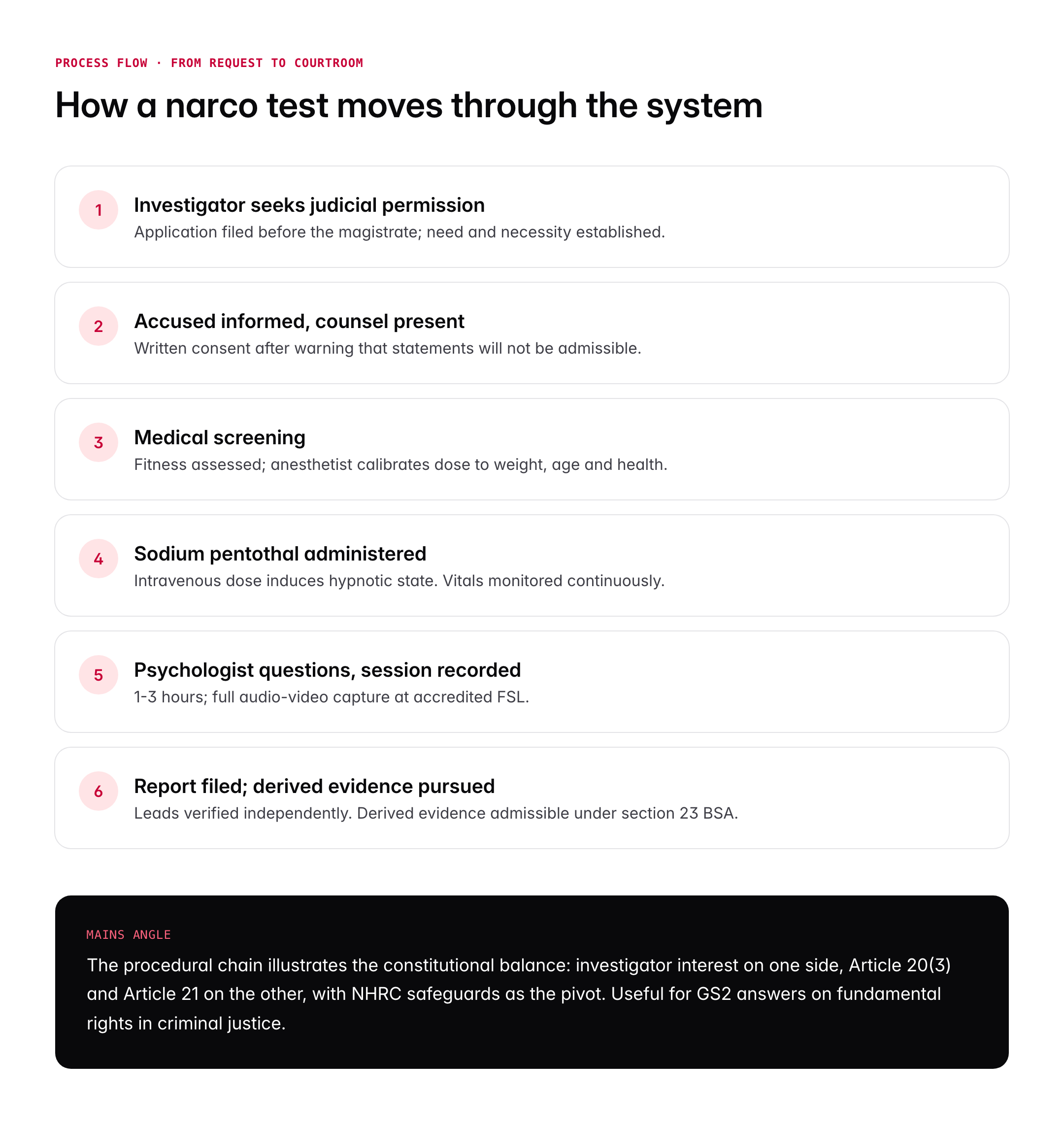
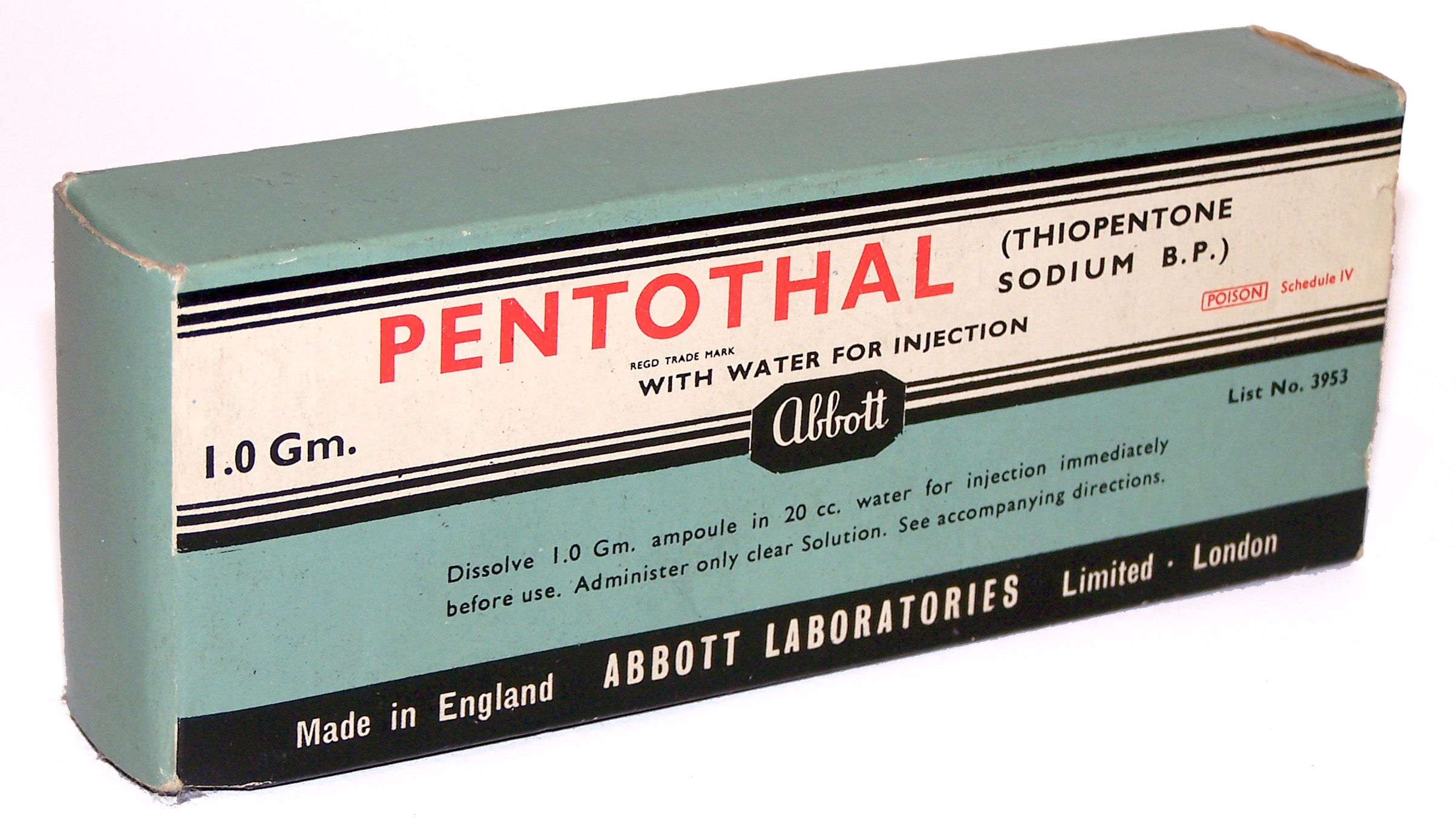
Sodium pentothal, a short-acting barbiturate, is injected intravenously in carefully calibrated doses while a trained anesthetist monitors vitals. The subject enters a hypnotic trance-like state somewhere between wakefulness and sleep, in which higher cortical functions and inhibitions are reduced. A forensic psychologist then asks pre-formulated questions, while investigators observe through a one-way mirror or recording. The session is typically audio- and video-recorded. A full test may last one to three hours, with the subject gradually emerging as the drug is metabolised.
Scientific Assumptions and Limits
The technique rests on the assumption that a person under barbiturate sedation loses the capacity to construct coherent lies. In reality, research since the 1950s has shown that subjects can still fabricate, may confabulate (produce false memories that feel true), and may be highly suggestible to leading questions. Medical and psychological bodies, including the American Medical Association, have long held that narcoanalysis results are unreliable as evidence of truth.
Polygraph and Brain Mapping
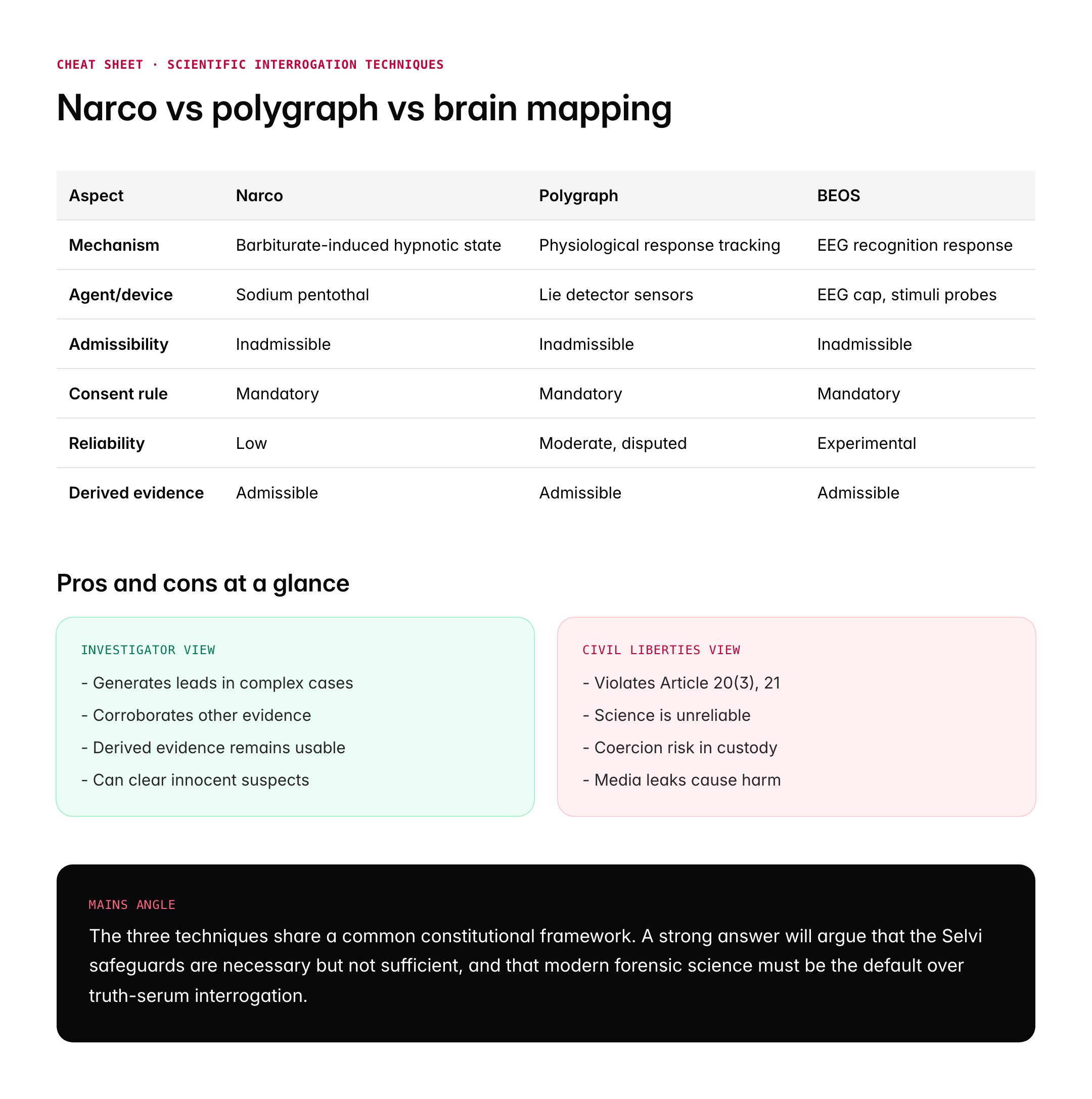
Three tests are often grouped together in Indian practice. A polygraph or lie detector measures physiological responses (pulse, blood pressure, respiration, skin conductance) to specific questions. Brain mapping, also called the Brain Electrical Oscillations Signature (BEOS) test developed by Dr C R Mukundan, records EEG patterns to identify whether a subject recognises crime-related stimuli. All three share the narco test’s legal status: permitted with consent, inadmissible as direct evidence.
Consent and Safeguards
The Selvi judgment requires the accused to consent voluntarily, in the presence of counsel, after being warned that statements made will not be admissible and that the test might yield material used against them. The NHRC guidelines require access to a lawyer, medical supervision, and recording of the procedure. The judicial magistrate must be informed, and the test must be conducted in an independent, accredited forensic facility.
Derived Evidence Rule
Although statements made during the test are not substantive evidence, information leading to discovery of a material fact (a hidden weapon, a body, a document) can be admitted under the derived-evidence rule. This is the single most important practical reason investigative agencies still seek narco tests.
Significance for UPSC and General Knowledge
- Core to GS2 discussions on fundamental rights, specifically the scope of Article 20(3) (right against self-incrimination) and its expansion in Selvi v Karnataka.
- Links to Article 21 and the right to mental privacy, later elaborated in the K S Puttaswamy (2017) privacy judgment.
- Provides a compact illustration of how the judiciary balances criminal-investigation effectiveness against individual liberty.
- Useful for ethics (GS4) questions on the moral limits of interrogation, the duty of investigators, and the role of informed consent.
- Features regularly in current affairs when a sensational case appears in headlines, making Prelims preparation on the topic evergreen.
- Illustrates evolution of Indian forensic science and the institutional role of the Central and State Forensic Science Laboratories, NHRC, and the Directorate of Forensic Sciences.
Detailed Analysis: Selvi v Karnataka and the Constitutional Question
The Selvi v State of Karnataka judgment is the anchor of the Indian legal position on narcoanalysis. The petitioners were a group of accused persons, including Smt Selvi, who challenged compulsory narco, polygraph and brain-mapping tests ordered by investigating agencies. The state argued that such tests were necessary for effective investigation, that they did not compel testimony because the subject was not conscious, and that they furthered public interest.
The court rejected the state’s reasoning on multiple grounds. First, on Article 20(3), which protects an accused from being compelled to be a witness against himself, the bench held that the protection extends to any process that elicits a testimonial response, whether conscious or under chemical influence. Drawing on the American precedent in Schmerber v California, but adapting it to Indian jurisprudence, the court classified narcoanalysis as “testimonial compulsion” because it produces verbal responses that can directly or indirectly incriminate the subject.
Second, on Article 21, the court read the right to personal liberty expansively to include the right against intrusion into mental privacy and the right to bodily integrity. Compulsory narcoanalysis, the bench held, amounts to a substantive intrusion into the personal space of the mind, akin to torture in its capacity to violate cognitive autonomy.
Third, the court held that even where the accused consents, the subsequent procedure must follow strict NHRC guidelines, including presence of counsel, medical safeguards, and judicial oversight. The court reaffirmed that statements made during the test are not admissible in evidence, but preserved the derived-evidence rule.
Post-Selvi, the practical use of narco tests has declined but not vanished. Agencies continue to seek judicial permission in high-profile cases, and some accused have voluntarily consented hoping to clear their names. Several High Courts have refused to grant permission in the absence of clear investigative necessity, citing Selvi’s consent and safeguards framework. The 2017 Puttaswamy judgment, which recognised the right to privacy as a fundamental right, further strengthened the Selvi reasoning on mental privacy.
Comparative Perspective
Different jurisdictions approach truth-serum interrogation very differently. A comparative snapshot:
| Country | Legal Status | Key Authority |
|---|---|---|
| India | Permitted with consent; inadmissible as direct evidence | Selvi v Karnataka, 2010 |
| United States | Generally inadmissible; rarely used in investigation | Townsend v Sain, 1963 |
| United Kingdom | Not part of standard investigation | PACE Act 1984 safeguards |
| Germany | Prohibited as violating human dignity | Article 136a Code of Criminal Procedure |
| France | Generally prohibited | Code of Criminal Procedure |
| Philippines | Allowed historically; contested | Case-by-case judicial review |
Indian jurisprudence is broadly aligned with Western liberal democracies in holding that compelled narco testing violates core constitutional rights. What distinguishes India is the preservation of the derived-evidence exception, which keeps the test practically useful to investigators. European civil-law systems, especially Germany, take the strictest view, rooted in post-war commitments to human dignity under Article 1 of the Basic Law.
Controversies and Debates
The narco test remains controversial on multiple fronts. Critics argue that even with consent, the accused is often under immense pressure in custody and that true voluntary consent is difficult to obtain. Medical associations have flagged the dual-use ethical problem of doctors administering barbiturates for interrogation rather than treatment, a practice at tension with the Hippocratic oath. Civil-liberties groups note that media leaks of narco tapes, as happened in the Aarushi case, cause severe reputational harm even when the test yields nothing usable.
Investigators counter that in particular case categories, serial killings, terrorism, large-scale financial fraud, the derived-evidence rule justifies the test. Defenders point to the ability of the test, when paired with polygraph and brain mapping, to narrow leads and corroborate confessions obtained by other means. A further debate concerns scientific validity: if narco results are fundamentally unreliable, why seek them at all? Proponents argue that reliability is not the issue; investigative direction is. Opponents counter that even this soft use risks weaponising unreliable science against individual liberty. The Law Commission of India has reviewed the topic more than once without recommending a shift from the Selvi position.
Prelims Pointers
- The term narcoanalysis refers to interrogation under the influence of drugs such as sodium pentothal.
- The landmark judgment is Selvi v State of Karnataka, 2010, delivered by CJI K G Balakrishnan.
- The court held compulsory narco violates Articles 20(3) and 21 of the Constitution.
- Statements made during a narco test are not admissible as substantive evidence in court.
- Material discovered as a consequence of such statements is admissible under the derived-evidence rule, formerly section 27 Indian Evidence Act, now section 23 Bharatiya Sakshya Adhiniyam, 2023.
- Informed consent in the presence of counsel is mandatory before the test.
- NHRC Guidelines, 2000 govern the conduct of the test.
- Related tests include polygraph (lie detector) and brain mapping (BEOS).
- Sodium pentothal is a short-acting barbiturate; the first truth-serum term coined by Robert House in 1922.
- The forensic science labs at Bangalore, Hyderabad and Gandhinagar are the leading Indian centres for such tests.
- The K S Puttaswamy, 2017 privacy judgment reinforced Selvi’s reasoning on mental privacy.
Mains Practice Questions
Q1. “Narcoanalysis is a form of testimonial compulsion.” Examine this statement in light of the Supreme Court’s judgment in Selvi v State of Karnataka (2010).
- Article 20(3) protects against being compelled to be a witness against oneself, including responses under chemical influence.
- Article 21 includes mental privacy and bodily integrity; compulsory narco intrudes into both.
- Court’s consent-plus-NHRC-guidelines framework and the derived-evidence exception.
Q2. Critically analyse the balance between investigative effectiveness and constitutional liberties in the use of scientific techniques such as narcoanalysis, polygraph and brain mapping.
- Utility: narrowing leads in complex cases, corroboration, derived evidence.
- Concerns: unreliable science, coercion in custody, medical ethics, media leaks.
- Way forward: stricter consent protocols, independent oversight, reliance on modern forensic science.
Conclusion
The narco test is a compact case study in how Indian constitutional jurisprudence navigates the tension between state interest in effective investigation and the individual’s right against self-incrimination and mental privacy. The Selvi v State of Karnataka judgment of 2010 remains the governing framework: compulsory narcoanalysis is unconstitutional, consent is mandatory, statements made during the test are not admissible as substantive evidence, and material discovered through such statements is admissible only under the strict derived-evidence rule.
For aspirants, the topic is a reliable recurring theme in current affairs and a useful lens on Articles 20(3) and 21, the evolving right to privacy after Puttaswamy, and the broader question of how scientific techniques should be governed in a criminal justice system. Knowing the procedure, the drugs used, the judicial safeguards and the ongoing controversies equips aspirants to answer both factual Prelims questions and analytical Mains prompts with confidence.
Frequently Asked Questions
What is a narco test?
A narco test, or narcoanalysis, is a scientific interrogation technique in which the subject is injected with a barbiturate such as sodium pentothal to induce a hypnotic semi-conscious state. In this state, inhibitions are reduced and the subject is questioned by a forensic psychologist. The technique is used by investigators to obtain leads, though it is not admissible as direct evidence in Indian courts.
Why is the narco test important for UPSC?
It is central to GS2 discussions on Article 20(3) (right against self-incrimination), Article 21 (right to life and mental privacy), and criminal-justice reform. The Selvi v Karnataka (2010) judgment is a landmark case aspirants must know. The topic also connects to GS4 ethics through questions on medical ethics, informed consent and the moral limits of interrogation.
How is narco test related to the Selvi judgment?
Selvi v State of Karnataka (2010) is the governing Supreme Court ruling. A three-judge bench led by CJI K G Balakrishnan held that compulsory narco, polygraph and brain-mapping tests violate Articles 20(3) and 21. The tests can be conducted only with informed consent following NHRC Guidelines 2000, and statements made during the test are not admissible as substantive evidence.
What drug is used in a narco test?
The most common drug is sodium pentothal, also known as thiopental sodium, a short-acting barbiturate that induces a hypnotic state. The dose is calibrated to the subject’s age, weight, gender and health, and is administered intravenously by a trained anesthetist. Scopolamine has also been used historically. The subject is monitored medically throughout the session.
Is a narco test admissible as evidence in India?
Statements made during a narco test are not admissible as substantive evidence, as per Selvi v Karnataka. However, material discovered as a consequence of such statements, such as a hidden weapon or document, is admissible under the derived-evidence rule, formerly section 27 of the Indian Evidence Act and now section 23 of the Bharatiya Sakshya Adhiniyam, 2023.
What safeguards are required during the test?
NHRC Guidelines 2000 require informed consent in the presence of counsel, a prior warning that statements will not be admissible, medical supervision by a qualified anesthetist, video recording of the procedure, and the test must be conducted at an accredited government forensic science laboratory. A judicial magistrate must be informed. Failure to follow safeguards can render the process unconstitutional.
How do narco, polygraph and brain mapping differ?
The narco test uses barbiturates to reduce inhibitions. The polygraph or lie detector measures physiological responses such as pulse and skin conductance to specific questions. Brain mapping, or the BEOS test, records EEG patterns to identify recognition of crime-related stimuli. All three share the same legal status in India after Selvi: permitted with informed consent, inadmissible as direct evidence.
Which high-profile cases have involved narco tests?
Indian cases include the 2002 Telgi stamp-paper scam, the 2006 Nithari killings, the 2008 Aarushi Talwar murder, the 26/11 Mumbai attacks investigation of Ajmal Kasab, the 2022 Shraddha Walkar murder and the 2024 Kolkata RG Kar Medical College case. These cases illustrate both the practical appeal of narco testing for investigators and the controversies around leaked tapes and unreliable results.
Tell Google you want more of this.
Add Anantam IAS as a preferred sourceOne tap, and this site shows up more often in your own Top Stories, AI Overviews and AI Mode. Remove it any time.