
The National Medical Commission (NMC) is the statutory regulator of medical education and the medical profession in India, constituted under the National Medical Commission Act, 2019. It replaced the Medical Council of India (MCI), a body founded in 1934 and dismantled after decades of allegations of corruption, poor quality assurance, and elite capture. The NMC represents the most significant overhaul of India's medical governance architecture in nearly a century, and has direct consequences for medical college accreditation, undergraduate and postgraduate admissions, medical fees, ethics, and cross-border qualification recognition.
Legislative Background
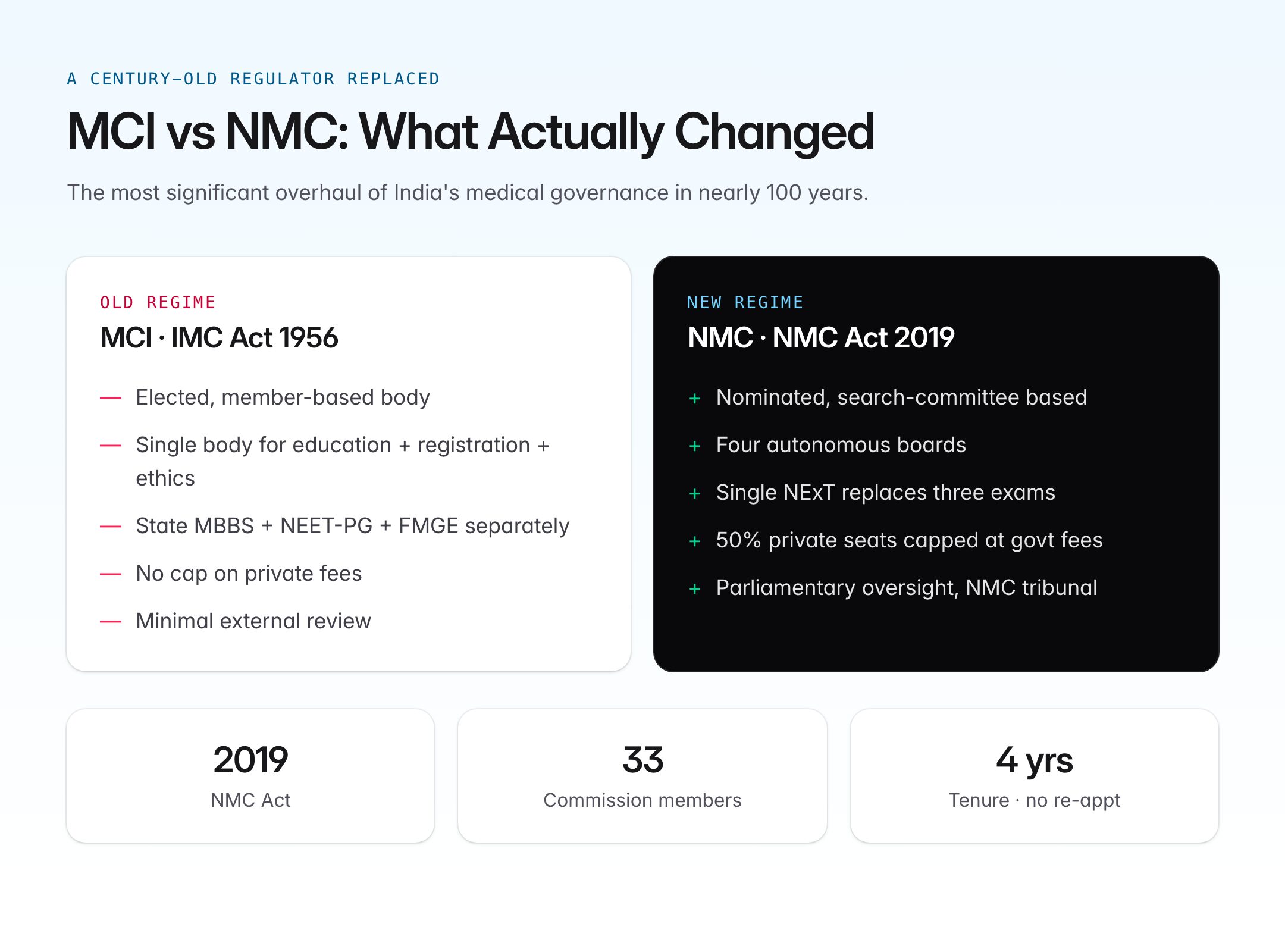
India's medical regulation journey:
| Body / Law | Year | Status |
|---|---|---|
| Indian Medical Council Act | 1933 | First statutory framework |
| Medical Council of India (MCI) | 1934 | Constituted under 1933 Act |
| Indian Medical Council Act | 1956 | Replaced 1933 Act |
| MCI dissolution (first) | 2010 | Board of Governors after Ketan Desai arrest |
| MCI restored | 2013 | Following Supreme Court intervention |
| Parliamentary Standing Committee report | 2016 | Called MCI "an opaque and corrupt body" |
| NMC Bill introduced | 2017 | Lapsed; re-introduced 2019 |
| NMC Act 2019 | 8 August 2019 | Replaced IMC Act 1956 |
| NMC constituted | 25 September 2020 | Supersedes Board of Governors |
| NMC (Amendment) | 2023 and subsequent regulations | Post-graduate seat expansion, fee rules, AEBAS, CBME updates |
Composition of NMC
The Commission at the apex has 33 members (Section 4 of the Act):
| Category | Number |
|---|---|
| Chairperson (medical professional of eminence) | 1 |
| Presidents of four Autonomous Boards | 4 |
| Part-time members (Director of nominated institutes like AIIMS Delhi, PGIMER, JIPMER, NIMHANS, Tata Memorial) | 10 |
| Representatives from states / UTs (rotational) | 9 |
| Chief Executive of Directorate General of Health Services | 1 (ex officio) |
| Medical professionals nominated by Central Government | 3 |
| Other part-time members including from management, law, medical ethics, consumer/patient rights advocacy | 5 |
Selection: A Search Committee chaired by the Cabinet Secretary recommends names to the Central Government. Tenure: four years, no re-appointment.
Four Autonomous Boards
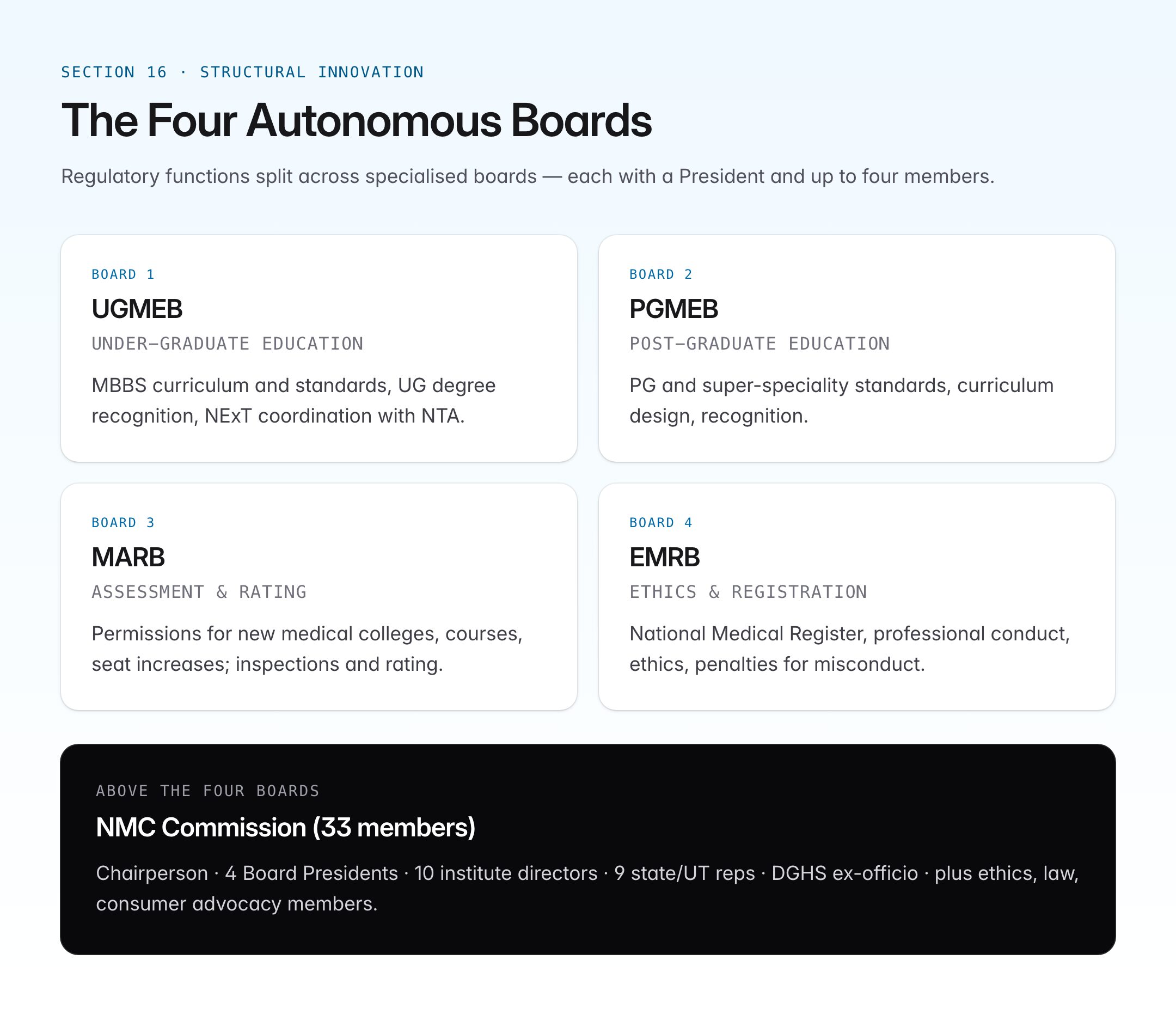
The Act's structural innovation is the separation of regulatory functions into four Autonomous Boards (Section 16):
| Board | Mandate |
|---|---|
| Under-Graduate Medical Education Board (UGMEB) | Standards and curriculum for MBBS, recognition of UG degrees, conducting NEXT (entrance portion) coordination with NTA |
| Post-Graduate Medical Education Board (PGMEB) | Standards for PG and super-speciality courses; curriculum; recognition |
| Medical Assessment and Rating Board (MARB) | Grant of permission to establish new medical colleges, start new courses, increase seats; inspection and rating of institutions |
| Ethics and Medical Registration Board (EMRB) | National Medical Register, regulation of professional conduct, promotion of ethics, penalties for misconduct |
Each Board has a President and up to four members. Boards function with operational autonomy, while the Commission oversees overall direction.
Medical Advisory Council
A broader advisory body (Section 11) — including one representative from each state and union territory, Vice-Chancellors of state health universities, NMC members — ensures federal consultation. It advises NMC on policy and reviews annual reports.
NEXT — National Exit Test
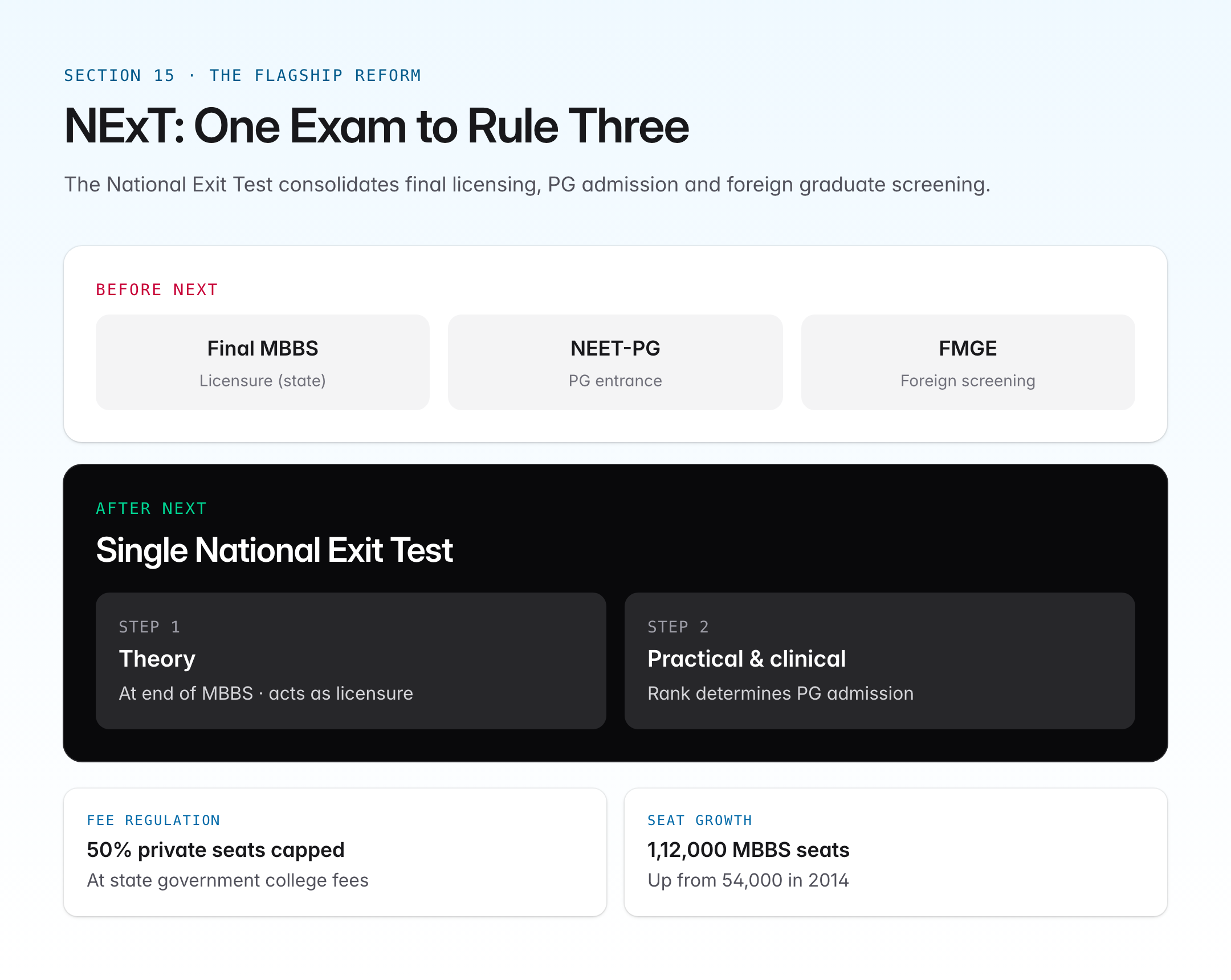
The flagship reform of the Act (Section 15) is the National Exit Test (NExT):
- Single exam replacing:
- Final-year MBBS exam (licensure)
- NEET-PG (postgraduate entrance)
- Screening Test for foreign medical graduates (FMGE)
- Two steps:
- NExT Step 1: Theory, at end of MBBS; acts as licensure
- NExT Step 2: Practical and clinical skills
- Rank in NExT determines PG admissions.
- Applicable to all allopathic graduates from Indian colleges and foreign medical graduates seeking to practise in India.
- Implementation has been repeatedly deferred; rules notified, dry run conducted, AIIMS Delhi designated as conducting body.
Impact: standardisation of final licensing across India, ending the multi-exam maze, creating a common merit list for PG admissions.
Fee Regulation
Section 10 of the Act empowers NMC to frame guidelines for determination of fees and other charges for 50 per cent of seats in private medical colleges and deemed universities. The NMC (Fixation of Fee and Other Charges) Guidelines, 2022 operationalise this: fees for 50% seats in private and deemed institutions are capped at the level of government medical college fees in the state.
Effect: for roughly half the seats in private colleges, fees are comparable to state-run colleges — a major affordability reform. Remaining seats continue under management quotas.
Other Reforms
- Common Counselling: All-India common counselling for 50% seats in private and deemed universities plus 15% All India Quota (AIQ) of state government seats (was already AIQ) and 100% of central institutes.
- Community Health Provider category (Section 32) — an NMC-licensed cadre of mid-level health practitioners to provide primary care. The Indian Medical Association and student bodies have consistently protested this as "mixopathy"; implementation remains contested.
- Competency-Based Medical Education (CBME) curriculum, updated 2023–24, for MBBS.
- Digital Medical Register — unique permanent registration number (NMR) for each practitioner.
- Penalties for unregistered practice and commercialisation raised substantially.
Comparison: MCI vs NMC
| Dimension | MCI (IMC Act 1956) | NMC (NMC Act 2019) |
|---|---|---|
| Body type | Elected, member-based | Nominated, search-committee based |
| Composition | Dominated by elected medical professionals | Mix of medical, academic, legal, ethics, consumer experts; state rotation |
| Structural separation | Single body for education, registration, ethics | Four autonomous boards |
| Licensing exam | State-level final MBBS + separate NEET-PG + FMGE | Single NExT |
| Private college fees | No cap | 50% seats at government-equivalent fees |
| Community health provider | Not defined | New cadre licensed by NMC |
| Accountability | Minimal external review | Performance audit, parliamentary oversight, NMC tribunal |
| Appeals | High Court writ jurisdiction | NMC → Government of India → High Court |
Impact on Medical Education
- Seat expansion: Medical UG seats grew from around 54,000 (2014) to over 1,12,000 (2024); PG seats from around 30,000 to over 72,000 — partly attributable to streamlined MARB processes.
- New medical colleges: Over 380 additional colleges approved between 2014 and 2024, many under the Central Sector Scheme for Establishment of New Medical Colleges Attached to District Hospitals.
- Private sector affordability: Capped fees on 50% private seats have lowered effective costs of medical education for meritorious students.
- Quality concerns: MARB inspections have been criticised for both over-strictness and, in some cases, repeat issues with new colleges' faculty strength and infrastructure.
- Community Health Provider controversy: Repeated legal challenges; implementation slow.
Criticisms
- Centralisation: Reduced role of elected doctor representatives; states worry about erosion of federal consultation.
- Executive control: Chairperson and Board presidents appointed by the Centre, raising independence concerns.
- Community health provider: Medical bodies argue risks to patient safety.
- Fee cap only on 50% seats: Remaining seats, especially NRI and management quotas, continue at high cost, sometimes cross-subsidising the capped seats.
- NEXT delays: Repeated postponements have created cohort-level uncertainty for MBBS students.
- Private college rating: MARB ratings still perceived as inconsistent.
Related Regulatory Bodies
| Body | Domain |
|---|---|
| National Commission for Indian System of Medicine (NCISM) | Ayurveda, Unani, Siddha, Sowa-Rigpa (under NCISM Act 2020) |
| National Commission for Homoeopathy (NCH) | Homoeopathy (under NCH Act 2020) |
| Dental Council of India (DCI) | Dental education — replacement National Dental Commission Act under discussion |
| Pharmacy Council of India | Pharmacy |
| Indian Nursing Council / National Nursing and Midwifery Commission | Nursing — new 2023 Act |
| National Medical Devices Council | Devices (proposed) |
| Central Drugs Standard Control Organisation (CDSCO) | Drugs, vaccines |
The NMC, NCISM, NCH and proposed National Dental Commission together represent a family of "Commission Acts" replacing older councils across health professions.
UPSC Relevance
Prelims: Year of Act (2019), replaced body (MCI / IMC Act 1956), number of autonomous boards (4), number of Commission members (33), single exit exam (NExT), fee cap (50% seats in private/deemed), companion Acts (NCISM 2020, NCH 2020).
GS-II (Governance): Regulatory reform, accountability, centre-state issues, statutory bodies. Typical question: "Examine how the National Medical Commission Act, 2019 addresses the failings of the Medical Council of India."
GS-II (Health): Human resources for health, skill mix, medical education access, affordability.
Essay: "Regulation and quality in public goods," "professions and accountability."
Interview: Expect questions on NExT rollout, Community Health Provider, fee regulation effectiveness, comparison with US/UK systems.
Understand NMC as a template reform — replacing elected, professional-majority councils with search-committee-selected multi-stakeholder bodies — that the Indian state is extending across the professions.
Tell Google you want more of this.
Add Anantam IAS as a preferred sourceOne tap, and this site shows up more often in your own Top Stories, AI Overviews and AI Mode. Remove it any time.