The National Medical Commission has now completed five years of operation. Established by the National Medical Commission Act, 2019 and operationalised in 2020, it replaced the Medical Council of India, an institution that had governed Indian medical education for nearly nine decades but had become a byword for centralised opacity, electoral capture and corruption complaints. The NMC architecture is a deliberate departure: a selected rather than elected commission, decomposition of regulatory functions into four autonomous boards, a single national exit examination that replaces multiple downstream tests, and fee regulation in private medical colleges. For a country that produces the largest number of medical graduates in the world after the United States, this is a structural reset of how the medical profession is governed.
For UPSC aspirants, the NMC sits at the intersection of GS Paper 2’s regulatory bodies, GS Paper 2’s health and education governance themes, and GS Paper 3’s human-resources-for-development questions. The Commission’s design choices answer specific failures of the MCI era, and its early years offer a real-world test of whether disaggregated regulation works better than monolithic regulation. This guide walks through the structure, the four boards, the NExT examination, the fee regulation framework, the Community Health Provider question, and the prelims and mains pointers an aspirant must carry.
Quick Facts on the National Medical Commission
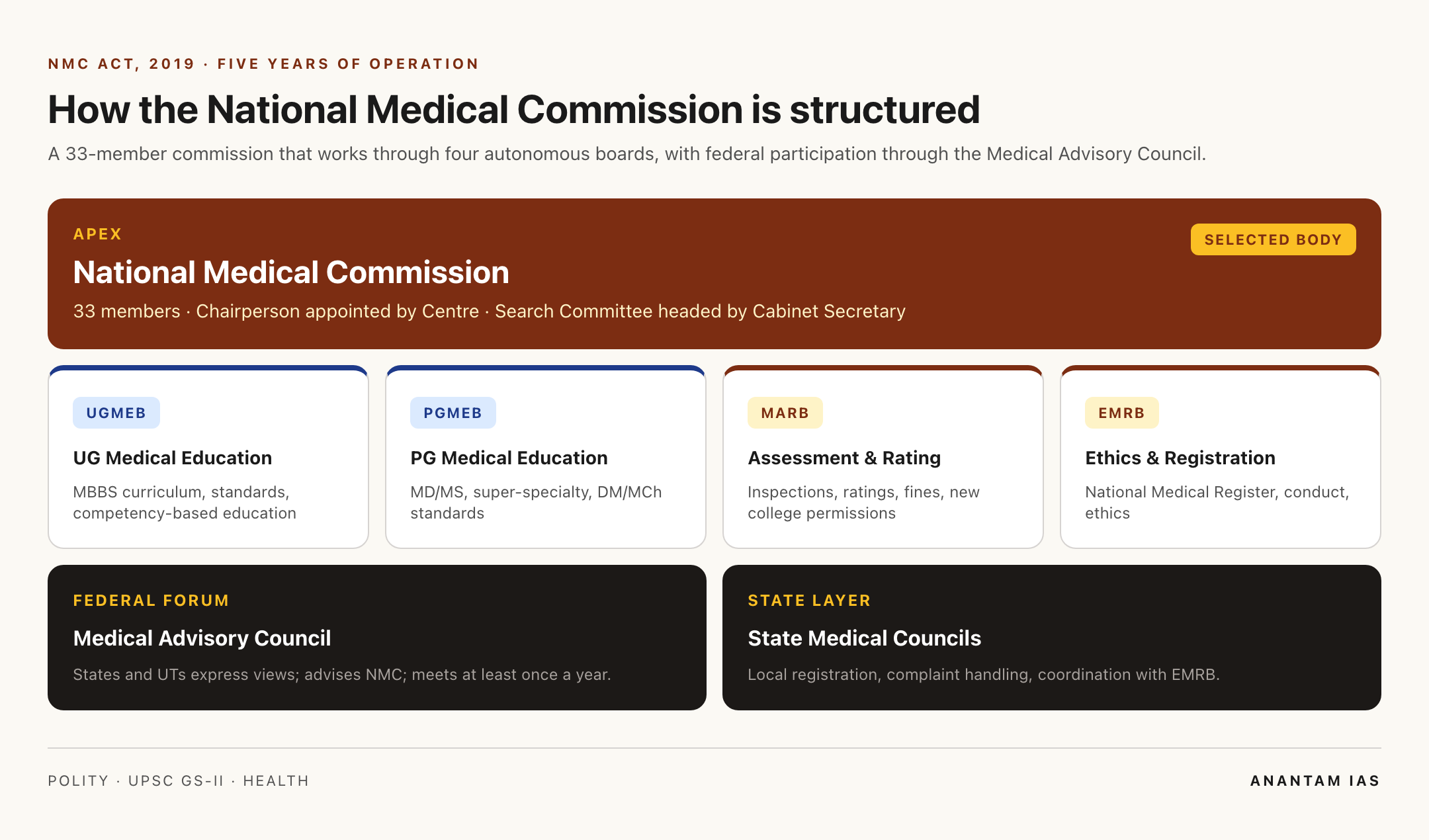
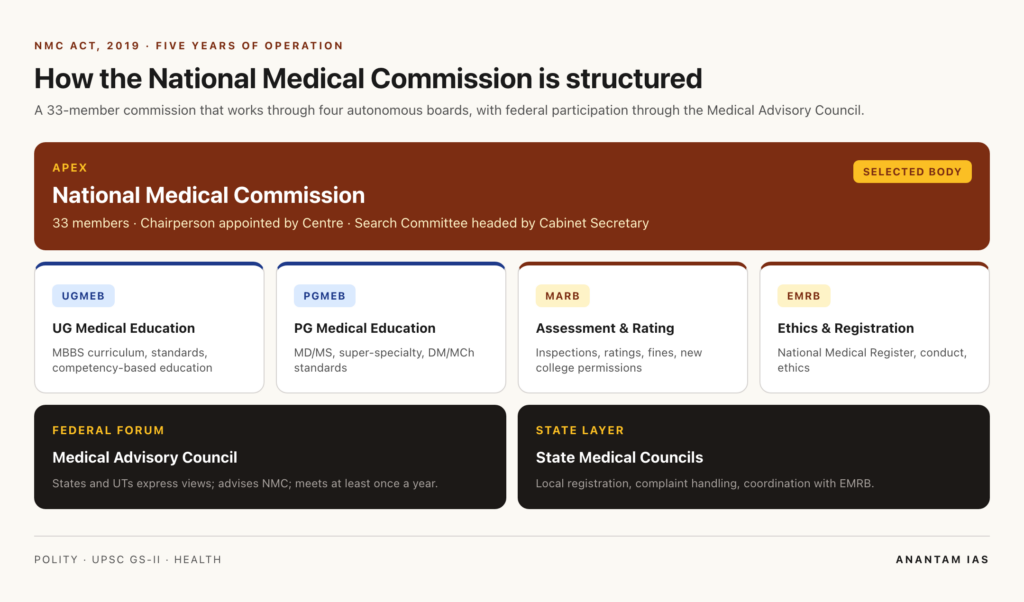
The NMC was established by the National Medical Commission Act, 2019 and replaced the Medical Council of India, which had been governed by the Indian Medical Council Act, 1956. The Commission has 33 members. The Chairperson is appointed by the Central Government on the recommendation of a Search Committee headed by the Cabinet Secretary. The NMC works through four autonomous boards: the Under-Graduate Medical Education Board, the Post-Graduate Medical Education Board, the Medical Assessment and Rating Board, and the Ethics and Medical Registration Board. The Medical Advisory Council provides a forum for state and union territory representation. The National Exit Test, called NExT, is designed to function as a licensing examination, a postgraduate entrance test and a screening test for foreign medical graduates rolled into one. The NMC has the power to frame guidelines for fees in 50 percent of seats in private medical colleges and deemed universities.
What the NMC Does
The NMC is the apex statutory regulator of medical education and practice in India. It sets standards for undergraduate and postgraduate medical education, accredits and rates medical colleges, regulates the entry of new colleges and the addition of new seats, maintains the National Medical Register of all licensed practitioners, frames the code of professional conduct, regulates fees in private medical colleges, and conducts the National Exit Test for the licensure of MBBS graduates. The Commission also acts as the principal channel for India’s engagement with global medical-education standards and frameworks.
Background and Historical Context
Medical regulation in India dates back to the Indian Medical Council Act, 1933, which established the Medical Council of India to register medical practitioners and oversee medical education. The 1956 Act expanded the MCI’s role and formalised its character as an elected body, with members chosen by registered medical practitioners and by university and state medical-council nominations. For most of the twentieth century, this design was viewed as a profession-led regulatory model that mirrored the British General Medical Council.
The MCI ran into serious problems from the 1990s onward. The Yashpal Committee on regulation of higher education and the Ranjit Roy Chaudhury Committee on medical education both flagged systemic failure. The 2010 arrest of MCI President Ketan Desai on corruption charges by the CBI led to the dissolution of the MCI by an ordinance and its replacement by a Board of Governors for an extended interim period. The Parliamentary Standing Committee on Health, in its 92nd report of 2016, recommended a comprehensive overhaul. Successive governments worked on a draft National Medical Commission Bill from 2017 onwards. The NMC Act was finally passed in 2019, and the Commission was operationalised in 2020. For more on regulatory bodies in Indian governance, our federalism explainer covers the broader Centre-state context.
Structure and Composition
The NMC has 33 members. The Chairperson is appointed by the Central Government on the recommendation of a Search Committee headed by the Cabinet Secretary. The Search Committee model represents a deliberate move away from the MCI’s elected structure, which had been seen as creating conflicts of interest where the regulators were drawn from and accountable to the regulated profession. Ex-officio members of the NMC include the Presidents of the four autonomous boards, the Director General of Health Services and the Director General of the Indian Council of Medical Research. Part-time members represent state governments, union territories and medical experts.
The Medical Advisory Council, distinct from the NMC itself, is a platform for state and union territory governments to express their views on medical education and practice. It advises the NMC on policy matters and ensures federal participation in a domain where the Centre has drawn substantial regulatory authority. The MAC is consulted before major regulations are framed and is required to meet at least once a year. Our Constitution of India explainer covers the underlying constitutional framework that allocates health and medical education across the legislative lists.
The Four Autonomous Boards
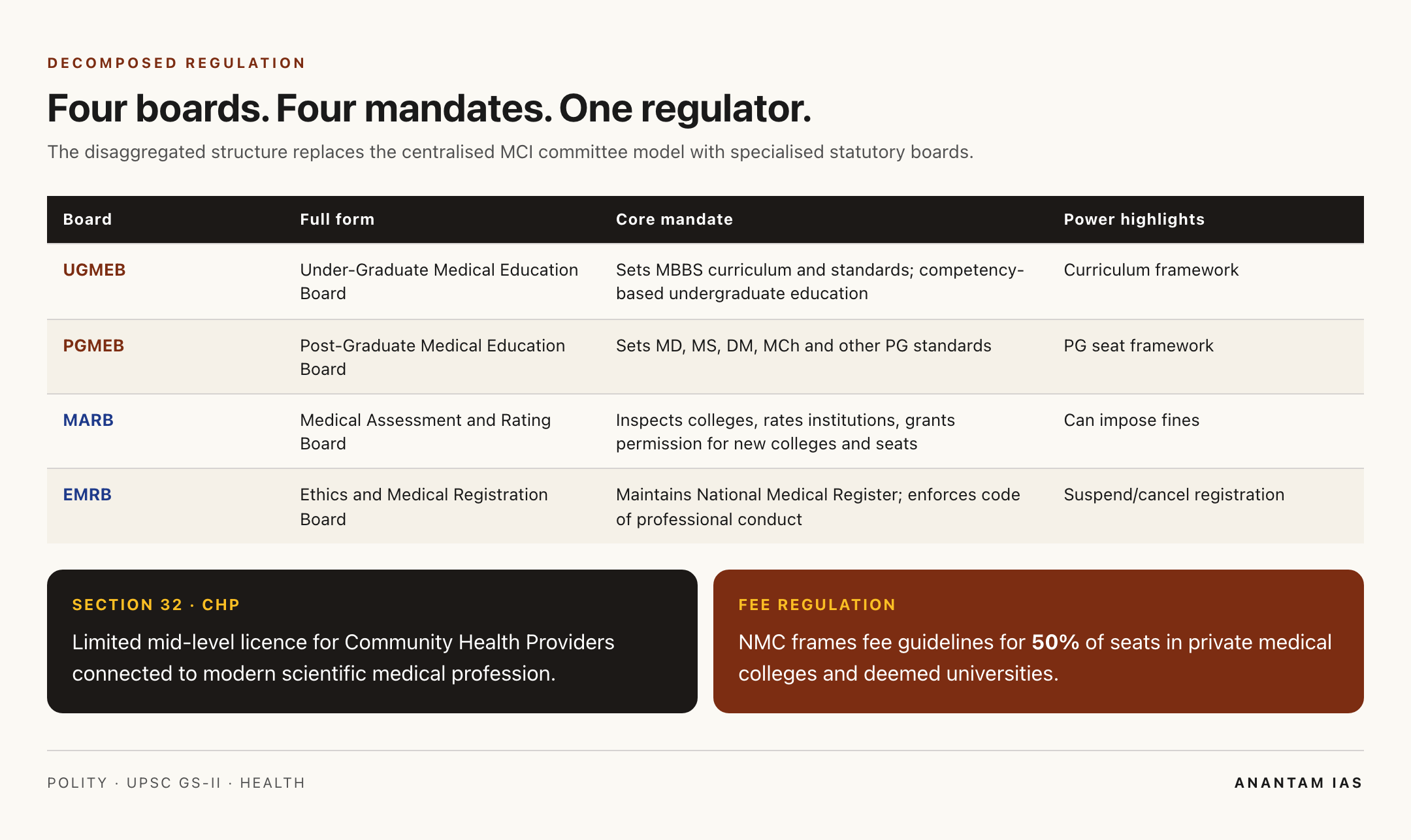
The defining structural feature of the NMC is the disaggregation of regulatory functions into four autonomous boards. The Under-Graduate Medical Education Board, called UGMEB, sets standards and curriculum for the MBBS programme, including assessment frameworks, clinical training requirements and the implementation of competency-based undergraduate education. The Post-Graduate Medical Education Board, called PGMEB, performs the equivalent function for postgraduate medical education, including MD, MS and DM/MCh programmes, and sets the framework for super-specialty education.
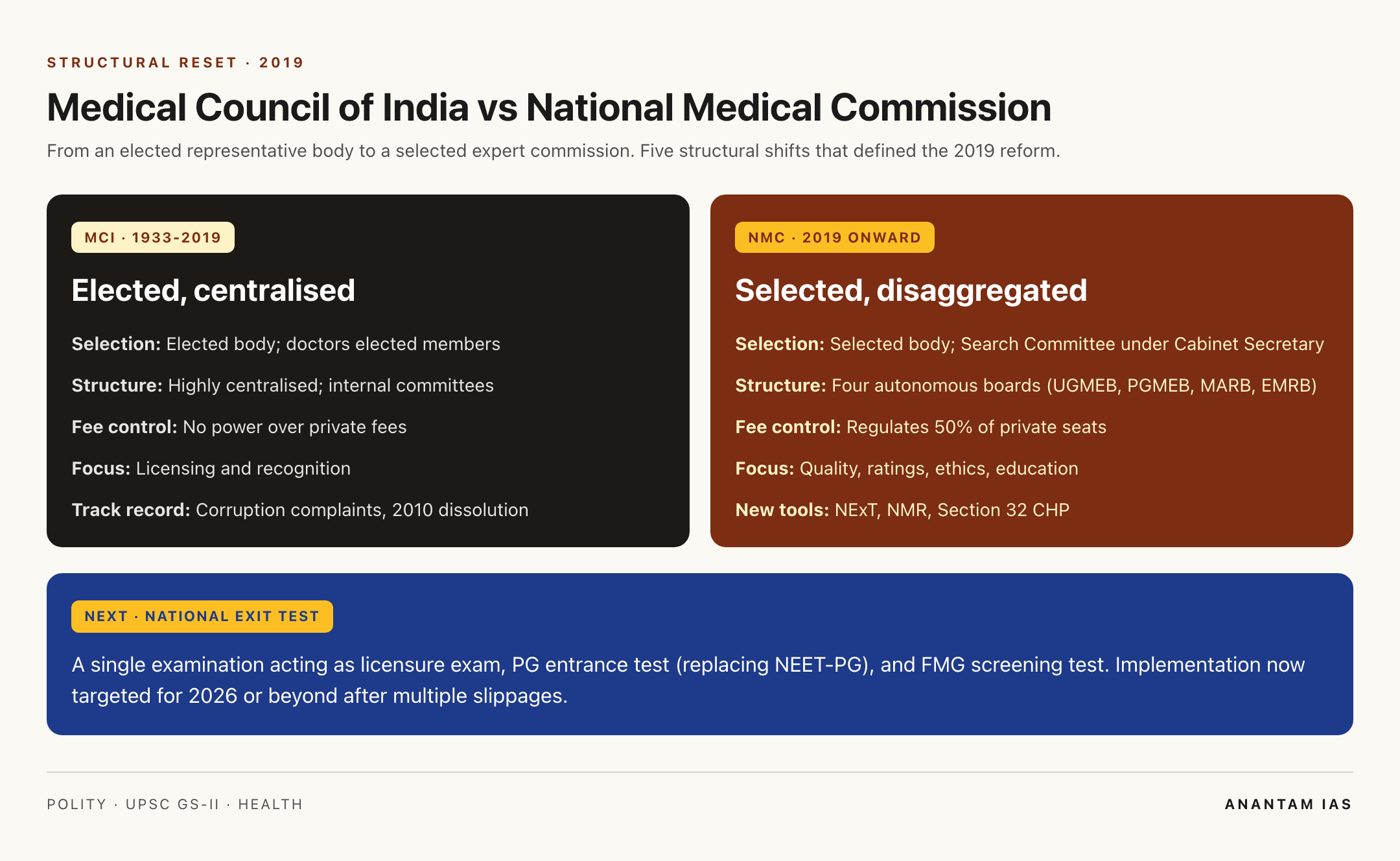
The Medical Assessment and Rating Board, called MARB, is the operational arm of quality enforcement. It inspects medical colleges, grants permission for the establishment of new medical colleges, approves the addition of new seats, rates colleges on a published scale and can impose fines for non-compliance with prescribed standards. MARB is the single most consequential of the four boards because it controls entry into the medical-education market. The Ethics and Medical Registration Board, called EMRB, maintains the National Medical Register, enforces the code of professional conduct, hears complaints of professional misconduct and can suspend or cancel registration of practitioners. The four-board structure replaces the centralised MCI model, where these functions were performed by committees of a single body.
NExT: The National Exit Test
The National Exit Test, called NExT, is one of the most consequential reforms introduced by the 2019 Act. It is designed to function as three things rolled into one. First, it is a licensure examination that an MBBS graduate must pass to be eligible to practise medicine. Second, it serves as the entrance examination for postgraduate medical courses, replacing the existing NEET-PG. Third, it operates as the screening test for foreign medical graduates seeking to practise in India, replacing the FMG examination. The intent is to standardise the quality threshold across all paths to the medical profession.
Implementation has been delayed. The original target of 2024 has slipped, with revised targets pointing toward 2026 or beyond. Mock NExT examinations have been conducted to test the format and infrastructure. The transition raises three operational questions: how to handle students who completed MBBS under the older licensure framework, how to ensure that NExT does not unduly compress preparation time for postgraduate aspirants, and how to maintain comparability of NExT scores across years for postgraduate admissions. These questions are still being negotiated through implementation regulations.
Fee Regulation in Private Medical Colleges
One of the most politically sensitive provisions of the NMC Act is the fee regulation power. The NMC has the power to frame guidelines for the determination of fees in 50 percent of seats in private medical colleges and deemed universities. The remaining 50 percent of seats can be priced at the discretion of the institution, subject to general principles of fair pricing. This is a significant departure from the MCI era, where the Centre had no direct fee-regulation power and state-level fee-regulation committees played the primary role.
The constitutional and legal context is layered. The TMA Pai Foundation case of 2002 and the P.A. Inamdar case of 2005 had together held that private unaided educational institutions have a right to autonomy in admissions and fees, subject to regulation in the public interest. The NMC fee-regulation framework operates within this jurisprudence. It applies to deemed universities even though deemed universities have historically claimed greater autonomy. Implementation has involved cost-based fee fixation principles, with the NMC issuing guidelines that link fees to verified institutional costs rather than market-based pricing.
Community Health Providers and the Mid-Level Question
Section 32 of the NMC Act allows the Commission to grant a limited licence to practise medicine at a mid-level to persons connected with the modern scientific medical profession. This is the legal basis for the Community Health Provider, or CHP, framework. The intent is to bridge the rural healthcare gap by allowing trained nurse practitioners, medical officers with intermediate qualifications and similar mid-level professionals to provide primary care services within a defined scope of practice.
The provision was politically controversial when the Bill was being considered. Medical associations, including the Indian Medical Association, argued that it would dilute the standards of medical practice. Public-health practitioners, including those working in rural and tribal areas, argued that the provision was essential to address the documented rural physician shortage. The Act eventually retained the provision but limited the scope of CHP practice. The implementation regulations under Section 32 are still evolving. For broader context on regulatory reforms, see our 42nd Amendment of the Indian Constitution explainer that touches on the Centre-state framework for health.
The National Medical Register
The Ethics and Medical Registration Board maintains the National Medical Register, a dynamic and digital database of all licensed practitioners in India, linked to Aadhaar for unique identification. The objective is to eliminate “ghost” practitioners, where the same individual is registered in multiple states under different identities, and to enable real-time verification of qualifications and licence status. The Register is also intended to feed into the broader Ayushman Bharat Digital Mission infrastructure.
Comparison: MCI vs NMC
The structural comparison is instructive. The MCI was an elected body, with members chosen by registered medical practitioners and by university and state-medical-council nominations. The NMC is a selected body, with members appointed through a Search Committee headed by the Cabinet Secretary. The MCI was highly centralised, performing all functions through internal committees. The NMC works through four autonomous boards, each with its own competence and decision-making authority. The MCI had no power to regulate private fees. The NMC has fee-regulation power over 50 percent of seats in private colleges and deemed universities. The MCI focused primarily on licensing and recognition. The NMC has a broader remit covering quality assessment, ratings, ethics and education standards.
Challenges and Criticisms
Three challenges shape the NMC’s first decade. The first is the implementation of NExT, where multiple deadline slippages have left the policy intent in suspension. The second is the federalism friction, where state medical councils have argued that the NMC framework reduces their statutory role to a subordinate position. The third is the Community Health Provider rollout, where the implementation regulations under Section 32 are still being finalised and the medical profession’s resistance has slowed deployment in many states.
Beyond these, structural questions persist. The fee-regulation framework has been challenged in courts on autonomy grounds, particularly with respect to deemed universities. The MARB ratings framework has not yet matured into a transparent national scoreboard that students and parents can use to compare colleges. And the EMRB’s professional-conduct adjudication mechanism has not yet built up a consistent body of disciplinary jurisprudence.
Prelims Pointers
The NMC was established by the National Medical Commission Act, 2019 and replaced the Medical Council of India. The Commission has 33 members. The Search Committee for the Chairperson is headed by the Cabinet Secretary. The four autonomous boards are UGMEB, PGMEB, MARB and EMRB. MARB has the power to grant permission for new medical colleges and to impose fines for non-compliance. EMRB maintains the National Medical Register. NExT is the National Exit Test, designed as licensing exam, PG entrance test and FMG screening test combined. The NMC has fee-regulation power over 50 percent of seats in private medical colleges and deemed universities. Section 32 of the Act allows licensure of Community Health Providers. The Medical Advisory Council is the federal-participation forum. Our fundamental rights and articles explainer covers the rights framework, including the right to health that has been read into Article 21.
Mains Practice Questions
- The National Medical Commission Act, 2019 represents a structural reset of medical regulation in India. Evaluate its design choices in the light of the failures of the Medical Council of India. (GS Paper 2, 250 words)
- Discuss the rationale and operational design of the National Exit Test, and analyse the implementation challenges. (GS Paper 2, 250 words)
- Examine the fee-regulation framework under the NMC Act, particularly with reference to the TMA Pai Foundation and P.A. Inamdar rulings. (GS Paper 2, 150 words)
- The Community Health Provider provision under Section 32 has divided the medical profession and public-health practitioners. Discuss. (GS Paper 2, 150 words)
Way Forward
Three reforms would strengthen the NMC framework. First, NExT implementation should be brought to a firm deadline, with a transition framework that protects students who entered MBBS under the older licensure regime. Second, the MARB ratings framework should be operationalised as a transparent national scorecard, with annual public reports on every recognised medical college, integrated with the National Medical Register. Third, the Community Health Provider regulations under Section 32 should be finalised in consultation with state governments, public-health practitioners and medical associations, with a clear scope of practice and supervision framework.
For students, the NMC reform is a useful case study of how Indian regulatory architecture has been moving away from elected representative bodies and toward selected expert commissions disaggregated into specialised boards. The trajectory matters because it sets precedents for similar reforms in other professional regulators, including the National Council for Higher Education and the proposed dental and pharmacy regulator reforms.
Frequently Asked Questions
What is the National Medical Commission?
The National Medical Commission, established by the National Medical Commission Act, 2019 and operationalised in 2020, is the apex statutory regulator of medical education and practice in India. It replaced the Medical Council of India, which had governed Indian medical education from 1933 onwards. The NMC has 33 members, works through four autonomous boards and is supported by the Medical Advisory Council for federal participation.
What are the four autonomous boards under the NMC?
The four boards are the Under-Graduate Medical Education Board (UGMEB), which sets MBBS standards; the Post-Graduate Medical Education Board (PGMEB), which sets MD, MS and DM/MCh standards; the Medical Assessment and Rating Board (MARB), which inspects, rates, fines and grants permissions for new colleges and seats; and the Ethics and Medical Registration Board (EMRB), which maintains the National Medical Register and enforces the code of professional conduct.
What is the National Exit Test?
The National Exit Test, called NExT, is a single examination designed to function as the licensure examination for MBBS graduates, the entrance examination for postgraduate medical courses, and the screening test for foreign medical graduates. It will replace the existing NEET-PG and the FMG examination. Implementation has been delayed and is now targeted for 2026 or beyond.
Why was the Medical Council of India replaced?
The MCI faced sustained criticism for centralised opacity, electoral capture by interest groups, and corruption complaints, including the 2010 arrest of its President on corruption charges. Successive parliamentary committees and expert reviews recommended replacing the MCI with a body that disaggregated regulatory functions, used a selected rather than elected model, and built in stronger conflict-of-interest safeguards. The NMC Act, 2019 was the legislative answer.
Does the NMC regulate fees in private medical colleges?
Yes. The NMC has the power to frame guidelines for the determination of fees in 50 percent of seats in private medical colleges and deemed universities. The remaining 50 percent of seats can be priced at the discretion of the institution, subject to general principles of fair pricing. This is a significant power that the MCI did not have, and it operates within the framework laid down by the TMA Pai Foundation and P.A. Inamdar rulings.
What is the Community Health Provider provision?
Section 32 of the NMC Act allows the Commission to grant a limited licence to practise medicine at a mid-level to persons connected with the modern scientific medical profession. This is the legal basis for the Community Health Provider framework. The intent is to bridge the rural healthcare gap by allowing trained nurse practitioners and similar mid-level professionals to provide primary care services within a defined scope of practice.
What is the National Medical Register?
The National Medical Register is a dynamic, digital database of all licensed medical practitioners in India, maintained by the Ethics and Medical Registration Board and linked to Aadhaar. The objective is to eliminate ghost practitioners, where the same person is registered under different identities in multiple states, and to enable real-time verification of qualifications and licence status by patients, employers and regulators.
Who chairs the Search Committee for the NMC Chairperson?
The Search Committee that recommends the Chairperson and members of the NMC is headed by the Cabinet Secretary. The Search Committee model is a deliberate move away from the MCI’s elected structure, in which regulators were drawn from and accountable to the regulated profession. The selected model is intended to insulate the Commission from internal capture by professional interest groups.
What is the Medical Advisory Council?
The Medical Advisory Council is a separate body, distinct from the NMC itself, that provides a platform for state and union territory governments to express their views on medical education and practice. It advises the NMC on policy matters and ensures federal participation in a domain where the Centre has drawn substantial regulatory authority. The MAC is required to meet at least once a year.
Has the NMC framework been challenged in courts?
Yes. Various provisions of the Act and subordinate regulations have been challenged in courts on grounds including institutional autonomy of deemed universities, the scope of fee regulation, federalism boundaries between Union and state regulators, and the operational design of NExT. The constitutional position has so far broadly upheld the Act, but specific subordinate regulations, particularly on fee regulation and CHP licensure, continue to face legal scrutiny.
Tell Google you want more of this.
Add Anantam IAS as a preferred sourceOne tap, and this site shows up more often in your own Top Stories, AI Overviews and AI Mode. Remove it any time.