Disclosure: this guide contains Amazon affiliate links. As an Amazon Associate, Anantam IAS earns from qualifying purchases — at no extra cost to you.
The Nitin Sangwan sociology book becomes useful when you can expand a short note into an explanation. Recognizing a term on the page isn’t enough for an optional answer. Give each reading session a concrete output: a concept in your own words, a mechanism, an example and a qualification.
I recommend keeping Essential Sociology as your organized working source if you can understand its explanations and locate your syllabus topics. Before buying another edition, identify what your present copy actually lacks. A new two-volume set won’t automatically repair an unclear concept.
Identify The Two-Volume Set
The current Amazon record identifies Essential Sociology 3rd ED (Two Volumes), published by EduGali. Buying decisions need the full title and the package contents, because a single volume can appear in the same search.
- The two-volume listing credits Nitin Sangwan, Seema and Shruti Jakhar. Credit all three when identifying this set.
- The verified two-volume Amazon listing is distinct from the separate Volume I and Volume II listings.
- Older copies and the current third-edition set may differ in pagination. Use your own index, not page numbers copied from another edition.
- Ask the seller for the title pages and contents if the listing doesn’t clearly say whether both volumes are included.
The guide below doesn’t depend on a promised question count or a claim that every syllabus line is fully covered. You can apply it to the copy you own, then verify gaps topic by topic.
Make A Two-Paper Checklist
Build separate Paper I and Paper II checklists before assigning reading. Paper I concepts become tools for interpreting Paper II material; that connection needs to be written down.
| Checklist area | What to locate in your copy | What the note must explain |
|---|---|---|
| Paper I: concepts and thinkers | Definitions and the relevant theorist’s argument | What the concept means and how the argument works |
| Paper I: research methods | Method, use and criticism | What evidence the method can produce and what it cannot establish |
| Paper I: stratification | Class, status, mobility and related terms | Which dimension of inequality is being discussed |
| Paper II: Indian social structure | Caste, class, family and other syllabus entries | Which Indian process is being analyzed |
| Paper II: social change | The relevant institutional or social change | The mechanism of change and its uneven effects |
| Across both papers | Theory-to-case connections | Why the concept helps interpret the case |
This is a syllabus checklist to fill, not a verified chapter-by-chapter contents list. Mark a topic “located,” “needs another explanation” or “not located.” Record the actual volume and page beside it.
Use the Sociology Optional guide for the wider preparation sequence. Keep this book’s role small enough that you can finish a cycle of reading and writing.
Expand A Note Into An Explanation
A short definition often conceals several different questions. Social mobility offers a useful place to practice separating them.
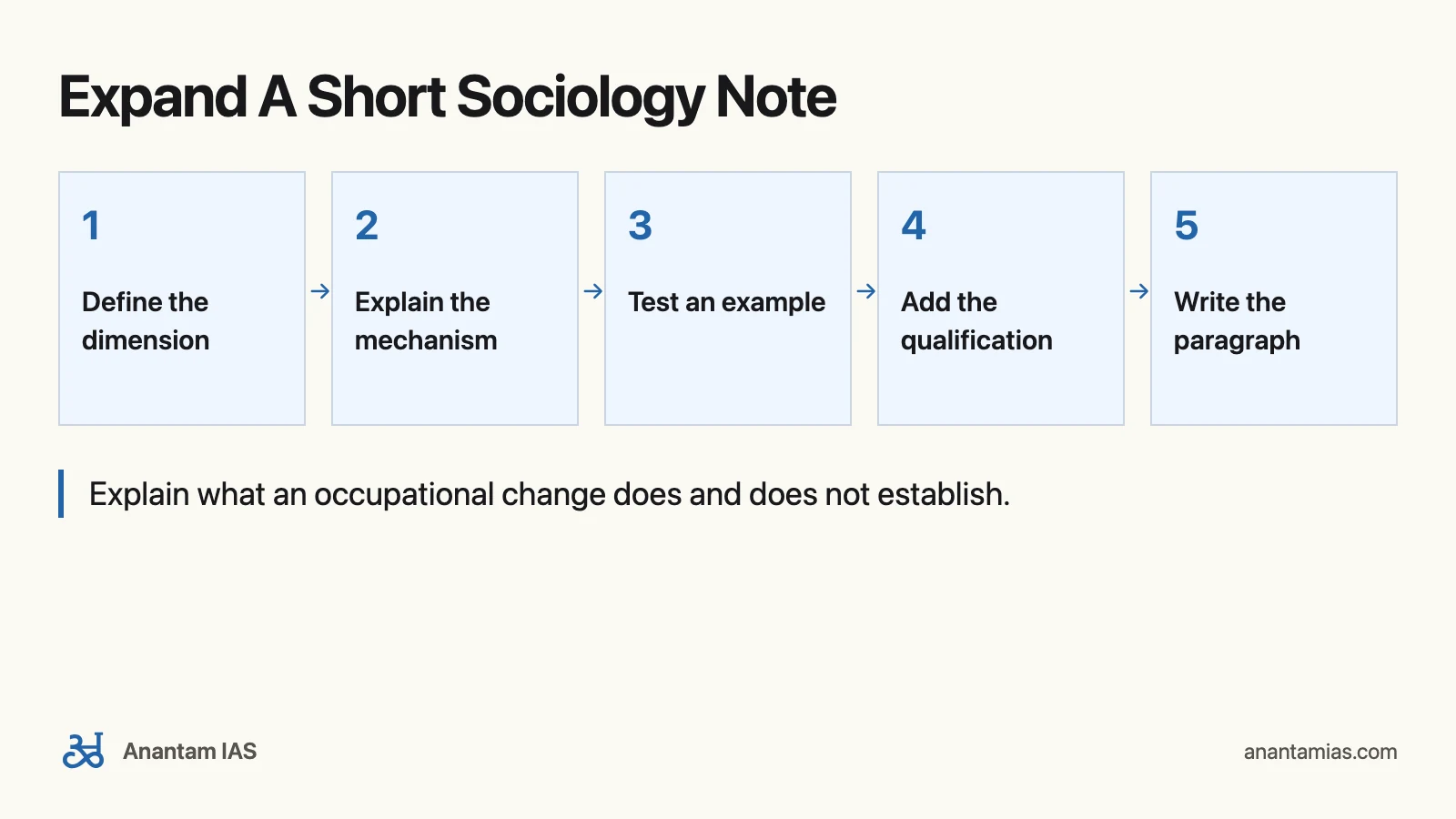
Original practice example, not a UPSC question: “Why does a change in occupation not establish that every form of social inequality has disappeared?”
Consider two hypothetical families:
| Family | Parent’s occupation | Adult child’s occupation | What the description gives us |
|---|---|---|---|
| A | Agricultural laborer | Salaried schoolteacher | An occupational change across generations |
| B | Small shopkeeper | Small shopkeeper | Broad occupational continuity across generations |
The information is deliberately limited. No income, job security, prestige or caste details are supplied.
Work through the reasoning before writing a conclusion:
- Name the dimension: The example records occupations. It doesn’t directly measure income or social standing.
- Name the comparison: Parent and child are different generations. The comparison concerns intergenerational mobility, not one person’s changing jobs over a lifetime.
- Avoid a premature rank: Calling the teacher’s move “upward” needs a stated criterion. Occupational prestige, security and income may not give exactly the same ranking.
- Keep other dimensions open: An occupational change doesn’t establish a change in caste membership or the end of discrimination.
- Separate a case from a population: One family can’t establish society-wide openness. That would need comparable evidence across many people.
OpenStax’s social stratification explanation is a useful companion when mobility vocabulary needs a fuller introduction.
A weak answer says “education brings mobility, therefore inequality ends.” A stronger paragraph would say:
An occupational change between a parent and child indicates a change in one dimension of social position. It can be studied as intergenerational mobility, but its direction depends on the ranking criterion used. Income, occupational prestige and caste-based relations need separate examination. Individual mobility can coexist with persistent group inequalities; wider conclusions need evidence beyond one family.
The paragraph is an original teaching model. It claims no real survey result. Now reopen your book and add the named scholar or framework that actually fits the argument in the passage you’ve read. Don’t attach a thinker merely because the name is familiar.
Build A Read-Recall-Write Cycle
A note is ready for revision when you can explain the connection between its terms. You don’t need to rewrite the entire page.
- Read for 20 minutes: Choose one small topic and underline the claim, not every important-sounding noun.
- Recall for 10 minutes: Close the book. Explain the term and one example aloud or on paper.
- Write for 15 minutes: Answer an original question or outline an authenticated PYQ. Preserve the real wording if you use a PYQ.
- Check for 5 minutes: Repair one missing mechanism, one unsupported inference or one misused term.
That is a 50-minute sample session. If you have less time, reduce the topic’s size. If a basic term remains unclear, spend the writing period on explanation first and write the answer in the next session.
At the week’s end, select a Paper II topic and link it to one Paper I concept. Explain what the link adds. A theorist’s name in the margin is not a completed connection.
Keep The Book’s Limits Visible
A structured source still needs checks around it. Edition labels and a long contents list don’t establish that you understand the material or that every example remains current.
- Use a fuller explanation when a compressed passage leaves you memorizing words without a mechanism. This is a rule for your reading, not a blanket verdict on the whole book.
- Date current evidence separately. Don’t transfer a figure from an older print into a present-day claim without verification.
- Treat solved answers as arguments to examine. Repeating their wording doesn’t test your own reasoning.
- Keep the published Sociology Optional notes available for topic navigation, then resolve specific gaps with the appropriate source.
Before buying anything else, finish the mobility worksheet with the information you can and cannot infer. If your notes now distinguish those two, the reading has produced something you can use.
Frequently Asked Questions
Who is credited on the Essential Sociology third-edition set?
The verified two-volume Amazon listing credits Nitin Sangwan, Seema and Shruti Jakhar and identifies EduGali as the publisher.
Does every Essential Sociology listing include both volumes?
No. Separate Volume I and Volume II listings appear alongside the two-volume set. Check the package contents and title pages before buying.
Should I upgrade from an older edition?
First identify a specific coverage or explanation gap. Compare the new contents with that gap. Different pagination alone does not establish a reason to replace a usable copy.
How should I connect Paper I with Paper II?
Select a Paper II case and one relevant Paper I concept. Explain what that concept helps reveal, then add evidence and qualifications. A theorist name by itself is not the connection.
What should a reading session produce?
A concept in your own words, a mechanism, an example and a qualification. The sample cycle combines reading, closed-book recall, writing and correction in 50 minutes; reduce topic size when time is short.
Tell Google you want more of this.
Add Anantam IAS as a preferred sourceOne tap, and this site shows up more often in your own Top Stories, AI Overviews and AI Mode. Remove it any time.