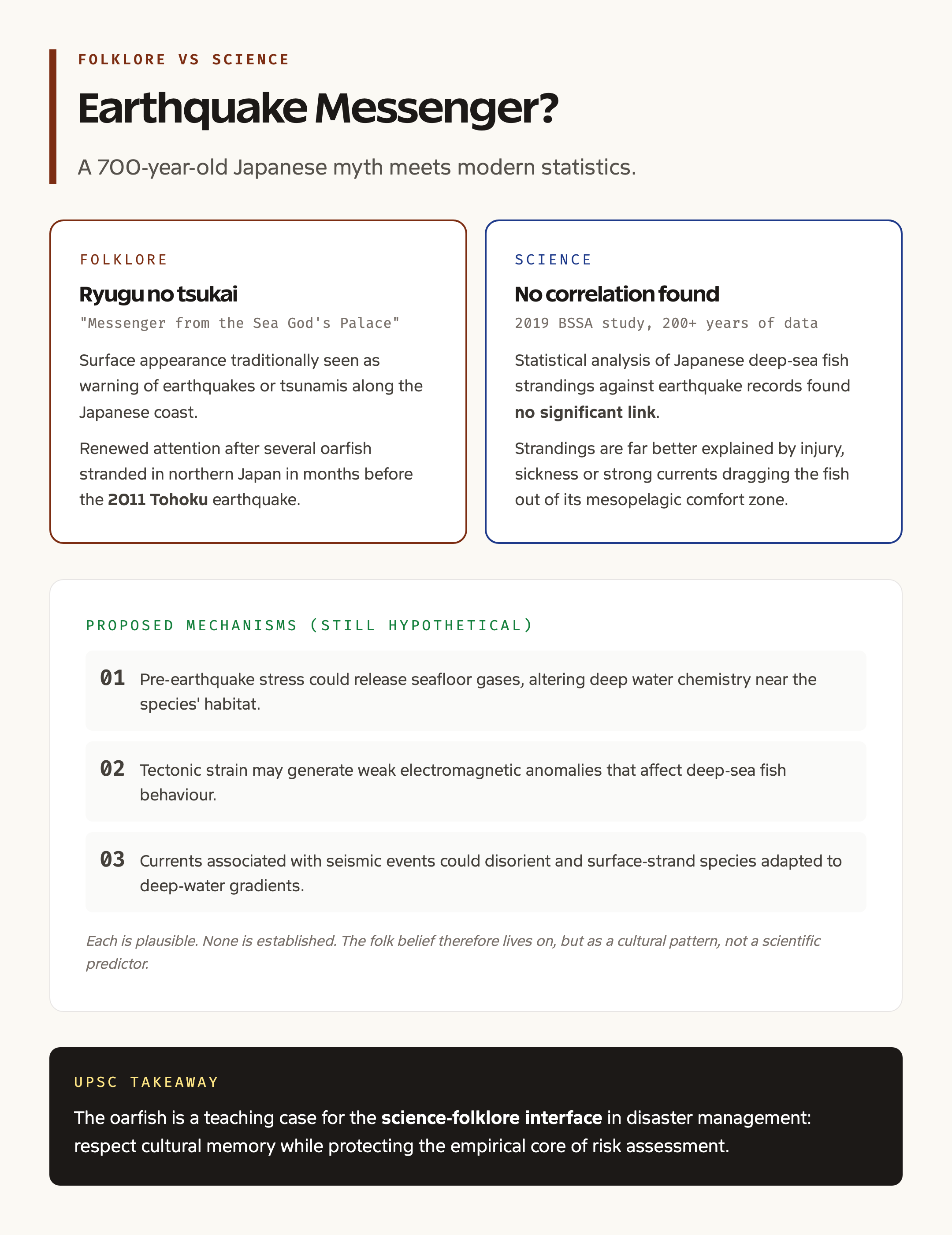
When a long, silvery, ribbon-like fish washes up on a beach in Japan, the local newspapers do not talk about ichthyology. They talk about earthquakes. The oarfish, Regalecus glesne, is one of the most spectacular and mysterious fish in the world. It grows up to three metres in length, sometimes reportedly longer, lives at depths between 200 and 1,000 metres in the open ocean, and in Japanese folklore is called Ryugu no tsukai — the messenger from the Sea God’s palace. For centuries, sightings have been linked to imminent earthquakes and tsunamis, a connection that has become a recurring fascination in popular media every time a major quake strikes the western Pacific.
Science is more cautious. The oarfish’s appearance at the surface is nearly always associated with sickness, injury, or strong currents that drag the fish out of its preferred deep zone. There is no controlled study showing that oarfish surface in unusual numbers before earthquakes. Yet the cultural connection is so persistent that even modern Japanese seismologists periodically have to address it in public communications. The oarfish therefore lives in two worlds: as the longest bony fish on Earth in marine biology textbooks, and as a mythic harbinger in the folk imagination of seafaring cultures.
For UPSC, the oarfish is a precise, high-yield species topic. It links marine zonation, the IUCN Red List, deep-sea fish biology, the difference between bony fish and other classes, and the wider question of how science and folklore interact around natural phenomena. This guide expands every dimension of the species and its surrounding context.
Quick Facts
- Scientific name: Regalecus glesne
- Common name: Giant oarfish; sometimes called King of Herrings
- Family: Regalecidae
- Body length: Typically up to 3 metres; some reports suggest specimens may grow much longer
- Body type: Long, ribbon-like, laterally compressed
- Colour: Silvery; skin coated in guanine crystals (no scales)
- Notable feature: Often swims vertically (head up) for camouflage and feeding
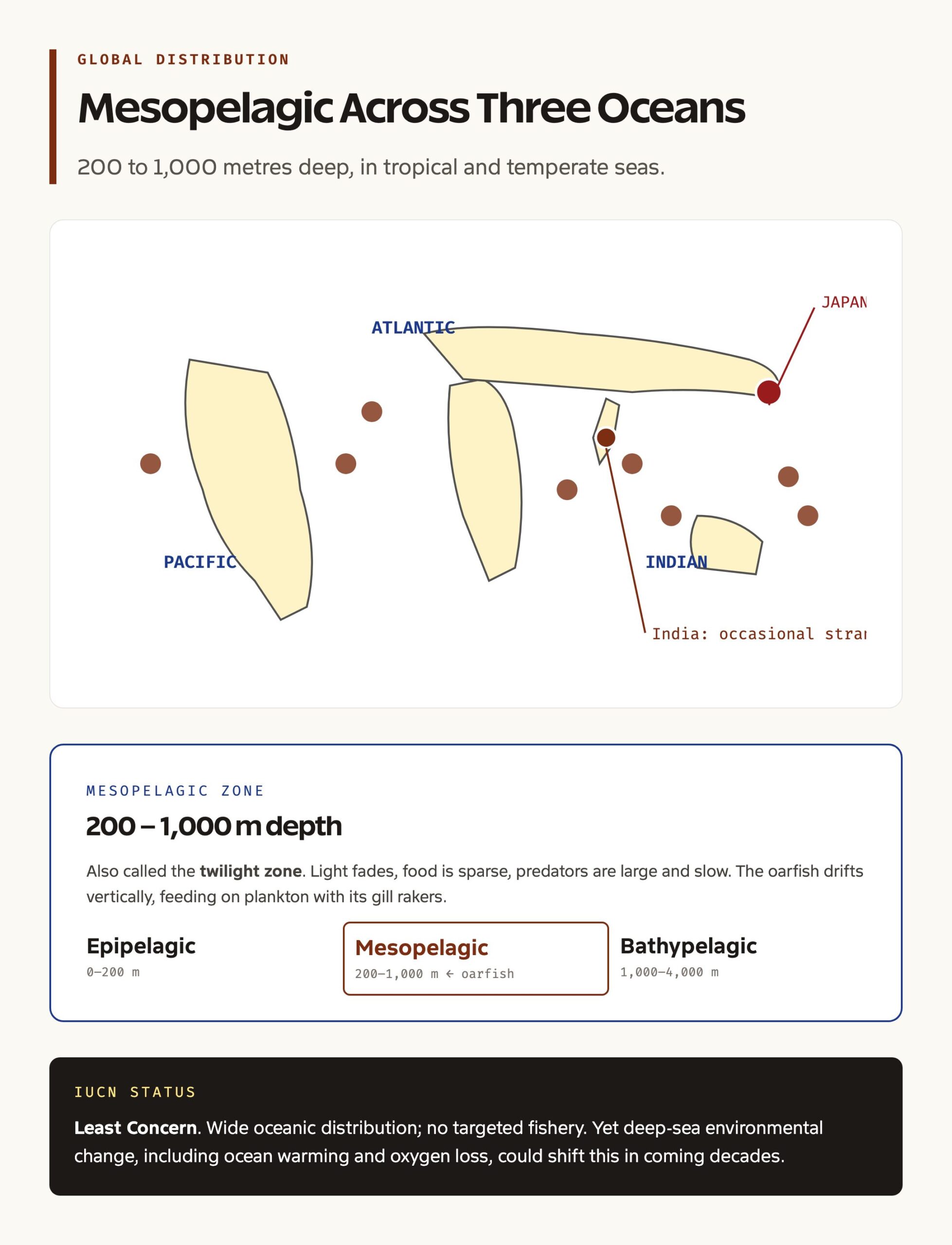
- Habitat zone: Mesopelagic zone of the open ocean (200 to 1,000 metres depth)
- Distribution: Atlantic, Pacific, and Indian Oceans
- Diet: Small crustaceans, plankton, and tiny fish, filtered with gill rakers
- IUCN Red List: Least Concern
- Cultural significance: Historically called sea serpents; in Japan, Ryugu no tsukai, messenger from the Sea God’s palace
- Folklore link: Sightings traditionally tied to earthquake or tsunami warnings, although scientific support is weak
- Class: Actinopterygii (ray-finned fish), within bony fish (Osteichthyes)
What Is the Oarfish
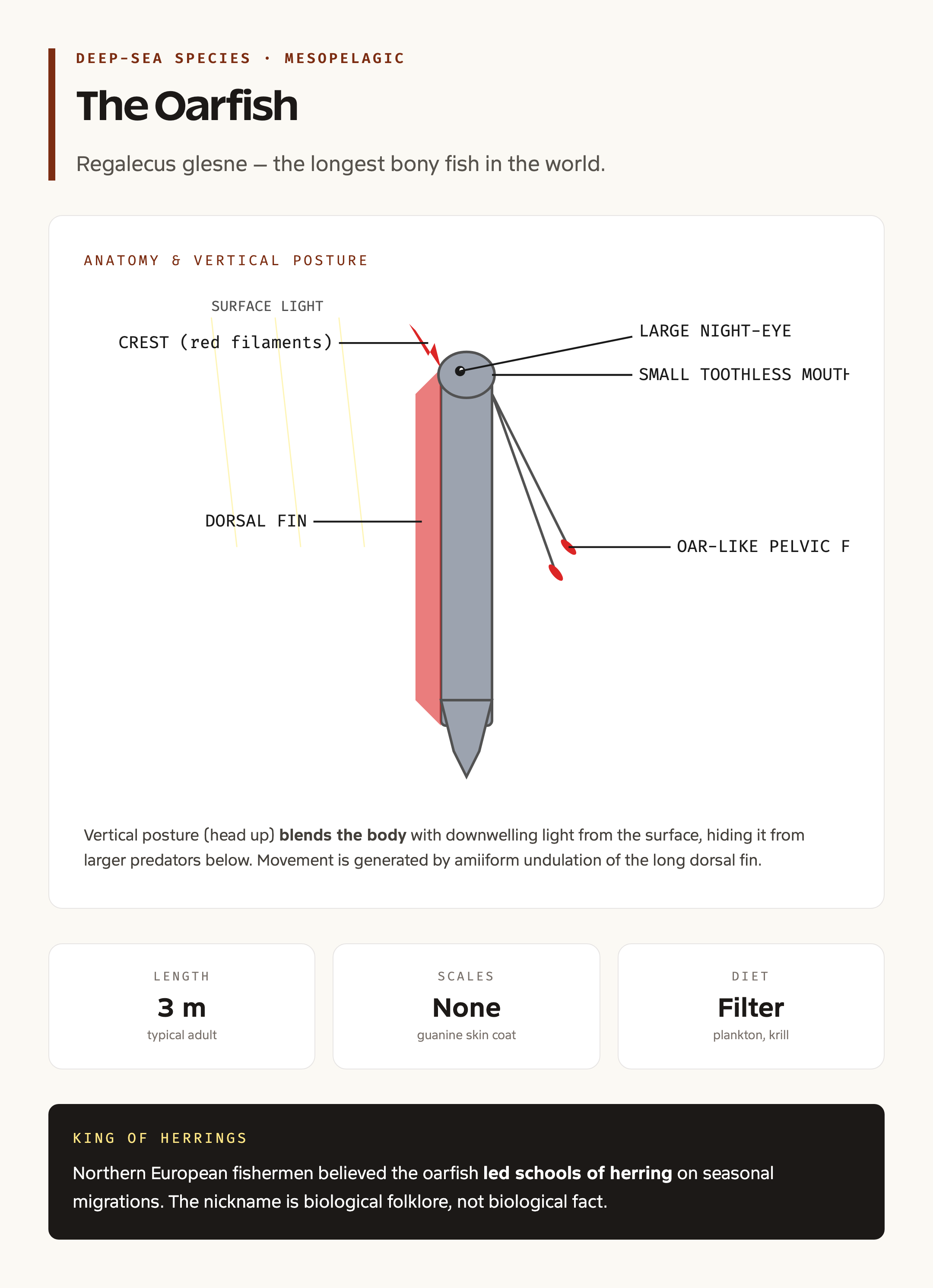
The oarfish is a deep-sea, ray-finned bony fish that holds the record for the longest bony fish in the world. Its body is shaped like a flat ribbon — long, thin, and laterally compressed, with a continuous dorsal fin running the entire length of the body. The fin’s first few rays are extended, often forming a crest or crown above the head, which is one of the easiest ways to identify the species in photographs. The pelvic fins are reduced to two long whip-like rays that resemble oars and probably gave the fish its English name.
The body has no true scales. Instead, the skin is coated with silvery guanine crystals that reflect light, giving the oarfish its mirror-bright appearance. This coating is so delicate that most beached specimens lose patches of the silver layer simply from being moved. The eyes are large, adapted to dim light at mesopelagic depths. The mouth is small, protrusible, and toothless, suited to filtering small prey rather than catching larger fish.
The most striking behavioural detail is vertical swimming. Underwater video from research submersibles has captured oarfish swimming with the body held nearly vertical, head pointed upward and the tail trailing below. This posture probably helps the fish blend with the dim downwelling light from the surface, hiding the body’s profile from larger predators below. It also positions the gill rakers to capture prey that drift downward in the water column.
The species was first described in 1772 by Norwegian biologist Peter Ascanius. It has been documented in every major ocean, but live encounters remain rare because of its deep-water habitat. Nearly all firm specimens come from beached individuals, accidental net captures, and submersible footage from oceanographic expeditions.
Background and Historical Context
The oarfish is woven through centuries of maritime folklore. Sailors crossing the open Atlantic and Pacific occasionally reported giant ribbon-like creatures rising vertically from the deep, sometimes mistaking them for sea serpents. The serpent legends of Norse, English, and Mediterranean sailors are now widely thought to have been inspired in part by sightings of oarfish at the surface. The name King of Herrings comes from a similar lineage: northern European fishermen believed the oarfish led schools of herring on their seasonal migrations.
Japanese folklore goes further. The oarfish is named Ryugu no tsukai, meaning messenger from Ryugu-jo, the underwater palace of the Sea God Ryujin. According to tradition, the fish only appears at the surface to warn coastal communities of impending disasters, especially earthquakes and tsunamis. After several oarfish surfaced and stranded in northern Japan in the months before the 2011 Tohoku earthquake and tsunami, the folklore received a fresh wave of public attention.
Science has examined the connection carefully. The leading hypothesis is that pre-earthquake stresses in the seafloor may release gases or alter electromagnetic fields that affect deep-sea fish behaviour, but the evidence remains inconclusive. A 2019 study in the Bulletin of the Seismological Society of America analysed Japanese deep-sea fish strandings against earthquake records over more than two centuries and found no statistically significant correlation. The folklore therefore persists as cultural memory, while the science continues to look for explanations of why oarfish strand at all.
In the Indian context, oarfish strandings have been recorded along the Indian coastline, including along the Maharashtra and Tamil Nadu shores. Each event is greeted with intense local curiosity but treated by Indian fisheries scientists as a normal mortality event rather than a natural prediction signal.
Key Features and Anatomy
A closer look at the oarfish reveals a series of unusual adaptations.
The continuous dorsal fin runs from above the eyes to the tip of the tail, with several hundred fin rays. The first rays are elongated, often topped with reddish-pink filaments and skin lobes, forming a flag-like crest visible in life. This crest may serve a display function during reproduction, although mating behaviour has never been observed in the wild.
The body is laterally compressed to a thickness of just a few centimetres in some sections, even though it can be over three metres long. This shape minimises drag during slow swimming and helps with camouflage when the fish hangs vertically.
The tail tapers to a point and lacks a well-developed caudal fin. Movement is generated almost entirely by undulations of the long dorsal fin, in a pattern called amiiform swimming. This propulsion mode is energetically efficient at slow speeds, suited to the oarfish’s low-prey deep-sea environment.
The eyes are large relative to the head, suggesting good low-light vision. Recent eye-physiology work indicates that oarfish, like other mesopelagic fish, have rod-dominated retinas optimised for the faint blue light that penetrates to several hundred metres of depth.
The lack of scales has earned the oarfish its silvery sheen but also makes it fragile. Beached specimens degrade quickly, and even careful handling damages the guanine layer. Most museum specimens worldwide are preserved in formalin and have lost much of their original colour, which is one reason live underwater footage from the past two decades has been so scientifically valuable.
Why It Matters
The oarfish matters in three connected ways.
It is a deep-sea ecology indicator. Because the oarfish lives in the mesopelagic zone, where light barely penetrates and food is sparse, its distribution and behaviour reflect the overall health of the open ocean’s middle waters. Increasing strandings in any region can signal disturbances in deep currents, oxygen levels, or prey availability. The mesopelagic zone is currently among the least understood ocean compartments, and the oarfish is a charismatic ambassador for the larger conservation question. Linked topics include biodiversity in India and broader marine biology pointers.
It is a cultural touchstone in disaster communication. The earthquake folklore around the oarfish is studied not just as superstition but as a case study in how communities incorporate natural signals into hazard preparedness. The 2011 Tohoku event reinforced public interest, and the oarfish has become a popular hook for science communicators introducing earthquake science to lay audiences.
It is a taxonomic landmark. As the world’s longest bony fish, the oarfish anchors a teaching point in marine zoology: bony fish (Osteichthyes) versus cartilaginous fish (Chondrichthyes, including sharks and rays). Many sharks are longer, but they are not bony fish. The whale shark, the largest fish overall, is cartilaginous. The oarfish therefore holds a specific record within the Actinopterygii (ray-finned fish) class.
Detailed Analysis: Oarfish in the Marine Food Web
The oarfish is a slow, gentle filter feeder despite its dramatic size. It positions itself vertically in the water column and filters small crustaceans, plankton, and tiny fish through its gill rakers. The energy budget of such a long, mostly stationary fish is remarkably low, which is consistent with the energy-poor mesopelagic environment.
Predators of the oarfish are not well documented. Large pelagic fish such as marlin, possible sharks, and toothed whales like sperm whales likely take occasional oarfish, especially when the fish is sick or near the surface. Strandings of oarfish frequently show injuries consistent with predation attempts, although the gentle drift of a dying oarfish to the surface may also explain many strandings without any predator interaction.
Reproduction remains poorly understood. Females are presumed to release pelagic eggs, which then hatch into ribbon-like larvae that drift in surface waters. Larval oarfish have been collected in plankton tows in the Atlantic and Pacific, and they show many of the adult features at a much smaller scale.
Lifespan is unknown but is presumed to be at least several years. Growth rates have been estimated from the few specimens whose otoliths (ear stones) have been studied, with rough indications of slow but steady growth.
The oarfish has historically been encountered as bycatch in deep longline fisheries, especially in tuna and swordfish operations. Reports of oarfish caught in Indian tuna longline fleets in the Andaman Sea exist in fisheries archives, although such captures are rare.
Comparative Snapshot: Oarfish and Other Marine Records
Several marine species hold related but different records.
The whale shark (Rhincodon typus) is the largest fish overall, reaching up to twelve metres or more. It is a cartilaginous fish, not a bony fish, so it does not displace the oarfish from the bony-fish record.
The basking shark and the megamouth shark are also large filter-feeders but are likewise cartilaginous.
The ocean sunfish (Mola mola) is the heaviest bony fish, weighing up to two thousand kilograms, but its body shape is short and rounded, not long and ribbon-like.
The blue marlin and the swordfish are large bony fish but are streamlined and predatory, with body lengths well below the oarfish’s three to five metre maximum.
Among truly long bony fish, the oarfish stands alone. The closely related slender oarfish (Regalecus russelii) is similar in shape but smaller. Together they form the small family Regalecidae of the order Lampriformes.
The oarfish therefore sits at a precise intersection: longest bony fish, mesopelagic zone resident, ribbon-shaped body. Each of these features is a distinct teaching point in marine biology.
Challenges in Studying the Oarfish
Several practical and scientific challenges shape what we know and do not know about the species.
Live observation is rare. The oarfish lives at depths beyond easy diving range, and even research submersibles encounter it only occasionally. Most data comes from beached specimens, which are usually injured or recently dead.
Specimen preservation is difficult. The fragile guanine skin and the soft body structure make whole-body preservation challenging. Few museums hold complete adult specimens, and even fewer hold them in conditions suitable for modern morphological analysis.
Genetic data is limited. Tissue samples from oarfish are scarce, and population-level genetic studies have been conducted on only a small number of specimens. As a result, the actual taxonomy of Regalecus is still being debated, and there is some discussion in the literature about whether Regalecus glesne and Regalecus russelii should remain separate species.
Behavioural data is fragmentary. Vertical swimming has been observed only in a handful of submersible video clips. Mating, spawning, and parental care have never been documented in the wild. Diet inferences come from gut content analysis of stranded specimens, which may not reflect normal feeding ecology.
Folklore distortion is a soft challenge. Public interest tends to spike around earthquake folklore stories, which can crowd out more rigorous biological reporting. Science communicators handling oarfish stories therefore have to weave in the cultural angle while protecting the empirical core.
Prelims Pointers
- Scientific name: Regalecus glesne
- Family: Regalecidae; Order: Lampriformes
- Class: Actinopterygii (ray-finned bony fish)
- It is the longest bony fish in the world, growing to about 3 metres
- Body is ribbon-like, laterally compressed
- It has no scales; skin is coated with silvery guanine
- It often swims vertically (head up) as a camouflage strategy
- Habitat zone: mesopelagic zone of the open ocean (200 to 1,000 metres)
- Distribution: Atlantic, Pacific, and Indian Oceans
- IUCN Red List: Least Concern
- Historically called “sea serpents” by sailors
- In Japanese folklore, called Ryugu no tsukai — messenger from the Sea God’s palace
- Linked culturally to earthquake and tsunami warnings, although scientific evidence is weak
- The whale shark is the largest fish overall but is cartilaginous, not bony
- The ocean sunfish (Mola mola) is the heaviest bony fish
Mains Practice Questions
- The oarfish illustrates the tension between traditional folklore and modern science in interpreting natural signals. Discuss with reference to the earthquake-prediction myth around oarfish in Japan and India. (250 words)
- The mesopelagic zone is one of the least understood ocean compartments. Examine the ecological significance of the zone and the role of indicator species like the oarfish in its conservation. (250 words)
- Distinguish between bony fish and cartilaginous fish. Use the oarfish and the whale shark as illustrative examples. (150 words)
Way Forward
A focused research and communication strategy would convert the oarfish’s fame into useful science.
Submersible and deep-camera surveys in the Indian Ocean, especially along the Andaman and Lakshadweep oceanic stretches, would generate the first systematic Indian footage of the species in its natural habitat. These could piggyback on existing oceanographic missions of the National Institute of Oceanography and the National Centre for Polar and Ocean Research.
Stranding-network monitoring along the Indian coastline, with rapid-response protocols for collecting fresh specimens, would build a tissue and morphological archive. The Marine Living Resources programme of the Ministry of Earth Sciences can anchor this work in coordination with state fisheries departments.
Public communication that combines folklore and science, especially in coastal Tamil Nadu, Maharashtra, and Andhra Pradesh, would convert each oarfish stranding event into an educational moment. The Japanese model of patient public messaging is worth studying.
International collaboration with Japan, Norway, and California where most oarfish encounters historically come from would import expertise and standardise reporting protocols.
Genetic and reproductive biology studies, supported through the Department of Biotechnology and partner institutes, would close some of the largest open questions in the species’ biology. Each tissue sample matters because live captures remain rare. Linked institutional infrastructure, similar to that supporting the river dolphins conservation work, can be adapted for deep-sea species.
The oarfish has been swimming through human imagination for centuries. Modern science is only now starting to catch up with the underwater reality. The opportunity is to keep both the wonder and the rigour intact.
Frequently Asked Questions
What is an oarfish?
The oarfish is a deep-sea ribbon-like fish, scientifically named Regalecus glesne. It is the longest bony fish in the world, growing up to about three metres, and lives in the mesopelagic zone of the open ocean.
Where does the oarfish live?
It lives in the mesopelagic zone of the open ocean, at depths between 200 and 1,000 metres. It has been recorded in the Atlantic, Pacific, and Indian Oceans, including occasional strandings along the Indian coastline.
Why is the oarfish called the King of Herrings?
Northern European fishermen believed that oarfish led schools of herring on their seasonal migrations. The English nickname King of Herrings comes from this old folklore. The connection is not biologically real, but the name has stuck.
Why does the oarfish swim vertically?
Vertical swimming with the head pointed upward helps the oarfish camouflage its body against the faint downwelling light from the surface. The posture also aligns the gill rakers to filter small prey drifting in the water column.
Are oarfish really linked to earthquakes?
The link is a centuries-old Japanese folk belief, with the fish called Ryugu no tsukai (messenger from the Sea God’s palace). Modern statistical studies have not found a strong correlation between oarfish strandings and earthquakes. The cultural connection persists, while science continues to investigate.
What is the IUCN status of the oarfish?
The oarfish is listed as Least Concern on the IUCN Red List. The species has a wide oceanic distribution and is not subject to targeted fishing or major identified threats, although deep-sea environmental changes could affect it in the future.
Is the oarfish the largest fish in the world?
No. The whale shark is the largest fish in the world by length and weight, but the whale shark is a cartilaginous fish. The oarfish is the longest bony fish. The ocean sunfish is the heaviest bony fish, but it is shorter and stockier.
What does the oarfish eat?
It feeds on small crustaceans, plankton, and tiny fish, which it filters using gill rakers. It is a slow, gentle filter feeder despite its dramatic length, which fits with the energy-poor mesopelagic environment.
Why is the skin of the oarfish silvery without scales?
The oarfish has no scales. Its skin is coated with silvery guanine crystals that reflect light. This produces a mirror-bright appearance but also makes the skin extremely fragile, easily damaged when the fish is handled or beached.
How is the oarfish relevant to UPSC?
It connects to marine biology, ocean zonation, the IUCN Red List, deep-sea ecology, the difference between bony and cartilaginous fish, and the science-folklore interface. It pairs well with topics on marine biodiversity, ocean conservation, and disaster management folklore.
Tell Google you want more of this.
Add Anantam IAS as a preferred sourceOne tap, and this site shows up more often in your own Top Stories, AI Overviews and AI Mode. Remove it any time.