A Parliament that meets less, debates less, and waves Bills through without examining them isn’t a stronger Parliament. It’s a quieter one. And in the Budget Session of 2026, the quiet got loud enough to notice. PRS Legislative Research, the think tank that has tracked Parliament’s vital signs for two decades, recorded that 77 percent of the Union Budget was “guillotined” that session, passed without a single minute of discussion in the House. The same session was stretched by three extra days so the government could introduce and pass three constitutional and electoral Bills, and the entire debate on all of them ran for 21 hours and 28 minutes spread over two days.
That’s the news. The story underneath it is slower and more worrying. For seventy years, India’s Parliament has been meeting less often, sending fewer laws to be examined, and passing more of them in a hurry. The institution still produces legislation at scale. What it produces less of is scrutiny. And scrutiny, not output, is what the Constitution actually asked Parliament to supply.
The Issue, Framed
The argument here isn’t that Parliament has stopped working. It hasn’t. The argument is narrower and sharper: Parliament’s deliberative function, the slow, public, adversarial examination of what the executive wants to do, has thinned out while its output function has held up. Those two aren’t the same thing, and conflating them is where most weak answers go wrong.
Let’s fix the vocabulary first, because the whole debate runs on terms that get used loosely. A sitting day is a day on which a House actually meets and transacts business. It’s the raw fuel of accountability, because everything else, questions, debates, votes, happens only on a day the House sits.
Question Hour is the first hour of a normal sitting, when ministers must answer questions put by members about their departments. It’s the most direct tool an ordinary MP has to hold a minister to account on the floor, on the record.
Departmental Standing Committees, often called DRSCs, are the 24 permanent panels, each shadowing a cluster of ministries, that examine Bills, budgets, and policy away from the glare of the House. Think of them as Parliament’s workshop. A Bill referred to one gets clause-by-clause attention from MPs of all parties, expert witnesses, and weeks of quiet work the noisy floor can’t manage. Referral isn’t mandatory, though. The Speaker of the Lok Sabha or the Chairman of the Rajya Sabha decides, usually on the piloting ministry’s recommendation. So when referral falls, it falls by choice.
A money bill, defined in Article 110, is a Bill dealing only with taxation, government borrowing, or spending from the Consolidated Fund. It carries a special privilege: the Rajya Sabha can’t amend or reject it, only recommend changes the Lok Sabha is free to ignore. So labelling a Bill a money bill effectively switches off half of Parliament. The Speaker certifies what counts as one, and that certification has been treated as hard to challenge in court.
The guillotine is the budget procedure where, once time runs out, the Speaker puts all outstanding Demands for Grants to a single vote, passed together, undiscussed. It quietly converts “we didn’t get to debate this ministry’s spending” into “this ministry’s spending is approved.”
And an ordinance, under Article 123, is a law the President promulgates when Parliament isn’t in session, on the Cabinet’s advice. It has the force of a statute but must be laid before Parliament and lapses if not approved within six weeks of reassembly. It’s meant for genuine emergencies. Lean on it too often and you’re legislating around Parliament rather than through it.
Hold those six terms. The decline story is really each one weakening at once.
What the Data Says
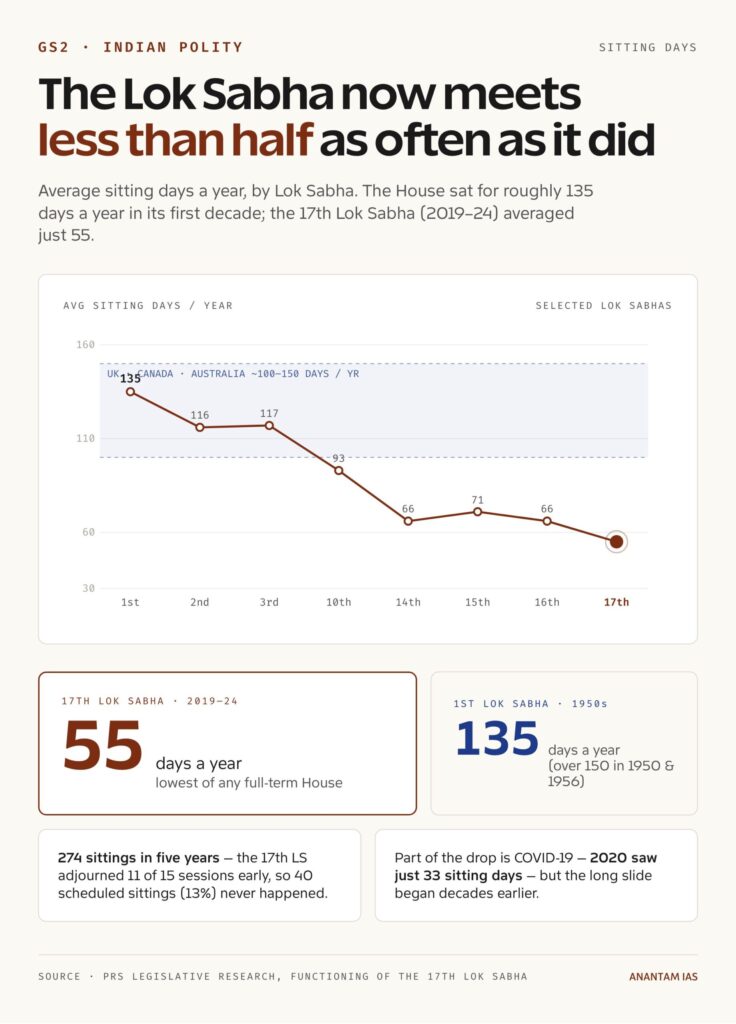
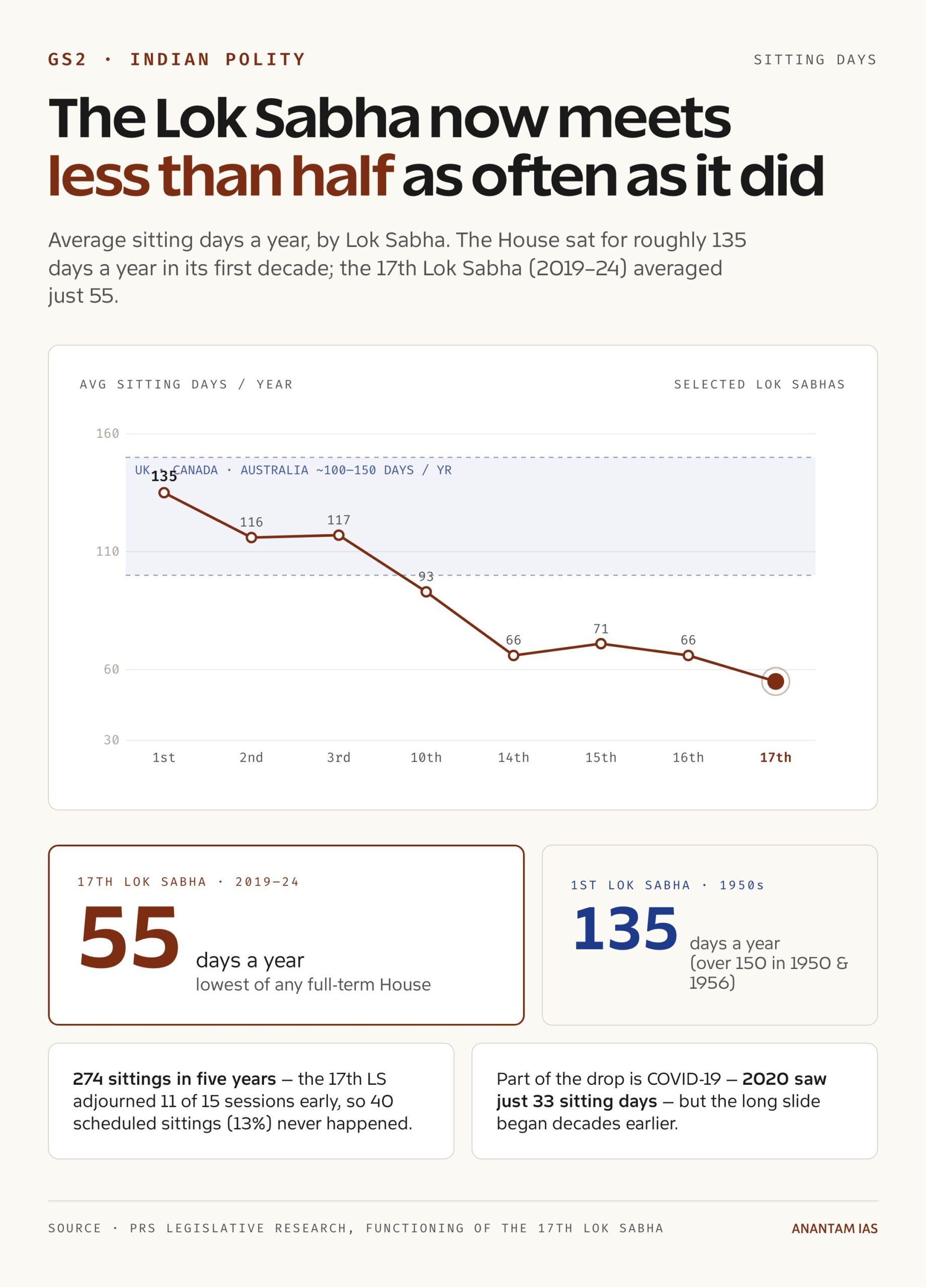
Start with how often Parliament even meets, because nothing else matters if the House isn’t sitting. The numbers below come from PRS Legislative Research, drawn from Lok Sabha records. The first Lok Sabha, in the 1950s, averaged about 135 sitting days a year. In 1950 and 1956 the House sat for more than 150 days. The second and third Lok Sabhas held around 116 to 117 days a year. Then the long slide began. The tenth Lok Sabha averaged about 93 days. The fourteenth, 66. The fifteenth, 71. The sixteenth, 66. And the seventeenth Lok Sabha, which ran from 2019 to 2024, averaged just 55 sitting days a year, the lowest of any Lok Sabha that completed its full term. Put plainly, the House now meets for roughly 40 percent of the days it met in its first decade.
The seventeenth Lok Sabha held 274 sittings across five years. Only four earlier Lok Sabhas managed fewer, and every one was dissolved before completing its term. Part of the drop is COVID-19; 2020 saw just 33 sitting days. But the rest is structural. Eleven of the seventeenth Lok Sabha’s 15 sessions were adjourned early, so 40 scheduled sittings, about 13 percent, never happened. By comparison, the parliaments of the United Kingdom, Canada, and Australia each sit for roughly 100 to 150 days a year, so India’s Parliament now meets less than half as often as the Westminster systems it was modelled on.
Now the scrutiny number, the heart of the matter. The share of Bills sent to a committee for detailed examination has collapsed. PRS’s own chart traces it: the fourteenth Lok Sabha referred about 60 percent of Bills, the fifteenth 71 percent, the sixteenth around 26 to 28 percent, and the seventeenth just 16 percent. Sources differ a little on the sixteenth Lok Sabha’s figure, which is why the honest way to cite it is a range, but the direction is unmistakable. From roughly seven in ten Bills examined to fewer than two in ten, inside a decade.
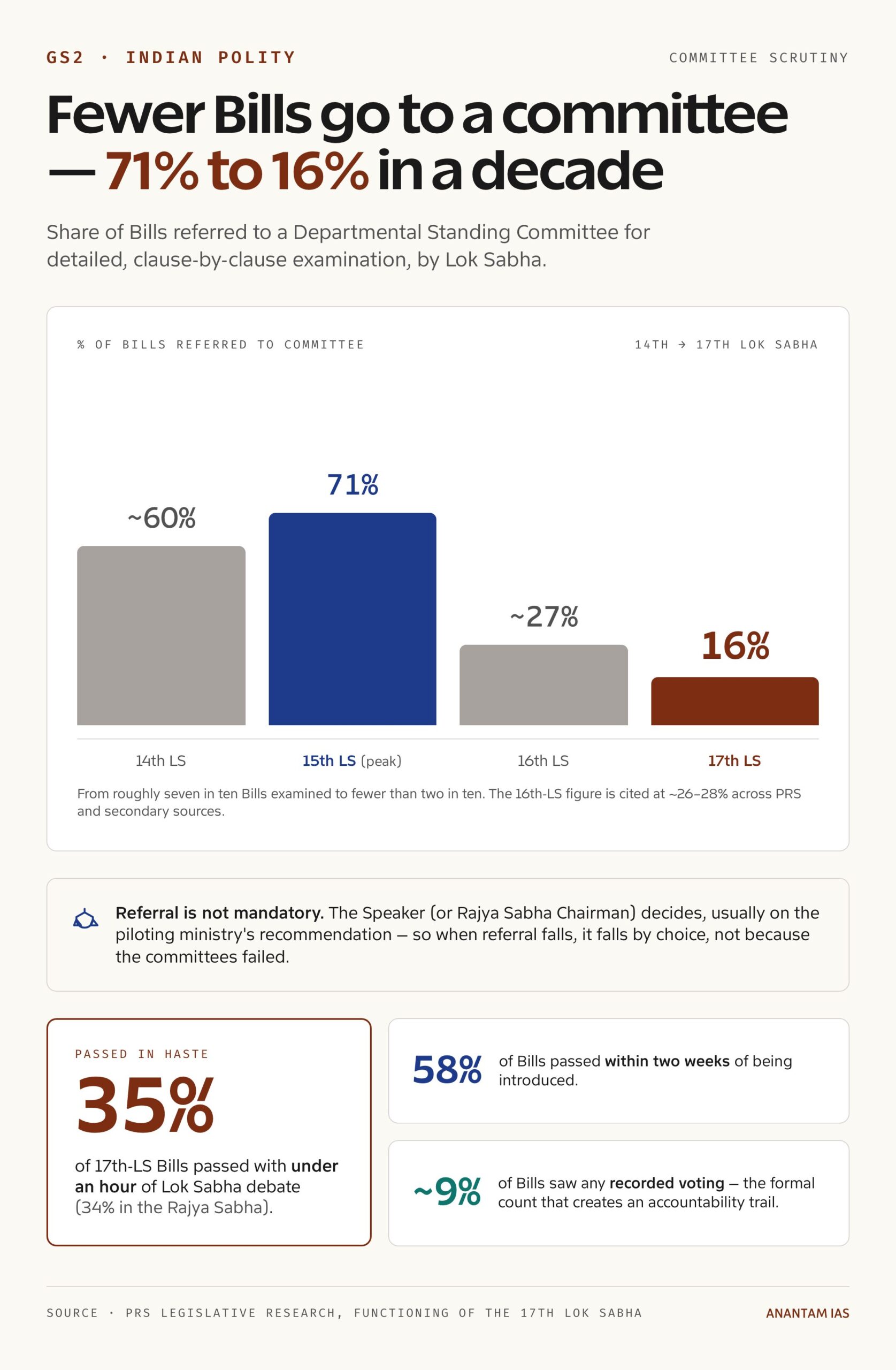
What happens when fewer Bills go to committee is that more get passed in a hurry. In the seventeenth Lok Sabha, 179 Bills were passed, leaving out the routine Finance and Appropriation Bills. Of those, 58 percent were passed within two weeks of being introduced, and 35 percent passed with less than an hour of debate in the Lok Sabha (34 percent in the Rajya Sabha). Two of the most consequential laws of the decade moved at sprint speed: the Jammu and Kashmir Reorganisation Bill of 2019 and the Women’s Reservation Bill of 2023 were each passed within two days of introduction. And recorded voting, the formal counting that creates a clear accountability trail, happened on only about 9 percent of Bills, roughly the same low rate as the two Lok Sabhas before it.
The Budget Session of 2026 sharpened all of this. PRS recorded that 77 percent of the Union Budget was guillotined, with only 2 of the 5 listed ministries, Agriculture and Railways, actually discussed; Home Affairs, External Affairs, and Power were not. Of all the Bills passed that session, only one had been examined by a parliamentary committee. And on 12 of the sitting days, the Lok Sabha spent under 15 minutes on Question Hour. Across the full seventeenth Lok Sabha, Question Hour ran for only 60 percent of its scheduled time in the Lok Sabha and 52 percent in the Rajya Sabha, with just 24 percent of orally listed questions actually answered on the floor of the Lok Sabha. The hour built for accountability is now the hour most often lost.
The Case For
Before declaring the institution broken, steelman the other side honestly, because the “Parliament still works” case is stronger than the headlines suggest.
Start with sheer output. The seventeenth Lok Sabha passed 179 Bills, including genuinely landmark laws: the Women’s Reservation Act of 2023, three Labour Codes, the Digital Personal Data Protection Act of 2023, and three new criminal codes replacing the colonial-era penal, procedure, and evidence statutes. A body that paralysed wouldn’t legislate at that scale. Whatever else is wrong, India’s Parliament is not failing to make law.
The committee system also does more work than the floor reveals. During the seventeenth Lok Sabha, the three Financial Committees and 24 Departmental Standing Committees together held about 1,700 meetings and produced around 1,280 reports. This is the “mini-Parliament” that grinds away year-round, examining budgets and policy even when the House is adjourned. And when the mechanism is used, it goes deep: the Joint Parliamentary Committee on the data protection Bill met 78 times over more than two years before that law was finalised. So the workshop isn’t shut. It’s just opened less often.
Parliament can also lengthen itself when there’s political will. The Winter Session of 2025 ran above 100 percent productivity in both Houses, each sitting extra hours, with more than 40 percent of the time spent on debates. And the Budget Session of 2026 was extended by three days precisely to legislate. The institution clearly retains the capacity to sit harder; what’s missing is the routine.
And here’s the point that keeps an honest answer balanced. Accountability still bites when it counts. A no-confidence motion was debated for 20 hours in August 2023. More striking, in the Budget Session of 2026 the Constitution (131st Amendment) Bill, a flagship government measure, was voted down 298 to 230. A Parliament that can defeat the executive’s own constitutional amendment on the floor is not a rubber stamp. Decline is real, but it’s a decline in habit and procedure, not a total collapse of function. Say that plainly, or the answer reads like a rant.
The Case Against
Here’s what the “still works” case walks past. Output measures how much law gets made. It says nothing about whether that law was examined before it bound 1.4 billion people. And on examination, the record is genuinely poor.
Take the numbers together rather than one at a time. A House that meets only 55 days a year, refers just 16 percent of Bills to committee, and passes a third of them with under an hour of debate isn’t doing scrutiny lightly. It’s mostly skipping it. The 179-Bill output looks impressive until you remember that 84 percent of those Bills were never examined clause by clause by a cross-party panel. That’s the trade the data shows: volume without scrutiny.
Then there’s the money-bill route, the most lawyerly form of bypass. Because a money bill under Article 110 strips the Rajya Sabha of any power to amend or reject, classifying a substantive law as one sidesteps the entire upper House. In K.S. Puttaswamy v. Union of India (2018), a five-judge Constitution Bench upheld, by 4 to 1, the passage of the Aadhaar Act as a money bill. Justice D.Y. Chandrachud dissented, calling it a “fraud on the Constitution,” because in his reading Aadhaar plainly wasn’t only about taxation or spending. A year later, in Rojer Mathew v. South Indian Bank (2019), another five-judge Bench found the Aadhaar reasoning unsatisfactory and referred the question of whether the Finance Act, 2017 was validly passed as a money bill to a larger seven-judge Bench. That reference is still pending. So the very test for what may be smuggled through as a money bill, and thereby past the Rajya Sabha, sits unresolved while the route stays open.
Disruption and suspension hollow things out from the other end. The seventeenth Lok Sabha’s term-average productivity was high, 88 percent in the Lok Sabha and 73 percent in the Rajya Sabha, but that average hides brutal sessions like Winter 2024, when the Lok Sabha functioned for 52 percent of its time and the Rajya Sabha for 39 percent. And in December 2023, after the Parliament security breach, 146 opposition MPs were suspended, the largest suspension in Indian parliamentary history. Several major laws, including the three criminal codes, were passed while the opposition benches sat largely empty. A debate with one side removed isn’t scrutiny. It’s stenography.
The structural neglect is quieter but telling. No Deputy Speaker has been elected since 2019, the first time the constitutional post under Article 93 has stayed vacant for an entire Lok Sabha term. Private Members’ Bills, the route by which an ordinary MP, not the government, can propose law, have gone dormant: 729 were introduced in the seventeenth Lok Sabha and only two were even discussed. No adjournment motion was taken up in either the sixteenth or seventeenth Lok Sabha. One by one, the tools that let Parliament push back against the executive have rusted from disuse.
The Deeper Structural Read
Step back, and the pattern isn’t really about any one government. It’s about a structural drift in how a Westminster-style parliament behaves when the executive grows confident and the calendar belongs to it.
Start with who controls the clock. In India’s system, the government decides when Parliament meets, for how long, and what it discusses. The Constitution only requires that no more than six months pass between two sessions, a floor so low it permits a Parliament that barely meets. So the single most important variable in scrutiny, time on the floor, is set by the very executive that scrutiny is supposed to check. That’s the design flaw underneath the falling sitting days.
Layer on the logic of a strong majority. When the governing party commands a comfortable Lok Sabha, the floor outcome of most Bills is a foregone conclusion. So debate and committee referral start to look, to a majority impatient to govern, like friction rather than value. The referral rate didn’t collapse because the committees failed. It collapsed because referral became optional and the majority chose to skip it. This is the “decline of legislatures” thesis comparative politics has discussed for decades: as executives professionalise and parties tighten their whip, legislatures slide from law-makers toward law-ratifiers. India is living a textbook case.
The money-bill route is the same drift in legal form. It’s not crude rule-breaking. It’s the executive using a genuine constitutional provision, Article 110, slightly outside its intended lane to remove an inconvenient veto point, the Rajya Sabha. And because the Speaker’s certification has been treated as nearly unchallengeable, the judiciary, the check that should police the boundary, has been slow and divided about whether it even can. The pending seven-judge reference in Rojer Mathew is, at bottom, the Court deciding how much of Parliament’s procedure it’s willing to supervise.
Here’s the part that matters for a future administrator. None of this shows up as a crisis. There’s no coup, no suspended constitution, no dramatic breakdown. The institution keeps meeting, keeps passing laws, keeps looking functional. The erosion is procedural and cumulative: a few fewer sitting days, a skipped committee referral, a money bill instead of an ordinary one. Each step is defensible on its own. The sum is a legislature that has quietly handed much of its deliberative power to the executive without anyone ever deciding, out loud, that it should.
What Should Be Done
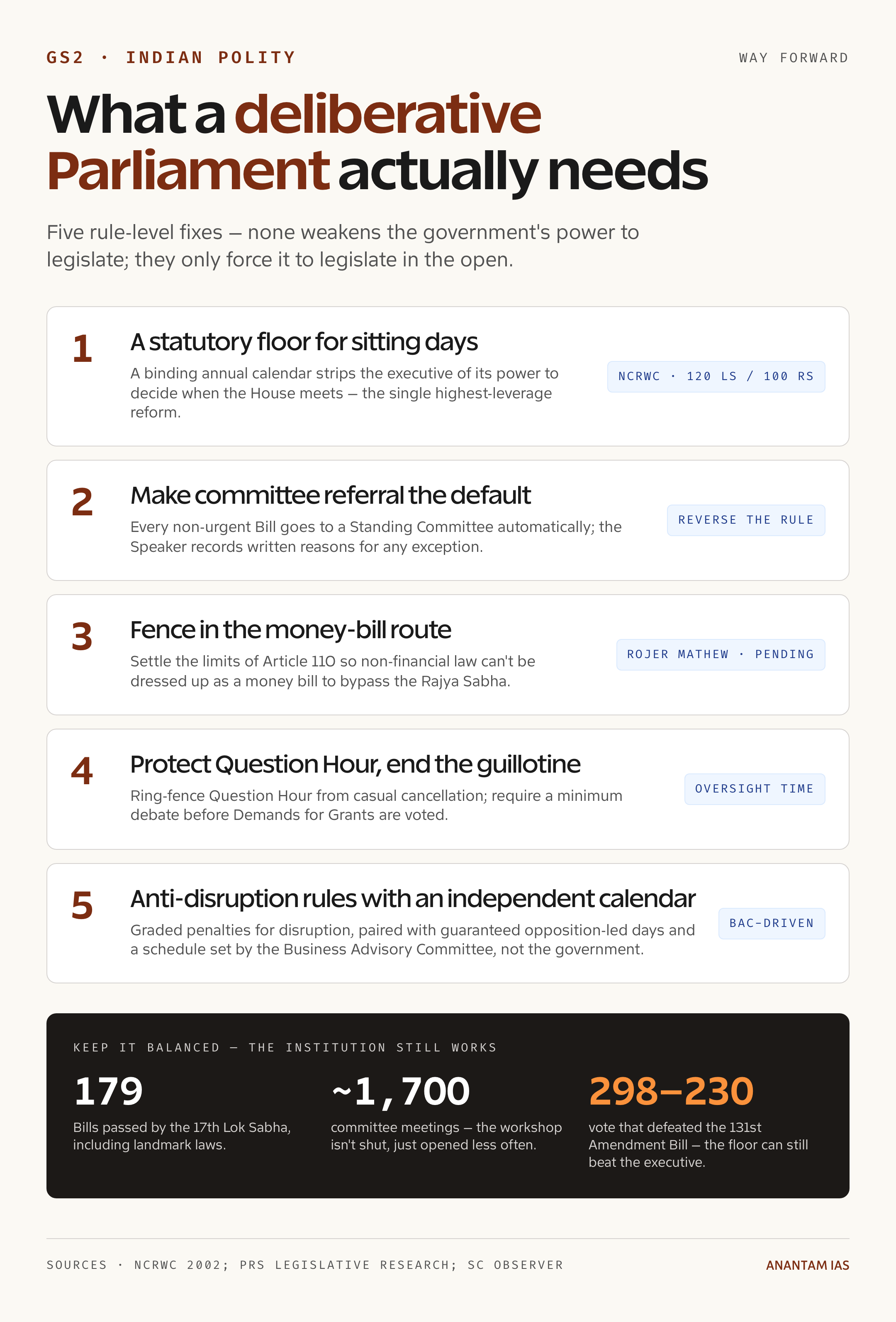
So what does a Parliament that scrutinises again look like? Not a vague plea for “more debate,” but a set of fixes you could write into the rules. Six of them, and none weakens the government’s ability to govern; they only force it to govern in the open.
- Set a statutory floor for sitting days. The National Commission to Review the Working of the Constitution recommended in 2002 a minimum of 120 days a year for the Lok Sabha and 100 for the Rajya Sabha. A binding annual calendar, fixed in advance, would strip the executive of its power to decide when the House meets and for how long. Private members’ Bills and presiding officers’ conferences have echoed this for years. It remains undone, and it’s the single highest-leverage reform on this list.
- Make committee referral the default. Reverse the rule. Every non-urgent Bill goes to a Departmental Standing Committee automatically, and the Speaker must record written reasons for any exception. That one change would have caught most of the 84 percent of seventeenth-Lok-Sabha Bills that skipped scrutiny, without banning fast-track laws where genuine urgency exists.
- Fence in the money-bill route. An expeditious ruling from the seven-judge Bench in Rojer Mathew would settle whether the Speaker’s money-bill certification is open to judicial review and where Article 110’s limits lie. Until non-financial law can no longer be dressed up as a money bill, the Rajya Sabha’s role as a revising chamber stays switchable-off at the executive’s convenience.
- Ring-fence Question Hour and end routine guillotining. Question Hour should be protected from casual cancellation, and Demands for Grants should require some minimum debate before they’re put to a vote. A budget where 77 percent of spending passes undiscussed isn’t a budget Parliament has approved. It’s one it has merely registered.
- Pair anti-disruption rules with guaranteed opposition time. Graded penalties for disruption only work if the opposition has a real, protected channel to be heard: a fixed quota of opposition-led days, and a calendar set by the Business Advisory Committee rather than handed down by the government. Discipline without voice just looks like silencing, and PRS has argued the two have to move together. The 146-MP suspension is what the system produces when they don’t.
- Fill the constitutional offices and revive dormant tools. Elect a Deputy Speaker as Article 93 plainly intends, and bring Private Members’ Bills and adjournment motions back into real use. These are the instruments through which Parliament, and the individual MP, pushes back. Leaving them empty is a choice, and it’s the wrong one.
Every one of these strengthens accountability without touching the government’s legitimate power to legislate. A Parliament that meets enough, examines what it passes, and can’t be bypassed by procedural shortcuts is a Parliament the public can actually trust to check power. That’s the entire point of having one.
For Your Mains Answer
This is a high-value GS2 topic. It maps straight onto the syllabus line on Parliament’s structure, functioning, and conduct of business, and it lets you weave in separation of powers, executive accountability, and the role of civil-society institutions like PRS in one frame.
GS paper mapping: GS2: Parliament and State Legislatures, structure and functioning; separation of powers; appointment to and functioning of constitutional posts; the legislative process and its scrutiny.
PSIR optional relevance: Paper I, Indian Government and Politics, on the working of Parliament and executive-legislature relations, and the “decline of legislatures” thesis. Paper I, Political Theory, on representation, deliberative democracy, and accountability. The comparative angle on the Westminster model and its dilution, the “cabinet-isation” of legislatures, and constitutionalism versus majoritarianism all fit here.
Likely question frames:
- “Parliament’s deliberative function has weakened even as its legislative output has held up.” Critically examine this with reference to recent data on sitting days and committee scrutiny.
- The money-bill route under Article 110 risks bypassing bicameral scrutiny. Discuss in light of the Puttaswamy (2018) and Rojer Mathew (2019) judgments.
- “A legislature that meets less, scrutinises less, and legislates in haste cedes power to the executive by default.” Analyse the structural causes and suggest reforms.
Quotable data points:
- Lok Sabha sitting days fell from about 135 a year (1st Lok Sabha) to 55 a year (17th Lok Sabha), the lowest of any full-term House.
- Bills referred to committees fell from 71 percent (15th Lok Sabha) to roughly 26 to 28 percent (16th) to 16 percent (17th).
- 35 percent of Bills in the 17th Lok Sabha passed with under an hour of debate; 58 percent passed within two weeks of introduction.
- 77 percent of the Union Budget was guillotined in Budget Session 2026, passed without discussion.
- 146 MPs were suspended in December 2023, the largest suspension in Indian parliamentary history.
- The validity of passing the Finance Act, 2017 as a money bill is pending before a seven-judge Supreme Court Bench in Rojer Mathew (2019).
- No Deputy Speaker has been elected since 2019, the first full-term vacancy in the post under Article 93.
- The steelman: the 17th Lok Sabha still passed 179 Bills, its committees held about 1,700 meetings, and the 131st Amendment Bill was voted down 298 to 230 in 2026.
Keywords to use: legislative scrutiny, deliberative democracy, executive accountability, parliamentary oversight, committee referral, money-bill route, budget guillotine, separation of powers, checks and balances.
Syllabus linkages: Parliament and State Legislatures, separation of powers, constitutional posts and bodies, the legislative process, judicial review of legislative procedure, the role of think tanks in accountability.
Balanced conclusion line: A Parliament is judged not by how many laws it passes but by how carefully it examines them before they bind the governed; output without scrutiny is the form of a legislature emptied of its function.
How to Build the Answer
Open with the distinction, not a definition. The whole topic turns on separating legislative output, which has held up, from legislative scrutiny, which has thinned. State that in the first sentence and the examiner knows you’ve understood the real question rather than the slogan version of it. A definition of “scrutiny” or “sitting day” can follow in the second sentence.
Bring data in early, but ration it. A strong first body paragraph can carry three figures: 135 to 55 sitting days, 71 to 16 percent committee referral, and 35 percent of Bills passed under an hour. Then say what they prove. The figure is the anchor; the “this means the House is skipping examination, not failing to legislate” is the mark.
Steelman before you criticise. Spend a clean two or three lines on why Parliament still works, the 179 Bills, the 1,700 committee meetings, the 131st Amendment voted down, before you build the decline case. An answer that only attacks reads as partisan; an answer that concedes the counter-case first reads as judgment.
Group the way forward, don’t scatter it. Cluster the reforms: a statutory sitting-days floor, default committee referral, limits on the money-bill route, protected Question Hour, anti-disruption rules paired with opposition time, and filling constitutional offices. Use the topic’s own vocabulary, Article 110, Article 93, DRSC, guillotine, so the answer sounds like institutional analysis, not a news recap.
Close on the structural point, not the news peg. The last line should show why this matters beyond one session: a legislature that cedes scrutiny cedes power to the executive by default. End on judgment, not summary.
Common Mistakes to Avoid
- Don’t equate output with health. “179 Bills passed” is not evidence the institution is fine. The mark is in noticing that most of those Bills were never examined.
- Don’t go one-sided. This topic has a real counter-case. Concede the 1,700 committee meetings and the defeated 131st Amendment before pressing the decline argument.
- Don’t drown in numbers. Three explained figures beat ten listed ones. Pick the sitting-days fall, the committee-referral collapse, and the guillotine, and tie each to a consequence.
- Don’t make it about one party. Frame the drift as structural, the executive controlling the calendar in a strong-majority system, not as a single government’s misconduct. UPSC rewards the institutional read.
- Don’t end on a flourish. Close with a constitutional principle, deliberation as the core function of a legislature, not a rhetorical line.
A Compact Answer Spine
- Introduction: Separate output (intact) from scrutiny (declining) in one sentence; define sitting day and committee referral in the next.
- Evidence: Three attributed data points, each tied to a consequence for accountability.
- Arguments: The case that Parliament still works, then the case that scrutiny has eroded. Keep both fair.
- Structural diagnosis: The executive controls the calendar; a strong majority makes scrutiny look like friction; the money-bill route removes a veto point.
- Way forward: Five or six grouped reforms, each with a clear actor, the rules, the Speaker, the Court, the Business Advisory Committee.
- Conclusion: Adapt the balanced conclusion line to the exact question wording.
Diagram or Flowchart Idea
For a 15-marker, draw one causal chain rather than a decorative web: executive controls the calendar → fewer sitting days → less floor time → committee referral made optional and skipped → Bills passed in haste, money-bill route used → Rajya Sabha and committees bypassed → executive accountability weakens. The examiner reads that logic in five seconds.
For a 10-marker, skip the diagram and use a two-column table instead, “Output (intact)” against “Scrutiny (declining),” with two or three rows each. It does more work under time pressure and is faster to evaluate.
Ethics and Governance Angle
Add one line on the value at stake, even in a GS2 answer. Scrutiny isn’t bureaucratic friction; it’s the mechanism by which the governed get to examine, through their representatives, the laws that will bind them. When 77 percent of a budget passes undiscussed, the citizen whose taxes fund it loses the one moment their elected MP was supposed to ask, on their behalf, where the money goes.
Then convert that into design, not sentiment. Don’t merely say “Parliament should debate more.” Say how: a statutory sitting-days floor, default committee referral, a protected Question Hour. That’s the move from moral language to administrative maturity, and it’s exactly what separates a mark-fetching answer from a preachy one.
A sentence pattern that travels across institutional topics: “The power is legitimate; its legitimacy depends on the procedure through which it’s exercised.” It accepts that the government is entitled to legislate while insisting that how it legislates is the constitutional question.
How to Use Data Without Sounding Mechanical
Use fewer numbers than you know. Lead with one big contrast (135 to 55 sitting days), add one that shows the scrutiny collapse (71 to 16 percent committee referral), and use one to make the steelman honest (179 Bills passed, 1,700 committee meetings). One trend, one collapse, one counter-fact is usually enough for a 15-marker.
Never leave a statistic standing alone. Follow it with “this means” or “the implication is.” The 16 percent referral figure means nothing until you add that it represents Bills binding the country without clause-by-clause examination. In Mains, the number is raw material; the inference is the finished answer.
Attribute cleanly and you gain credibility for free. “PRS records,” “the Supreme Court in Rojer Mathew referred,” “the NCRWC recommended” each signals a verified source without cluttering the prose. Vague figures with no source read as memorised; attributed ones read as understood.
One last sweep before you stop: cut any sentence that sounds grand but proves nothing, and replace it with a fact, a cause, a consequence, or a reform. That single habit is the difference between an answer that feels informed and one that feels inflated. Write for the examiner who has 90 seconds and a red pen.
FAQ
Why are fewer sitting days a problem if Parliament still passes plenty of laws?
Because sitting days are the raw material of accountability, not just law-making. Question Hour, debates, committee work, and votes can only happen on a day the House meets. A Parliament that passes laws but sits for only 55 days a year, down from about 135 in the 1950s per PRS, is producing legislation while doing far less of the public examination that’s supposed to precede it. Output has held up; scrutiny hasn’t.
What is the money-bill route, and why is it controversial?
A money bill under Article 110 deals only with taxation, borrowing, or government spending, and the Rajya Sabha can’t amend or reject it, only recommend changes the Lok Sabha may ignore. So classifying a substantive law as a money bill effectively bypasses the upper House. In Puttaswamy (2018) the Supreme Court upheld the Aadhaar Act’s passage as a money bill 4 to 1, with Justice Chandrachud dissenting; in Rojer Mathew (2019) it referred the broader question to a seven-judge Bench, where it’s still pending.
Doesn’t the falling committee referral rate just mean committees aren’t needed?
No. Departmental Standing Committees do clause-by-clause, cross-party examination that the noisy floor can’t manage, and they still held about 1,700 meetings in the 17th Lok Sabha per PRS. Referral fell from 71 percent (15th Lok Sabha) to 16 percent (17th) not because the committees failed, but because referral is the Speaker’s discretionary call and a confident majority chose to skip it. The mechanism works; it’s just used far less.
Is the decline of Parliament the fault of one government?
It’s better understood as a structural drift than a single government’s doing. Sitting days have fallen across decades and across parties, because the executive controls the parliamentary calendar and a strong majority makes scrutiny look like friction. That said, the sharpest declines, the 16 percent referral rate, the 77 percent budget guillotine in 2026, the 146-MP suspension of 2023, are recent, so the trend has accelerated. The fix is institutional: rules that take calendar and referral choices out of the executive’s sole discretion.
Tell Google you want more of this.
Add Anantam IAS as a preferred sourceOne tap, and this site shows up more often in your own Top Stories, AI Overviews and AI Mode. Remove it any time.