The place-value system in India is the mathematical invention that made modern arithmetic, algebra and computation possible. Under it, a single digit’s meaning depends on its position — the ‘2’ in 23 means twenty, but the ‘2’ in 200 means two hundred. The earliest dated inscriptional evidence for the fully positional decimal notation, complete with placeholder zeros, appears on the Mankani copper plates of 595–596 CE, issued in present-day Gujarat by a feudatory of the Kalachuri king Sankaragana. Combined with the literary evidence of Aryabhata’s Aryabhatiya (499 CE) and Brahmagupta’s Brahmasphutasiddhanta (628 CE), the Mankani plates anchor India as the unambiguous birthplace of the system the world now uses.
For UPSC aspirants, the place-value system in India is a high-yield topic in Prelims (history of science, ancient India) and Mains GS-I (Indian heritage, contribution to world civilisation). It also threads into questions on the spread of Indian knowledge through the Arab world to medieval Europe — the so-called Indo-Arabic numerals.
Quick Facts on the Place-Value System
- What it is: Positional decimal notation where digit value depends on position
- Base: 10 (decimal)
- Critical feature: Zero as placeholder and as a number
- Earliest dated epigraphic evidence: Mankani copper plates, 595–596 CE (Sankheda, Gujarat)
- Earliest literary description: Aryabhatiya (499 CE) by Aryabhata
- First rules for operating with zero: Brahmasphutasiddhanta (628 CE) by Brahmagupta
- Earliest surviving inscription using a written ‘0’ symbol: Gwalior inscription, 876 CE
- Spread: India → Abbasid Baghdad (8th c.) → Al-Khwarizmi (820s CE) → medieval Europe (Fibonacci, 1202 CE)
What “Place Value” Actually Means
In a positional system, each digit’s meaning is multiplied by a power of the base according to where it sits. The number 2026 means 2×10³ + 0×10² + 2×10¹ + 6×10⁰. Two innovations together make this possible:
- A fixed base — in India and now globally, base 10
- A zero placeholder to mark an empty position
Without zero, you cannot distinguish 23 from 203. Without a fixed base and consistent positions, you cannot represent any number with just ten digits. The place-value system in India combined these two features for the first time in human mathematical history.
What Came Before
Earlier civilisations had partial solutions. Babylonian mathematics used base 60 positionally but had no consistent placeholder until late antiquity, and even then the placeholder was not used at the end of numbers. Greek and Roman numerals were not positional at all. Chinese rod numerals were positional but used spaces rather than a written zero. Egyptian and early Brahmi numerals had separate symbols for ten, twenty, hundred, etc. — no positional logic.
Indian mathematics broke through by combining decimal base, ten digit-shapes, and a written zero, all in one coherent system.
The Mankani Copper Plates of 595–596 CE
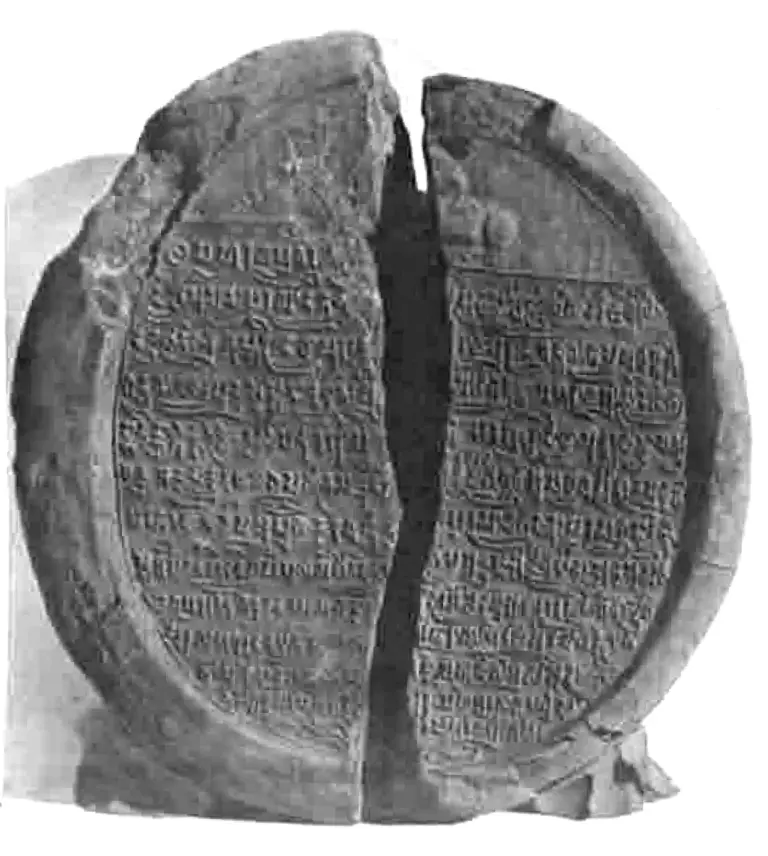
The Mankani copper plates — also called the Sankheda plates after the find-spot in Vadodara district of Gujarat — are land-grant inscriptions issued by Nirihullaka, a feudatory of the Kalachuri-Chedi king Sankaragana. They are dated to the Kalachuri-Chedi era year 346, which converts to 595–596 CE.
What makes these plates the foundational document of the place-value system in India is their date itself, written in fully positional decimal notation. The date ‘346’ is written using three Brahmi digit-shapes placed in positions whose values are powers of ten — exactly the system we use today, though the digit shapes have since evolved.
Why the Mankani Plates Matter
Before Mankani, dates and numbers in Indian inscriptions were typically written in word-form (eka, dasa, sata — one, ten, hundred) or in cumulative Brahmi numerals where each power of ten had its own symbol. The Mankani plates are the first dated epigraphic instance where a number is written using a small set of digit-shapes whose values depend purely on position.
A few earlier inscriptions and manuscript fragments — the Bakhshali manuscript (debated dating, possibly 3rd–7th c. CE), the Mihirakula inscriptions — have been claimed as earlier place-value evidence, but their dating is contested. The Mankani plates, by contrast, are securely dated by their internal year and unanimously accepted by epigraphists. They settle the question.
Aryabhata: The Literary Anchor (499 CE)
Aryabhata’s Aryabhatiya, composed in 499 CE at the age of 23, is the earliest surviving Indian mathematical text to describe and use place value explicitly. In the Ganitapada chapter, Aryabhata writes:
Sthanam sthanam dasagunam syat — “Each position is ten times the previous one.”
This is a one-line description of the place-value system in India. Aryabhata also lays out names for places up to 10¹⁸ (parardha), confirming that mathematicians of his time routinely worked with very large positional numbers.
What Aryabhata Did Not Do
Aryabhata used the place-value concept but wrote his own numerical results using a peculiar alphabetic notation (the katapayadi-like system specific to Aryabhata) rather than the decimal digits we now use. His system was positional but used consonant clusters as digits. The fully digit-based positional notation that we now recognise as the Indian system appears clearly in inscriptional form at Mankani a century later.
Brahmagupta: Zero Becomes a Number (628 CE)
A century after Mankani, Brahmagupta’s Brahmasphutasiddhanta (628 CE) takes the next step. Brahmagupta is the first known mathematician to define zero as a number in its own right and to lay down rules for arithmetic operations involving zero:
- A positive number plus zero is the positive number
- Zero plus zero is zero
- Zero minus a positive number is the negative of that number
- The product of any number and zero is zero
- (He even attempted division by zero, treating 0/0 as 0 — an error later corrected by Bhaskara II)
Brahmagupta’s rules for operating with zero, together with his rules for negative numbers (which he called “debts”), make him arguably the most important figure in completing the place-value system in India. He moves zero from being merely a placeholder to being a fully fledged mathematical entity.
The Gwalior Inscription of 876 CE
The Gwalior inscription of 876 CE on the Chaturbhuj temple wall is the earliest surviving inscription in India containing a fully formed written zero symbol — a small circle — used inside positional numbers (it records the dimensions of a flower garden as 270 hastas long and 187 hastas wide, with the zero clearly visible). It does not establish the invention of zero, which is earlier, but it gives us the earliest unambiguous epigraphic example of the modern zero shape.
Together, Mankani (positional decimal, 596 CE) and Gwalior (written zero, 876 CE) bracket the consolidation of the system as we now know it.
How the Place-Value System Spread
The Indian system reached the Arab world through translations of Indian astronomical texts (the Siddhantas) at the court of Caliph al-Mansur in Baghdad in the 770s CE. The Persian mathematician Al-Khwarizmi wrote his influential treatise Kitab al-Jam wal-Tafriq bi Hisab al-Hind (“Book on Calculation by the Hindu Method”) in the 820s CE, presenting the Indian system to the Islamic world.
From the Arab world, the system entered Europe through Spain and Sicily. Leonardo of Pisa (Fibonacci) wrote the Liber Abaci in 1202 CE, presenting “the nine Indian figures” and the sign “0” to Christian Europe. By the 15th century the Indian system had displaced Roman numerals across European commerce and science.
The route — India → Arabia → Europe — is why the digits are called both Indo-Arabic (acknowledging the Indian origin and Arabic transmission) and historically Hindu numerals in older European texts.
Names for Zero
Indian texts give zero many names: shunya (void), kha (sky), bindu (dot), akasha (space). Each captures a different aspect — emptiness, the heavenly void, a marking dot, mathematical space. The Arabic translation sifr gives us both the English words “cipher” and “zero” (through Italian zefiro).
Significance for UPSC
The place-value system in India matters for UPSC because it:
- Establishes India as a major contributor to world science
- Anchors specific dated evidence — the Mankani plates of 595–596 CE
- Threads through Aryabhata, Brahmagupta and Bhaskara as named mathematicians
- Demonstrates Indo-Arabic transmission to medieval Europe
- Underlies modern computing — every binary computation ultimately rests on positional notation
Frequently Asked Questions
What are the Mankani copper plates?
The Mankani plates, also called the Sankheda plates, are land-grant inscriptions dated to 595–596 CE (Kalachuri era 346) found near Vadodara in Gujarat. They contain the earliest securely dated epigraphic example of fully positional decimal notation in India.
Who invented the place-value system in India?
The system evolved over centuries rather than being invented by a single person. Aryabhata (499 CE) described it explicitly, the Mankani plates (596 CE) record it epigraphically, Brahmagupta (628 CE) formalised zero as a number, and the Gwalior inscription (876 CE) shows the modern written zero symbol.
When was zero invented in India?
Zero as a placeholder appears in Indian mathematical use before the Mankani plates of 596 CE. Zero as a number with its own arithmetic rules is formalised by Brahmagupta in 628 CE. The earliest surviving inscription with the modern circular zero symbol is the Gwalior inscription of 876 CE.
What did Aryabhata say about place value?
In the Aryabhatiya (499 CE), Aryabhata wrote sthanam sthanam dasagunam syat — “each position is ten times the previous one” — explicitly stating the decimal positional principle and naming places up to 10¹⁸.
What is the Gwalior inscription’s role?
The Gwalior inscription of 876 CE on the Chaturbhuj temple records the dimensions of a flower garden using positional numbers including the modern circular zero symbol. It is the earliest surviving inscription showing the zero in its modern shape.
How did the system reach Europe?
Indian astronomical texts reached Baghdad in the 770s CE. Al-Khwarizmi described the system in Arabic in the 820s. The system entered Europe through Spain and Sicily and was popularised by Fibonacci’s Liber Abaci in 1202 CE. This route is why the digits are called Indo-Arabic.
What does shunya mean?
Shunya means void, emptiness or zero in Sanskrit. Other Indian names for zero include kha (sky), bindu (dot) and akasha (space). The Arabic translation sifr gives the English words zero and cipher.
Why is place value so important?
Place value reduces all of arithmetic to operations on a handful of digit-shapes. It makes large numbers writeable, multiplication and division mechanisable, algebra possible, and ultimately digital computing thinkable. No other mathematical invention has had such practical consequence.
Tell Google you want more of this.
Add Anantam IAS as a preferred sourceOne tap, and this site shows up more often in your own Top Stories, AI Overviews and AI Mode. Remove it any time.