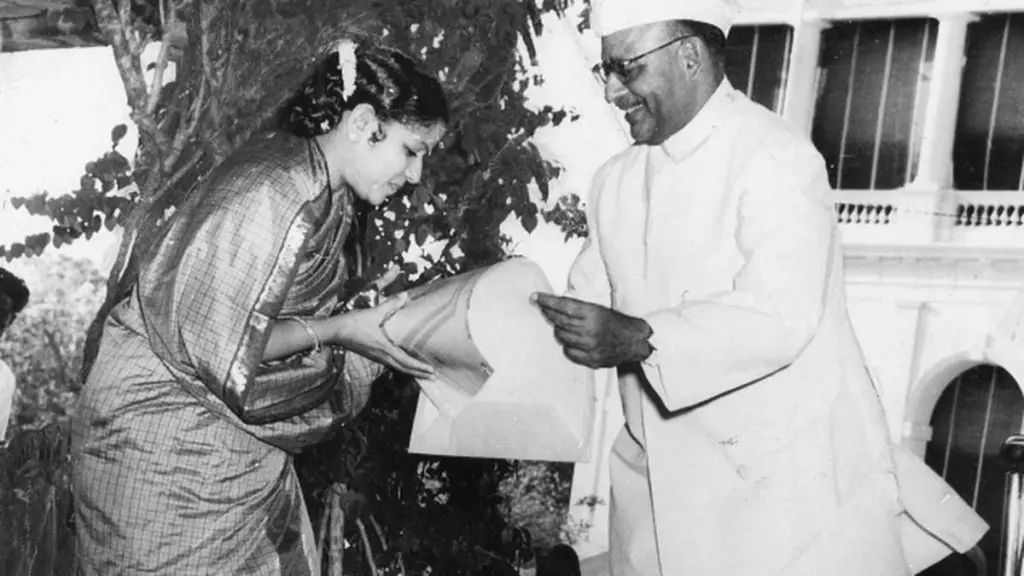
MS Subbulakshmi (1916 to 2004) was a Carnatic vocalist from Madurai who became, in 1998, the first musician to receive the Bharat Ratna, India’s highest civilian award. She sang at the United Nations General Assembly in 1966, won the Ramon Magsaysay Award in 1974 and recorded devotional music, such as the Venkateswara Suprabhatam, that remains among the most played in South India. She matters because she carried a regional classical art to a national and then a world audience without leaving its grammar behind.
Most readers carry her three firsts as one blurred fact. The Magsaysay came for public service, not for music as such; the Sangita Kalanidhi of 1968 made her the first woman to hold Carnatic music’s top title; and the Bharat Ratna came only in 1998, three decades after the UN concert. This note puts each honor in its year and also sets out what her biographers still argue about.
Who Was MS Subbulakshmi?
Madurai Shanmukhavadivu Subbulakshmi took her initials from her mother’s name, in the custom of the hereditary musician families she was born into. Britannica places her in the Isai Vellalar community, a hereditary group of musicians and dancers. The table gives the facts most often asked.
| Fact | Detail |
|---|---|
| Born | 16 September 1916, Madurai, Madras Presidency |
| Died | 11 December 2004, Chennai |
| Parents | Mother Shanmukhavadivu, a veena player; father Subramania Iyer, an advocate |
| Tradition | Carnatic (South Indian classical) music, with a large devotional repertoire |
| Teachers | Her mother; later Musiri Subrahmanya Iyer and Semmangudi Srinivasa Iyer; Hindustani training under Narayanrao Vyas |
| Films | Six films between 1938 and 1947, from Sevasadanam to the Hindi Meera |
| Landmark concerts | Edinburgh Festival 1963; UN General Assembly on UN Day 1966; Carnegie Hall 1977; Royal Albert Hall 1982 |
| Major honors | Padma Bhushan 1954; Sangita Kalanidhi 1968; Magsaysay 1974; Padma Vibhushan 1975; Bharat Ratna 1998 |
How Did a Madurai Girl Become a National Voice?
Her career moved in four clear phases: a hereditary musical childhood, a breakthrough at the Madras Music Academy, a decade in films and then forty years of concerts that took her across India and abroad. Each phase widened the audience without changing the core training.
Madurai and the First Recordings
Her mother was a professional veena player, and the house was full of musicians. The Magsaysay Foundation’s biography says that by the age of 10 she was accompanying her mother at concerts, and Britannica records her first recording, the Tamil song ‘Maragatha Vadivu’, in 1926. Her first public concert followed in 1927 at Tiruchirappalli.
The Music Academy Breakthrough
The Madras Music Academy’s annual conference was the most exacting stage in Carnatic music, and it had not featured a woman singer. A PIB feature written for her centenary dates her debut there to 1 January 1932, when she stepped in for the senior vocalist Ariyakudi Ramanuja Iyengar; Britannica gives 1933. The year differs by source, but the point doesn’t: she was the first woman to sing at the conference, and senior musicians took her seriously from that day.
The Film Years, 1938 to 1947
Films gave her a mass audience before radio and records reached small towns. Her debut, Sevasadanam (1938), directed by K. Subrahmanyam, was a social-reform film about a young girl married to an old man. In 1940 she married T. Sadasivam, a freedom fighter and journalist who became the manager of her career, and the two produced Sakuntalai that year. The film was based on Kalidasa’s Sanskrit play Abhijnanashakuntalam and directed by Ellis Dungan, an American who made several Tamil films in the 1940s without knowing the language. Its songs were hits, and they made her voice familiar to people who would never buy a concert ticket. That pattern, a classical voice reaching new listeners through a popular medium, runs through the rest of her career.
Then came Meera (Tamil 1945, Hindi 1947), with her in the title role of the sixteenth-century poet-saint Mirabai. The Hindi version opened in New Delhi on 5 December 1947, and PIB’s feature records that Sarojini Naidu, long called the ‘Nightingale of India’, said she was handing the title to her. After Meera she left cinema for good.
Forty Years on the Concert Stage
From the 1950s she was India’s most traveled classical singer. Britannica lists the landmarks:
- the Edinburgh International Festival in 1963;
- the United Nations General Assembly in New York on UN Day in 1966;
- Carnegie Hall in New York in 1977;
- the Royal Albert Hall in London in 1982.
She stopped performing after Sadasivam died in 1997 and spent her last years out of public life. She died in Chennai in December 2004 and was cremated with state honors.
What Made Her Music Distinct?
Her music combined full Carnatic technique with a devotional repertoire sung in many languages, and that combination is the reason she reached listeners who had never sat through a classical concert. Britannica notes that her early singing was known for fast, clean brigas, quick ornamental phrases, and that she later gave more space to bhajans, devotional songs set to simple tunes.
Three terms help here. A raga is a melodic framework with its own notes and phrases, closer to a mood with rules than to a fixed tune. A kriti is a composed song set in a raga, the main item of a Carnatic concert, with Tyagaraja as its best-known composer. A ragam-tanam-pallavi is the improvised centerpiece in which the singer explores a raga freely, then rhythmically and then builds variations on one line. She sang all three, so the label ‘devotional singer’ undersells her.
Two items show the range:
- Melaragamalika, a single composition that travels through all 72 parent ragas of the Carnatic system, recorded at the request of the Kanchi Shankaracharya, Chandrasekharendra Saraswati.
- Venkateswara Suprabhatam, a Sanskrit hymn to wake the deity at Tirumala, whose recording became one of the most played devotional records in South India.
Her languages went far beyond Tamil. She sang in Sanskrit, Telugu, Hindi, Bengali, Gujarati and Urdu, from Tyagaraja and Annamacharya to Kabir, Tulsidas and Tagore. That breadth fits the Bhakti tradition, whose saint-poets she sang in their own languages. For the difference between the two classical systems she crossed, the note on Hindustani and Carnatic music is the place to start.
The UN Concert and Gandhi’s Bhajan
Two performances carry her public meaning. At the UN in 1966 she sang Maitreem Bhajata, a Sanskrit benediction composed by the Kanchi Shankaracharya that asks for friendship among all people. That choice turned a concert into a statement about India’s outlook at the United Nations.
The other came earlier. Britannica records that Mahatma Gandhi asked her to sing the bhajan ‘Hari Tum Haro’; she didn’t know it, so she learned and recorded it overnight. After his assassination in 1948, All India Radio broadcast that recording as a tribute.
Which Awards Did MS Subbulakshmi Receive?
She received India’s three highest civilian awards, Carnatic music’s top title and Asia’s best-known prize for public service. The order matters more than the list, because the three firsts sit decades apart.
| Year | Honor | Why it matters |
|---|---|---|
| 1954 | Padma Bhushan | Among the first Padma awards, in the year they began |
| 1968 | Sangita Kalanidhi, Music Academy, Madras | First woman to hold the title |
| 1974 | Ramon Magsaysay Award, Public Service category | First Indian musician to win it |
| 1975 | Padma Vibhushan | Second-highest civilian award |
| 1988 | Kalidas Samman | Madhya Pradesh’s national arts award |
| 1998 | Bharat Ratna | First musician to receive it |
Read the Magsaysay row carefully. The Foundation gave it in the Public Service category, which is why charity sits in her record beside music. Britannica counts more than 200 benefit concerts, for causes that included the Kasturba Gandhi National Memorial Trust, Sankara Nethralaya and the Cancer Institute in Chennai.
The Bharat Ratna row needs one more fact. Her award was notified on 1 March 1998. The earlier recipients included the filmmaker Satyajit Ray (1992) but no musician, so she remains the first musician on the list. Five more followed:
- Ravi Shankar in 1999;
- Lata Mangeshkar and Bismillah Khan in 2001;
- Bhimsen Joshi in 2009;
- Bhupen Hazarika, posthumously, in 2019.
The full roll, with every year and field, is on the Bharat Ratna page, and the separate Padma awards note explains how the Padma tiers work.
What Do Biographers Still Debate?
Her life sits on two live questions: how far her rise depended on remaking her public image, and whether the turn to devotional music cost Carnatic music anything. Neither has a settled answer, and an answer that admits that is stronger than one that picks a side.
The first is about community and respectability. Britannica notes that she was born into a hereditary musician community that included devadasis, women dedicated to temple service through music and dance, a group that reformers of the 1920s to 1940s targeted. Her marriage into a Brahmin nationalist household and her shift to a devotional public persona came in the same years. Britannica records that some writers credit Sadasivam with that transition. Others read it as her own choice. Biographies by T.J.S. George and Keshav Desiraju discuss this in detail.
The second is about purity. Britannica notes that classical purists criticized her for giving concert time to bhajans and lighter pieces. The counter-evidence is the record itself: Melaragamalika, ragam-tanam-pallavis and the Music Academy’s own title in 1968. The fair reading is that she widened the audience while keeping the grammar.
MS Subbulakshmi Today
Her legacy is honored by the state, by the UN and by Carnatic music’s own institutions, and in 2024 it reached the Supreme Court. These are the dated developments worth knowing:
- 2016, birth centenary. The UN Postal Administration issued a stamp in her honor, fifty years after her General Assembly concert.
- 13 September 2017. The Finance Ministry announced Rs 100 and Rs 10 commemorative coins, minted by the Security Printing and Minting Corporation of India; the Vice President released the coin on 19 September 2017.
- Since 2005. The Music Academy’s Sangita Kalanidhi has carried a cash award instituted by The Hindu in her name.
- 16 December 2024. In an interim order on a petition by her grandson, who relied on her will, the Supreme Court directed that the singer chosen for the 2024 Sangita Kalanidhi not be recognized as a recipient of the award carrying her name while the case continued. The Court said the order was no comment on the singer’s music.
The 2024 dispute shows that a name can itself become heritage, with legal weight. Her own instruction, as her family read it, now limits how her name is used.
How to Study MS Subbulakshmi for Exams
She sits in General Studies Paper I under Indian culture, especially the performing arts, and she is a reliable Prelims item through the awards. Art and Culture accounts for 94 of the 1,403 questions in the Prelims question bank from 2013 to 2026, and pairing an artist with an award, a year or a first is one of its commonest shapes.
Mains asks about the arts in broad terms, and she is evidence inside those answers. Mains 2019 GS Paper I asked “What makes the Indian society unique in sustaining its culture? Discuss.”, and an artist who carried temple and court music to radio, film and the UN is a precise example of continuity through new media.
The revision facts worth fixing:
- Born 16 September 1916 at Madurai; died 11 December 2004 at Chennai.
- Carnatic vocalist from the hereditary Isai Vellalar community; mother Shanmukhavadivu, a veena player.
- First woman Sangita Kalanidhi, 1968.
- Ramon Magsaysay Award for Public Service, 1974; the first Indian musician to win it.
- Bharat Ratna, 1998; the first musician to receive it.
- UN General Assembly concert on UN Day 1966, where she sang Maitreem Bhajata.
- Title role in Meera (Tamil 1945, Hindi 1947).
Three confusions cost marks:
- The first musician Bharat Ratna was MS Subbulakshmi in 1998, not Ravi Shankar, who followed in 1999. Satyajit Ray (1992) was a filmmaker.
- Her Magsaysay category was Public Service, while Ravi Shankar’s in 1992 was for journalism, literature and the creative communication arts.
- Sangita Kalanidhi is the Music Academy’s title, not a government award, so it never appears on a Padma or Bharat Ratna list.
The sibling comparison an examiner can set:
| Musician | Tradition | Bharat Ratna | Magsaysay |
|---|---|---|---|
| MS Subbulakshmi | Carnatic vocal | 1998 | 1974, Public Service |
| Ravi Shankar | Hindustani sitar | 1999 | 1992, Creative Communication Arts |
| Bismillah Khan | Hindustani shehnai | 2001 | Not awarded |
| Bhimsen Joshi | Hindustani vocal | 2009 | Not awarded |
She is a small entry in the syllabus and a strong one inside an answer, because her dates turn a vague claim about cultural continuity into evidence. The candidate who keeps her three firsts in their own years, 1968, 1974 and 1998, has learned the habit this part of the paper rewards.
Frequently Asked Questions
Who was MS Subbulakshmi?
MS Subbulakshmi was a Carnatic vocalist from Madurai who lived from 1916 to 2004. She sang classical and devotional music in many languages, acted in films between 1938 and 1947 and performed at the UN General Assembly in 1966. In 1998 she became the first musician to receive the Bharat Ratna.
What is the full form of MS in MS Subbulakshmi?
MS stands for Madurai Shanmukhavadivu. Madurai is her birthplace and Shanmukhavadivu was her mother’s name, which she took in the custom of her hereditary musician community.
When did MS Subbulakshmi get the Bharat Ratna?
She received the Bharat Ratna in 1998, and the notification naming her is dated 1 March 1998. She was the first musician to receive India’s highest civilian award; Ravi Shankar followed in 1999.
When did MS Subbulakshmi sing at the United Nations?
She sang at the United Nations General Assembly in New York on UN Day in 1966, at the invitation of the UN. Her program included Maitreem Bhajata, a Sanskrit benediction for friendship among all people. The UN marked her centenary with a stamp in 2016.
Why did MS Subbulakshmi receive the Ramon Magsaysay Award?
She received the 1974 Ramon Magsaysay Award in the Public Service category. The Foundation honored her music together with the benefit concerts she gave for hospitals, trusts and relief funds. She was the first Indian musician to win it.
Which films did MS Subbulakshmi act in?
She acted in six films between 1938 and 1947, beginning with Sevasadanam in 1938 and including Sakuntalai in 1940. Her best-known film was Meera, released in Tamil in 1945 and in Hindi in 1947, after which she left cinema for music.
Was MS Subbulakshmi the first woman Sangita Kalanidhi?
Yes. The Music Academy, Madras, conferred its Sangita Kalanidhi title on her in 1968, the first time a woman received it. Since 2005 the title has carried a cash award instituted by The Hindu in her name.
Practice Questions
Prelims
1. Consider the following statements about MS Subbulakshmi: 1. She was the first musician to be awarded the Bharat Ratna. 2. She received the Ramon Magsaysay Award in the category of Creative Communication Arts. Which of the statements given above is/are correct?
- (a) 1 only
- (b) 2 only
- (c) Both 1 and 2
- (d) Neither 1 nor 2
Answer: (a) She received the Bharat Ratna in 1998 as the first musician, but her 1974 Magsaysay was in the Public Service category.
2. Which one of the following musicians received the Bharat Ratna earliest?
- (a) Ravi Shankar
- (b) Lata Mangeshkar
- (c) MS Subbulakshmi
- (d) Bhimsen Joshi
Answer: (c) MS Subbulakshmi received it in 1998, Ravi Shankar in 1999, Lata Mangeshkar in 2001 and Bhimsen Joshi in 2009.
3. Consider the following statements: 1. Sangita Kalanidhi is conferred by the Music Academy, Madras. 2. MS Subbulakshmi was the first woman to receive the Sangita Kalanidhi. 3. Sangita Kalanidhi is one of the Padma awards. Which of the statements given above are correct?
- (a) 1 and 2 only
- (b) 2 and 3 only
- (c) 1 and 3 only
- (d) 1, 2 and 3
Answer: (a) The Music Academy gave her the title in 1968, the first to a woman; it is not a government award.
4. MS Subbulakshmi played the title role in a film on which saint-poet?
- (a) Andal
- (b) Mirabai
- (c) Akka Mahadevi
- (d) Lal Ded
Answer: (b) She played Mirabai in Meera, released in Tamil in 1945 and in Hindi in 1947.
5. At the United Nations General Assembly in 1966, MS Subbulakshmi sang which Sanskrit benediction?
- (a) Vande Mataram
- (b) Maitreem Bhajata
- (c) Bhaja Govindam
- (d) Venkateswara Suprabhatam
Answer: (b) Maitreem Bhajata, composed by the Kanchi Shankaracharya Chandrasekharendra Saraswati, asks for friendship among all people.
Mains
- Safeguarding the Indian art heritage is the need of the moment. Discuss. (10 marks, 150 words) Previous year: Mains 2018, GS Paper I.
- How did MS Subbulakshmi’s career use film, radio and records to carry Carnatic music beyond its traditional audience? Illustrate with dated examples. (10 marks, 150 words)
- Examine how hereditary musician communities were affected by social reform in early twentieth-century South India, with reference to the career of MS Subbulakshmi. (15 marks, 250 words)
- Performing artists have served as India’s cultural ambassadors since Independence. Evaluate this role with reference to MS Subbulakshmi’s concerts abroad. (15 marks, 250 words)
- Critically assess the view that devotional music narrowed rather than widened the reach of Indian classical music. (15 marks, 250 words)
Tell Google you want more of this.
Add Anantam IAS as a preferred sourceOne tap, and this site shows up more often in your own Top Stories, AI Overviews and AI Mode. Remove it any time.