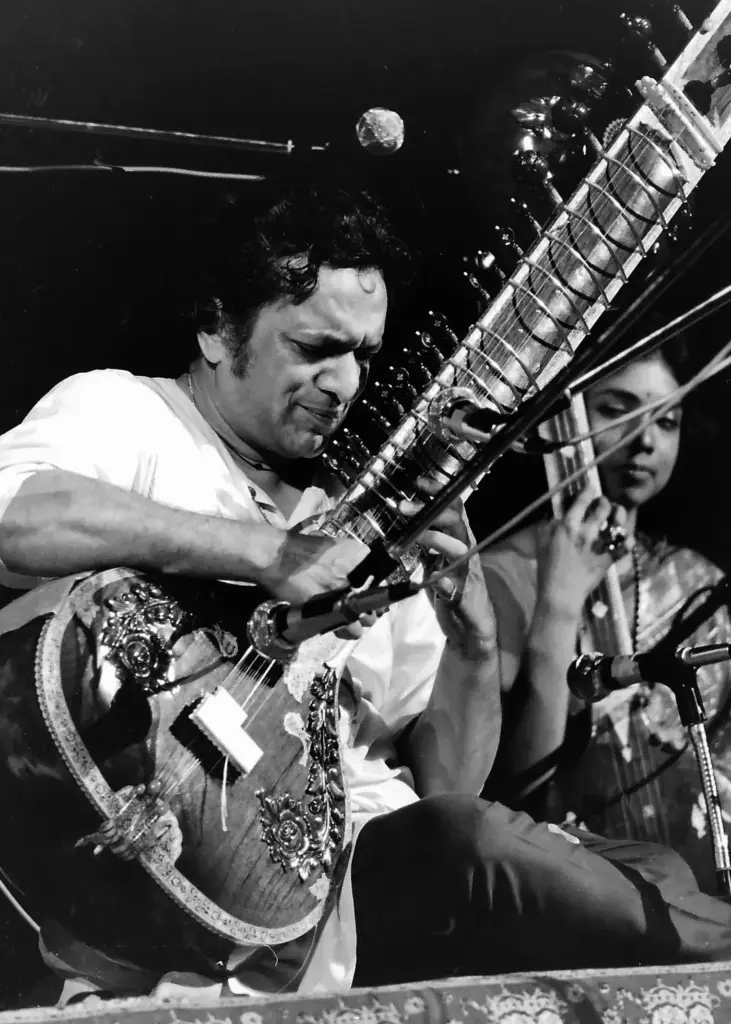
Pandit Ravi Shankar (1920 to 2012) was a Hindustani sitar player and composer from Benares, trained in the Maihar gharana under Ustad Allauddin Khan, who did more than any other musician to make Indian classical music familiar in Europe and America. He scored Satyajit Ray’s Apu trilogy, played at Woodstock in 1969 and received the Bharat Ratna in 1999. He matters because his career is the clearest case of Indian classical music becoming a world music without being turned into something else.
The common picture is a sitarist who became famous because George Harrison of the Beatles took lessons from him. The record runs the other way. By the time Harrison sought him out in the mid-1960s he had trained for seven years at Maihar, led the music of All India Radio for about eight years and recorded with Yehudi Menuhin. This note follows the sequence and then sets out what critics have argued about since the 1960s.
Who Was Pandit Ravi Shankar?
Ravi Shankar was born Ravindra Shankar Chowdhury into a Bengali family and grew up partly in Europe with his elder brother’s dance troupe. The honorific pandit marks mastery of a classical tradition. The table gives the core facts.
| Fact | Detail |
|---|---|
| Born | 7 April 1920, Benares (now Varanasi) |
| Died | 11 December 2012, San Diego, California |
| Instrument | Sitar, a long-necked plucked string instrument of Hindustani music |
| Guru and school | Ustad Allauddin Khan, Maihar gharana, from 1938 |
| Public office | Music director, All India Radio, 1948 to 1956 (Britannica); nominated member of the Rajya Sabha, 1986 to 1992 |
| Film scores | Neecha Nagar (1946), the Apu trilogy (1955 to 1959), Gandhi (1982) |
| Compositions | 31 ragas by Britannica’s count; sitar concertos; the most sung tune of Saare Jahan Se Accha |
| Major honors | Sangeet Natak Akademi Award 1962; Padma Bhushan 1967; Padma Vibhushan 1981; Magsaysay 1992; Bharat Ratna 1999 |
How Did Ravi Shankar Become a Sitar Master?
He became a sitarist late by classical standards, at 18, after a childhood spent as a dancer, and he got there through seven years of strict discipleship. The phases below explain why his later fame rested on more than charm.
Paris and the Dance Troupe
At about 10 he left Benares for Paris with his elder brother Uday Shankar, who was forming what the Magsaysay citation calls Europe’s first Indian dance company. He toured Europe and America with it, danced solo roles and learned to play several instruments. He also met the best young musicians of Europe, which later made him unusually easy to work with in the West.
Seven Years at Maihar
In 1938 he gave that life up. He went to Maihar, a small princely state in central India, to study under Ustad Allauddin Khan, the court musician who founded the Maihar gharana. A gharana, literally ‘household’, is a school of Hindustani music with its own style, repertoire and line of teachers.
The training followed the guru-shishya system, in which the pupil lives with the teacher and learns by daily practice and imitation rather than from a syllabus. The Magsaysay citation says he shaved his head, accepted the rules of discipleship and became his teacher’s favorite pupil, staying seven and a half years. Fellow pupils at Maihar included the guru’s son, the sarod player Ali Akbar Khan.
Bombay, IPTA and All India Radio
He finished his training in the mid-1940s and moved to Bombay. There he composed for the Indian People’s Theatre Association, a left-wing theatre movement, and recomposed the tune of Muhammad Iqbal’s ‘Saare Jahan Se Accha’. Britannica notes that his version is the one most commonly sung and is used by the Indian Army as a marching song.
From 1948 to 1956, by Britannica’s dates, he was music director of All India Radio, where he founded the Indian National Orchestra, an ensemble of Indian instruments playing composed and arranged music. The Magsaysay citation credits him with hundreds of songs for the radio in folk and classical styles. That job taught him to write for groups, a skill his film scores used.
How Did He Take the Sitar to the World?
He took the sitar abroad in three steps: patient tours from 1956, a long partnership with the violinist Yehudi Menuhin and then the pop audience that George Harrison opened up in the late 1960s. The order matters, because the classical reputation came first.
Tours, Menuhin and the West Meets East Records
He left All India Radio in 1956 to tour Europe and America, often for small audiences, explaining ragas before he played them. A raga is a melodic framework, a set of notes with fixed ascent, descent and characteristic phrases, linked to a mood and often to a time of day. His habit of explaining it on stage turned concerts into lessons, and his Western audiences learned to listen for structure.
His concerts and recordings with Yehudi Menuhin began in the 1960s. Their album West Meets East won a Grammy, the first of three he won in his lifetime.
Harrison, Monterey and Woodstock
George Harrison had played a sitar on the 1965 Beatles song ‘Norwegian Wood’ and sought him out for proper lessons. The friendship that followed put Ravi Shankar in front of a pop audience at three famous events:
- the Monterey Pop Festival in 1967;
- the Woodstock festival in 1969;
- the Concert for Bangladesh in 1971, which he and Harrison organized to raise money for refugees of the Bangladesh war.
The last of these is worth a line in any answer on soft power. A concert in New York raised international attention for a humanitarian crisis on India’s border months before the war of December 1971.
Film, Concertos and Collaborations
His film work spans Indian and world cinema. He scored Neecha Nagar (1946), which won the top prize at Cannes, Satyajit Ray’s Apu trilogy (1955 to 1959), beginning with Pather Panchali, and Richard Attenborough’s Gandhi (1982), which brought him an Academy Award nomination for best original score. His concertos for sitar and orchestra, especially Raga Mala (first performed in 1981), put the raga inside a Western form. The jazz saxophonist John Coltrane and the composer Philip Glass both drew on his work, and Glass recorded the album Passages with him in 1990.
What Did Ravi Shankar Add to Hindustani Music?
His additions were new ragas, new formats and a new audience, while his core concert style stayed within Maihar training. Britannica credits him with 31 ragas, among them Bairagi, Rasiya and Banjara. Creating a raga means fixing a new combination of notes and phrases that other musicians can then use, so a composer’s raga outlives his recordings.
He also tried to build institutions. He founded the Kinnara School of Music in Bombay in 1962 and a second in Los Angeles in 1967, then closed both after he grew disenchanted with institutional teaching. That failure says something about the guru-shishya system: it transmits well from person to person and badly through classrooms.
To see how ragas differ between the two classical systems he worked across, the note on Hindustani and Carnatic music maps them side by side. For a single raga worked through in detail, the note on Raga Bilawal shows how a parent scale works.
Which Honors Did Ravi Shankar Receive?
He received every major Indian honor for a musician plus a run of international awards. The Indian ones, in order, show how the state recognized him over four decades:
- 1962: Sangeet Natak Akademi Award; he was later made a Fellow of the Akademi.
- 1967: Padma Bhushan.
- 1981: Padma Vibhushan.
- 1986 to 1992: nominated member of the Rajya Sabha, the seat the President fills from people distinguished in the arts, letters, science and social service.
- 1992: Ramon Magsaysay Award for Journalism, Literature and Creative Communication Arts.
- 1999: Bharat Ratna, by a notification of 16 February 1999 that also named Jayaprakash Narayan, Amartya Sen and Gopinath Bordoloi.
Abroad, he won Grammys for West Meets East, The Concert for Bangladesh and Full Circle, a Carnegie Hall concert with his daughter Anoushka Shankar. In February 2013, two months after his death, he won a fourth Grammy for The Living Room Sessions Part 1 and received the Recording Academy’s lifetime achievement award.
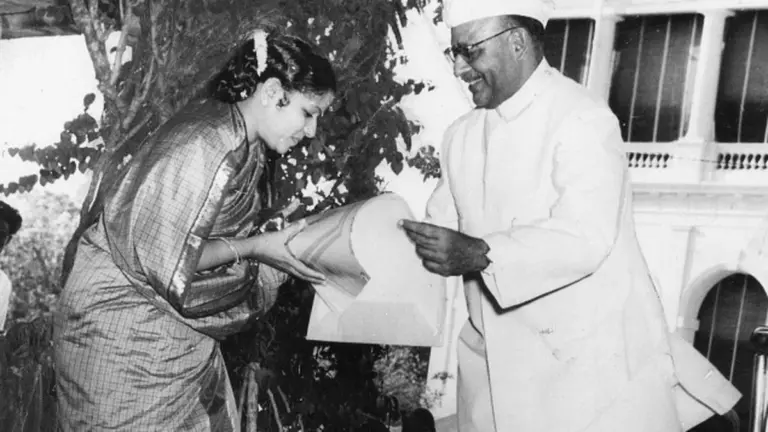
He was the second musician to receive the Bharat Ratna, after MS Subbulakshmi in 1998. The full list is on the Bharat Ratna page, and the Padma awards note explains the tiers below it.
What Do Critics Debate About His Legacy?
Two arguments have followed him since the 1960s: whether his Western work diluted the tradition and whether his fame came at the cost of Indian contemporaries who stayed home. Both deserve a fair statement.
The dilution argument says that fusion projects, pop festivals and short concert formats for Western audiences simplified ragas. The counter-evidence is that his classical recitals stayed classical and that he explained ragas rather than reshaping them for applause. Britannica singles out exactly this double skill, calling his equally expert work in traditional Indian music and in Indian-influenced Western music especially remarkable. He also wrote two autobiographies 30 years apart, My Life, My Music (1969) and Raga Mala (1999), which remain the main first-hand source for his own view.
The second argument is about attention. Western audiences came to think of Indian music through one name, while masters such as his fellow Maihar pupil Ali Akbar Khan were less known abroad. It is fair to note, though, that he performed with India’s most distinguished percussionists and shared his stages with other Indian musicians. The balanced view is that he opened a door others then walked through.
Pandit Ravi Shankar Today
His centenary fell on 7 April 2020, and the concerts planned in India, Europe and America were halted by the pandemic, so his students held a virtual tribute instead. His standing in public life rests on three facts that remain fixed: the 1999 Bharat Ratna, his tune of ‘Saare Jahan Se Accha’ and the role he set for musicians as cultural ambassadors.
That ambassador role is now policy language. India’s outreach to its diaspora and partners leans on music and dance, and a recent note on cultural diplomacy shows how ministers talk about it. The large Indian community in the United States, discussed in the note on the diaspora in North America, is part of the audience he first built.
How to Study Pandit Ravi Shankar for Exams
He sits in General Studies Paper I under Indian culture and the performing arts, and he turns up in Paper II wherever soft power is asked. Art and Culture accounts for 94 of the 1,403 questions in the Prelims question bank from 2013 to 2026; an artist-to-instrument or artist-to-gharana pairing is the likely Prelims shape.
Mains tests the theme rather than the man. Mains 2015 GS Paper II asked “Terrorist activities and mutual distrust have clouded India-Pakistan relations. To what extent the use of soft power like sports and cultural exchanges could help generate goodwill between the two countries? Discuss with suitable examples.” A paragraph on musicians as ambassadors, with the Concert for Bangladesh as a dated example, is exactly the kind of evidence such a question rewards.
The revision facts worth fixing:
- Born 7 April 1920, Benares; died 11 December 2012, San Diego.
- Sitar; Maihar gharana; guru Ustad Allauddin Khan, from 1938.
- Music director of All India Radio, 1948 to 1956, by Britannica’s dates; founded the Indian National Orchestra.
- Film scores: Neecha Nagar, the Apu trilogy and Gandhi.
- Monterey 1967, Woodstock 1969, Concert for Bangladesh 1971.
- Rajya Sabha nominated member, 1986 to 1992.
- Magsaysay 1992; Bharat Ratna 1999.
Four confusions cost marks:
- Ravi Shankar and Sri Sri Ravi Shankar are different people; the second is the founder of the Art of Living, not a musician.
- The first musician Bharat Ratna was MS Subbulakshmi (1998); Ravi Shankar was the second (1999).
- Allauddin Khan and Alauddin Khalji sound alike; the first founded the Maihar gharana, the second was a Delhi Sultan.
- Ali Akbar Khan played the sarod, not the sitar, though he trained at Maihar beside Ravi Shankar.
The comparison with his Bharat Ratna peers:
| Musician | Instrument or form | Tradition | Bharat Ratna |
|---|---|---|---|
| MS Subbulakshmi | Vocal | Carnatic | 1998 |
| Ravi Shankar | Sitar | Hindustani, Maihar gharana | 1999 |
| Bismillah Khan | Shehnai | Hindustani | 2001 |
| Lata Mangeshkar | Playback vocal | Film music | 2001 |
He gives an answer on culture and foreign policy a name, a date and a place. The aspirant who can place him precisely, Maihar in 1938, Woodstock in 1969 and the Bharat Ratna in 1999, can turn a general claim about soft power into an argument with evidence behind it.
Frequently Asked Questions
Who was Pandit Ravi Shankar?
Pandit Ravi Shankar was a Hindustani sitar player and composer who lived from 1920 to 2012. He trained under Ustad Allauddin Khan of the Maihar gharana, led the music of All India Radio and made Indian classical music widely known in Europe and America. He received the Bharat Ratna in 1999.
Which gharana did Ravi Shankar belong to?
He belonged to the Maihar gharana, founded by Ustad Allauddin Khan at Maihar in central India. He studied there from 1938 for about seven years under the guru-shishya system, living with his teacher’s family.
When did Ravi Shankar get the Bharat Ratna?
He received the Bharat Ratna in 1999, by a notification dated 16 February 1999 that also named Jayaprakash Narayan, Amartya Sen and Gopinath Bordoloi. He was the second musician to receive it after MS Subbulakshmi in 1998.
Which films did Ravi Shankar compose music for?
He composed the scores for Neecha Nagar in 1946, Satyajit Ray’s Apu trilogy from 1955 to 1959 beginning with Pather Panchali, and Richard Attenborough’s Gandhi in 1982. The Gandhi score earned him an Academy Award nomination.
What was Ravi Shankar’s connection with George Harrison?
George Harrison of the Beatles sought him out for sitar lessons in the mid-1960s and the two became lifelong friends. Together they organized the Concert for Bangladesh in 1971 to raise money for refugees, and Harrison’s interest brought Ravi Shankar a large pop audience.
Was Ravi Shankar a member of Parliament?
Yes. He was a nominated member of the Rajya Sabha from 12 May 1986 to 11 May 1992. The President nominates 12 members for their distinction in fields such as art, literature, science and social service.
Did Ravi Shankar compose the tune of Saare Jahan Se Accha?
He recomposed the tune of Muhammad Iqbal’s poem in the mid-1940s while working with the Indian People’s Theatre Association. His version is the one most commonly sung today and is used as a marching song.
Practice Questions
Prelims
1. Consider the following statements about Pandit Ravi Shankar: 1. He trained under Ustad Allauddin Khan of the Maihar gharana. 2. He was the first musician to receive the Bharat Ratna. Which of the statements given above is/are correct?
- (a) 1 only
- (b) 2 only
- (c) Both 1 and 2
- (d) Neither 1 nor 2
Answer: (a) He trained at Maihar from 1938; the first musician Bharat Ratna was MS Subbulakshmi in 1998, a year before him.
2. Consider the following pairs: 1. Ravi Shankar: Sitar 2. Ali Akbar Khan: Sarod 3. Bismillah Khan: Shehnai. Which of the pairs given above are correctly matched?
- (a) 1 and 2 only
- (b) 2 and 3 only
- (c) 1 and 3 only
- (d) 1, 2 and 3
Answer: (d) All three pairs are correct.
3. Ravi Shankar composed the music for which of the following films?
- (a) Mother India
- (b) Pather Panchali
- (c) Mughal-e-Azam
- (d) Do Bigha Zamin
Answer: (b) He scored Satyajit Ray’s Apu trilogy, which begins with Pather Panchali.
4. In which category did Ravi Shankar receive the Ramon Magsaysay Award in 1992?
- (a) Public Service
- (b) Government Service
- (c) Journalism, Literature and Creative Communication Arts
- (d) Community Leadership
Answer: (c) His 1992 award was for Journalism, Literature and Creative Communication Arts.
5. Consider the following statements: 1. Ravi Shankar served as a nominated member of the Rajya Sabha. 2. Ravi Shankar was music director of All India Radio. Which of the statements given above is/are correct?
- (a) 1 only
- (b) 2 only
- (c) Both 1 and 2
- (d) Neither 1 nor 2
Answer: (c) He was a nominated member from 1986 to 1992 and led All India Radio’s music from the late 1940s to 1956.
Mains
- What makes the Indian society unique in sustaining its culture? Discuss. (10 marks, 150 words) Previous year: Mains 2019, GS Paper I.
- Explain the guru-shishya parampara with reference to the training of Ravi Shankar at Maihar. What are its strengths and limits today? (10 marks, 150 words)
- Assess the role of Indian musicians as cultural ambassadors in the decades after Independence, with reference to Ravi Shankar. (15 marks, 250 words)
- Fusion with Western music has both popularized and diluted Indian classical music. Critically examine. (15 marks, 250 words)
- How did state institutions such as All India Radio shape Indian classical music after 1947? Illustrate with examples. (15 marks, 250 words)
Tell Google you want more of this.
Add Anantam IAS as a preferred sourceOne tap, and this site shows up more often in your own Top Stories, AI Overviews and AI Mode. Remove it any time.