PM-AASHA (Pradhan Mantri Annadata Aay SanraksHan Abhiyan) is the Government of India's umbrella scheme for assured price support to farmers of oilseeds, pulses and copra (dried coconut) — crops that fall outside the high-procurement zone of paddy and wheat. Launched in September 2018, PM-AASHA was designed to plug the gaps in the MSP regime which historically benefited only 6% of farmers (per the Shanta Kumar Committee, 2015) and overwhelmingly favoured water-intensive cereals in Punjab, Haryana and select states. The scheme was consolidated and extended through 2025-26 with a total outlay of approximately Rs 35,000 crore by the Cabinet in 2024.
For UPSC, PM-AASHA is a recurring GS-III topic, intersecting with MSP, agricultural diversification, doubling farmers' income, edible oil import dependence, food security, and DBT. Prelims has tested launch year, components (PSS, PDPS, PPPS), and the implementing agencies (NAFED, FCI, NCCF). Mains has asked about PM-AASHA's effectiveness in addressing MSP gaps and reducing edible-oil import dependence.
What is the PM-AASHA Scheme?
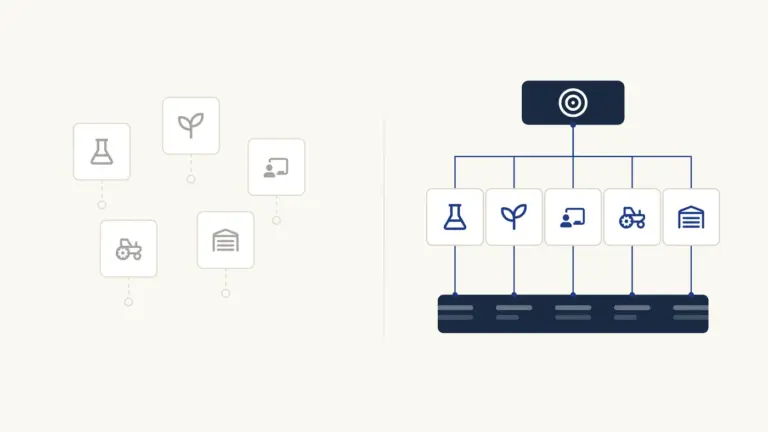
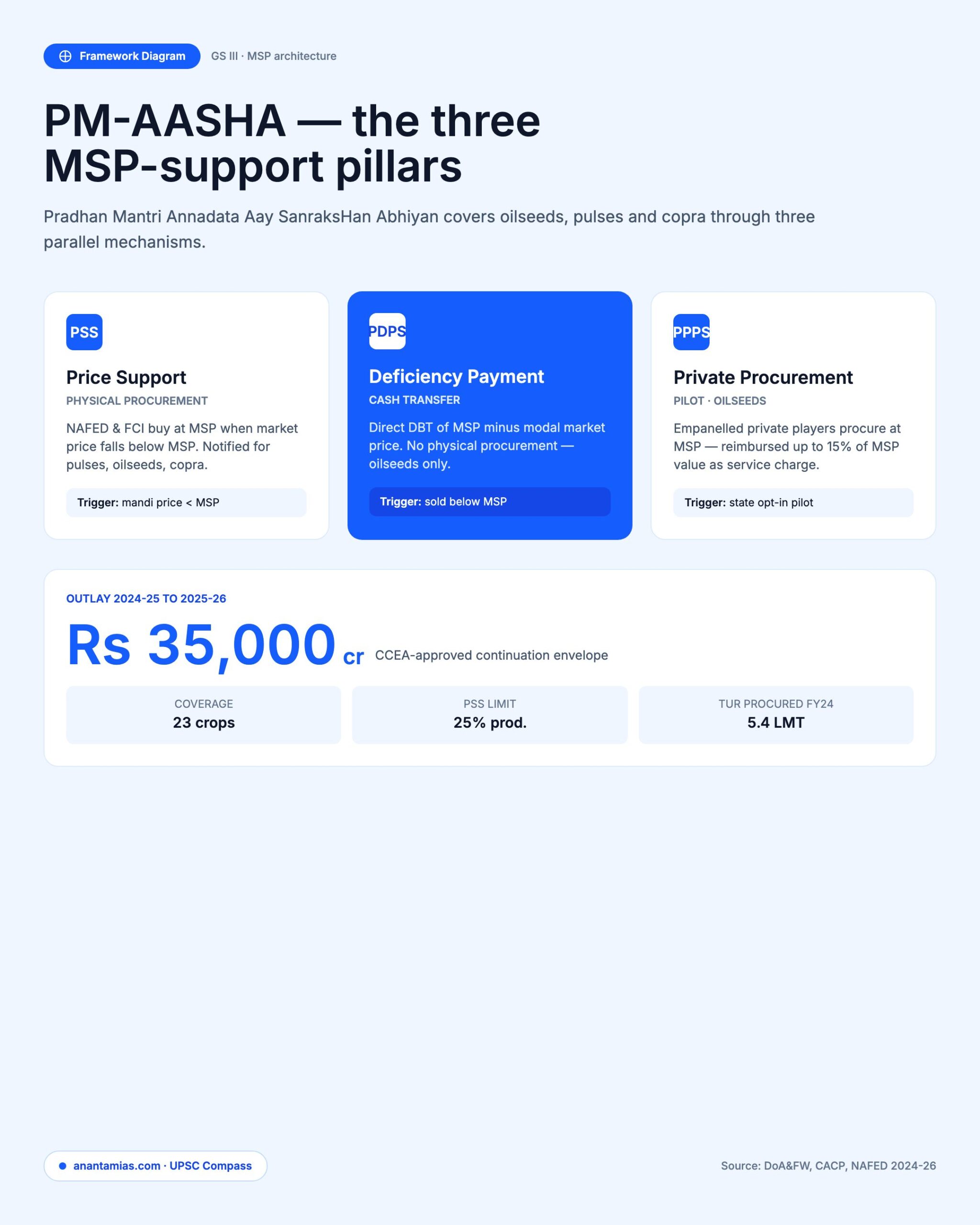
PM-AASHA is a bundle of three components that together provide price assurance to farmers of notified oilseeds, pulses and copra:
| Component | Mechanism | Best Suited For |
|---|---|---|
| Price Support Scheme (PSS) | Physical procurement at MSP by Central Nodal Agencies (NAFED, FCI, NCCF) | Pulses, oilseeds, copra |
| Price Deficiency Payment Scheme (PDPS) | DBT compensation when market price < MSP; no procurement | Notified oilseeds |
| Pilot of Private Procurement & Stockist Scheme (PPPS) | Private players procure at MSP; government compensates losses | Oilseeds in pilot districts |
The scheme is demand-driven — implementation is triggered when state governments request specific components for specific crops, and when the market price falls below MSP.
Background: Why PM-AASHA Was Launched
Gaps in the Pre-2018 MSP Regime
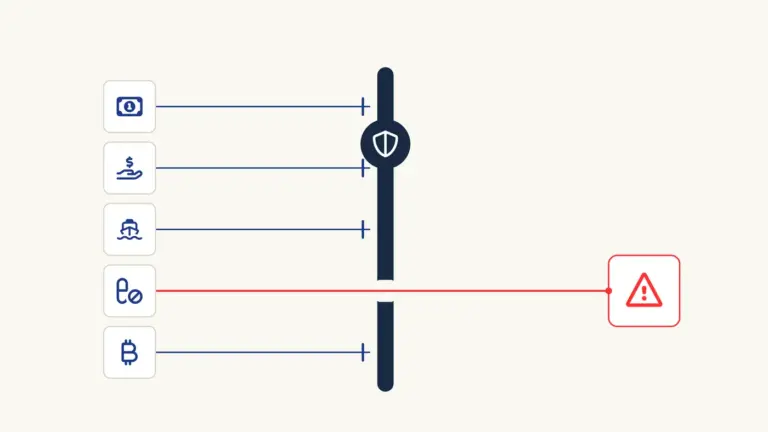
The MSP system before PM-AASHA had four structural failures:
- Crop bias: Procurement focused almost entirely on rice and wheat, distorting cropping patterns toward water-intensive cereals.
- Geographic bias: Punjab, Haryana, MP, UP, Telangana captured ~70% of procurement; rainfed and Eastern Indian farmers excluded.
- Farmer bias: Shanta Kumar Committee (2015) found only 6% of farmers benefited from MSP procurement.
- No safety net for non-procured crops: Pulses and oilseeds farmers received MSP only if NAFED/FCI procured; otherwise they sold at market price, often below MSP.
Edible Oil Import Crisis
India is the world's largest importer of edible oils, with imports of 15-16 million tonnes/year, costing USD 18-22 billion annually. The strategic objective of PM-AASHA was to shift cropping patterns to oilseeds and pulses for self-reliance.
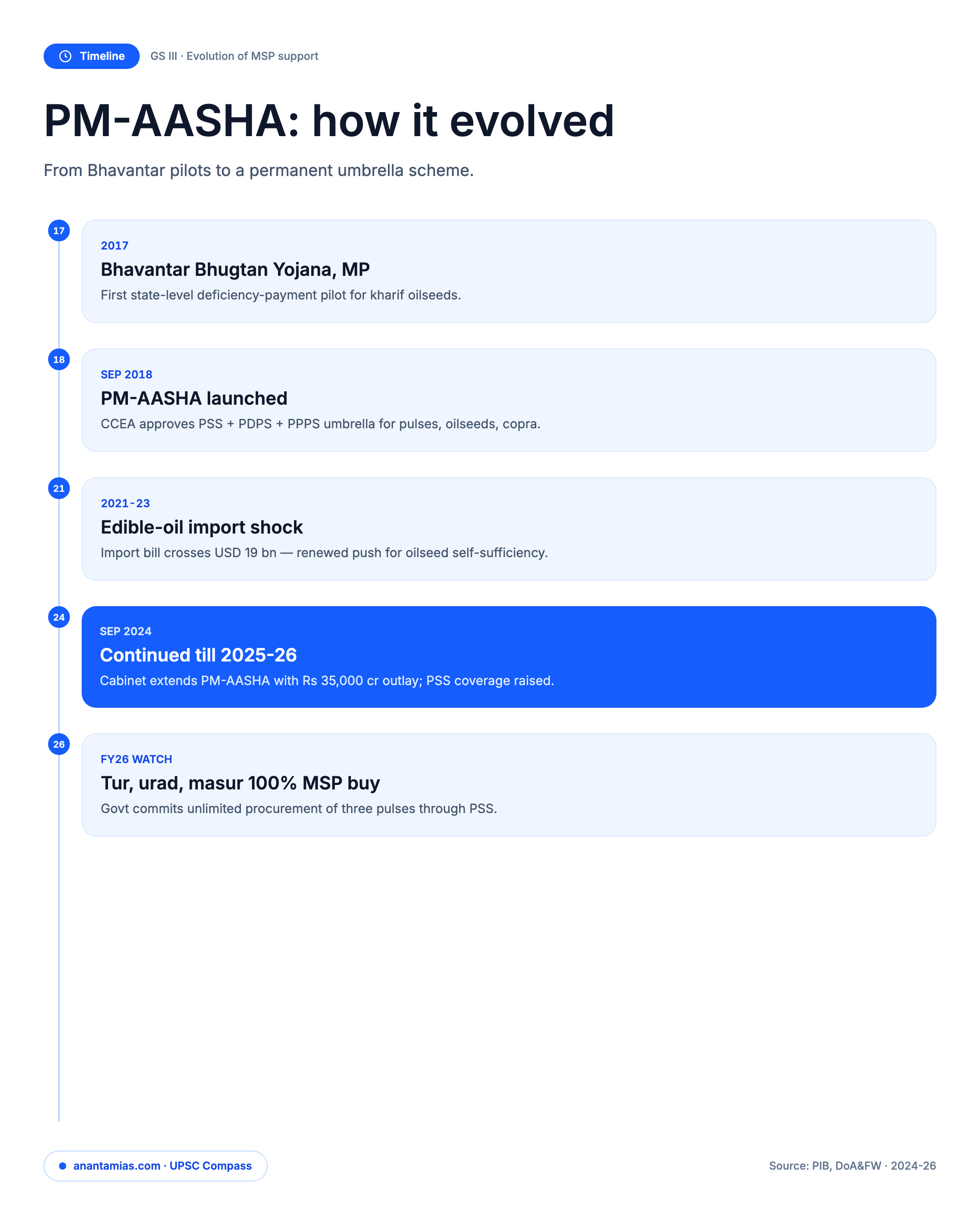
Bhavantar Bhugtan Yojana (Madhya Pradesh, 2017)
The MP government's pilot of a price-deficiency payment for soyabean and other oilseeds inspired PDPS. Bhavantar exposed both the appeal of DBT-based price support and the operational risks of trader-farmer collusion.
Components: Detailed Architecture
1. Price Support Scheme (PSS)
Mechanism: When market price for a notified pulse, oilseed, or copra falls below MSP, NAFED, FCI, NCCF, and state agencies physically procure produce from registered farmers at MSP.
Highlights:
- 100% expenditure (operational + losses) borne by Centre up to a quantity ceiling.
- Procurement only from registered farmers in notified APMCs/procurement centres.
- Stocks held by NAFED for buffer stock and PDS distribution.
Coverage: Tur, urad, moong, masur, chana, soyabean, groundnut, mustard, sunflower, sesamum, niger seed, copra.
2. Price Deficiency Payment Scheme (PDPS)
Mechanism: No physical procurement. Farmer sells in the market at prevailing price; government pays the difference between MSP and modal market price directly to the farmer's bank account via DBT.
Highlights:
- Reduces operational burden of physical procurement.
- Avoids storage and distribution costs.
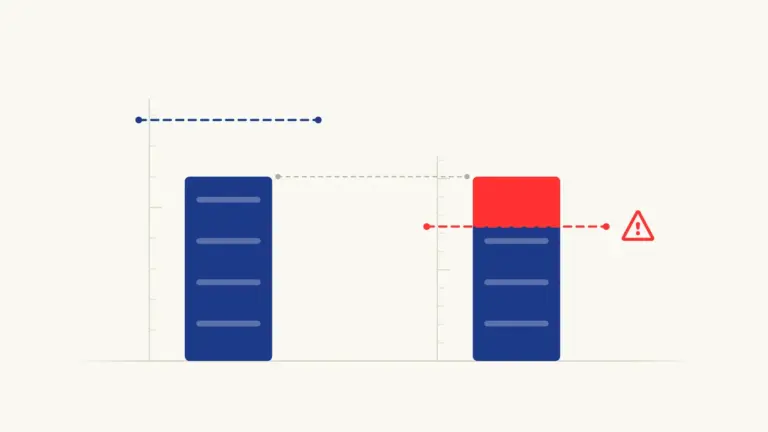
- Compensates farmers for price gap up to 25% of MSP.
- Implementation is per-state, per-crop, and per-season notified.
Risks:
- Collusion — traders quote artificially low prices; farmers benefit from DBT but final prices remain depressed.
- Modal price manipulation in thin markets.
3. Pilot of Private Procurement & Stockist Scheme (PPPS)
Mechanism: Selected private companies are allowed to procure notified oilseeds at MSP in pilot districts. The government compensates the private players for the difference between MSP and the eventual sale price (capped at a notified loss percentage).
Highlights:
- Brings private capital and infrastructure into MSP procurement.
- Reduces government's direct procurement burden.
- Aligned with the Food Corporation of India reforms philosophy.
Reality check: Private sector enthusiasm has been muted because of administrative complexity and reputational risk.
Benefits of PM-AASHA
- Plugs the MSP gap for crops outside paddy-wheat.
- Incentivises crop diversification away from water-intensive paddy/wheat to oilseeds and pulses.
- Self-reliance in pulses and oilseeds — reduces edible-oil imports of 15-16 million tonnes/year.
- Compensation mechanism for farmers via DBT under PDPS.
- Reduces government burden by roping in private players via PPPS.
- Supports doubling farmers' income by stabilising returns.
- Buffer stock for PDS — pulses and oilseeds procured under PSS go to PDS, ICDS, MDM.
- Curbs distress sales — farmers know there is a price floor.
- Encourages farmers to register and use formal mandis.
Challenges and Criticism
PDPS Issues — Madhya Pradesh Lessons
The Bhavantar Bhugtan Yojana experience showed:
- Traders colluded with farmers — quoted artificially low prices in mandi books, then split DBT compensation.
- Modal price suppression in thin markets — when daily arrivals fall, the modal market price is easily manipulated.
- Lack of transparency in price calculation.
Limited Private Sector Enthusiasm for PPPS
Private players hesitate because:
- Procurement at MSP carries reputational risk if quality is questioned later.
- Compensation calculation is bureaucratic and slow.
- Storage and disposal logistics are complex.
PSS Procurement Bottlenecks
- APMC dependence: PM-AASHA procurement is routed through APMCs, which themselves suffer from accessibility, infrastructure, and warehousing gaps.
- Procurement quotas: Quantitative ceilings limit how much NAFED/FCI can procure.
- Quality grading disputes during procurement.
- Delayed payments in some states.
Fiscal Burden
PM-AASHA expanded budget headroom is significant — Rs 35,000 crore allocation through 2025-26. Critics argue these resources could yield more impact in irrigation, post-harvest infrastructure, or crop insurance.
Coverage Gaps
- Many notified crops do not see PM-AASHA implementation in many states because the trigger (market price < MSP) does not activate.
- Tribal areas, North-East, and rainfed regions still under-covered.
MSP Calculation Debate
PM-AASHA assures MSP, but the MSP itself uses A2+FL formula rather than C2 formula as recommended by the Swaminathan Commission. Effectively, the price assurance is on a contested base.
Recent Developments (2024-2026)
| Year | Update |
|---|---|
| 2018 | PM-AASHA launched with PSS, PDPS, PPPS components |
| 2024 | Cabinet approves continuation through 2025-26 with Rs 35,000 crore outlay |
| 2024 | NAFED procurement of pulses crosses 30 lakh tonnes; tur and urad heavily procured |
| Budget 2024-25 | Special outlay for edible oil mission; PM-AASHA dovetails |
| 2025 | National Mission on Edible Oils-Oilseeds (NMEO-Oilseeds) launched with Rs 10,103 crore for 2024-25 to 2030-31 |
| Budget 2025-26 | PM-AASHA scaled up; PDPS extended to soybean and groundnut in 8 states |
| 2025-26 | Tur dal procurement at MSP scaled up amid global shortages |
| 2026 | Ramesh Chand Committee review of MSP and PM-AASHA framework finalised |
Reforms and Way Forward
- Strengthen modal-price discovery to prevent PDPS gaming — use e-NAM data, AgriStack, and satellite-based crop estimation.
- Expand PPPS with simpler compensation rules and quicker payouts.
- Increase storage capacity for NAFED/FCI procurement under AIF.
- Bring all major oilseeds and pulses under PM-AASHA by default in deficit states.
- Link PM-AASHA with Crop Insurance (PMFBY) for end-to-end risk coverage.
- Encourage FPOs as procurement partners under PSS and PPPS.
- Move toward C2-based MSP as recommended by Swaminathan.
- Co-locate PM-AASHA with NMEO-Oilseeds for integrated oilseed strategy.
- Digitise procurement — Aadhaar-linked farmer registration, e-payment, drone-based crop inspection.
- State-Centre alignment — incentivise states to operationalise PM-AASHA components.
- Shift focus to coarse cereals (millets) — extend PM-AASHA-style support to bajra, jowar, ragi.
Government Schemes and Budget Allocations (2025-26)
- PM-AASHA: continued with Rs 35,000 crore outlay through 2025-26.
- National Mission on Edible Oils-Oilseeds (NMEO-Oilseeds): Rs 10,103 crore (2024-25 to 2030-31).
- National Mission on Edible Oils-Oil Palm (NMEO-OP): Rs 11,040 crore (2021-26).
- Pulses procurement under NAFED: Rs 6,000+ crore annually.
- PMFBY (crop insurance): complementary safety net.
- Operation Greens: perishable price stabilisation; complements PM-AASHA's grain/oilseed focus.
- PM-Kisan: income support layer.
Mains Answer Hook
A nuanced GS-III answer should: (a) frame PM-AASHA as a structural correction of MSP regime gaps highlighted by the Shanta Kumar Committee; (b) describe the three-component architecture — PSS, PDPS, PPPS — and the rationale for each; (c) cite the Bhavantar lessons as cautionary tales for PDPS design; (d) link to edible oil import bill and the NMEO-Oilseeds mission; (e) suggest reforms — modal-price integrity, FPO partnership, AgriStack integration, PMFBY linkage.
Use: "PM-AASHA is the second leg of MSP reform — what the Public Distribution System did for consumers, PM-AASHA aims to do for producers of pulses and oilseeds."
Prelims Pointers
- PM-AASHA full form: Pradhan Mantri Annadata Aay SanraksHan Abhiyan.
- Launch year: 2018; extended through 2025-26 with Rs 35,000 crore.
- Three components: Price Support Scheme (PSS), Price Deficiency Payment Scheme (PDPS), Pilot of Private Procurement & Stockist Scheme (PPPS).
- Implementing agencies: NAFED, FCI, NCCF, state agencies.
- PDPS inspiration: Bhavantar Bhugtan Yojana (Madhya Pradesh, 2017).
- Coverage: pulses (tur, urad, moong, chana, masur), oilseeds (soybean, groundnut, mustard, sunflower, sesamum, niger), copra.
- MSP recommendation: Cabinet Committee on Economic Affairs (CCEA) on advice of CACP.
- A2+FL vs C2: A2+FL is current basis; Swaminathan Commission recommended C2.
FAQ on PM-AASHA Scheme
What is the full form of PM-AASHA?
Pradhan Mantri Annadata Aay SanraksHan Abhiyan.
What does PM-AASHA cover?
Pulses, oilseeds, and copra — crops outside the dominant rice-wheat MSP procurement system.
What are the three components of PM-AASHA?
Price Support Scheme (PSS) for physical procurement, Price Deficiency Payment Scheme (PDPS) for DBT compensation, and Pilot of Private Procurement & Stockist Scheme (PPPS) for private-sector procurement.
How does PDPS work?
Farmers sell in the open market; if the market price is below MSP, the government pays the difference directly to the farmer's bank account via DBT.
Why was PM-AASHA needed?
Because the MSP regime benefited only ~6% of farmers (Shanta Kumar Committee) and was biased toward rice and wheat. PM-AASHA extends price support to pulses and oilseeds.
What is the latest budget allocation for PM-AASHA?
The Cabinet approved continuation through 2025-26 with a total outlay of approximately Rs 35,000 crore.
PM-AASHA is the Indian government's structural answer to the lopsided MSP regime. For UPSC, anchor your prep in the three components (PSS, PDPS, PPPS), the Shanta Kumar 6% finding, the Bhavantar Madhya Pradesh experience, the Rs 35,000 crore outlay, and the linkage with NMEO-Oilseeds. That gives you both Prelims facts and Mains analytical depth.
Tell Google you want more of this.
Add Anantam IAS as a preferred sourceOne tap, and this site shows up more often in your own Top Stories, AI Overviews and AI Mode. Remove it any time.