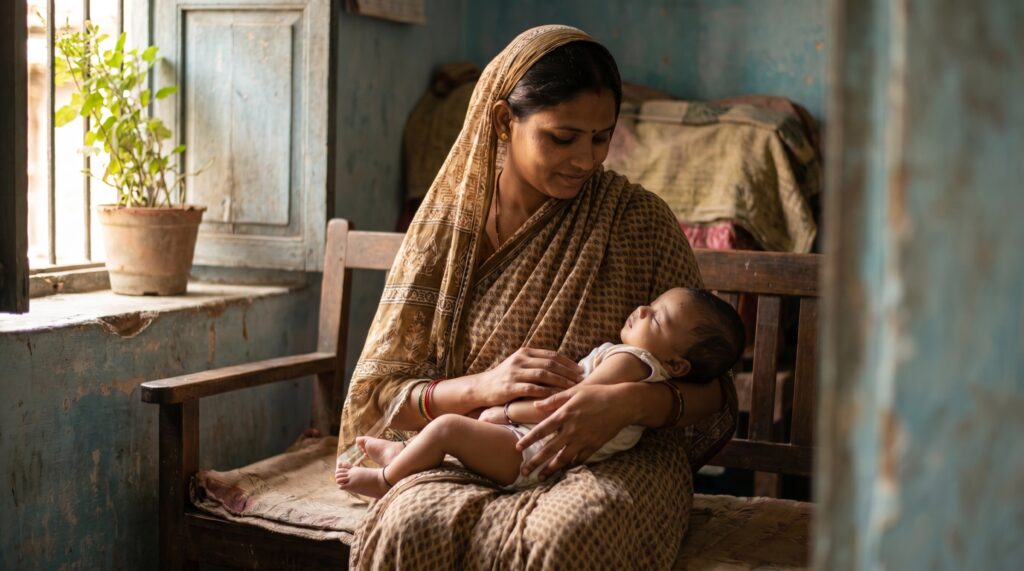
A daily-wage worker who is seven months pregnant faces a brutal arithmetic: rest before and after delivery means weeks of lost income, but working through it risks her health and her baby’s. For a woman with no paid maternity leave, that is not a hypothetical, it is the choice every pregnancy forces. The Pradhan Mantri Matru Vandana Yojana (PMMVY) exists to soften exactly that trade-off, by putting cash in her hands so that resting and going for check-ups costs her a little less. If you have seen the name on a scheme list and want to know what it really offers, who gets it, and where it falls short, this is the full picture.
PMMVY is a centrally sponsored maternity benefit scheme run by the Ministry of Women and Child Development. It gives eligible pregnant and lactating women a cash benefit, paid straight into their bank account in instalments, on the condition that they register the pregnancy, get antenatal check-ups, and immunise the child. It replaced an earlier pilot, the Indira Gandhi Matritva Sahyog Yojana, and was rolled out nationally from 1 January 2017.
What PMMVY is and why it was created
PMMVY is a conditional cash transfer for maternity, meaning the state pays a woman a fixed sum, but only when she completes certain steps tied to her health and her child’s. The logic is partly compensation and partly nudge. It offers partial wage compensation so a poor woman can afford to rest during late pregnancy and after childbirth, and it uses the payment as an incentive to draw her into the formal health system for check-ups and immunisation. The name itself signals the intent: “Matru Vandana” means honouring the mother.
The problem it targets is real and measurable. A large share of Indian women work in the informal economy, as farm labour, domestic help, or home-based workers, where no employer pays for maternity leave. The formal-sector protection of the Maternity Benefit Act, which grants paid leave to salaried women, simply does not reach them. So the woman most likely to work until the day she delivers, and to return to work too soon, is precisely the one with no cushion. PMMVY is the government’s attempt to extend a maternity cushion to that uncovered majority, the women the labour laws miss.
There is also a nutrition and mortality angle. Undernourished mothers and inadequate antenatal care feed directly into India’s maternal and infant health burden. By tying the cash to check-ups and immunisation, the scheme tries to buy better health outcomes, not just income relief.
The cash benefit and how it is paid in instalments
Under the revamped scheme, a woman gets 5,000 rupees for her first child, paid in two instalments, each released only after she meets a specific condition. The instalment design is deliberate: the money arrives in stages that line up with the health steps the scheme wants her to complete, so the payment and the behaviour reinforce each other.
Here is the current structure of instalments and their conditions:
| Child | Instalment | Amount | Condition attached |
|---|---|---|---|
| First child | First instalment | 3,000 rupees | Early registration of pregnancy and at least one antenatal check-up |
| First child | Second instalment | 2,000 rupees | Registration of the child’s birth and completion of the first cycle of immunisation |
| Second child (only if a girl) | Single instalment | 6,000 rupees | Birth of the second child who is a girl, with registration and immunisation completed |
Notice the split. The first 3,000 rupees reward early registration and an antenatal check-up, pulling the woman into care during pregnancy. The remaining 2,000 rupees wait until the birth is registered and the baby has had its first immunisation cycle, which includes vaccines such as BCG, OPV, DPT, and Hepatitis-B. So the cash is not a lump-sum handout; it is a sequence of small rewards for doing the things that protect mother and child.
The original 2017 design paid the 5,000 rupees in three instalments rather than two, and the revamp simplified it to two for the first child while adding the second-child benefit described below. The money reaches the woman through Direct Benefit Transfer into her Aadhaar-linked bank or post office account, which is meant to cut out middlemen and leakage.
Eligibility and the first-child rule
The scheme is meant for pregnant and lactating women aged 19 years and above, and its most important boundary is that the first-child benefit is for the first living child in the family. This first-child restriction is the feature that shapes who the scheme reaches, and it is where a lot of the debate sits, so it is worth understanding precisely.
For the first child, an eligible woman gets the 5,000 rupees in the two instalments above. That was the whole scheme when it launched. The revamp then added a targeted second slice: if a woman’s second child is a girl, she becomes eligible for an additional 6,000 rupees, paid in a single instalment after the girl child’s birth. That addition carries a clear social purpose, to nudge families away from son-preference and to support the girl child, folded into the wider Mission Shakti umbrella under which the revamped PMMVY now runs.
Some women are excluded by design. Those in regular employment with the Central or State Government or a public sector undertaking are left out, because they already receive paid maternity leave, as are women getting a similar maternity benefit under any other law. The scheme is aimed at the uncovered, not at those the formal system already protects. Beyond that, the practical eligibility gate is documentation: a bank or post office account, Aadhaar, and the Mother and Child Protection card that records the pregnancy and the health steps.
The conditions tied to health and care
Every rupee under PMMVY is conditional on a health action, which is what separates it from an unconditional cash transfer. The design rests on the belief that attaching money to check-ups and immunisation will lift the numbers on both. Understanding these conditions matters, because they are also where eligible women most often stumble.
The first instalment requires early registration of the pregnancy at an Anganwadi Centre or an approved health facility, plus at least one antenatal check-up (ANC). This is the step that gets a pregnant woman onto the health system’s radar early, when problems can still be caught. The second instalment requires that the child’s birth is registered and that the child has received its first cycle of immunisation. So the payments are gates: you pass through them by completing exactly the actions that reduce maternal and infant risk.
This conditionality is a double-edged design. It genuinely pushes women toward institutional care, which links the scheme to India’s broader push for safe, institutional childbirth. But the same conditions can shut out the most vulnerable, a woman who delivers at home, lacks documents, or cannot reach a facility, meets the need the scheme was built for yet may fail its conditions. That tension runs through the whole programme.
How PMMVY links to the National Food Security Act
PMMVY is not just a welfare scheme; it is the vehicle that delivers a legal entitlement, and that legal backing is what makes it more than a discretionary programme. The National Food Security Act, 2013 created a right, and PMMVY is one of the main ways the government honours it.
Section 4 of the National Food Security Act entitles every pregnant and lactating woman to a maternity benefit of not less than 6,000 rupees. That figure is a statutory floor, not a favour. Here is the arithmetic the government uses to reach it: PMMVY provides 5,000 rupees for the first child, and the woman is expected to receive around 1,000 rupees more for an institutional delivery under Janani Suraksha Yojana (JSY), the cash-assistance scheme for safe deliveries. Together, the PMMVY and JSY amounts are meant to add up to roughly the 6,000 rupees the law promises.
That link is important for two reasons. It shows PMMVY is anchored in a legal right rather than resting on the goodwill of the day’s government, and it explains why the headline PMMVY figure is 5,000 and not 6,000. The gap is designed to be filled by JSY. Whether every eligible woman actually receives both, and reaches the full statutory 6,000, is a separate and harder question.
How to apply for PMMVY
A woman applies through her nearest Anganwadi Centre or an approved health facility, and the process is built around the ground-level worker rather than around paperwork the woman must chase alone. The Anganwadi worker or ASHA is usually the first point of contact and helps fill the forms.
The practical steps are straightforward on paper. The woman registers her pregnancy and submits the application form along with her Aadhaar, her bank or post office account details, and her Mother and Child Protection (MCP) card. Each further instalment is claimed by showing that the relevant condition, the antenatal check-up, the birth registration, the immunisation, has been met. Under the revamped scheme, applications and processing also run through a dedicated PMMVY software platform, so records and payments move online and the benefit lands via Direct Benefit Transfer.
One honest note for anyone helping a relative apply: keep the bank account, Aadhaar, and MCP card seeded and consistent from the start, because most disbursement delays come from a mismatch between these documents, not from ineligibility.
Honest limitations of the scheme
PMMVY does real good, and it also leaves real gaps, and a fair account has to name both. The most-cited criticisms are structural, not incidental.
First, the first-child restriction. By covering only the first living child, the scheme misses the second, third, and later pregnancies, which are often the ones in the poorest and most vulnerable households where the wage loss bites hardest. The second-child benefit helps only if that child is a girl, so a woman having a second son gets nothing. Critics, including parliamentary committees, have argued this contradicts the National Food Security Act’s promise of a benefit for pregnant women generally, not just first-time mothers.
Second, the amount and its erosion. The 5,000-rupee figure has stayed put since 2017, so inflation has quietly shrunk its real value each year, and even at full value it falls short of the wages a woman loses over the weeks around childbirth. The benefit is partial compensation, and it was never enough to fully replace lost income.
Third, conditionality and documentation exclude the very women it targets. Aadhaar seeding failures, bank-account mismatches, missing birth or immunisation records, and the demand for institutional steps all create friction, and the woman who delivers at home or lacks papers can be filtered out. Reported delays in disbursement compound this; a benefit meant to help during pregnancy loses much of its point if it arrives many months late. Coverage, while it runs into crores of beneficiaries, still falls well short of the total number of eligible pregnancies each year.
None of this makes the scheme a failure. It makes it a partial, improvable answer to a genuine need, which is the fairest way to hold it.
How to study this for the exam
Anchor the scheme to a few hard facts, then layer the analysis on top, because examiners reward both recall and judgment. Fix that PMMVY is run by the Ministry of Women and Child Development, is a centrally sponsored conditional cash transfer, launched in 2017, and gives 5,000 rupees for the first child in two instalments, with a 6,000-rupee benefit for a second child if she is a girl under the revamped scheme.
The two links that carry the most marks are the legal and the complementary one. Tie PMMVY to Section 4 of the National Food Security Act, 2013 and its 6,000-rupee entitlement, and explain how PMMVY plus JSY are meant to add up to that floor. Then keep the instalment-and-condition table in your head, since a factual question often turns on which action unlocks which payment.
For any answer that asks you to evaluate the scheme, lead with what it does well, extending a maternity cushion to informal-sector women and using cash to pull them into antenatal care, then give the balanced critique: the first-child cap, the frozen amount, and the exclusionary side of conditionality. A response that names both the intent and the honest gaps reads as understanding, not memorisation.
Frequently Asked Questions
What is the Pradhan Mantri Matru Vandana Yojana (PMMVY)?
PMMVY is a centrally sponsored maternity benefit scheme run by the Ministry of Women and Child Development. It gives eligible pregnant and lactating women a conditional cash benefit, paid into their bank account in instalments, to partly compensate for lost wages and encourage antenatal care and immunisation. It was launched on 1 January 2017.
How much money does PMMVY provide?
A woman gets 5,000 rupees for her first child, paid in two instalments of 3,000 and 2,000 rupees. Under the revamped scheme, if her second child is a girl, she is eligible for an additional 6,000 rupees paid in a single instalment. The money is transferred directly into her Aadhaar-linked account.
Who is eligible for PMMVY?
Pregnant and lactating women aged 19 years and above are eligible, primarily for their first living child. Women in regular government or public sector employment, who already receive paid maternity leave, and those getting a similar benefit under another law, are excluded. The second-child benefit applies only when that child is a girl.
What conditions are attached to the PMMVY instalments?
The first instalment requires early registration of the pregnancy and at least one antenatal check-up. The second instalment requires that the child’s birth is registered and the child has completed the first cycle of immunisation. The payments are released only after each condition is met.
How does PMMVY relate to the National Food Security Act?
Section 4 of the National Food Security Act, 2013 entitles pregnant and lactating women to a maternity benefit of not less than 6,000 rupees. PMMVY’s 5,000 rupees, combined with about 1,000 rupees under Janani Suraksha Yojana for an institutional delivery, is meant to meet that statutory entitlement.
How do I apply for PMMVY?
Apply at your nearest Anganwadi Centre or approved health facility, usually with help from the Anganwadi worker or ASHA. Submit the application form with your Aadhaar, bank or post office account details, and Mother and Child Protection card. Each instalment is claimed by showing that the relevant health condition has been met.
What are the main criticisms of PMMVY?
The main criticisms are the first-child restriction, which excludes later pregnancies except a second girl child; the benefit amount of 5,000 rupees, unchanged since 2017 and eroded by inflation; and the documentation and conditionality that can exclude the poorest women, along with reported delays in payment.
Practice Questions
1. The Pradhan Mantri Matru Vandana Yojana is implemented by which ministry?
a) Ministry of Health and Family Welfare
b) Ministry of Rural Development
c) Ministry of Women and Child Development
d) Ministry of Labour and Employment
Answer: c) Ministry of Women and Child Development (as a centrally sponsored maternity benefit scheme.)
2. Under the revamped PMMVY, the cash benefit for the first child is:
a) 6,000 rupees in three instalments
b) 5,000 rupees in two instalments
c) 5,000 rupees in three instalments
d) 6,000 rupees in a single instalment
Answer: b) 5,000 rupees in two instalments (of 3,000 and 2,000 rupees.)
3. The maternity benefit entitlement of not less than 6,000 rupees is provided under:
a) The Maternity Benefit Act, 1961
b) Section 4 of the National Food Security Act, 2013
c) The Janani Suraksha Yojana guidelines
d) The Mission Shakti framework
Answer: b) Section 4 of the National Food Security Act, 2013 (which PMMVY, with JSY, is meant to fulfil.)
4. Under the revamped scheme, the additional 6,000-rupee benefit for a second child is available:
a) For any second child
b) Only if the second child is a boy
c) Only if the second child is a girl
d) Only for twins
Answer: c) Only if the second child is a girl (to support the girl child and discourage son preference.)
5. Which of the following is a condition for the first instalment of PMMVY?
a) Completion of the child’s immunisation
b) Registration of the child’s birth
c) Early registration of pregnancy and at least one antenatal check-up
d) Enrolment of the child in an Anganwadi
Answer: c) Early registration of pregnancy and at least one antenatal check-up (the birth registration and immunisation conditions apply to the later instalment.)
Mains-style questions
1. Discuss the objectives of the Pradhan Mantri Matru Vandana Yojana and evaluate how far its design meets the needs of women in the informal sector. 2. “Conditional cash transfers can both extend care and exclude the vulnerable.” Examine this tension with reference to India’s maternity benefit scheme. 3. Analyse the relationship between the Pradhan Mantri Matru Vandana Yojana and the maternity benefit entitlement under the National Food Security Act, 2013. 4. The first-child restriction in PMMVY has drawn sustained criticism. Assess the arguments for and against covering only the first living child. 5. Suggest reforms to strengthen the delivery and reach of maternity benefit schemes in India, drawing on the limitations observed in PMMVY.
Judge PMMVY by the woman it was built for, the informal-sector worker with no employer to pay her leave, and the verdict is mixed but not cynical. The scheme does put real money into real hands and does pull women toward antenatal care, which matters. But a benefit frozen at 5,000 rupees since 2017, capped mostly at the first child, and gated behind documents the poorest often lack, is a floor with holes in it. The honest work ahead is not to praise the scheme or dismiss it, but to widen its reach, index its amount, and smooth the path so the cash arrives when a mother actually needs it, during the pregnancy, not long after.
Tell Google you want more of this.
Add Anantam IAS as a preferred sourceOne tap, and this site shows up more often in your own Top Stories, AI Overviews and AI Mode. Remove it any time.