The argument about democracy is an argument about how much it can be asked to deliver. Elite theorists lowered the demand until the theory matched the practice; participatory and deliberative theorists refused, and asked instead why the practice was so thin.
This is chapter 6 of the PSIR Optional Notes, from the part on Political Theory in the Paper I syllabus. The complete book is a free download.
UPSC syllabus
Democracy: Classical and contemporary theories; different models of democracy: representative, participatory and deliberative.
In one page
- Democracy means rule by the people, and every model is a different answer to three questions: who counts as the people, how directly do they rule, and over what range of decisions.
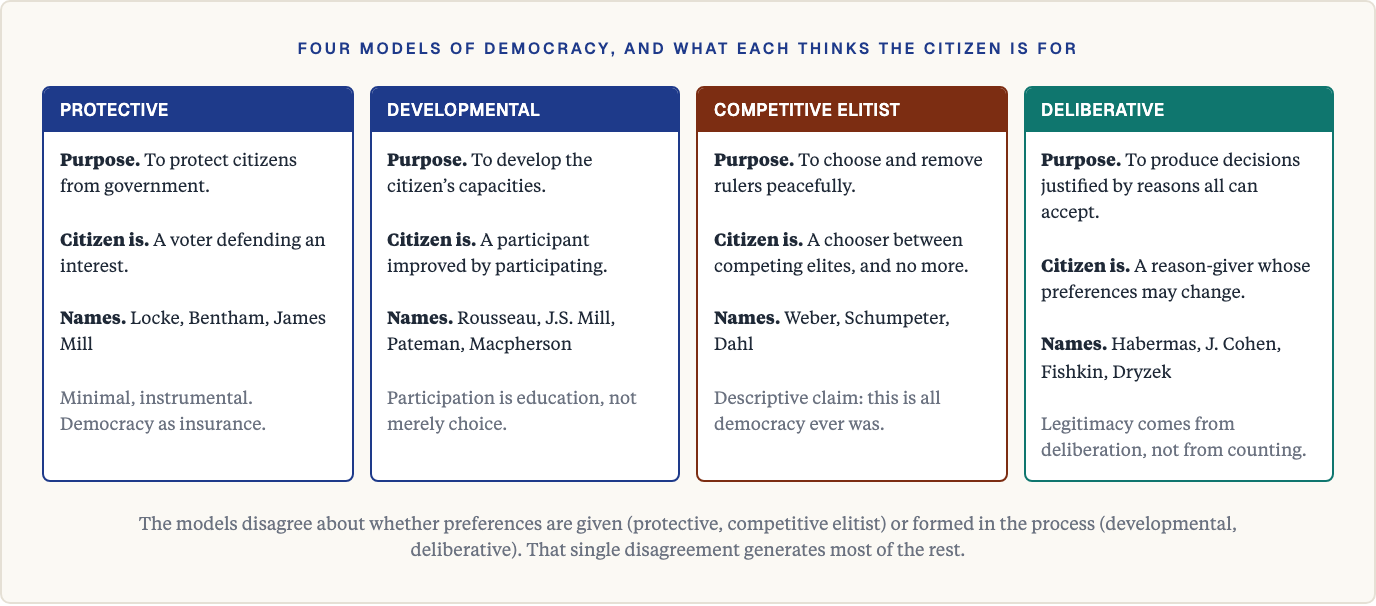
- Protective democracy defends citizens from government (Locke, Bentham, James Mill). Developmental democracy improves citizens through participation (Rousseau, J.S. Mill).
- Elite theory claims rule by the few is inevitable. Mosca and Pareto argue it sociologically, Michels states it as the iron law of oligarchy, and Schumpeter converts it into a definition of democracy itself.
- Schumpeter‘s competitive elitism redefines democracy as an institutional arrangement in which individuals acquire the power to decide by a competitive struggle for the people’s vote. The citizen’s role begins and ends at the ballot.
- Dahl‘s polyarchy is the empirical version: not rule by the people but open contestation plus inclusive participation, measured by institutional guarantees.
- Participatory democracy (Pateman, Macpherson) rejects the reduction: participation is educative, and a citizenry given no opportunity to participate cannot be cited as evidence of apathy.
- Deliberative democracy (Habermas, Cohen, Fishkin, Dryzek) relocates legitimacy from the counting of preferences to the quality of the reasoning that shapes them.
- Lijphart distinguishes majoritarian from consensus democracy, and shows that plural societies fail under the first. India’s institutional design is more consociational than its Westminster labels suggest.
Classical roots
Athenian democracy, from Cleisthenes’ reforms of 508 BCE, was direct: the Assembly was open to all citizens, most offices were filled by lot rather than election, and pay for office made participation possible for the poor. The franchise excluded women, slaves and resident foreigners, so the demos was a minority of the adult population.
Its classical critics set the terms of every subsequent doubt. Plato argued in the Republic (c. 375 BCE) that governing is a skill, that the many lack it, and that democracy therefore substitutes the flattery of the crowd for knowledge; the ship-of-state analogy is the compressed form of the argument. Aristotle classified democracy as the perverted form of polity, rule by the many in their own interest rather than the common one, and proposed the mixed constitution with a large middle class as the stable alternative.
Benjamin Constant‘s distinction between the liberty of the ancients and of the moderns (1819) explains why direct democracy could not simply be scaled. Ancient liberty was the citizen’s share in collective sovereignty, purchased by the complete subjection of the individual to the community; modern liberty is the security of private enjoyment. A modern state cannot deliver the first without destroying the second, which is why representation is not merely a concession to size.
Locke and the foundations of the modern form
UPSC asked in 2025 how Locke’s ideas of constitutionalism, freedom and property shaped western democracy. Four contributions carry the answer.
- Consent as the ground of authority. Political power is legitimate only where it derives from the consent of the governed, which makes any unconsented authority usurpation.
- Government as trust, hence limited. Power is fiduciary, held for specified ends, and a government that exceeds them forfeits it. This is the seed of constitutionalism and judicial limitation.
- Property and the independent citizen. Property acquired by mixing labour with nature is pre-political, so it limits what the state may take, and it underwrites the independence on which citizenship was thought to depend. The exclusionary side of that thought, the propertyless as unfit to vote, is part of the record.
- The right of resistance. If the trust is breached the people may resume power. This converts obedience from an unconditional duty into a conditional one, which is the hinge on which 1688, 1776 and 1789 all turn.
The qualification an answer should make: Locke was not a democrat. He assumed a propertied electorate and a supreme legislature rather than universal suffrage. He supplied the premises from which democracy was later derived, which is a different claim and a more accurate one.
The elite critique
Thinker
Joseph Schumpeter (1883–1950)
Key works. Capitalism, Socialism and Democracy (1942)
Core claim. The classical doctrine, that democracy realises the common good through a popular will, is empirically false: there is no determinate common good, and voters are ignorant and suggestible on public questions. Democracy is better defined procedurally, as that institutional arrangement for arriving at political decisions in which individuals acquire the power to decide by means of a competitive struggle for the people’s vote.
Standard critique. It defines the problem away: a definition that makes elite competition sufficient cannot then be used to show that elite competition is enough. It has no way to distinguish a democracy from a managed contest between indistinguishable elites.
Exam hook. The pivot of any democracy answer. Everything after 1942 is either an extension of Schumpeter or a revolt against him.
The elite tradition precedes him. Gaetano Mosca argued that in every society a ruling class performs the political functions while a numerous class is directed. Vilfredo Pareto added the circulation of elites: history is a graveyard of aristocracies, and lions give way to foxes and back again. Robert Michels, studying the German Social Democratic Party in Political Parties (1911), produced the iron law of oligarchy: organisation itself generates leadership, expertise and permanence, so who says organisation says oligarchy. His case is the strongest available, because he took the most internally democratic mass party of his day and showed oligarchy emerging inside it.
Robert Dahl‘s polyarchy is the empirically minded successor. Rather than asking whether a system is democratic, he asks how far it satisfies two dimensions, public contestation and inclusive participation, secured through institutional guarantees: elected officials, free and fair elections, inclusive suffrage, the right to run, freedom of expression, alternative information sources and associational autonomy. No actual system is a democracy in the ideal sense; the useful question is where a system sits.
Participatory democracy
Carole Pateman‘s Participation and Democratic Theory (1970) attacks the empirical foundation of competitive elitism. Elite theorists observed low participation and inferred citizen incapacity; Pateman, returning to Rousseau and J.S. Mill, argues the causation runs the other way. Participation is educative: people acquire political competence by participating, so a system that offers no opportunities produces the apathy that is then cited to justify it. Her practical proposal is the democratisation of the workplace, on the ground that work is where most adults encounter authority daily.
C.B. Macpherson, whose view of power UPSC asked about in 2025 and which Chapter 7 develops, supplies the accompanying theory. Liberal democracy inherited from market society a conception of the individual as a proprietor and a consumer of utilities, which he called possessive individualism. Genuine democracy requires the maximisation of developmental power, each person’s capacity to use and develop their human capacities, which is obstructed by the continuous net transfer of powers from the many to the few in a capitalist economy.
Deliberative democracy
The deliberative turn, from the late 1980s, shifts the locus of legitimacy. On aggregative models a decision is legitimate because it counts preferences fairly. On deliberative models it is legitimate because it emerges from a process of reason-giving among free and equal citizens in which preferences are not merely registered but tested and revised.
Jürgen Habermas supplies the foundation. In The Structural Transformation of the Public Sphere (1962) he traces the rise and decay of a bourgeois public sphere in which private persons reasoned publicly; in his later work the ideal speech situation specifies the conditions of undistorted communication, and Between Facts and Norms (1992) works out the implications for law and constitutional democracy. Legitimate law is law that all affected could agree to in a rational discourse.
Joshua Cohen formalised the model, James Fishkin operationalised it as deliberative polling, in which a representative sample is briefed, deliberates and is re-polled, and John Dryzek extended it to a discursive account operating across the whole public sphere rather than in designed forums.
The objections, all of which a good answer records:
- Scale. Deliberation works in a room of two hundred, not a polity of a billion. The reply is the systemic turn: the test applies to the deliberative system as a whole, not to a single forum.
- Inequality reproduced. Iris Marion Young argued that valorising dispassionate argument privileges the educated and the culturally dominant, and proposed that greeting, rhetoric and narrative be admitted as legitimate modes of communication.
- Polarisation. Sunstein’s finding that like-minded deliberating groups shift toward more extreme positions cuts against the assumption that deliberation moderates.
- Difference. Where disagreement is about identity rather than interest, more talk may harden rather than reconcile.
India has genuine deliberative institutions worth naming: the Gram Sabha, which the Seventy-third Amendment made the constitutional body of the whole village electorate, the social audit machinery under MGNREGA, and the consultative requirements of the Forest Rights Act. Their performance is uneven, and the gap between the designed forum and its capture by dominant local interests is exactly the inequality objection in practice.
| Aggregative | Deliberative | |
|---|---|---|
| Source of legitimacy | Fair counting of preferences | Quality of the reasons offered and accepted |
| Status of preferences | Given, exogenous, not to be questioned | Formed and revised in the process itself |
| Model of the citizen | Consumer choosing between offers | Reason-giver open to persuasion |
| Central institution | The election | The forum, and the public sphere around it |
| Failure mode | Majority tyranny; preference manipulation invisible | Exclusion of the inarticulate; polarisation; unworkable at scale |
Majoritarian and consensus democracy
Arend Lijphart‘s Patterns of Democracy (1999) distinguishes two institutional families. Majoritarian or Westminster democracy concentrates power: single-party cabinets, executive dominance, two-party systems, first-past-the-post, unitary government, unicameralism, a flexible constitution. Consensus democracy disperses it: coalition cabinets, executive–legislative balance, multiparty systems, proportional representation, federalism, strong bicameralism, a rigid constitution and judicial review.
His earlier consociational model, drawn from the Netherlands, Belgium, Austria and Switzerland, specifies four devices for deeply divided societies: grand coalition, mutual veto, proportionality in representation and public appointments, and segmental autonomy.
The Indian application is worth making explicitly, because India is usually described as Westminster and behaves otherwise. Parliamentary supremacy and first-past-the-post are majoritarian; federalism, strong bicameralism at the state level in some states, a rigid constitution, judicial review, linguistic reorganisation, Article 371 special provisions, Sixth Schedule autonomy, reserved seats, and thirty years of coalition government at the centre are all consensus devices. The functioning of Indian democracy through the 1989 to 2014 period is better explained by Lijphart’s second family than his first.
Democracy in India, and the standing critiques
India democratised without the conditions the modernisation literature said were required: without industrialisation, mass literacy or a large middle class, and with universal adult franchise from the first election rather than a gradual extension. That fact alone falsifies the strong version of the prerequisites thesis, and it is worth stating in any answer on democracy in developing societies.
Ambedkar‘s warning in the Constituent Assembly on 25 November 1949 remains the sharpest internal critique: India was entering a life of contradictions, political equality alongside social and economic inequality, and a political democracy resting on an undemocratic society was at risk. His formula, that democracy is not merely a form of government but primarily a mode of associated living, sets a substantive test that the procedural models cannot.
The three external critiques:
Marxist. Liberal democracy is bourgeois democracy: it delivers formal political equality while leaving economic power untouched, and the range of decisions actually subject to popular control excludes production and investment. Lindblom’s privileged position of business, from Chapter 2, is the non-Marxist version of the same point.
Feminist. The public sphere was constituted by excluding the domestic, so a democracy that regulates only the public leaves the sphere in which most women’s subordination operates outside politics altogether. Formal enfranchisement does not by itself alter this.
Post-colonial. Chatterjee’s political society, from Chapter 2, describes a population that relates to the state through negotiated claims rather than enforceable rights, which is neither a failure of democracy nor an instance of the textbook model.
Debate: Is competitive elitism a realistic theory or a surrender?
Realistic. Schumpeter and Dahl describe how democracies actually work. Voters are rationally ignorant, since a single vote almost never decides anything; policy is made by organised elites; and the achievement of democracy, the peaceful removal of rulers, is real and rare. Michels’s iron law is empirically well founded, and a theory that demands what no polity has delivered is not a theory but a wish. A surrender. Pateman’s objection is that the evidence is an artefact of the design. Citizens denied opportunities to participate look apathetic; give them a Gram Sabha with real powers and the picture changes. And a definition that reduces democracy to elite competition cannot distinguish a healthy democracy from a hollow one, which is precisely the distinction the present decade demands, when elections continue while press freedom, judicial independence and opposition space contract. The examiner’s line. Treat Schumpeter as a floor, not a ceiling. Competitive elections are a necessary condition and a genuine achievement; they are not sufficient, and the democratic-backsliding literature exists precisely because a purely procedural test scores the hollowed-out case as a pass.
Democracy is that institutional arrangement for arriving at political decisions in which individuals acquire the power to decide by means of a competitive struggle for the people’s vote
Joseph Schumpeter, Capitalism, Socialism and Democracy, 1942
Who says organisation, says oligarchy
Robert Michels, Political Parties, 1911
Democracy is primarily a mode of associated living, of conjoint communicated experience
B.R. Ambedkar, Annihilation of Caste, 1936
Where answers lose marks
- Writing a history of democracy from Athens onward. The question is almost always about models; the history should occupy two sentences.
- Treating elite theory as a criticism of democracy. Mosca and Michels criticise; Schumpeter redefines, and the redefinition is what has to be evaluated.
- Confusing participatory with direct democracy. Pateman’s claim is about the educative effect of participation in all spheres, including work, not about abolishing representation.
- Presenting deliberative democracy without its objections. Scale, Young’s exclusion argument and polarisation are the three to name.
- Calling India a Westminster democracy without qualification. Its consociational devices are extensive and are what carried it through the coalition decades.
- Using Ambedkar’s 1949 warning as a closing flourish without stating the argument: political democracy on an undemocratic social base is unstable.
Asked before
- Explain briefly the elite theory of democracy. (2025, Paper I, 10 marks)
- The foundational base of western democracy has been shaped by Locke’s ideas of constitutionalism, freedom and property. Elucidate. (2025, Paper I, 20 marks)
- Deliberative democracy seeks to promote democratic decision making about public issues among the citizens. Discuss. (2024, Paper I, 15 marks)
- Success of contemporary democracies lies in the State limiting its own power. Explain. (2023, Paper I, 20 marks)
Answer skeleton
Deliberative democracy seeks to promote democratic decision making about public issues among the citizens. Discuss. (15 marks, 250 words)
Frame. State the shift precisely: legitimacy moves from the fair aggregation of given preferences to the quality of the reasoning through which preferences are formed.
The core claim. A decision is legitimate if it could be justified by reasons that free and equal citizens could accept. Habermas’s ideal speech situation supplies the conditions; Cohen formalises the model.
What it adds. It makes preference manipulation visible, which aggregative models cannot see. It gives minorities a claim to be answered rather than merely outvoted.
Institutional forms. Fishkin’s deliberative polling; citizens’ assemblies; in India, the Gram Sabha under the Seventy-third Amendment, MGNREGA social audits, Forest Rights Act consultation.
Objections, in order of force. Scale, answered by the systemic turn. Young’s argument that valuing dispassionate reason privileges the educated. Sunstein on group polarisation. Capture of designed forums by dominant local interests, which is what Gram Sabha experience shows.
Conclude. Deliberation is best read as a corrective to aggregation rather than a replacement for it. Voting remains the decision rule; deliberation determines whether the vote expresses anything worth counting.
Last-mile revision
- Athens from 508 BCE: assembly, lot, pay for office; exclusion of women, slaves, metics. Plato’s ship of state; Aristotle’s polity and the mixed constitution.
- Constant 1819: ancients’ liberty is participation, moderns’ is private security.
- Locke’s four contributions: consent, trust and limited government, property, right of resistance. Not himself a democrat.
- Mosca’s ruling class; Pareto’s circulation of elites; Michels’s iron law from Political Parties (1911); Schumpeter’s procedural definition, 1942; Dahl’s polyarchy, contestation plus participation.
- Pateman 1970: participation is educative, apathy is produced. Macpherson: possessive individualism, extractive versus developmental power.
- Deliberative: Habermas (public sphere 1962, ideal speech, Between Facts and Norms (1992)), Cohen, Fishkin’s deliberative polling, Dryzek’s discursive turn.
- Objections to deliberation: scale, Young on exclusion, Sunstein on polarisation, capture.
- Lijphart: majoritarian versus consensus, and the four consociational devices, grand coalition, mutual veto, proportionality, segmental autonomy.
- India: democratisation without prerequisites; Ambedkar’s contradiction of 25 November 1949; Marxist, feminist and post-colonial critiques.
Read the rest. This chapter is one of 58 in the complete PSIR Optional Notes, covering Paper I and Paper II in full — free to download.
Tell Google you want more of this.
Add Anantam IAS as a preferred sourceOne tap, and this site shows up more often in your own Top Stories, AI Overviews and AI Mode. Remove it any time.