
Liberty and equality are treated as rivals by those who define liberty as non-interference, and as conditions of each other by those who define it as capacity. The whole dispute turns on that definitional choice, which is why it cannot be settled by pointing at outcomes.
This is chapter 4 of the PSIR Optional Notes, from the part on Political Theory in the Paper I syllabus. The complete book is a free download.
UPSC syllabus
Equality: Social, political and economic; relationship between equality and freedom; Affirmative action.
In one page
- Berlin‘s negative liberty asks how far a person is left to act unobstructed; positive liberty asks who is master. His warning is that positive liberty divides the self into higher and lower, licensing coercion in the name of the real self.
- MacCallum dissolves the dichotomy: all freedom is triadic, an agent free from an obstacle to do something. Rival theories differ in what they put in the three slots, not in having one concept each.
- Republican liberty, in Pettit and Skinner, is freedom as non-domination. The slave of a kind master is unfree even when unobstructed, because the master could interfere at will.
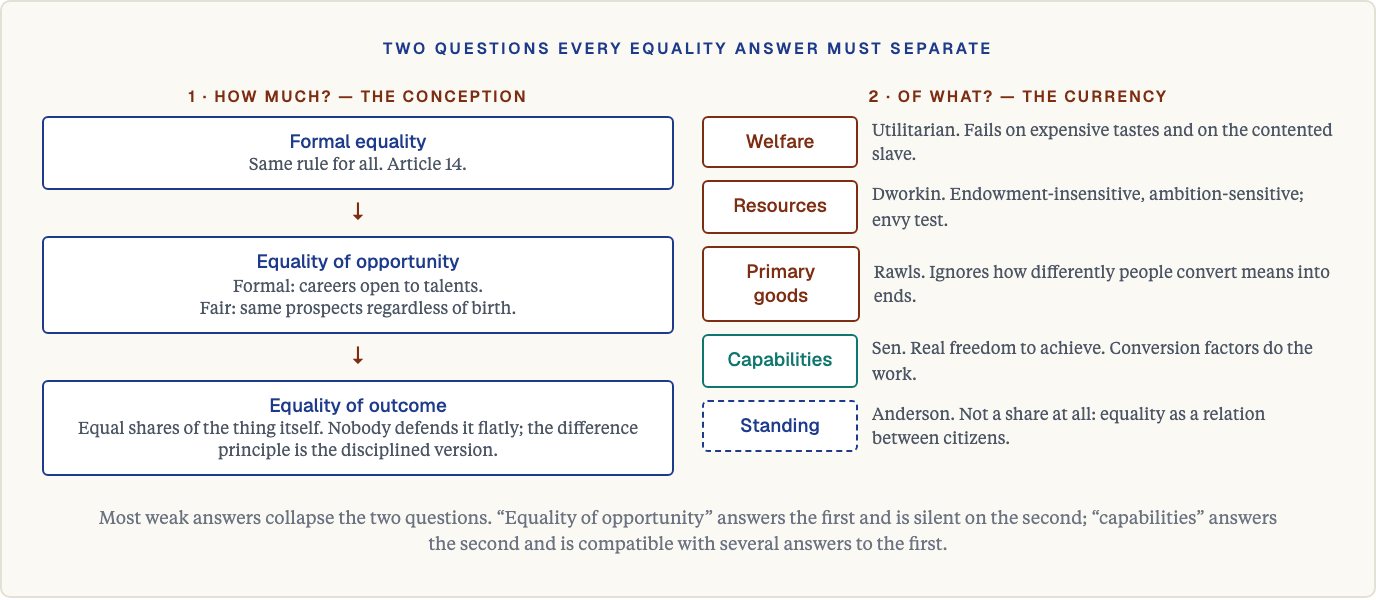
- Equality separates into two questions: how much equality (formal, of opportunity, of outcome) and equality of what (welfare, resources, primary goods, capabilities, standing). Most weak answers merge them.
- The classical liberal holds that liberty and equality conflict, since equalising requires interference. The egalitarian holds that they are conditions of each other, since without resources liberty is merely formal. Both are right about their own definition of liberty.
- Affirmative action rests on three distinct arguments, compensatory, distributive and representational, which have different implications; the objections from merit, individual right and stigma attack them differently.
- In India the argument is constitutional. Article 14’s formal guarantee has been read progressively as substantive equality, with Articles 15(4) and 16(4) as facets of it rather than exceptions to it.
- The multicultural claim is that equal treatment of unequally placed cultures is not equal treatment. Kymlicka defends group-differentiated rights; Barry rejects them; Okin asks what they do to women inside those groups.
Liberty: the two concepts and their critics
Thinker
Isaiah Berlin (1909–1997)
Key works. “Two Concepts of Liberty” (1958), Four Essays on Liberty (1969)
Core claim. Negative liberty is the area within which a person can act unobstructed by others. Positive liberty is being one’s own master, self-direction. The second is the more dangerous, because it permits the claim that a person’s true self wills what they refuse, so that coercion becomes liberation.
Standard critique. The dichotomy is artificial (MacCallum); the association of positive liberty with totalitarianism is guilt by historical association rather than argument; negative liberty is worthless to those without means to use it.
Exam hook. The default frame for any liberty question. Always pair with MacCallum’s dissolution and the republican third position, or the answer stays at textbook level.
Negative liberty
Freedom is the absence of deliberate interference by other people. Hobbes gives the crudest version: a free man is one not hindered to do what he has a will to do. Bentham, Mill and, in the twentieth century, Hayek and Nozick, refine it.
Three features matter. Only human obstacles count, so poverty limits freedom only if someone arranged it. Freedom is therefore compatible with great inequality. And the question is about the extent of the unobstructed area, not about who governs it, which is why Berlin insists that liberty and democracy are distinct: a benevolent despot may leave a wider area free than a majority does.
Positive liberty
Freedom is self-mastery, the condition of being directed by one’s own reason rather than by appetite, ignorance or the will of another. Rousseau, Kant, Hegel, Green and Marx belong here. T.H. Green’s formulation is the most usable: freedom is a positive power or capacity of doing something worth doing, and a person disabled by ignorance or want is not free merely because no one is stopping them.
Berlin’s objection is structural rather than historical. Positive liberty requires a distinction between the real or higher self and the empirical or lower self. Once made, the distinction can be transferred from the individual to a collective, a nation, a class, a party, which then claims to know the real will of individuals better than they do. Rousseau’s forced to be free is the hinge; the Jacobin and Soviet uses are the consequence Berlin feared.
The reply is that the danger is real but not entailed. Green, Hobhouse and Sen all hold positive conceptions without any authoritarian implication, because they locate the judgement of what is worth doing in the individual, not in the state. And negative liberty has its own pathology: a freedom that is formally available and practically unusable is a freedom in name.
MacCallum’s dissolution
Gerald MacCallum, in “Negative and Positive Freedom” (1967), argues that there is one concept of freedom with a triadic structure: x is free from y to do or become z. Every statement about freedom fills all three slots, whether or not it says so. Apparent negative theorists simply restrict y to human interference and leave z open; positive theorists admit internal and material obstacles into y and specify z more richly.
This is the single most useful move available in a liberty answer, because it converts an unresolvable clash of concepts into a tractable argument about what counts as an obstacle.
Republican liberty
The third position, revived by Quentin Skinner and Philip Pettit, holds that freedom is non-domination: the absence of anyone’s capacity to interfere arbitrarily, whether or not they use it. The test case is the slave with a kind master, who suffers no interference but lives at another’s discretion, and adjusts their behaviour accordingly.
Its practical payoff is large. On the negative view, an unaccountable authority that happens not to intervene leaves you free; on the republican view it does not, which is why republicanism generates a positive argument for constitutional checks, judicial review and the rule of law without the metaphysics of the real self. For Indian answers it explains why the mere absence of interference is a poor test of freedom for those dependent on landlords, employers or officials.
Key terms
Liberty of the ancients and the moderns — Constant’s 1819 distinction. Ancient liberty is the share in collective self-government; modern liberty is the security of private enjoyment. Modern states cannot deliver the first without sacrificing the second.
Harm principle — Mill’s limit on legitimate coercion: power may be exercised over a member of a civilised community against their will only to prevent harm to others.
Self-regarding and other-regarding — Mill’s distinction, and the weakest joint in his argument, since almost no action is wholly self-regarding.
Non-domination — Republican freedom. Freedom from the arbitrary power of another, whether or not that power is exercised.
Equality: how much, and of what
The conceptions
Formal equality is equality before the law: the same rule applied to all, with no distinctions of birth, rank, caste or sex. Article 14’s first limb states it. It is a genuine achievement and an insufficient one, since equal rules applied to unequally placed people reproduce the inequality.
Equality of opportunity has a weak and a strong version. Formal equality of opportunity is careers open to talents: no legal barriers to any position. Fair equality of opportunity, in Rawls’s sense, requires that those with the same native talent and willingness to use it have the same prospects regardless of the social class into which they were born, which demands intervention in education and family circumstance.
Equality of outcome is rarely defended flatly, because identical shares ignore differences of need, effort and choice. Its disciplined form is the difference principle, which permits inequality but only when it benefits the worst off.
Equality of what
Amartya Sen‘s 1979 Tanner Lecture asks the question that reorganised the field. Every egalitarian theory is committed to equality of something, and its character comes from what that something is.
- Welfare. The utilitarian answer. It fails twice: on expensive tastes, since someone who requires champagne to reach the same satisfaction gets more; and on adaptive preferences, since the deprived learn to want less, so equal welfare can coexist with gross deprivation.
- Resources. Ronald Dworkin‘s answer in “What Is Equality?” (1981). His distribution must be endowment-insensitive and ambition-sensitive: people should not be worse off through unchosen handicaps, but should bear the costs of their own choices. The envy test and the hypothetical insurance market are his devices.
- Primary goods. Rawls’s answer, treated in Chapter 3. Its defect is that people convert means into ends at very different rates.
- Capabilities. Sen’s answer: the real freedoms a person has to achieve the lives they have reason to value. The conversion factors, disability, climate, social norms, are precisely what the resource metrics miss.
- Standing. Elizabeth Anderson‘s answer in “What Is the Point of Equality?” (1999): equality is not a share of anything but a relation between citizens, the absence of hierarchy and oppression. Her target is luck egalitarianism, which she argues insults the badly-off by making aid conditional on proving they are not to blame.
Luck egalitarianism, in Cohen and Arneson, distinguishes brute luck from option luck: inequality traceable to unchosen circumstance is unjust, inequality traceable to deliberate gambles is not. It is intuitively powerful and produces the harsh implication Anderson attacks, that the reckless uninsured motorcyclist may be left to their fate.
The relation between liberty and equality
Three positions, and an answer needs all three.
They conflict. The classical liberal position. Equalising requires taking from some and giving to others, which is interference, so more equality is less liberty by definition. Hayek adds that since people differ, treating them equally produces unequal outcomes, and producing equal outcomes requires treating them unequally. Nozick’s Wilt Chamberlain argument is the sharp form: liberty upsets patterns.
They are conditions of each other. The positive-liberal and socialist position. A right to do something one lacks the means to do is not a freedom. R.H. Tawney, in Equality (1931), gives the standard image: freedom for the pike is death for the minnows. Extreme economic inequality creates private power over others’ lives, which is a loss of freedom in exactly the republican sense.
They are ordered. Rawls’s position. Liberty and equality are both required but the first principle has lexical priority, so basic liberties cannot be traded for economic gain. This is not a compromise but a ranking, and it distinguishes Rawls from both the libertarian and the socialist.
The 2024 question, on whether economic equality shapes the relation between democratic citizenship and liberty, is a direct invitation to the second and third positions. Democratic citizenship promises equal political standing; gross economic inequality converts into unequal political influence through funding, media ownership and lobbying; so the equal liberty of citizens is undermined by economic inequality even where formal rights are intact. Walzer’s argument about sphere dominance, from Chapter 3, is the cleanest theoretical statement of the mechanism.
Affirmative action
The three arguments for
- Compensatory. A remedy for identifiable historical wrongs. It is the most intuitive and the most vulnerable, since the beneficiaries are not the individuals wronged and those who bear the cost are not the wrongdoers.
- Distributive. Forward-looking. Present inequality of starting points makes formal equality of opportunity a fiction, so the remedy corrects the competition rather than settling a historical debt. This is the strongest ground and the one closest to Rawls’s fair equality of opportunity.
- Representational and social-utility. Diverse institutions function better, and a bureaucracy or judiciary drawn from a single stratum lacks legitimacy and information. Ambedkar’s argument for representation in the services rests here as much as on redress.
The objections
Merit: selection should track ability, and quotas do not. The reply is that measured merit is itself a product of unequal preparation, so scores test opportunity as much as ability.
Individual rights: the better-qualified applicant is treated as a means to a social goal. This is the Nozickean and Dworkinian objection, though Dworkin himself concluded that no one has a right to be selected on any particular criterion, only to be treated with equal concern.
Stigma and mismatch: preference may mark beneficiaries as unqualified and place them in settings where they underperform. The evidence is contested and highly context-dependent.
Elite capture: benefits concentrate in the best-placed members of the designated group, which is the empirical basis of the creamy-layer doctrine.
Entrenchment: making caste the operative category in law may perpetuate the salience of the identity the policy exists to dissolve. Ambedkar’s own position, that reservation was a temporary instrument for political representation, is often cited here, and is frequently misused: he sought its extension in the services precisely because social change was not arriving.
The Indian constitutional argument
The reading of Article 14 has shifted decisively. In the earliest phase, Articles 15(4) and 16(4) were treated as exceptions to the equality guarantee, which meant they had to be construed narrowly. From State of Kerala v. N.M. Thomas (1976) onward the court has treated them as facets of equality: substantive equality is the principle, and special provision is its application rather than a departure from it.
The doctrinal landmarks are set out in Chapter 3 and should be cross-referenced rather than repeated: Indra Sawhney (1992) for the creamy layer and the fifty per cent rule, M. Nagaraj (2006) and Jarnail Singh (2018) for promotions, and Janhit Abhiyan (2022) for economic criteria and the breach of the ceiling.
Two live questions belong here. Whether economic disadvantage alone is a constitutionally adequate ground, which the 2022 majority answered yes and the dissent answered no on the ground that excluding the backward classes from an economic quota is itself discriminatory. And whether the fifty per cent rule survives, given that it was always described as a rule of prudence rather than a constitutional limit, and has now been breached with judicial approval.
The multicultural perspective
UPSC asked in 2025 for the relation between equality and liberty from the multicultural perspective, and in 2023 for the multicultural perspective on rights. The core claim is the same in both: identical treatment of differently situated cultural groups is not equal treatment, because the state is never culturally neutral. Its language, calendar, public holidays, dress codes and default norms embody the majority’s culture, which is thereby subsidised invisibly while minority practices bear a cost.
Thinker
Will Kymlicka (b. 1962)
Key works. Multicultural Citizenship (1995), Liberalism, Community and Culture (1989)
Core claim. A secure societal culture is a precondition of meaningful individual choice, so protecting minority cultures is required by liberalism, not against it. He distinguishes polyethnic rights (accommodation for immigrant groups), self-government rights (for national minorities) and special representation rights.
Standard critique. His limit, that groups may claim external protections against the wider society but not internal restrictions on their own members, is hard to police in practice, and most contested cultural claims are precisely about internal restrictions.
Exam hook. The standard authority for any multiculturalism question. Balance with Barry and Okin.
Charles Taylor‘s “The Politics of Recognition” (1992) supplies the deeper argument: identity is dialogically formed, so misrecognition inflicts real harm, and a politics of equal dignity that ignores difference can itself be a form of it.
Brian Barry, in Culture and Equality (2001), mounts the egalitarian-liberal counter-attack: group-differentiated rights fracture the common citizenship on which redistribution depends, and a uniform rule that burdens some people more than others is objectionable only when the burden is unreasonable, which is a question about the rule, not about culture.
Susan Moller Okin‘s “Is Multiculturalism Bad for Women?” (1999) presses the sharpest objection: group rights are typically claimed by group elders, and the practices most fiercely defended, in marriage, divorce, inheritance and dress, bear most heavily on women and children. Protecting the group may entrench the subordination of its least powerful members.
For India the debate is not abstract. Personal law, minority educational institutions under Article 30, Sixth Schedule autonomy, and the reservation of seats in local bodies are all group-differentiated arrangements, and each attracts precisely the Kymlicka-versus-Okin argument. The uniform civil code debate is this chapter’s argument conducted in constitutional language.
Debate: Does affirmative action violate equality?
Yes. It makes an ascriptive characteristic the operative criterion, which is what Article 14 was written to prevent. It burdens individuals who committed no wrong, it entrenches the identity it claims to dissolve, and its benefits accrue disproportionately to the best-placed members of designated groups, which is why the creamy-layer doctrine had to be invented. No. It violates formal equality in order to serve substantive equality, which is the equality the Constitution actually promises: the Preamble’s equality of status and opportunity, not merely of legal form. Identical treatment of unequally placed people is not neutral; it ratifies an existing distribution created by centuries of exclusion. The Indian courts have accepted this since N.M. Thomas (1976). The examiner’s line. The disagreement is about which conception of equality is authoritative, not about the policy. Make that explicit, then evaluate the instrument on its own terms: strong on representation, weaker on the poorest within groups, and increasingly strained as economic and caste disadvantage diverge, which is what the EWS litigation exposed.
Freedom for the pike is death for the minnows
R.H. Tawney, Equality, 1931
Liberty is liberty, not equality or fairness or justice or human happiness or a quiet conscience
Isaiah Berlin, Two Concepts of Liberty, 1958
Where answers lose marks
- Reproducing Berlin’s dichotomy and stopping. MacCallum’s triadic dissolution and the republican third position are what lift the answer.
- Treating positive liberty as inherently totalitarian. Berlin’s claim is that it is liable to a particular perversion, not that Green or Sen are authoritarians.
- Merging the two equality questions. How much equality and equality of what are separate; an answer that never says which currency it is using is imprecise throughout.
- Defending affirmative action on compensatory grounds alone. It is the weakest of the three arguments and the easiest to attack.
- Asserting that reservation was meant to be temporary without noting what Ambedkar actually said and when. Article 334’s ten-year limit applied to reserved legislative seats, not to Articles 15(4) and 16(4).
- Writing on multiculturalism without Okin. An answer that presents group rights purely as a minority-protection issue has missed the internal-restrictions problem.
Asked before
- Write a note on the relation between equality and liberty from the multi-cultural perspective. (2025, Paper I, 10 marks)
- The nature of relationship between equality of democratic citizenship and liberty of citizens is influenced by economic equality. Comment. (2024, Paper I, 15 marks)
- Affirmative Action Policies draw as much strong criticism as strong support. Analyze this statement in the context of equality. (2023, Paper I, 15 marks)
- Multicultural perspective on rights. (2023, Paper I, 10 marks)
Answer skeleton
Affirmative Action Policies draw as much strong criticism as strong support. Analyze this statement in the context of equality. (15 marks, 250 words)
Frame. Say at once that the disagreement is about which conception of equality governs. Formal equality condemns affirmative action; substantive equality requires it. Everything else follows from that choice.
The case for, in three grounds. Compensatory (historical redress), distributive (unequal starting points make formal opportunity a fiction), representational (legitimacy and information in public institutions). Rank them: the distributive ground is the strongest.
The case against, in three grounds. Merit and the individual’s claim to be judged on it; stigma and mismatch; elite capture within designated groups.
Test the objections. Measured merit encodes unequal preparation, so the merit objection assumes what it must prove. Elite capture is a real finding and the reason for the creamy-layer doctrine, which is a correction inside the policy rather than a refutation of it.
Indian anchor. The shift from treating Articles 15(4) and 16(4) as exceptions to treating them as facets of Article 14, from N.M. Thomas (1976) onward; Indra Sawhney (1992) for the creamy layer; Janhit Abhiyan (2022) for the strain that economic criteria place on the whole framework.
Conclude. The instrument is strongest where the disadvantage is group-based and persistent, weakest where disadvantage has become individual and economic. That divergence, not the merit objection, is the live problem.
Last-mile revision
- Berlin 1958: negative liberty is the unobstructed area, positive liberty is self-mastery; the danger is the higher-self manoeuvre.
- MacCallum 1967: freedom is triadic, x free from y to do z. Constant 1819: ancients versus moderns. Pettit and Skinner: non-domination, the kind master.
- Green: freedom as a positive power of doing something worth doing. Mill: harm principle, self-regarding and other-regarding.
- Two equality questions: how much (formal, opportunity formal and fair, outcome) and of what (welfare, resources, primary goods, capabilities, standing).
- Dworkin 1981: endowment-insensitive, ambition-sensitive; envy test. Sen 1979: equality of what, capabilities, conversion factors. Anderson 1999: relational equality against luck egalitarianism. Brute luck versus option luck.
- Liberty and equality: conflict (Hayek, Nozick), mutually conditioning (Green, Tawney), or lexically ordered (Rawls).
- Affirmative action: compensatory, distributive, representational arguments; merit, individual right, stigma, elite capture, entrenchment objections.
- India: N.M. Thomas (1976) exceptions to facets; Indra Sawhney (1992); Nagaraj (2006); Jarnail Singh (2018); Janhit Abhiyan (2022).
- Multiculturalism: Kymlicka’s societal culture, polyethnic, self-government and representation rights, external protections versus internal restrictions; Taylor on recognition; Barry’s egalitarian objection; Okin on women inside the group.
Read the rest. This chapter is one of 58 in the complete PSIR Optional Notes, covering Paper I and Paper II in full — free to download.
Tell Google you want more of this.
Add Anantam IAS as a preferred sourceOne tap, and this site shows up more often in your own Top Stories, AI Overviews and AI Mode. Remove it any time.