
They agree that untouchability is intolerable and disagree about everything that follows. The disagreement is not personal or tactical: it is about whether the source of the evil is a corrupted practice reformable from within, or the religious sanction itself.
This is chapter 17 of the PSIR Optional Notes, from the part on Indian Political Thought in the Paper I syllabus. The complete book is a free download.
UPSC syllabus
Indian Political Thought: M. K. Gandhi, B. R. Ambedkar.
In one page
- Gandhi’s system is developed in Chapters 2 and 9. Here it is read as Indian political thought: swaraj, satyagraha, sarvodaya, trusteeship and the constructive programme, and what they imply for caste.
- Gandhi distinguishes varna from caste: varna is a scheme of hereditary occupation without hierarchy, caste its degeneration, and untouchability the sin to be expelled from Hinduism.
- Ambedkar denies the distinction can be sustained. Caste is not a division of labour but a division of labourers, graded and hereditary, and its sanction is religious, so reform requires destroying that sanction.
- Annihilation of Caste (1936), the undelivered address, is the central text; its remedy is inter-dining and inter-marriage, and beyond that the rejection of the shastras that authorise the order.
- The Poona Pact of 24 September 1932 traded separate electorates for reserved seats in a joint electorate, under Gandhi’s fast unto death. Ambedkar signed and never accepted the trade as fair.
- Ambedkar’s positive programme is constitutional and statist: State and Minorities (1947) proposes state socialism written into the constitution itself, and Article 17 abolishes untouchability outright.
- Constitutional morality is his term for the habits of restraint without which a democratic constitution is only a form; he warns it is not a natural sentiment and must be cultivated.
- His conversion to Buddhism on 14 October 1956, and The Buddha and His Dhamma (1957), are the logical terminus: an exit from the religion whose sanction he held to be the root.
Gandhi as Indian political thought
The apparatus is set out in Chapter 9 and should not be repeated at length: the inseparability of means and ends, ahimsa, satyagraha, swaraj in its inner and outer senses, swadeshi, sarvodaya, trusteeship, and the critique of modern civilisation in Hind Swaraj (1909). What belongs here is what those commitments imply for Indian society, and where they were contested from within.
Varna, caste and untouchability
Gandhi’s position moved over four decades, and an answer that presents a single fixed view is inaccurate.
His early position defended varnashrama as a law of hereditary occupation which he held to involve no superiority or inferiority, and which restrained competition and acquisitiveness by limiting a person’s economic ambition to their calling. Caste, with its restrictions on inter-dining and inter-marriage and its graded ranking, he treated as a later corruption, and untouchability as an excrescence with no sanction in the essential faith. Harijan, children of God, was his renaming of the excluded, which Ambedkar and later Dalit writers rejected as patronising.
His later position moved considerably. By the mid-1930s he was arguing that varna implied no hereditary restriction he would enforce, and by the 1940s he was encouraging inter-caste marriage and declining to attend weddings that were not between a caste Hindu and a Dalit. The trajectory is real, and the fair statement is that he ended much closer to Ambedkar’s practical prescriptions than he began, while never conceding the theoretical point.
The constructive programme
Gandhi’s answer to the charge that he offered only sentiment is the constructive programme: khadi and village industries, removal of untouchability, communal unity, basic education (Nai Talim), village sanitation, prohibition, and the uplift of women. Its logic is that swaraj is built rather than transferred, and that a people incapable of running its own villages cannot run a country. It is also, in his own account, the training ground for satyagraha: those who will not sweep a latrine are unlikely to face a lathi charge with discipline.
Ambedkar
Thinker
B. R. Ambedkar (1891–1956)
Key works. Castes in India (1916), Annihilation of Caste (1936), What Congress and Gandhi Have Done to the Untouchables (1945), State and Minorities (1947), The Buddha and His Dhamma (1957), Who Were the Shudras? (1946), The Problem of the Rupee (1923)
Core claim. Caste is not an economic division but a religiously sanctioned system of graded inequality maintained by endogamy. Since its authority is scriptural, it cannot be reformed by appeals to conscience; the sanction itself must be destroyed. Political democracy without social democracy is unstable, so the state must be the instrument of emancipation, with guarantees written into the constitution rather than left to goodwill.
Standard critique. His faith in constitutional and state remedies has been questioned by later Dalit writers as over-reliant on an apparatus staffed by the dominant; and his early economic writing has received less attention than it merits.
Exam hook. Ambedkar recurs across the whole syllabus: here, in Chapter 3 on justice, in Chapter 6 on democracy, and throughout Part IV on the Constitution.
The theory of caste
Castes in India (1916), presented at Columbia when he was twenty-five, already contains the mechanism: caste is maintained by endogamy superimposed on a population that was originally one cultural unit. The practices that enforce it, sati, enforced widowhood and child marriage, all exist to solve the problem of surplus men and women created by the requirement to marry within the group. Caste is thus not a natural division but a machinery of closure, and its distinctive Indian feature is that it is not merely a wall around one group but a system in which each group encloses itself in imitation of those above.
Annihilation of Caste (1936) is the political argument. Its principal claims:
- Caste is not a division of labour but a division of labourers, and one graded and hereditary, so it is unlike any economic organisation of work.
- It disables efficiency by assigning occupation by birth rather than aptitude, and disables sympathy by making each group indifferent to those outside it. Hindu society, he argues, is not a society at all but a collection of castes.
- Its authority is religious. Because caste is sanctioned by shastra, appeals to reason and humanity fail: the caste Hindu is not being immoral by his own lights but obedient. Hence the remedy must attack the sanction, not the behaviour.
- The practical solvent is inter-marriage, since a real fusion of blood dissolves the sense of separateness that inter-dining alone cannot.
- Therefore the destruction of the belief in the sanctity of the shastras is the condition of social reform, and he ends by announcing his own intention to leave Hinduism.
The Gandhi–Ambedkar exchange
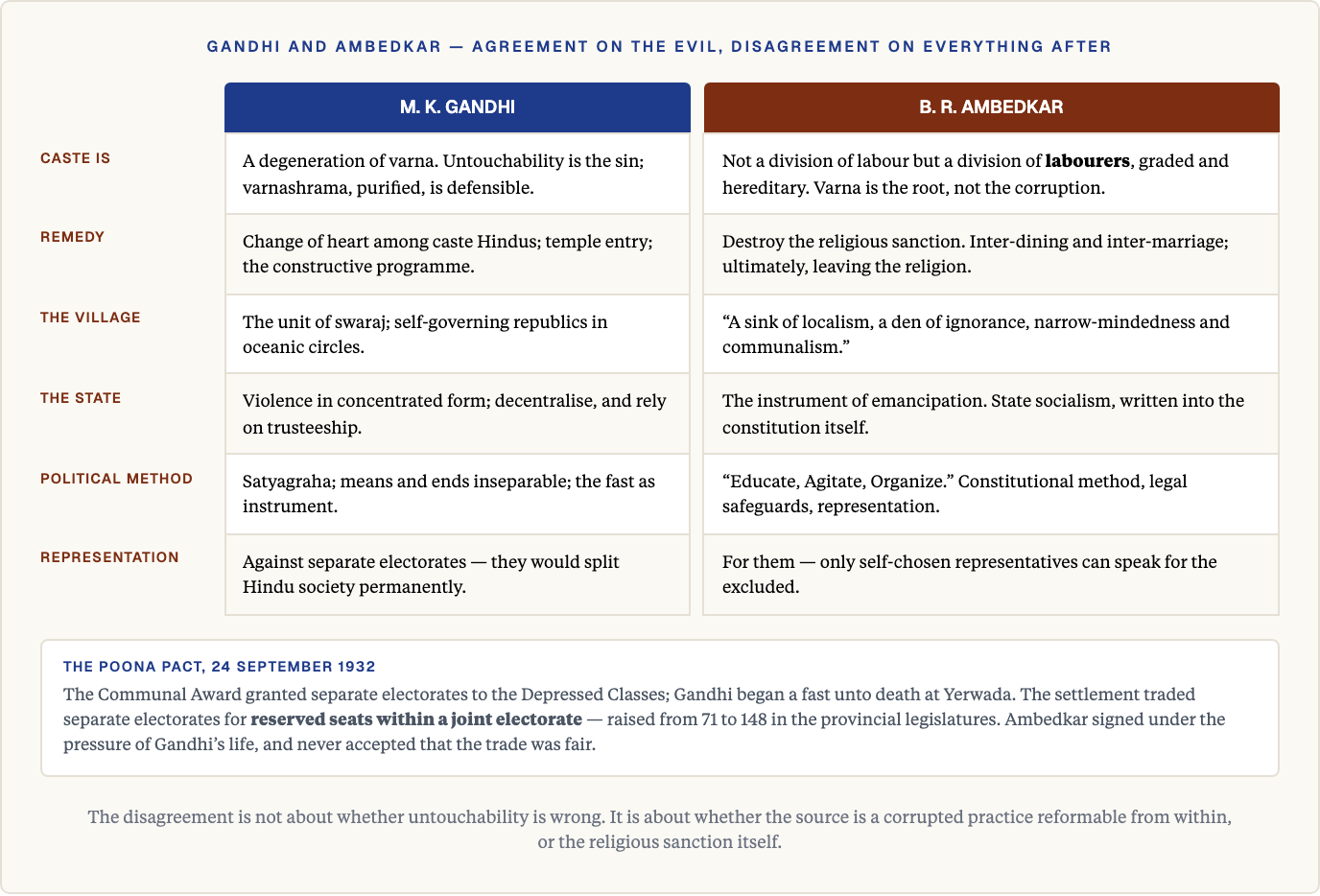
Three specific disputes carry the marks.
Separate electorates and the Poona Pact. The Communal Award of August 1932 granted the Depressed Classes separate electorates, giving them a double vote and representatives chosen by themselves alone. Gandhi opposed it as a vivisection of Hindu society that would make the untouchables a permanent separate element, and began a fast unto death in Yerwada prison. The resulting Poona Pact of 24 September 1932 substituted reserved seats within a joint electorate, increasing the number of reserved provincial seats from 71 to 148 with a primary election mechanism that was later dropped. Ambedkar’s judgement, stated in What Congress and Gandhi Have Done to the Untouchables (1945), is that he was compelled by the moral pressure of a life at stake to surrender the one instrument that would have given his people independent political representation.
Priority: political freedom or social reform. Gandhi held that the removal of untouchability was integral to swaraj and pursued both together; Ambedkar held that swaraj under an unreformed social order would transfer power to the very castes that oppressed his people, and that social democracy must precede or accompany political independence rather than follow it.
The village. Gandhi’s village republic is Ambedkar’s target. In the Constituent Assembly on 4 November 1948 he called the village a sink of localism, a den of ignorance, narrow-mindedness and communalism, and defended the individual rather than the village as the unit of the Constitution.
The positive programme
Ambedkar is often read only as a critic, which is a serious under-reading.
State and Minorities (1947) proposes what he called state socialism established by the constitution itself and therefore not alterable by an ordinary legislative majority: key industries state-owned, agriculture as state enterprise with collective farming on leased land, and state-run insurance. His argument is characteristic: leaving economic structure to parliamentary politics leaves the poor dependent on the goodwill of those who own, and constitutional entrenchment is the only protection.
On democracy, his formula is the one quoted everywhere and understood less often: democracy is primarily a mode of associated living, of conjoint communicated experience, and it requires the prior existence of fraternity. Constitutional morality, a phrase he took from Grote’s history of Greece, is the set of habits, restraint in the exercise of power, deference to form, acceptance of criticism, without which constitutional forms are only forms. His warning is that it is not a natural sentiment in India and must be cultivated, and that in a society where the plinth is undemocratic, democratic forms sit precariously.
His three warnings in the Constituent Assembly on 25 November 1949 should be reproducible: abandon the grammar of anarchy, meaning unconstitutional methods such as civil disobedience and satyagraha once constitutional remedies exist; avoid bhakti, hero-worship, which he called a sure road to degradation and eventual dictatorship, in a degree unequalled in the politics of any other country; and recognise that political democracy resting on social and economic inequality is a life of contradictions that those who suffer will eventually blow up.
Buddhism
The conversion at Nagpur on 14 October 1956, with several hundred thousand followers, is the practical conclusion of Annihilation of Caste (1936). His twenty-two vows explicitly reject the Hindu pantheon and the doctrine of avatars, and affirm the equality of all human beings. The Buddha and His Dhamma (1957), published posthumously, presents a rationalist and social reading, sometimes called Navayana: the Buddha as a social reformer, dhamma as morality grounded in reason and directed at suffering in this world, and a deliberate downplaying of the supernatural. Scholars of Buddhism dispute the textual fidelity of the reading; politically, it is the point, since the object was to supply an egalitarian religious home rather than to reconstruct an ancient one.
Debate: Was the Poona Pact a betrayal or a settlement?
Betrayal. Ambedkar had won, by argument before the Franchise Committee and at the Round Table Conferences, an instrument that would have given the Depressed Classes representatives answerable only to them. He surrendered it not to a better argument but to the threat of Gandhi’s death, which was moral coercion by any name. Reserved seats within a joint electorate produce representatives acceptable to the caste-Hindu majority, which is precisely the dependence he was trying to escape. Settlement. Separate electorates had already hardened Hindu-Muslim politics after 1909 and would have institutionalised a permanent split within Hindu society, with unpredictable consequences for the Dalits themselves as a small and dispersed minority. The Pact more than doubled reserved seats, and reservation in joint electorates became the constitutional model that has since delivered continuous Dalit presence in every legislature. The examiner’s line. Judge the instrument by what it was for. As a mechanism for numbers, the Pact was a gain; as a mechanism for autonomy, it was a loss, and Ambedkar’s complaint was always about the second. The subsequent record supports both readings: reserved seats have produced representation without producing an independent Dalit political bloc, which is exactly what he predicted.
Caste is not a division of labour. It is a division of labourers
B. R. Ambedkar, Annihilation of Caste, 1936
On the 26th of January 1950 we are going to enter into a life of contradictions. In politics we will have equality and in social and economic life we will have inequality
B. R. Ambedkar, Constituent Assembly, 25 November 1949
Constitutional morality is not a natural sentiment. It has to be cultivated
B. R. Ambedkar, Constituent Assembly, 4 November 1948
Where answers lose marks
- Presenting Gandhi’s view of caste as fixed. It moved substantially between the 1920s and the 1940s, and saying so is more accurate and more useful.
- Reducing the disagreement to the Poona Pact. The deeper dispute is whether the sanction of caste is religious, and therefore whether reform from within is possible at all.
- Treating Ambedkar as only a critic of Hinduism. State and Minorities (1947), constitutional morality, and his economic writing are the constructive half.
- Using “Harijan” as neutral vocabulary. It was Gandhi’s coinage and was rejected by those it named; “Dalit” or “Scheduled Castes” is the appropriate register.
- Saying Ambedkar drafted the Constitution alone. He chaired the Drafting Committee, which is the accurate claim and still a large one.
- Quoting the 25 November 1949 warnings without their content: the grammar of anarchy, bhakti in politics, and the contradiction between political and social democracy.
Asked before
- Dr. Ambedkar’s clarion call, “Educate, Agitate and Organize”, strategizes the Dalit movement towards achieving civil liberty. Discuss. (2023, Paper I, 15 marks)
- Discuss the contribution of the Dalit struggle to establish egalitarianism in Indian society during freedom movement. (2024, Paper I, 20 marks)
- Write a note on the Dalit perspective of Indian National Movement. (2025, Paper I, 10 marks)
- The blueprint of Gram Swaraj is the key to understand the Gandhian perspective on planning. Discuss. (2024, Paper I, 15 marks)
Answer skeleton
Dr. Ambedkar’s clarion call, “Educate, Agitate and Organize”, strategizes the Dalit movement towards achieving civil liberty. Discuss. (15 marks, 250 words)
Frame. Read the slogan as a sequence, not three parallel exhortations. Each term answers a specific obstacle, and the order matters.
Educate. Not literacy alone but the acquisition of the knowledge that confers standing, and the critical capacity to see caste as a human arrangement rather than a sacred order. His own trajectory, Columbia and the London School of Economics, is the demonstration; the Bahishkrit Hitakarini Sabha of 1924 the institutional expression.
Agitate. Public assertion of the right to shared resources, because a right unclaimed is not established. Mahad satyagraha, March 1927, for water from the Chavdar tank, and the burning of Manusmriti (c. 200 BCE–200 CE) in December that year; Kalaram temple entry, 1930.
Organize. Independent political capacity, since dependence on caste-Hindu parties returns the community to petitioning. Independent Labour Party 1936, Scheduled Castes Federation 1942, and the demand for separate electorates.
Why this order. An uneducated mass agitates without direction; an educated but unorganised one is co-opted individually. Organisation without education produces followers rather than citizens.
Assessment. It converted a religiously sanctioned disability into a political question, and it delivered constitutional guarantees, Article 17, reservation, and the abolition of untouchability. Its limits: the Poona Pact showed how easily an organised minority can be outflanked, and civil liberty on paper has outpaced social equality in practice, which is exactly the contradiction he warned of on 25 November 1949.
Last-mile revision
- Gandhi: varna as occupation without hierarchy, caste as degeneration, untouchability as sin; Harijan; position moved toward inter-caste marriage by the 1940s.
- Constructive programme: khadi, village industries, removal of untouchability, communal unity, Nai Talim, sanitation, women’s uplift.
- Ambedkar, Castes in India (1916): endogamy superimposed; sati, enforced widowhood, child marriage as its mechanisms.
- Annihilation of Caste (1936): division of labourers not labour; disables efficiency and sympathy; religious sanction; inter-marriage as solvent; destroy belief in shastric authority.
- Poona Pact, 24 September 1932: Communal Award of August 1932, Gandhi’s fast at Yerwada, separate electorates traded for reserved seats in a joint electorate, 71 to 148.
- Milestones: Bahishkrit Hitakarini Sabha 1924; Mahad satyagraha and Manusmriti burning 1927; Kalaram temple entry 1930; Independent Labour Party 1936; Scheduled Castes Federation 1942.
- State and Minorities (1947): constitutionally entrenched state socialism.
- Constitutional morality (from Grote), 4 November 1948; the village as a sink of localism; the three warnings of 25 November 1949.
- Conversion at Nagpur, 14 October 1956; twenty-two vows; The Buddha and His Dhamma (1957); Navayana.
Read the rest. This chapter is one of 58 in the complete PSIR Optional Notes, covering Paper I and Paper II in full — free to download.
Tell Google you want more of this.
Add Anantam IAS as a preferred sourceOne tap, and this site shows up more often in your own Top Stories, AI Overviews and AI Mode. Remove it any time.