
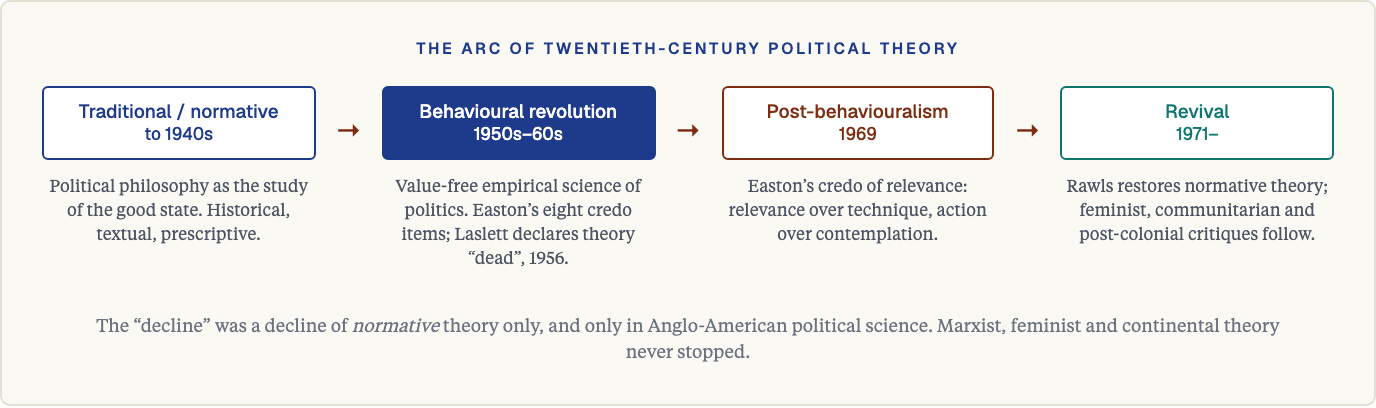
Political theory was pronounced dead in 1956 and was flourishing again by 1971. What died was one way of doing it, and the argument about why it died is still the argument about what political theory is for.
This is chapter 1 of the PSIR Optional Notes, from the part on Political Theory in the Paper I syllabus. The complete book is a free download.
UPSC syllabus
Political Theory: meaning and approaches.
In one page
- Political theory is systematic reflection on the nature and purposes of political authority. It differs from political thought (the historical record of what people said), from political philosophy (the evaluative core), and from political science (the empirical study of political behaviour).
- Four families of approach: normative or philosophical, historical, empirical (institutional, behavioural, systems, rational choice), and critical (Marxist, feminist, post-modern, post-colonial).
- The behavioural revolution of the 1950s made political science value-free, quantitative and predictive. Easton’s eight intellectual foundation stones are the standard statement of what it demanded.
- The decline thesis runs from Cobban’s 1953 essay to Laslett’s 1956 verdict that political philosophy was, for the moment, dead. Its causes: positivism, the rise of ideology-as-substitute, behaviouralism’s hostility to value judgements, and specialisation.
- Isaiah Berlin answered in 1962 that theory cannot die while men disagree about ends, and that no empirical technique can settle a question about what ought to be done.
- Post-behaviouralism is Easton’s own correction, delivered in 1969: substance before technique, relevance before rigour, and a duty for the scholar to act. This is the credo of relevance.
- The revival is dated to A Theory of Justice (1971), though Arendt, Strauss, Oakeshott and Wolin had kept normative work alive throughout.
- For every approach question, the marks are in the limits of the approach, not the description. Behaviouralism’s blindness to values, institutionalism’s blindness to informal power, rational choice’s thin account of motivation.
What political theory is, and what it is not
The word carries three overlapping senses and UPSC has asked about the confusion directly.
Political thought is descriptive and historical. It is the whole body of what has been said about politics in a period or a tradition, including pamphlets, speeches and constitutional argument. Gandhi’s writings are political thought.
Political philosophy is normative and evaluative. It asks what the state ought to do, what justifies obedience, what justice requires. It proceeds by argument from premises, not by evidence from observation.
Political theory is broader than philosophy and narrower than thought. It is systematic, generalising reflection on political life which may be either normative or explanatory. Rawls on justice is political theory; so is Easton on the political system.
Political science claims the status of a science: it studies political behaviour empirically, seeks regularities, and aspires to explanation and prediction.
Key terms
Normative — Concerned with what ought to be. Proceeds by argument, cannot be settled by data.
Empirical — Concerned with what is. Proceeds by observation, cannot by itself settle a question of value.
Positivism — The doctrine that only statements verifiable by observation or true by definition are meaningful. The philosophical engine behind the decline thesis.
Fact–value dichotomy — Hume’s claim that an ought cannot be derived from an is. Behaviouralism’s founding assumption; the target of every critique of it.
What makes a question “political”
UPSC asked this in 2024 as a twenty-marker, and the trap is to answer with a definition of the state. Three answers compete.
The institutional answer, from the traditional approach, is that politics is what happens in and around the institutions of government. This is the sense in which we speak of political parties and political office. Its limitation is that it defines politics by location, so anything outside the state apparatus is by definition not political.
The power answer, from Lasswell and the behaviouralists, is that politics is the authoritative allocation of values, or in Lasswell’s formulation, who gets what, when and how. Politics happens wherever power is exercised, including in firms and families. This is broader and more analytically useful, but so broad it risks making everything political.
The conflict-and-collective-action answer, from Bernard Crick’s In Defence of Politics (1962), is that politics is the activity by which differing interests within a ruling unit are conciliated by giving them a share of power. On this view politics is a distinctive achievement, not a universal feature of social life, and totalitarian regimes abolish politics rather than practise it.
The feminist slogan the personal is political belongs to this debate. It is an argument that the boundary between political and private is itself a political settlement, drawn in a way that removes the family from scrutiny. Chapter 9 develops it.
Approaches: the traditional family
The philosophical or normative approach
The oldest approach, and the one UPSC asked about in 2025. It treats political questions as questions of value, to be answered by reasoned argument about the good life and the just order. Its method is conceptual analysis, thought experiment and the interpretation of texts. Plato’s Republic (c. 375 BCE) is its founding performance; Rawls’s original position is its twentieth-century one.
Its assumptions are that political questions cannot be reduced to empirical questions, that values can be reasoned about rather than merely asserted, and that the theorist’s task is to clarify and justify rather than to predict.
The standard criticisms are that it is speculative and unverifiable, that it substitutes the theorist’s preferences for evidence, and that it is culture-bound, which is the post-colonial objection. The standard defence, and the one to give in an answer, is that political practice is saturated with normative claims, so refusing to examine them does not make them go away; it only leaves them unexamined.
The historical approach
Political ideas are read as responses to their contexts. Machiavelli is understood through the condition of sixteenth-century Italy, Hobbes through the English Civil War. In its rigorous modern form, the Cambridge School of Quentin Skinner and J.G.A. Pocock argues that a text must be read as an intervention in the political argument of its own moment, and that reading past thinkers as contributors to timeless debates produces anachronism.
The limitation is relativism. If Locke speaks only to 1688, he has nothing to say about property today, and the point of studying him becomes obscure.
The institutional approach
The dominant approach until the 1940s and, in a revised form, dominant again. It studies formal structures: constitutions, legislatures, executives, courts, electoral systems, federal arrangements. Its method is legal, descriptive and comparative. Bryce, Wheare and Finer are the classic names; in India, the study of the Constitution as a working document belongs here.
Its weakness, and the reason behaviouralism displaced it, is that formal rules diverge sharply from actual behaviour. Two states with identical constitutions may behave completely differently, and the approach has no way to explain this because it does not look at parties, pressure groups, political culture or informal power.
New institutionalism, from March and Olsen’s work in the 1980s, restores institutions to the centre while accepting the behavioural critique. Institutions here are not just formal bodies but rules, norms and standard operating procedures that structure behaviour; the approach’s slogan is that institutions matter because they shape preferences rather than merely aggregating them.
The behavioural revolution
Thinker
David Easton (1917–2014)
Key works. The Political System (1953), A Framework for Political Analysis (1965), “The New Revolution in Political Science” (1969)
Core claim. Political science must become a genuine science, built on observable behaviour and testable generalisation; the political system is best analysed as the authoritative allocation of values through inputs of demand and support, conversion, outputs and feedback.
Standard critique. The demand for value-neutrality is itself a value position and conservative in effect; the systems model treats stability as the norm and cannot handle revolutionary change.
Exam hook. Easton is on both sides of this chapter. He wrote the behavioural manifesto and then wrote its correction, which is the point examiners want made.
Behaviouralism emerged from the Chicago School of Charles Merriam in the interwar years, matured in post-war America under the influence of logical positivism and generous foundation funding, and became the discipline’s orthodoxy in the 1950s and 1960s. Its object of study shifted from the institution to the individual and the group: voting behaviour, party identification, elite recruitment, political socialisation.
Easton’s eight intellectual foundation stones are the standard statement of the creed and should be reproducible in an answer:
- Regularities. There are discoverable uniformities in political behaviour which can be expressed as generalisations or theories.
- Verification. The validity of such generalisations must be testable against relevant behaviour.
- Techniques. Rigorous means of acquiring and interpreting data must be examined and refined.
- Quantification. Precision requires measurement wherever measurement is possible.
- Values. Ethical evaluation and empirical explanation are distinct enterprises and should be kept analytically separate.
- Systematisation. Research must be theory-oriented and theory must be science-oriented; fact-gathering without theory is not knowledge.
- Pure science. Understanding and explanation logically precede the application of knowledge to social problems.
- Integration. Political research must not divorce itself from the other social sciences.
The gains were real. Political science acquired survey research, statistical inference and comparative data; the study of voting, political culture and political development became possible in a way it had not been. The costs were equally real and provoked the reaction.
| Institutional | Behavioural | |
|---|---|---|
| Unit of study | Formal structures: constitutions, organs, offices | Individuals and groups: attitudes, voting, participation |
| Method | Legal, descriptive, comparative, historical | Empirical, quantitative, survey and statistical |
| Stance on values | Openly prescriptive; asks what a good constitution is | Value-neutral by design; keeps fact and value apart |
| Blind spot | Informal power, political culture, why identical rules work differently | Formal structure, history, institutional context, meaning |
| Verdict on change | Change comes through constitutional design | Change is aggregate behavioural change |
| Typical finding | India’s federalism is quasi-federal in design | Voters in India increasingly split tickets between state and national polls |
The decline of political theory
The thesis and its authors
Alfred Cobban opened the case in “The Decline of Political Theory” (1953), arguing that political theory had lost its practical purpose: it once addressed rulers about what should be done, and had become an academic exercise addressed to other academics.
Peter Laslett delivered the sentence in the preface to Philosophy, Politics and Society (1956): for the moment, anyway, political philosophy was dead. His diagnosis was partly the influence of logical positivism, which had reduced normative statements to expressions of preference, and partly the shock of ideology, which had made grand political theorising look dangerous.
Robert Dahl added in 1958 that political philosophy was dead in the English-speaking world, killed by positivism and by the political scientist’s new empirical confidence.
Why it was said to have died
- Positivism. If only verifiable statements are meaningful, then “the state ought to secure equality” is not a proposition at all but an expression of feeling. Ayer’s emotivism made normative theory look literally senseless.
- Behaviouralism. The discipline’s prestige moved to those who could measure. Value questions were not merely unanswerable but professionally unrespectable.
- Hyperfactualism. Easton’s own charge, made in 1953: the discipline had drowned in facts without theory, and the great tradition had been reduced to the history of ideas.
- The end-of-ideology thesis. Daniel Bell and Seymour Martin Lipset argued that the great ideological battles were settled in the West, leaving only technical questions of administration. If the ends are agreed, only means remain, and means are an empirical matter.
- Specialisation. The theorist became a historian of ideas, teaching a canon rather than contributing to argument.
Berlin’s answer, and why it settled the question
Isaiah Berlin replied in “Does Political Theory Still Exist?” (1962) with the argument that has held ever since. Political theory can only disappear if either all political questions become empirical, or all are dissolved as meaningless. Neither is possible, because political life consists of disagreement about ends, and no amount of evidence about means can settle a disagreement about ends. Worse, values genuinely conflict: liberty and equality are both good and cannot both be maximised, so choice between them is unavoidable and cannot be delegated to a technique.
The decline, on any fair reading, was narrower than the obituaries implied. It was a decline of Anglo-American normative theory over roughly fifteen years. Marxist theory, Frankfurt School critical theory, existentialist and phenomenological political thought, and the work of Arendt, Strauss, Oakeshott and Voegelin, continued without interruption.
Post-behaviouralism and the credo of relevance
Easton’s presidential address to the American Political Science Association in 1969, “The New Revolution in Political Science”, is the pivot. Delivered against the background of Vietnam, the civil rights struggle and campus revolt, it conceded that a discipline obsessed with technique had nothing to say about the crises around it.
The credo of relevance has two slogans and seven propositions. The slogans are that substance must precede technique, and that action must accompany contemplation. The propositions, which UPSC asked about in 2023, run as follows:
- Substance must precede technique. It is better to be vague about an urgent question than precise about an irrelevant one.
- Behavioural science conceals an ideology of empirical conservatism: describing what is tends to endorse it.
- Behavioural research loses contact with reality by abstracting from it.
- Research on values and their constructive development is an inseparable part of the study of politics.
- Intellectuals bear the historic role of protecting the humane values of civilisation.
- To know is to bear the responsibility to act, and to act is to reshape society.
- The politicisation of the profession follows: professional associations cannot stand aside from the issues of the day.
Post-behaviouralism did not repudiate empirical method. It subordinated it. The behavioural techniques remained; what changed was the claim that value questions could be excluded, and the claim that the scholar was a neutral observer.
Debate: Was the decline of political theory real?
Yes. Between roughly 1950 and 1970 the leading Anglo-American journals published almost no systematic normative argument. Theory was taught as the history of ideas. Practitioners themselves, Laslett and Dahl among them, reported the death from inside the discipline. A field where the leading figures agree the enterprise has stopped has, in the relevant sense, stopped. No. The claim confuses a regional professional fashion with the health of a subject. Frankfurt School critical theory, Arendt’s The Human Condition (1958), Strauss’s Natural Right and History (1953), Oakeshott’s Rationalism in Politics (1962) and the whole Marxist tradition are normative political theory of the first rank, produced during the supposed death. The obituary was written by people who were not reading widely. The examiner’s line. Treat the decline as a real crisis of one tradition with specific causes, and use Berlin to explain why the crisis could not be permanent. A candidate who denies the decline entirely has not engaged with Laslett; one who accepts it uncritically has not read outside the Anglo-American canon.
Critical and contemporary approaches
Marxist
Political phenomena are explained by their relation to the mode of production and to class struggle. The state is not a neutral arbiter but an instrument or a condensation of class power, and political theory that ignores the economic base mistakes appearance for reality. Chapter 2 develops the instrumentalist and structuralist variants; Chapter 8 develops the ideology.
Feminist
The tradition’s central categories are gendered. The public–private division that constitutes the political domain excludes precisely the sphere in which women’s subordination is organised; the abstract individual of liberal theory is tacitly male. The approach is both critical, in exposing this, and reconstructive, in proposing an ethics of care, a politics of difference, or a reworked account of citizenship.
Post-modern
Following Foucault, Lyotard and Derrida, this approach rejects grand narratives and foundationalist claims. There is no view from nowhere; knowledge is bound up with power, and the apparently neutral categories of political science are themselves instruments of ordering. Applied to political theory, it dissolves the sovereign subject and directs attention to discourse, normalisation and the productive rather than merely repressive operation of power. Its limitation, pressed by Habermas among others, is that a thoroughgoing scepticism about foundations leaves no ground for the critique it wants to make.
Post-colonial
The canon is provincial: it universalises the European experience and treats colonised societies as deviations to be measured against it. Post-colonial theory, in Said, Bhabha, Spivak, Chatterjee and Chakrabarty, both attacks Eurocentrism and works from it, since its critical vocabulary comes from the same tradition. This double relation is what UPSC meant in 2023 by calling Eurocentrism both the target and the motive force of post-colonial theory.
For the moment, anyway, political philosophy is dead
Peter Laslett, Philosophy, Politics and Society, 1956
It is better to be vague than non-relevantly precise
David Easton, The New Revolution in Political Science, 1969
Where answers lose marks
- Writing the approaches as a list of definitions. Every approach question is really a question about what the approach cannot see.
- Treating the decline as the death of all political theory everywhere. Name what survived and where.
- Confusing behaviouralism with behaviourism. The latter is a school of psychology.
- Presenting post-behaviouralism as a rejection of empirical method. It subordinates method to relevance; Easton kept the techniques.
- Omitting Berlin from a decline-and-revival answer. His argument, not Rawls’s book, is what shows the decline could not last.
- Using Easton’s eight foundation stones as decoration. If they are quoted, at least two should be connected to the critique that follows.
Asked before
- Explain the Philosophical approach to the study of Political theory. (2025, Paper I, 10 marks)
- Provide a comparative analysis of behavioural and institutional approach to the study of political theory. (2025, Paper I, 20 marks)
- Elucidate the meanings inherent in the term “political” with appropriate illustrations. (2024, Paper I, 20 marks)
- Behavioural approach to Political Science. (2024, Paper I, 10 marks)
- Normative approach in Political Science. (2023, Paper I, 10 marks)
- Decline of political theory. (2023, Paper I, 10 marks)
- “Credo of Relevance” in post-behaviouralism advocates the importance of action science. Analyze. (2023, Paper I, 15 marks)
Answer skeleton
“Credo of Relevance” in post-behaviouralism advocates the importance of action science. Analyze. (15 marks, 250 words)
Frame. Locate the credo: Easton’s 1969 APSA address, delivered by the author of the behavioural manifesto against his own creation.
State the two slogans. Substance before technique; action alongside contemplation. These are the compressed form of the whole argument.
Unpack “action science”. Propositions 5 to 7: intellectuals must protect humane values, knowledge carries a duty to act, and the profession itself must be politicised. Science that only describes is not neutral, because description of the existing order tends to legitimise it.
Show the context. Vietnam, civil rights, campus revolt. A discipline that could measure turnout but not speak to a war had a relevance problem, not a methods problem.
Analyse critically. Two objections. If scholarship is committed, its findings become contestable as advocacy. And relevance is itself a value judgement, so the credo relocates the value problem rather than solving it.
Conclude. Post-behaviouralism did not restore normative theory by itself; it cleared the ground on which Rawls built in 1971. Its lasting achievement is that value-neutrality ceased to be the discipline’s default self-description.
Last-mile revision
- Thought is historical; philosophy is normative; theory is systematic reflection, either normative or explanatory; science is empirical.
- Cobban 1953, Laslett 1956, Dahl 1958 for the decline; Berlin 1962 for the answer; Easton 1969 for post-behaviouralism; Rawls 1971 for the revival.
- Easton’s eight foundation stones: regularities, verification, techniques, quantification, values, systematisation, pure science, integration.
- Causes of decline: positivism, behaviouralism, hyperfactualism, the end-of-ideology thesis, specialisation.
- Berlin’s argument: theory dies only if political questions become wholly empirical or wholly meaningless; neither happens because ends conflict and values are plural.
- Credo of relevance: substance before technique, action alongside contemplation, seven propositions.
- Three answers to “what is political”: institutional (location), power (Lasswell, allocation), conciliation (Crick, achievement).
- New institutionalism, March and Olsen: institutions shape preferences, they do not merely aggregate them.
- Critical approaches: Marxist (base and class), feminist (public–private), post-modern (discourse and power), post-colonial (Eurocentrism as target and source).
Read the rest. This chapter is one of 58 in the complete PSIR Optional Notes, covering Paper I and Paper II in full — free to download.
Tell Google you want more of this.
Add Anantam IAS as a preferred sourceOne tap, and this site shows up more often in your own Top Stories, AI Overviews and AI Mode. Remove it any time.