
Every advance in the theory of power has come from noticing something the previous account could not see. The sequence from Dahl to Lukes to Foucault is a progressive widening of what counts as power, bought at a progressive cost in observability.
This is chapter 7 of the PSIR Optional Notes, from the part on Political Theory in the Paper I syllabus. The complete book is a free download.
UPSC syllabus
Power, hegemony, ideology and legitimacy.
In one page
- Weber: power is the probability that an actor will carry out their own will despite resistance. Dahl‘s operational version: A has power over B to the extent that A can get B to do something B would not otherwise do.
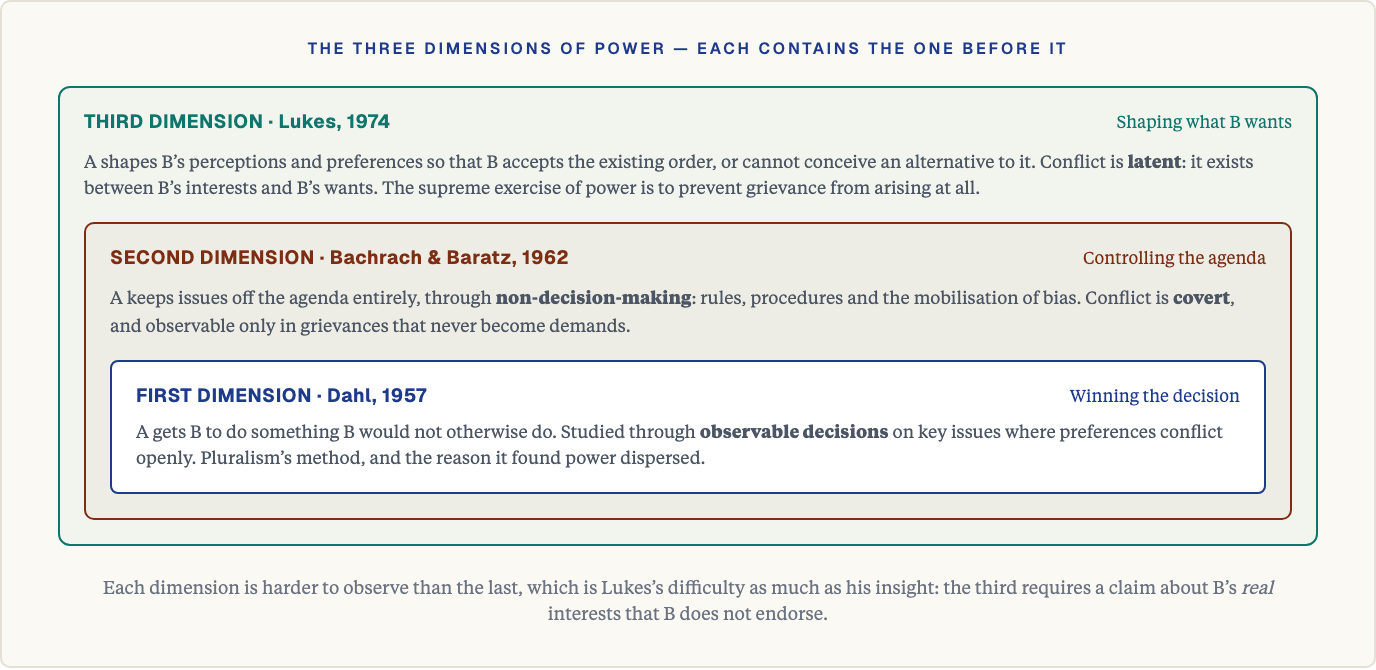
- First dimension (Dahl): power is visible in decisions. Second (Bachrach and Baratz, 1962): power also keeps issues off the agenda, through non-decision-making. Third (Lukes, 1974): power shapes what people want, so that grievance never arises.
- Gramsci‘s hegemony is the second and third dimensions worked out historically: the ruling class rules by manufactured consent through civil society, not by force alone.
- Foucault rejects the whole model. Power is not held but exercised, not repressive but productive, not centralised but capillary; power/knowledge, disciplinary power and the panopticon are the analytical tools.
- Macpherson distinguishes extractive power, the ability to use other people’s capacities, from developmental power, the ability to use one’s own. Liberal democracy’s failure is the continuous net transfer of the second into the first.
- Authority is the recognised right to command. Weber’s three pure types are traditional, charismatic and legal-rational, and charisma must undergo routinisation to survive its holder.
- Legitimacy for Weber is a matter of belief. Beetham‘s three-dimensional correction, legality plus justifiability plus expressed consent, is what makes the concept usable rather than circular.
- Habermas‘s legitimation crisis explains how a system can be legally impeccable and still lose the belief on which it depends.
Power: the three dimensions
The first: decisions
Robert Dahl‘s formulation in “The Concept of Power” (1957) gave the behavioural revolution a measurable variable: A has power over B to the extent that A can get B to do something that B would not otherwise do. Power is thus relational, situational and, crucially, observable through decisions actually taken on issues where preferences visibly conflict. The method produced Who Governs? (1961) and its pluralist conclusion that different elites prevailed in different domains.
The trouble is that the method determines the finding. If power is only visible in decisions, then a study of decisions cannot discover power that operates by preventing them.
The second: non-decisions
Peter Bachrach and Morton Baratz, in “Two Faces of Power” (1962), identified the face Dahl’s method missed. Power is also exercised when A devotes energy to creating or reinforcing social and political values and institutional practices that limit the scope of the political process to the consideration of issues that are comparatively innocuous to A. They called this non-decision-making and the mechanism the mobilisation of bias.
Grievances are suppressed before they become demands: by rules of procedure, by the anticipation of defeat, by the labelling of a claim as unreasonable, or by simply never being on any agenda.
The third: preferences
Thinker
Steven Lukes (b. 1941)
Key works. Power: A Radical View (1974; second edition 2005)
Core claim. Both earlier views assume observable conflict. But A may exercise power over B by influencing, shaping or determining B’s very wants, so that B accepts an order contrary to their real interests. The supreme exercise of power is to prevent conflict from arising at all.
Standard critique. It requires attributing real interests to people that they themselves do not acknowledge, which invites the objection that the theorist substitutes their own judgement for the subject’s. Lukes accepted the difficulty in the 2005 edition and located real interests in what people would want under conditions of relative autonomy.
Exam hook. The organising frame for any power question. Note that Lukes’s three-dimensional view is cumulative, not an alternative to the first two.
The connection to ideology is direct, and to adaptive preferences: if the deprived learn not to want what they cannot have, their contentment is evidence of power, not of satisfaction. Applied to India, the third dimension is what explains the historical acceptance of caste hierarchy by those subordinated within it, and why Ambedkar treated the destruction of the religious sanction as prior to any political remedy.
Hegemony
Thinker
Antonio Gramsci (1891–1937)
Key works. Prison Notebooks (written 1929–35)
Core claim. In advanced societies the dominant class rules less by coercion than by hegemony: moral and intellectual leadership secured through civil society, so that its particular worldview is accepted as common sense. The state is properly understood as political society plus civil society, force armoured by consent.
Standard critique. The concept is elastic enough to explain any outcome, which weakens it as an explanation; it underestimates the degree to which subordinate groups dissent while outwardly conforming, a point pressed by James Scott’s work on hidden transcripts.
Exam hook. UPSC asked about the linkage between power and hegemony in 2024. The answer is that hegemony is Lukes’s third dimension given a historical and institutional account.
Three of Gramsci’s derived concepts carry marks. The war of position, the long struggle for cultural leadership through education, media, religion and popular culture, replaces the frontal war of manoeuvre as the strategy appropriate to societies with dense civil societies. Organic intellectuals are those produced by a class to articulate and generalise its worldview, as against traditional intellectuals who imagine themselves autonomous. And passive revolution describes change directed from above that modernises social relations while preventing the subordinate classes from becoming an independent political force, which Indian scholars from Sudipta Kaviraj to Partha Chatterjee have used to characterise both the national movement’s later phase and post-1947 state-led development.
Louis Althusser‘s ideological state apparatuses (1970) is the structuralist parallel: alongside the repressive state apparatus of army, police and courts, the school, church, family and media reproduce the relations of production by interpellating individuals as subjects who recognise themselves in the roles offered to them.
Foucault: power without a centre
Michel Foucault, whose concept of power UPSC asked about in 2023, breaks with the entire tradition above. Four propositions organise the answer.
- Power is exercised, not possessed. It is not a commodity held by a sovereign or a class but a relation that circulates through a network. There is no central point from which it emanates.
- Power is productive, not merely repressive. It does not simply say no. It produces knowledge, categories, subjects and desires. The delinquent, the patient and the homosexual are not discovered by the human sciences but constituted by them.
- Power and knowledge imply one another. Power/knowledge is not the claim that knowledge serves power but that the exercise of power generates domains of knowledge and that knowledge is itself an exercise of power.
- Where there is power there is resistance. Resistance is internal to the relation, not external to it, which is why Foucault has no theory of emancipation and does not want one.
The historical argument in Discipline and Punish (1975) is that sovereign power, spectacular and directed at the body, gives way from the eighteenth century to disciplinary power, which operates through surveillance, examination, normalisation and the minute organisation of time and space in prisons, schools, barracks, factories and hospitals. Bentham’s panopticon is its diagram: because the inmate can always be seen but never knows when, surveillance is internalised and the prisoner becomes the principle of their own subjection.
The History of Sexuality (1976) adds biopower, power over populations as living beings, exercised through statistics, public health, birth rates and hygiene; the later lectures add governmentality, the conduct of conduct, which analyses liberal government as the management of populations through their own freedom rather than against it.
The critiques: Foucault leaves no ground for normative judgement, since if all knowledge is implicated in power there is no standpoint from which to criticise, which is Habermas’s objection; and the dissolution of the subject makes collective agency hard to theorise, which is the Marxist and feminist objection, though feminist scholars have made extensive use of disciplinary power to analyse the government of women’s bodies.
Macpherson on power
C.B. Macpherson, asked about in 2025, offers the most directly political of these accounts. In The Political Theory of Possessive Individualism (1962) he argues that the seventeenth century bequeathed a conception of the individual as essentially the proprietor of their own person and capacities, owing nothing to society for them. Society becomes a series of market relations between such proprietors, and freedom becomes freedom from dependence on others’ wills.
From this he derives a distinction that is the heart of any answer on him.
- Extractive power: a person’s ability to use other people’s capacities. It is a power over others and its increase in one person is a decrease in another.
- Developmental power: a person’s ability to use and develop their own capacities. It is a power to, and it is not inherently competitive; all can increase it together.
Capitalist market society, on his account, involves a continuous net transfer of powers from those without capital to those with it, because those lacking access to the means of labour must sell their capacity to work. Liberal democracy therefore contains a contradiction: it proclaims the equal right of each to develop their capacities while resting on an economy that systematically transfers those capacities upward. His ideal, participatory democracy, is the institutional correction, and it is why Macpherson belongs with Pateman in Chapter 6.
Authority
Authority is the recognised right to be obeyed, as distinct from the mere ability to compel. Power is the capacity to secure compliance; authority is the entitlement to it, and it succeeds by acknowledgement rather than by threat. Hannah Arendt makes the sharpest distinction: where force is used, authority has failed; and where argument is used, authority is in abeyance, since authority precludes the use of external means of coercion and equally precludes persuasion, which presupposes equality.
Weber‘s three pure types of legitimate domination are the framework.
| Type | Ground of the claim | Characteristic form |
|---|---|---|
| Traditional | The sanctity of immemorial custom and the status of those who exercise it | Monarchy, patriarchy, patrimonial and feudal rule |
| Charismatic | Devotion to the exceptional sanctity, heroism or exemplary character of an individual | Prophets, revolutionary and national leaders |
| Legal-rational | Belief in the legality of enacted rules and the right of those elevated under them to issue commands | Bureaucracy, constitutional state, the modern norm |
Three points make the difference between a textbook answer and a good one. Charismatic authority is inherently unstable because it rests on a person and on the continuing demonstration of their extraordinary quality, so it must undergo routinisation, converting into traditional (hereditary succession) or legal-rational (institutionalised office) form, or die with its holder. Legal-rational authority produces the bureaucracy Weber both admired for its technical superiority and feared as an iron cage of rationalised, impersonal life. And modern regimes are mixtures: Indian authority is legal-rational in its constitutional design, traditional in the persistence of caste and dynastic deference, and periodically charismatic in its leadership.
Legitimacy
Weber and the belief-based account
For Weber, an order is legitimate if it is believed to be legitimate by those subject to it. This is a sociological, descriptive account and it has an obvious defect: it makes legitimacy a matter of successful persuasion, so a regime that manufactures belief through propaganda counts as legitimate. That is exactly what UPSC’s 2025 question, on legitimacy acquired by consent versus manufactured by indoctrination, is probing.
Beetham’s correction
David Beetham, in The Legitimation of Power (1991), argues that Weber’s account mistakes the evidence for the thing. Power is legitimate to the degree that it satisfies three conditions:
- Legality. It conforms to established rules.
- Justifiability. The rules can be justified by reference to beliefs shared by both dominant and subordinate, which is a normative test, not merely a factual one about what people believe.
- Legitimation. There is evidence of consent expressed through actions: elections, participation, oaths, public acclamation.
The corresponding failures are illegitimacy (breach of rules), legitimacy deficit (rules no longer justifiable by shared beliefs) and delegitimation (withdrawal of expressed consent). This scheme is far more usable in an answer than Weber’s, because it lets you say precisely which component has failed in a given case.
Habermas and legitimation crisis
Habermas, in Legitimation Crisis (1973), describes how advanced capitalist states generate their own legitimacy problems. The state intervenes to manage economic crisis; in doing so it becomes visibly responsible for outcomes that were previously attributed to the market; when it fails to deliver, a rationality crisis in administration becomes a legitimation crisis, the withdrawal of mass loyalty, and ultimately a motivation crisis in which the cultural system stops supplying the motivations the system requires. His resolution, developed later, is discursive: legitimacy can only be regenerated through undistorted public deliberation, which links this chapter to Chapter 6.
Debate: Is legitimacy secured by consent or manufactured by indoctrination?
Consent. On Beetham’s account manufactured belief fails the second and third conditions. Beliefs induced by propaganda are not shared beliefs by which rules can be justified, since the subordinate would not hold them under conditions of free information, and acclamation extracted under conditions of controlled expression is not evidence of consent. A regime that must manufacture belief has a legitimacy deficit it is concealing. Manufacture. The Gramscian and Lukesian reply is that the distinction is not clean. Every regime shapes the beliefs by which it is judged, through schooling, national ritual, history curricula and media. If hegemony works by making a particular order appear as common sense, then all consent is to some degree produced, and the question is one of degree rather than of kind. The examiner’s line. Do not resolve it by definition. Take the degree question seriously and specify the test: legitimacy is closer to genuine consent where the conditions for withdrawing it exist, meaning free information, organised opposition, and a real possibility of removing rulers. That is why the presence of competitive elections and a free press is evidence about legitimacy and not merely about democracy. Close with the observation that no regime survives long on coercion alone, which is Gramsci’s point and the reason he studied consent rather than force.
Power is the probability that one actor within a social relationship will be in a position to carry out his own will despite resistance
Max Weber, Economy and Society, 1922
A has power over B to the extent that he can get B to do something that B would not otherwise do
Robert Dahl, The Concept of Power, 1957
Is it not the supreme exercise of power to get another or others to have the desires you want them to have?
Steven Lukes, Power: A Radical View, 1974
Where answers lose marks
- Describing the three dimensions as competing theories. They are cumulative: each includes the previous and adds what it could not see.
- Omitting the objection to the third dimension. Real interests that the subject does not acknowledge is the difficulty, and Lukes himself conceded it in 2005.
- Treating Foucault as a fourth face of power. He rejects the model in which the question is who holds power; saying so is half the answer.
- Reducing hegemony to propaganda. Hegemony operates through consent that feels like common sense, which is why civil society, not the state, is its terrain.
- Giving Weber’s three types of authority without routinisation. Charisma’s instability is the analytically interesting part.
- Using Weber’s belief-based definition of legitimacy uncritically when the question is about indoctrination. Beetham’s three conditions are the instrument that question requires.
Asked before
- Explain the Macpherson’s view on power. (2025, Paper I, 10 marks)
- Do you think that legitimacy acquired by consent or manufactured by indoctrination is an essential element in maintenance of political rule? Justify your answer with relevant examples. (2025, Paper I, 15 marks)
- Legitimacy adds positive value to political authority and obligation. Discuss. (2024, Paper I, 20 marks)
- Linkage between Power and Hegemony. (2024, Paper I, 10 marks)
- Foucault’s concept of power. (2023, Paper I, 10 marks)
Answer skeleton
Do you think that legitimacy acquired by consent or manufactured by indoctrination is an essential element in maintenance of political rule? Justify your answer with relevant examples. (15 marks, 250 words)
Frame. Two claims are being asked about: that legitimacy is essential, and that consent and manufacture are alternatives. Accept the first, complicate the second.
Why legitimacy is essential. Coercion is expensive and self-defeating: a regime that must compel every act of compliance cannot govern a complex society. Weber’s whole typology exists because domination requires belief in its rightness.
Consent, on Beetham’s test. Legality, justifiability by shared beliefs, and expressed consent. Manufactured belief fails the second and third, because beliefs induced under controlled information are not shared beliefs and controlled acclamation is not evidence.
Manufacture, on Gramsci and Lukes. Hegemony works by making a contingent order appear as common sense; the third dimension of power shapes wants. So all consent is partly produced, and the distinction is one of degree.
The test that distinguishes them. Whether the conditions for withdrawing consent exist: free information, organised opposition, a real possibility of removing rulers. This is what separates a legitimate order from a manufactured one.
Examples. Contrast a regime whose consent survives free elections and a free press with one that suppresses both while claiming overwhelming support. Note Habermas’s legitimation crisis, where legality persists while mass loyalty drains away, as the case that shows legality alone is insufficient.
Conclude. Legitimacy is essential; manufactured legitimacy is real but brittle, because it cannot survive the free flow of information that a modern economy requires.
Last-mile revision
- Weber: power as probability of carrying out one’s will despite resistance. Dahl 1957: A gets B to do what B would not otherwise do.
- Three dimensions: Dahl (decisions), Bachrach and Baratz 1962 (non-decisions, mobilisation of bias), Lukes 1974 (preference-shaping, latent conflict, real interests).
- Gramsci: hegemony, war of position and manoeuvre, organic intellectuals, passive revolution. Althusser: ideological state apparatuses, interpellation.
- Foucault: power exercised not possessed, productive not repressive, capillary, power/knowledge; Discipline and Punish (1975), panopticon, disciplinary power; biopower and governmentality. Habermas’s normative objection.
- Macpherson: possessive individualism (1962), extractive versus developmental power, net transfer of powers, participatory democracy as the correction.
- Authority: Arendt’s distinction from both force and persuasion. Weber’s traditional, charismatic, legal-rational; routinisation of charisma; the iron cage.
- Legitimacy: Weber’s belief-based account and its defect. Beetham’s three conditions, legality, justifiability, expressed consent, and the three failures, illegitimacy, legitimacy deficit, delegitimation.
- Habermas 1973: rationality crisis to legitimation crisis to motivation crisis.
Read the rest. This chapter is one of 58 in the complete PSIR Optional Notes, covering Paper I and Paper II in full — free to download.
Tell Google you want more of this.
Add Anantam IAS as a preferred sourceOne tap, and this site shows up more often in your own Top Stories, AI Overviews and AI Mode. Remove it any time.