
A right is a claim strong enough to override the general welfare. Every dispute in this chapter is about where such claims come from, and every attack on rights is an attack on the answer given.
This is chapter 5 of the PSIR Optional Notes, from the part on Political Theory in the Paper I syllabus. The complete book is a free download.
UPSC syllabus
Rights: Meaning and theories; different kinds of rights; concept of Human Rights.
In one page
- A right is a justified claim that entails a corresponding duty in someone else. Hohfeld‘s four incidents, claim, liberty, power and immunity, keep the term precise; most confusion in answers comes from using one word for four things.
- Natural rights theory grounds rights in nature or reason and makes them prior to the state. Legal theory grounds them in enactment, so a right not enforceable is not a right. Bentham’s nonsense upon stilts is the classic statement of the second against the first.
- Will theory (Hart) makes a right a protected choice; interest theory (Raz, MacCormick) makes it a protected interest. Will theory cannot explain the rights of infants; interest theory struggles to explain why not every interest generates a right.
- Marx‘s critique in On the Jewish Question (1843) is that the rights of man are the rights of the egoistic individual, separated from community, and that political emancipation is not human emancipation.
- Vasak‘s three generations map onto liberty, equality and fraternity: civil-political, socio-economic, and solidarity rights. The Vienna Declaration of 1993 rejected the implied hierarchy.
- The universalism versus cultural relativism debate is the live one. Both positions have a fatal version, and Sen‘s reply to the Asian values argument is the way through.
- The multicultural claim is that uniform rights presuppose a culturally neutral state that does not exist, so equal rights may require differentiated rights.
- In India, rights expanded through Article 21. Maneka Gandhi (1978) imported substantive due process in effect, and Puttaswamy (2017) recognised privacy as intrinsic to it.
What a right is
A right is a claim that others are under a duty to respect, and which the claimant is entitled to press. Three features distinguish rights from mere interests or desires: they are justified by some ground, they correlate with duties, and they have a peculiar peremptory force. Ronald Dworkin‘s formulation is that rights are trumps over background justifications of policy: to say someone has a right is to say that the general welfare is not a sufficient reason to override it.
Hohfeld’s analysis
Wesley Hohfeld‘s scheme (1913, 1917) is the precision instrument. He identified four distinct positions that the word “right” is used for, each with its own correlative.
| Incident | What it means | Correlative in others |
|---|---|---|
| Claim-right | X is owed something by Y | Y has a duty to X |
| Liberty (privilege) | X has no duty not to act | Others have no-right that X refrain |
| Power | X can alter legal relations | Y is under a liability to that change |
| Immunity | X’s position cannot be altered by Y | Y is under a disability |
The distinction that matters most in political argument is the first two. A claim-right to education imposes a duty on the state to provide it. A liberty to speak imposes only a duty not to obstruct. Arguments about whether socio-economic rights are “real” rights are usually arguments about whether they are claims or merely liberties.
Key terms
Rights as trumps — Dworkin’s account: a right defeats an appeal to the general welfare, and a government that overrides it must show more than aggregate benefit.
Will theory — A right is a protected choice; the right-holder controls the correlative duty and can waive it. Hart’s position.
Interest theory — A right exists where an aspect of a person’s well-being is sufficient reason to hold others under a duty. Raz’s position.
Inalienable — Incapable of being surrendered even voluntarily. Locke’s life and liberty are inalienable; property, on his account, is not.
Theories of rights
Natural rights
Rights inhere in persons by virtue of their nature or their rationality, prior to and independent of any state. Locke‘s life, liberty and estate is the canonical list, and the American Declaration of 1776 and the French Declaration of 1789 are its political expression. Thomas Paine, in Rights of Man (1791), distinguishes natural rights, which belong to a person as a person, from civil rights, which are natural rights exchanged for the greater security of society.
Its strength is that it provides a standpoint from which existing law can be condemned, which is exactly what a purely legal theory cannot do. Its weakness is metaphysical: the ground of these rights, whether God, nature or reason, is contested, and different traditions read off different lists.
Legal and utilitarian theories
Bentham rejected natural rights entirely. Rights are the children of law: from real law come real rights, but from imaginary law come imaginary rights. Natural rights are simple nonsense; natural and imprescriptible rights are rhetorical nonsense, nonsense upon stilts. On this account a right is a legally enforceable claim, and its justification is that recognising it maximises utility.
The utilitarian defence of rights is stronger than it looks. J.S. Mill argued in Utilitarianism (1861) that a right is something society ought to defend a person in the possession of, and that the reason is general utility, but of an extraordinarily important kind, which is why rights feel categorical even though their ground is consequentialist.
The objection is the one Rawls pressed: utilitarianism does not take seriously the distinction between persons. A theory that permits sacrificing one for the aggregate has not explained the force we actually attribute to rights.
Historical and conservative
Burke treated rights as inherited entitlements accumulated within a specific political tradition, not deductions from abstract reason. The Englishman’s rights are an entailed inheritance from forefathers, and the French error was to abandon a real inheritance for an abstraction. The strength is realism about how rights are actually secured; the weakness is that it offers nothing to those whose tradition never granted them any.
The Marxist critique
Marx, in On the Jewish Question (1843), delivers the critique still most worth knowing. The so-called rights of man are the rights of the egoistic individual, of man separated from other men and from the community: liberty as the right to do as one likes within limits, property as the right to enjoy one’s fortune without regard to others, security as the guarantee of that egoism. Political emancipation, the winning of equal civil status, is real progress but is not human emancipation, because it leaves the material conditions of domination untouched and merely removes them from political view.
The reply, from Sen among others, is that formal rights are the instruments through which substantive claims are actually won, and that regimes which suspended them in the name of material equality delivered neither.
Kinds of rights
Negative and positive
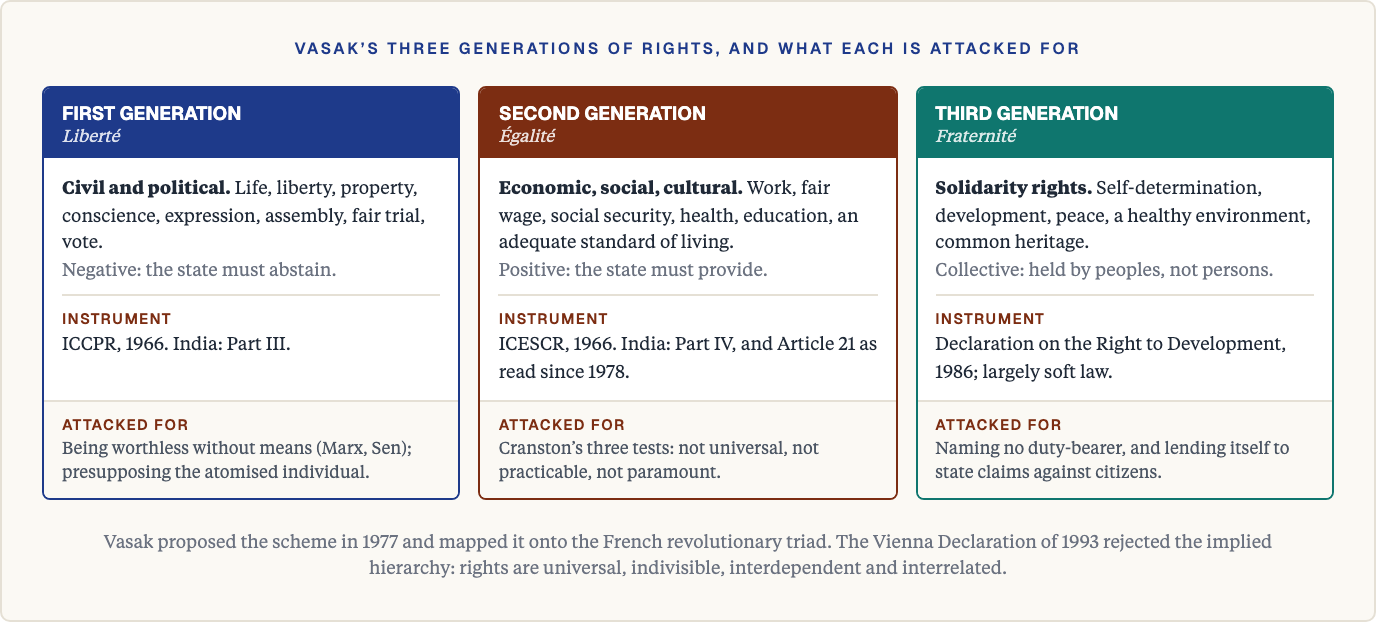
Negative rights require others, chiefly the state, to abstain. Positive rights require provision. The distinction is analytically useful and practically overstated: enforcing a negative right to property requires courts, police and registries, all of which cost money, so the idea that first-generation rights are cost-free does not survive scrutiny.
Maurice Cranston‘s three tests are the standard case against socio-economic rights being rights at all. To qualify, a claim must be universal (owed to everyone), practicable (capable of being met now) and paramount (of overriding importance). A right to paid holidays fails the first two. The counter-argument, accepted in the ICESCR’s language of progressive realisation, is that practicability is a matter of degree, and that a right can impose a duty of best endeavour without imposing an immediate duty of full provision.
The three generations
Karel Vasak proposed the scheme in 1977 and mapped it onto the revolutionary triad. The sequence is historical rather than logical, and the hierarchy it implies was expressly repudiated by the Vienna Declaration and Programme of Action of 1993, which affirmed that all human rights are universal, indivisible, interdependent and interrelated.
Third-generation rights attract the sharpest doctrinal objection: they identify no determinate duty-bearer. If everyone has a right to development, who is obliged to deliver it, and what happens if they do not? The second objection is political: collective rights held by peoples can be, and have been, invoked by states against their own citizens, on the argument that individual claims must yield to national development.
Human rights
The modern regime begins with the Universal Declaration of Human Rights (1948), a General Assembly resolution and not a treaty, given binding force by the two Covenants of 1966, the ICCPR and the ICESCR, both of which entered into force in 1976. The split into two covenants was itself a Cold War artefact: the West prioritised civil and political rights, the Soviet bloc socio-economic, and the compromise was two instruments with different enforcement machinery, the stronger attached to the first.
Universalism against cultural relativism
This is the debate UPSC asked about in 2024, and the marks are in showing that both positions have a defensible and an indefensible version.
Strong universalism holds that human rights are valid everywhere and admit of no cultural qualification. Its indefensible version is the claim that a particular Western liberal articulation of rights is the only possible one, which is genuinely parochial and has served as a cover for intervention.
Strong relativism holds that moral standards are internal to cultures, so external criticism is illegitimate. Its indefensible version licenses any practice a regime describes as traditional, and it has an internal problem: cultures are not unanimous, and the people who declare what the culture requires are usually those the practice benefits.
The Asian values argument, advanced in the 1990s by Lee Kuan Yew and Mahathir Mohamad and reflected in the Bangkok Declaration of 1993, held that Asian societies prioritise order, consensus, family and community over individual claims, and that political rights may reasonably be traded for development.
Amartya Sen‘s reply in “Human Rights and Asian Values” (1997) does the necessary work. He denies the premise on historical grounds: Ashoka’s edicts on tolerance and Akbar’s insistence on free discussion are Asian, and so are authoritarian traditions, so “Asia” contains no single value set. He denies the trade-off on evidence: there is no established correlation between authoritarian rule and economic growth, and his famine argument, that no substantial famine has occurred in a functioning democracy with a free press, shows political rights doing developmental work. And he notes the identity of the speakers: the argument is advanced by governments, not by the populations whose values are being described.
Weak universalism, the position most defensible, holds that a core of rights is universal while their institutional expression legitimately varies. Vienna 1993 codified something close to it by affirming universality while acknowledging that national and regional particularities must be borne in mind.
The multicultural perspective
The claim, developed in Chapter 4, applies to rights directly: a uniform scheme of rights presupposes a culturally neutral state, and no state is culturally neutral. Its language, calendar and default norms are the majority’s, so identical rules impose unequal burdens. Kymlicka therefore argues that a liberal commitment to individual autonomy requires group-differentiated rights, since autonomy is exercised within a secure societal culture. His limit is that groups may claim external protections against the wider society but not internal restrictions on their own members.
Okin‘s objection is that the practices most fiercely defended fall on women, and Barry‘s is that differentiated rights fracture the common citizenship on which redistribution depends. In India this is not theory: Article 30’s minority educational rights, personal law, and the uniform civil code debate under Article 44 are precisely this argument in constitutional form.
Rights in India
Part III is enforceable against the state under Article 12, with Articles 15(2), 17, 23 and 24 operating horizontally against private parties as well. The remedy is itself a fundamental right under Article 32, which Ambedkar called the heart and soul of the Constitution.
The expansion has happened almost entirely through Article 21.
- A.K. Gopalan (1950) read the rights as separate silos and confined Article 21 to procedure established by law, however unreasonable.
- R.C. Cooper (1970) and Maneka Gandhi (1978) reversed this. Articles 14, 19 and 21 are a connected scheme, and the procedure contemplated must be fair, just and reasonable, which imports substantive review in all but name.
- From that base Article 21 has been read to include livelihood, shelter, health, education (later made express by the Eighty-sixth Amendment and Article 21A), a clean environment, speedy trial and legal aid.
- K.S. Puttaswamy (2017) held privacy to be intrinsic to life and personal liberty, unanimously, overruling M.P. Sharma and Kharak Singh on the point.
Two institutional points complete the picture. The National Human Rights Commission, established under the Protection of Human Rights Act 1993, has recommendatory powers only and cannot directly investigate armed-forces complaints, which is the standing criticism of it. And Fundamental Duties in Article 51A, inserted by the Forty-second Amendment in 1976 on the recommendation of the Swaran Singh Committee, are non-enforceable but have been used as an interpretive aid, notably in environmental cases.
Debate: Are human rights universal, or a Western export?
Universal. The claim rests on personhood, not culture, and the arguments for relativism are almost always made by governments rather than by the people whose culture is invoked. Cultures are internally contested; deferring to their official spokesmen is deferring to their powerful. The Vienna Declaration’s language of indivisibility was adopted by consensus, including by the states now said to reject the framework. Western. The historical genealogy is undeniably European, the list is weighted toward the individual against the community, and the enforcement record is selective in a way that tracks power. The insistence on civil-political rights over socio-economic ones was itself a Cold War position, which shows the supposedly universal core is contingent. The examiner’s line. Distinguish the origin of a concept from its validity: an idea’s provenance does not settle whether it is true, or algebra would be suspect in Europe. Take the weak-universalist position, a universal core with variable institutional expression, and use Sen’s threefold reply, that there is no single Asian value set, no established authoritarian growth premium, and no warrant for treating governments as spokesmen for cultures.
Natural rights is simple nonsense: natural and imprescriptible rights, rhetorical nonsense, nonsense upon stilts
Jeremy Bentham, Anarchical Fallacies, 1796
None of the so-called rights of man goes beyond egoistic man, man as a member of civil society
Karl Marx, On the Jewish Question, 1843
Where answers lose marks
- Using “right” for four different things. If an answer distinguishes a claim from a liberty even once, it reads as trained.
- Presenting natural rights and legal rights as a historical sequence. They are rival grounds, and the natural-rights position is alive in every constitutional argument about unenumerated rights.
- Reciting the three generations without the objection to the third. The absence of a determinate duty-bearer is the whole difficulty.
- Treating the Asian values debate as settled by asserting universalism. Sen’s reply works because it engages the premise, not because it asserts the conclusion.
- Saying the UDHR is binding. It is a General Assembly resolution; the Covenants of 1966 carry the obligation, though much of the UDHR is now treated as customary law.
- Writing about Article 21’s expansion without Maneka Gandhi (1978). That is where the silo reading of Gopalan ends.
Asked before
- The debate on human rights is caught between the limitations of both universalism and cultural relativism. Comment. (2024, Paper I, 20 marks)
- Multicultural perspective on rights. (2023, Paper I, 10 marks)
Answer skeleton
The debate on human rights is caught between the limitations of both universalism and cultural relativism. Comment. (20 marks, 350 words)
Frame. Accept the premise and specify it. Each position has a defensible weak version and an indefensible strong one; the question is asking for both sets of limits, not for a choice.
Universalism, and its limit. Grounded in personhood; gives a standpoint from which any regime can be criticised. Its limit is that the supposedly universal list has a particular genealogy, was weighted toward civil-political rights for Cold War reasons, and has been enforced selectively along lines of power.
Relativism, and its limit. Real insight: rights language can carry cultural imperialism, and institutions must fit societies. Its limit is that cultures are not unanimous, so the question becomes who speaks for them, and the answer is usually those the practice benefits.
The Asian values episode. Lee and Mahathir; Bangkok Declaration 1993. It is the debate’s sharpest instance because it was advanced by states about their own populations.
Sen’s threefold reply. No single set of Asian values, since Ashoka and Akbar are as Asian as any authoritarian tradition; no demonstrated authoritarian growth premium; and the famine argument, which shows political rights doing developmental work.
The way through. Weak universalism: a universal core with variable institutional expression, which is close to what Vienna 1993 adopted. Note that Indian constitutional practice already runs this way, uniform fundamental rights alongside Article 30 and personal law.
Conclude. The debate is not resolved by choosing a side but by disaggregating: which right, whose claim, and who is speaking for the culture.
Last-mile revision
- Hohfeld’s four incidents and correlatives: claim/duty, liberty/no-right, power/liability, immunity/disability.
- Dworkin: rights as trumps. Hart: will theory. Raz and MacCormick: interest theory.
- Locke and Paine for natural rights; Bentham’s nonsense upon stilts for the legal theory; Burke for the historical; Marx 1843 for political against human emancipation.
- Cranston’s three tests against socio-economic rights: universal, practicable, paramount. ICESCR’s answer is progressive realisation.
- Vasak 1977: three generations mapped to liberty, equality, fraternity. UDHR 1948, ICCPR and ICESCR 1966 in force 1976, Vienna 1993 for universality and indivisibility.
- Asian values: Lee Kuan Yew, Mahathir, Bangkok Declaration 1993. Sen 1997: no single Asian value set, no growth premium, the famine argument.
- Kymlicka’s group-differentiated rights, external protections against internal restrictions; Okin and Barry as the counters.
- India: Gopalan (1950) silos, Maneka Gandhi (1978) the connected scheme and fair procedure, Puttaswamy (2017) privacy. Article 32 as the heart and soul.
- Article 51A duties: Forty-second Amendment 1976, Swaran Singh Committee, non-enforceable but interpretively used.
Read the rest. This chapter is one of 58 in the complete PSIR Optional Notes, covering Paper I and Paper II in full — free to download.
Tell Google you want more of this.
Add Anantam IAS as a preferred sourceOne tap, and this site shows up more often in your own Top Stories, AI Overviews and AI Mode. Remove it any time.