
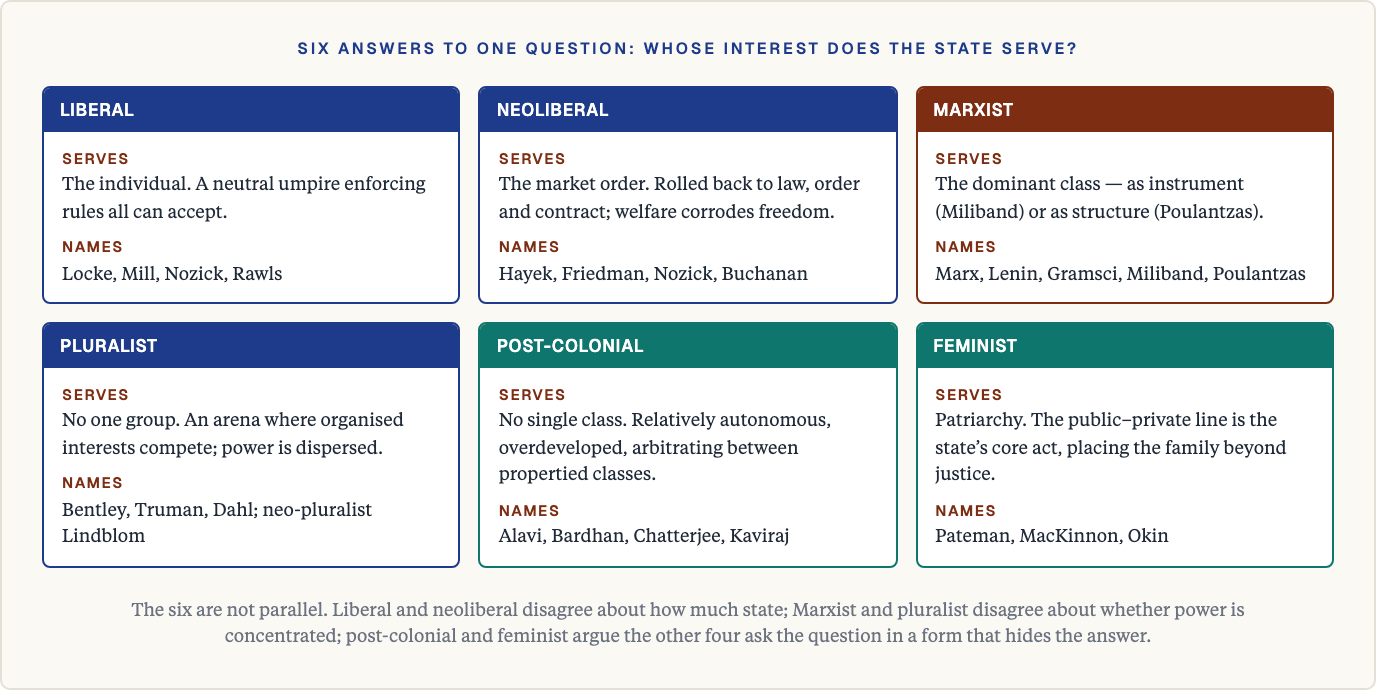
Every theory of the state is an answer to one question: in whose interest does it act? The theories differ less in what they observe than in where they look for the answer, which is why evidence rarely settles the argument between them.
This is chapter 2 of the PSIR Optional Notes, from the part on Political Theory in the Paper I syllabus. The complete book is a free download.
UPSC syllabus
Theories of the state: Liberal, Neoliberal, Marxist, Pluralist, Post-colonial, Feminist.
In one page
- The state is a compulsory political association with a monopoly of legitimate violence over a territory. Weber’s definition is the one to open with; it is descriptive and says nothing about purpose, which is where the theories diverge.
- Liberal: the state is an instrument created by individuals to secure rights it cannot itself define. Its authority rests on consent and is limited by that purpose.
- Neoliberal: the state should be rolled back to the framework functions of law, order and contract. Welfare provision corrodes freedom and produces the servile mind.
- Marxist: the state is not neutral. In the instrumentalist reading it is the executive committee of the bourgeoisie; in the structuralist reading it is relatively autonomous and serves capital precisely by not obeying capitalists.
- Pluralist: power is dispersed among competing organised groups and the state is the arena where their competition is resolved. Neo-pluralism concedes that business holds a privileged position.
- Post-colonial: the colonial state was overdeveloped relative to its society. The successor state is relatively autonomous, arbitrating between proprietary classes, and Chatterjee’s political society names what liberal citizenship misses.
- Feminist: the state is patriarchal. Its foundational act is the public–private division, which places the family beyond the reach of justice.
- Gandhi belongs in this chapter as the anti-statist. The state, for him, is violence in concentrated form; his alternative is not anarchy but Ramrajya built from self-governing villages.
Defining the state
Max Weber gives the definition that all sides accept as a starting point: the state is a human community that successfully claims the monopoly of the legitimate use of physical force within a given territory. Three features are doing the work. The monopoly is of legitimate force, so the state is distinguished not by violence but by the recognised right to it. The claim is successful, so statehood is an achieved condition, not a legal status. And the monopoly is territorial, which distinguishes the modern state from feudal and imperial forms organised around persons rather than borders.
Four attributes follow in the standard account: population, territory, government and sovereignty. In the international context, the Montevideo Convention of 1933 adds the capacity to enter into relations with other states.
Two distinctions carry marks.
State and government. The state is permanent, abstract and inclusive of all citizens; government is temporary, concrete and consists of officeholders. Governments change without the state changing. The distinction is what makes it coherent to oppose a government while owing allegiance to the state.
State and civil society. Civil society is the sphere of voluntary association outside the state and, in most usages, outside the family. Hegel treated it as the realm of particular interest, requiring the state to reconcile it into a universal interest. Gramsci relocated it as the terrain on which hegemony is built and contested, which is the sense that matters for Chapter 7.
The liberal state
The contractarian foundation
Liberal theory derives the state from individuals who exist, conceptually, before it. In the state of nature men are free and equal; the inconveniences of that condition lead them to contract into political society. The state is therefore instrumental: it exists for purposes given to it from outside, and its authority is limited by them.
Hobbes produces an absolutist conclusion from individualist premises. The state of nature is a state of war of every man against every man, life is solitary, poor, nasty, brutish and short, and escape requires surrendering all right to a sovereign whose power must be undivided and unaccountable, since a divided sovereign is no sovereign.
Locke produces the liberal conclusion. The state of nature is inconvenient rather than intolerable: it has a law of nature and natural rights to life, liberty and estate, but lacks a settled law, an impartial judge and an effective executive. Government is therefore a trust, limited to remedying those three defects, and the people retain the right to resist and replace a government that violates the trust. This is the source of constitutionalism, limited government, and the doctrine of the right of revolution that UPSC asked about in 2024.
Rousseau breaks the pattern. Sovereignty rests with the people and cannot be represented; the general will is not the will of all but the will aimed at the common good, and the individual who dissents from it may be forced to be free. That phrase is the reason he is read as an ancestor of both radical democracy and totalitarian democracy, Talmon’s charge.
From negative to positive liberalism
Classical liberalism, from Locke through Adam Smith to the early Mill, conceives the state negatively: it is a necessary evil, and freedom is the absence of interference. Mill’s harm principle in On Liberty (1859) states the limit, that the only purpose for which power may rightfully be exercised over any member of a civilised community against their will is to prevent harm to others.
Positive liberalism emerges from the late nineteenth century in T.H. Green, Hobhouse and Hobson, and matures in Keynes and Beveridge. Its claim is that freedom is not merely the absence of restraint but the presence of capacity, so ignorance, sickness and destitution are as real an obstacle to freedom as a policeman. The state acquires a positive duty to remove them. The welfare state is this argument institutionalised, and Rawls is its most rigorous defence.
Key terms
Instrumental view of the state — The state exists for purposes external to it, chiefly the protection of rights, and has no ends of its own. The core liberal premise.
Constitutionalism — Government limited by a higher law, enforced by an independent judiciary. Locke’s trust doctrine institutionalised.
Nightwatchman state — The minimal state confined to defence, policing and enforcement of contracts. Classical liberal ideal, revived by Nozick.
Enabling state — The positive-liberal state that removes the social obstacles to effective freedom. Green’s argument, Beveridge’s institutions.
The neoliberal state
Thinker
Friedrich Hayek (1899–1992)
Key works. The Road to Serfdom (1944), The Constitution of Liberty (1960), Law, Legislation and Liberty (1973–79)
Core claim. Economic planning is incompatible with freedom because the knowledge required to plan is dispersed and tacit, existing nowhere in aggregate. The market is a discovery procedure and a spontaneous order; the state’s proper role is to maintain the general rules within which that order operates, not to direct outcomes.
Standard critique. The knowledge argument tells against comprehensive planning but not against redistribution or regulation; the claim that welfare states slide toward totalitarianism is not borne out by the post-war record of Scandinavia.
Exam hook. The strongest theoretical case against the welfare state. Pair with Nozick for the rights argument and Buchanan for the fiscal one.
Neoliberalism as a state theory has three components. Hayek’s epistemic case says the planner cannot know enough. Public choice theory, from Buchanan and Tullock, applies economic assumptions to political actors: bureaucrats maximise budgets, politicians maximise votes, and the result is an inexorable growth of government serving those inside it rather than the public. Nozick’s rights case, treated in Chapter 3, says redistribution violates self-ownership regardless of its consequences.
The programme that follows is deregulation, privatisation, fiscal discipline, a shift from universal provision to targeting, and a redefinition of the citizen as a consumer of public services. In India this describes the direction of the 1991 reforms, though the Indian state’s disengagement has been highly uneven: liberalised in industrial licensing and trade, still dominant in banking, land and agricultural procurement.
The standard critiques are that market failure is as real as government failure and that neoliberalism has no theory of it; that the rolled-back state has in practice been a restructured rather than a smaller state, since deregulation requires a large regulatory apparatus; and that the resulting inequality corrodes the political equality liberalism claims to value.
The Marxist state
The classical position
For Marx and Engels the state belongs to the superstructure, determined in the last instance by the economic base. The Communist Manifesto (1848) gives the instrumentalist formula: the executive of the modern state is but a committee for managing the common affairs of the whole bourgeoisie. The state is not an arbiter above classes; it is a weapon of the dominant class, and its apparent neutrality is itself ideological.
Lenin, in The State and Revolution (1917), draws the strategic conclusion. The bourgeois state cannot be captured and used by the proletariat; it must be smashed and replaced by the dictatorship of the proletariat, which is a state of a new type. As classes disappear, the state’s repressive functions become unnecessary and it withers away, leaving the administration of things in place of the government of men.
Gramsci makes the decisive amendment. In advanced societies the ruling class governs less by coercion than by hegemony, the manufactured consent secured through civil society: schools, churches, press, popular culture. The state in the expanded sense is political society plus civil society, force plus consent. The revolutionary strategy that follows is not the frontal assault, the war of manoeuvre, but the long contest for cultural leadership, the war of position.
The instrumentalist–structuralist debate
The Miliband–Poulantzas exchange of 1969–73 is the reference point.
Ralph Miliband, in The State in Capitalist Society (1969), argues empirically: the personnel of the state elite are drawn overwhelmingly from the propertied class, share its outlook and its schools, and act accordingly. The state serves capital because capitalists staff and lobby it.
Nicos Poulantzas replies that this concedes too much. If the state served capital only through personnel, staffing it differently would change its character. The state serves capital structurally, by virtue of its position in the mode of production, and it does so best when it is relatively autonomous from any particular capitalist faction, because only then can it impose the long-term interest of capital as a whole against short-term capitalist greed. Welfare legislation and factory acts are therefore evidence for the theory, not against it.
The structuralist version is more powerful and less falsifiable, which is the standing objection to it. If both action for capitalists and action against them count as serving capital, it is not clear what would count as disconfirming evidence.
| Liberal | Marxist | |
|---|---|---|
| Origin | Contract among free individuals | Emergence of private property and class division |
| Nature | Neutral umpire, instrument of all | Instrument or condensation of class power |
| Autonomy | Genuinely above particular interests | Only relatively autonomous, and in capital’s long interest |
| Underlying premise | Individuals and their consent are prior to society | Social being determines consciousness; the individual is a product of class relations |
| Law | The framework of freedom, equal for all | Formal equality masking substantive domination |
| Future | Permanent, reformable | Withers away with the abolition of classes |
The premise row is what an examiner is looking for. The liberal begins from methodological individualism, so the state must be explained by what individuals want. The Marxist begins from the mode of production, so what individuals want must itself be explained. The disagreement is therefore prior to any evidence about how states behave.
The pluralist state
Pluralism begins in the group theory of Arthur Bentley and David Truman, and reaches its influential form in Robert Dahl‘s Who Governs? (1961), a study of New Haven concluding that different elites prevailed in different issue areas, that no single group ruled, and that the system was therefore a polyarchy: rule by many minorities, in which any group that organises can obtain a hearing.
The theory of the state that follows is that the state is a neutral arena. Public policy is the resultant of group pressure; the state registers the balance rather than imposing a direction of its own.
The critiques are well developed and an answer needs at least two.
- Non-decisions. Bachrach and Baratz argued in 1962 that Dahl studied only decisions actually taken, and so could not see the power to keep issues off the agenda entirely.
- Elite theory. C. Wright Mills’s The Power Elite (1956) finds a unified elite spanning corporate, military and political hierarchies, not competing minorities.
- Unequal organisability. Groups do not form in proportion to interests. Olson’s logic of collective action shows that small groups with concentrated interests organise easily while large diffuse groups do not, so pluralism systematically over-represents producers against consumers.
- Neo-pluralism. Charles Lindblom’s Politics and Markets (1977) concedes the central point: business occupies a privileged position, because governments depend on investment decisions they do not control, so business does not need to lobby to be obeyed.
Applied to India, pluralism is at its most persuasive in explaining the politics of the coalition era and the influence of farm, trade and caste associations, and at its weakest in explaining which claims never reach the agenda at all.
The post-colonial state
Thinker
Hamza Alavi (1921–2003)
Key works. “The State in Post-Colonial Societies: Pakistan and Bangladesh” (1972)
Core claim. The colonial state was overdeveloped relative to the society it governed, built to subordinate an entire native social formation. The successor state inherits that apparatus, so it is not the instrument of any single indigenous class but is relatively autonomous, mediating between three propertied classes: the metropolitan bourgeoisie, the indigenous bourgeoisie and the landed classes.
Standard critique. Derived from Pakistan’s military-bureaucratic experience and travels poorly to India, where an elected political class has consistently subordinated the bureaucracy and the army.
Exam hook. The starting point for any post-colonial state answer. Correct it with Bardhan for India.
Pranab Bardhan, in The Political Economy of Development in India (1984), offers the Indian version: three dominant proprietary classes — industrial capitalists, rich farmers, and the professional and bureaucratic elite — none strong enough to dominate. The state’s relative autonomy is real but its effect is stalemate, since surplus is dissipated in subsidies bought by each class rather than invested. This is the standard explanation of why Indian planning underperformed its ambitions.
Partha Chatterjee adds the conceptual move that matters most. In The Politics of the Governed (2004) he distinguishes civil society, the domain of proper citizens with enforceable rights, from political society, the domain in which the great majority negotiates with the state through claims that are not strictly legal at all: encroached land regularised, illegal connections tolerated, benefits secured through the language of need and political brokerage. This is not a failure of citizenship but a distinct mode of politics, and it explains a great deal about Indian urban governance.
Sudipta Kaviraj supplies the accompanying argument: the Indian state’s modernity is a grafted, elite project encountering a society organised on entirely different principles, which produces the persistent gap between the state’s formal categories and the way people actually live under them.
Post-colonial theory’s wider claim, which UPSC pressed in 2023, is that Eurocentrism is both its target and its motive force. It attacks the universalisation of European categories, and it does so with concepts, sovereignty, rights, civil society, that come from precisely that tradition. Chakrabarty’s formula in Provincializing Europe (2000) is that European thought is at once indispensable and inadequate.
The feminist state
Feminist theory holds that the state is not gender-neutral, and identifies the mechanism rather than merely asserting the conclusion.
Carole Pateman, in The Sexual Contract (1988), argues that the social contract of liberal theory was preceded by a sexual contract: the fraternal pact among men that established their access to women’s bodies and labour. The public sphere of contract and consent was constituted by excluding the domestic sphere from it, so the liberal state’s founding act is the public–private division itself.
Catharine MacKinnon takes the radical position: the liberal state is male in the specific sense that it adopts the standpoint of men in its very claim to objectivity. Neutrality in a condition of substantive inequality reproduces that inequality, so formally equal law delivers unequal outcomes.
Susan Moller Okin takes the liberal-feminist position: the fault is not liberalism but liberalism’s failure to apply its own principles to the family, which is the first school of justice and the site where gender is produced.
Liberal, socialist and radical feminism generate three different prescriptions. Liberal feminism seeks equal access to the state, through legal reform, suffrage and anti-discrimination law. Socialist feminism argues that the state serves capitalism through the unpaid reproductive labour performed in the household. Radical feminism doubts that a patriarchal state can be the instrument of women’s emancipation at all.
In India the argument is concrete: the state that legislated against dowry and domestic violence is the same state whose personal-law regime leaves the family largely to religious jurisdiction, and whose criminal law treated marital rape as an exception. Both facts are evidence, and a good answer holds them together rather than choosing one.
Gandhi against the state
Gandhi’s position does not fit the six categories and UPSC has asked it directly, quoting his claim that the state does the greatest harm to mankind by destroying individuality, which lies at the root of all progress.
The argument has three steps. First, the state is organised violence: it is force in concentrated form, and even its beneficial acts rest on compulsion. Second, because moral action must be voluntary to be moral, compulsion cannot make people good; a state that acts for people atrophies the faculty by which they would act for themselves. Third, centralisation of power requires centralisation of production, which is why he links the modern state to the machine civilisation criticised in Hind Swaraj (1909).
His alternative is not the absence of order but its inversion. Ramrajya is a moral order, not a theocracy: sovereignty rests with self-governing villages, authority flows upward through what he called oceanic circles rather than downward from a centre, and the individual is the unit rather than the mass. Trusteeship performs for property what village swaraj performs for power, converting ownership into stewardship without expropriation.
The criticisms an answer must record: the village he idealised was, as Ambedkar insisted, a sink of localism and the natural home of caste oppression, so decentralisation without social reform delivers freedom to dominant castes; trusteeship depends on a change of heart with no enforcement if it fails to come; and a stateless order has no obvious defence against external aggression. Nehru’s practical rejoinder, that a poor country needs a strong developmental state, won the argument in 1947 and remains the standing counter.
Debate: Is the state a neutral arbiter or an instrument of the dominant?
Neutral. Liberal and pluralist theory point to what the state actually does: it legislates against the interests of capital, taxes the rich, enforces labour rights, and changes direction when governments change. If it were simply an instrument, alternation would be cosmetic and reform impossible. Dahl’s finding that different elites prevail in different issue areas is evidence, not assumption. Instrumental. The Marxist reply is that reforms are concessions extracted under pressure and compatible with continued class rule, and that the structuralist account predicts them. Lindblom’s neo-pluralism concedes the essential point from inside pluralism: business has a privileged position because governments depend on investment they do not command, so business does not need to win arguments. Feminist and post-colonial theory add that neutrality between unequals is not neutrality at all. The examiner’s line. The dispute is not settled by evidence because the theories disagree about what would count as evidence. The productive answer specifies the conditions under which each is more nearly right: pluralism describes issue-specific bargaining in stable polyarchies well; structural theories describe the boundaries within which that bargaining happens. In India, Bardhan’s dominant-classes account explains the boundaries and pluralism explains the bargaining inside them.
The executive of the modern state is but a committee for managing the common affairs of the whole bourgeoisie
Marx and Engels, The Communist Manifesto, 1848
The state is a human community that successfully claims the monopoly of the legitimate use of physical force within a given territory
Max Weber, Politics as a Vocation, 1919
The state represents violence in a concentrated and organised form
M.K. Gandhi, interview in The Modern Review, 1935
Where answers lose marks
- Listing six theories without a comparative axis. Fix the question first, in whose interest does the state act, and let the six be answers to it.
- Giving the Marxist theory only in its instrumentalist form. Poulantzas’s relative autonomy is what makes the theory able to explain welfare legislation.
- Treating pluralism as refuted. Neo-pluralism is the live position and Lindblom’s privileged position of business is its most quotable concession.
- Using Alavi for India without correction. His model is derived from Pakistan; India’s elected political class subordinated the bureaucracy, which is precisely what his model does not predict.
- Presenting the feminist critique as a demand for more women in office. The argument is about the public–private division, not about representation.
- Turning Gandhi into an anarchist. He rejected the centralised state, not order or authority; Ramrajya and the oceanic circles are the positive content.
Asked before
- What is the Marxist and liberal approach towards the state? On what grounds the theoretical differences between them are premised? Explain. (2025, Paper I, 20 marks)
- “State …does the greatest harm to mankind by destroying individuality, which lies at the root of all progress.” — Mahatma Gandhi. Elucidate. (2025, Paper I, 15 marks)
- Pluralist theory of State. (2024, Paper I, 10 marks)
- Success of contemporary democracies lies in the State limiting its own power. Explain. (2023, Paper I, 20 marks)
- Eurocentrism is both the target and the motive force of the post-colonial political theory. Discuss. (2023, Paper I, 15 marks)
Answer skeleton
What is the Marxist and liberal approach towards the state? On what grounds are the theoretical differences between them premised? (20 marks, 350 words)
Frame. The question has two halves and the second carries the marks. Do not spend more than a third of the answer describing the two theories.
Liberal, compressed. Contractarian origin, instrumental purpose, neutral umpire, limited by rights, reformable. Hobbes to Locke to Rawls; the shift from negative to positive liberalism shows the tradition’s internal range.
Marxist, compressed. Superstructural, class-determined, coercive. Instrumentalist (Manifesto, Miliband) and structuralist (Poulantzas) variants; Gramsci’s hegemony adds consent to coercion; withering away as the terminus.
The premise, first ground. Methodological individualism against historical materialism. Liberalism explains the state by what individuals want; Marxism explains what individuals want by their position in production. This is prior to any evidence.
The premise, second ground. The status of neutrality. For the liberal, neutrality is an achievement of institutional design; for the Marxist it is the form class rule takes, so formal equality before the law masks substantive domination.
The premise, third ground. Whether the state is permanent. Liberalism has no theory of a stateless future; Marxism requires one, because the state is defined by the class division it would outlive.
Evaluate. Note the convergence: Poulantzas’s relative autonomy and Lindblom’s neo-pluralism approach each other from opposite directions. Close on India, where Bardhan’s dominant-classes account uses a Marxist frame to explain an outcome, policy stalemate, that pluralism describes but does not explain.
Last-mile revision
- Weber’s definition: monopoly of legitimate physical force within a territory, successfully claimed.
- Hobbes: state of nature as state of war, absolute undivided sovereign. Locke: inconvenience, trust, right of revolution. Rousseau: general will, forced to be free.
- Negative to positive liberalism: Locke and Mill to Green, Hobhouse, Beveridge, Rawls.
- Neoliberalism has three legs: Hayek on dispersed knowledge and spontaneous order, public choice on self-interested officials, Nozick on rights.
- Marxist state: Manifesto’s committee formula; Lenin’s smashing and withering away; Gramsci’s hegemony and war of position; Miliband (personnel) versus Poulantzas (structure, relative autonomy).
- Pluralism: Bentley, Truman, Dahl’s Who Governs? (1961) and polyarchy. Critiques: Bachrach and Baratz on non-decisions, Mills’s power elite, Olson on collective action, Lindblom’s privileged position of business.
- Post-colonial: Alavi’s overdeveloped state and mediation between three propertied classes; Bardhan’s dominant proprietary classes and stalemate; Chatterjee’s political society; Kaviraj on grafted modernity; Chakrabarty’s indispensable and inadequate.
- Feminist: Pateman’s sexual contract, MacKinnon on male objectivity, Okin on the family as the first school of justice.
- Gandhi: state as concentrated violence, morality requires voluntariness, Ramrajya, oceanic circles, trusteeship. Ambedkar’s counter on the village and caste.
Read the rest. This chapter is one of 58 in the complete PSIR Optional Notes, covering Paper I and Paper II in full — free to download.
Tell Google you want more of this.
Add Anantam IAS as a preferred sourceOne tap, and this site shows up more often in your own Top Stories, AI Overviews and AI Mode. Remove it any time.