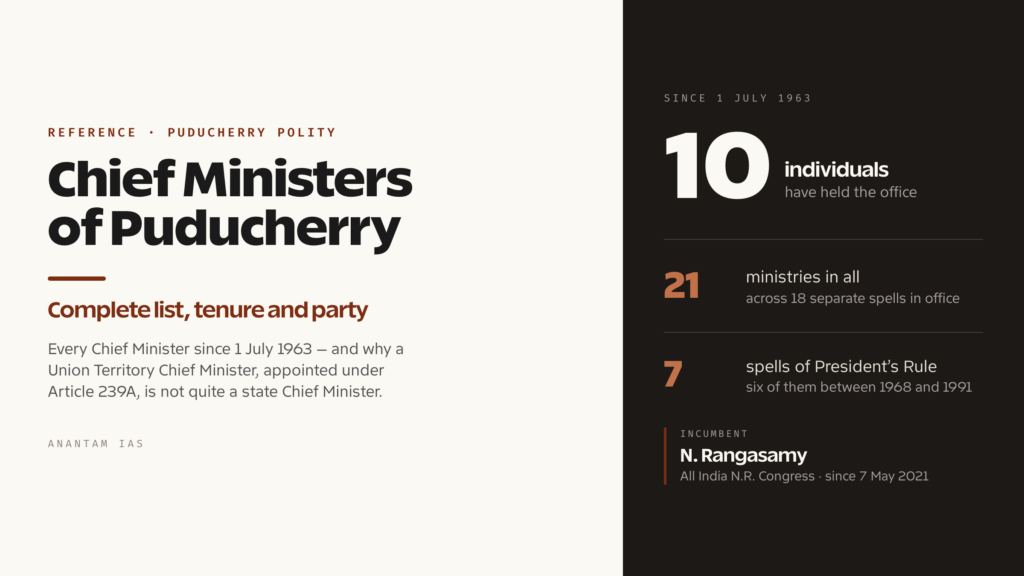
N. Rangasamy of the All India N.R. Congress is the Chief Minister of Puducherry. He has been in office continuously since 7 May 2021, and after the National Democratic Alliance won the May 2026 assembly election he was sworn in for a fifth ministry on 13 May 2026. Ten people have held the office since it was created in 1963.
Those ten have formed twenty-one ministries across eighteen separate spells in office, and the territory has been under President’s Rule seven times. Puducherry is also not a state, which changes what its Chief Minister can actually do — that difference is worth understanding before reading the list, so it comes first.
How the Office Works in Puducherry
Puducherry is a Union Territory with a legislature, and that phrase does a lot of work. Article 239 puts every Union Territory under the President, administered through an Administrator he appoints — in Puducherry, styled the Lieutenant Governor. Article 239A, inserted by the Fourteenth Amendment in 1962, then allowed Parliament to create a legislature and a Council of Ministers for certain Union Territories. Parliament did that through the Government of Union Territories Act, 1963, which set up the Puducherry Legislative Assembly and the office of Chief Minister with effect from 1 July 1963.
Three things follow from that legal route, and each marks a real difference from a state.
First, the appointment. In a state, Article 164 has the Governor appoint the Chief Minister. In Puducherry it is the President who appoints the Chief Minister and the ministers, on the advice of the Union government, with the Lieutenant Governor as the channel. The convention is still the same in substance — the leader who commands a majority in the assembly gets the job — but the constitutional source is different.
Second, the legislative field. The Puducherry assembly can make laws on the State List and the Concurrent List for the territory, but a law made by Parliament on the same subject prevails, and certain categories of bills need the President’s assent before they take effect. A state legislature faces no such routine filter.
Third, and most practically, the Lieutenant Governor. Section 44 of the 1963 Act requires the Council of Ministers to aid and advise the Lieutenant Governor, but where the two differ, the Lieutenant Governor refers the matter to the President and may act on his own in an urgent case pending that decision. Land, police and public order remain with the Union administration in ways they do not in a state. Puducherry’s history has repeatedly turned on how a particular Lieutenant Governor has read those powers, and the Madras High Court in 2019 held that the Lieutenant Governor cannot interfere in the day-to-day administration of an elected government — a ruling that has been carried further in appeal.
The assembly itself has 30 elected members plus up to three nominated by the Union government, and the nominated members have been held to have voting rights, which in a house this small can decide a government. The territory is also geographically split across Puducherry, Karaikal, Mahe and Yanam. When no government can be sustained, President’s Rule follows the Article 356 route applied to the territory, the ministry is dissolved and the office lies vacant.
Complete List of Chief Ministers of Puducherry
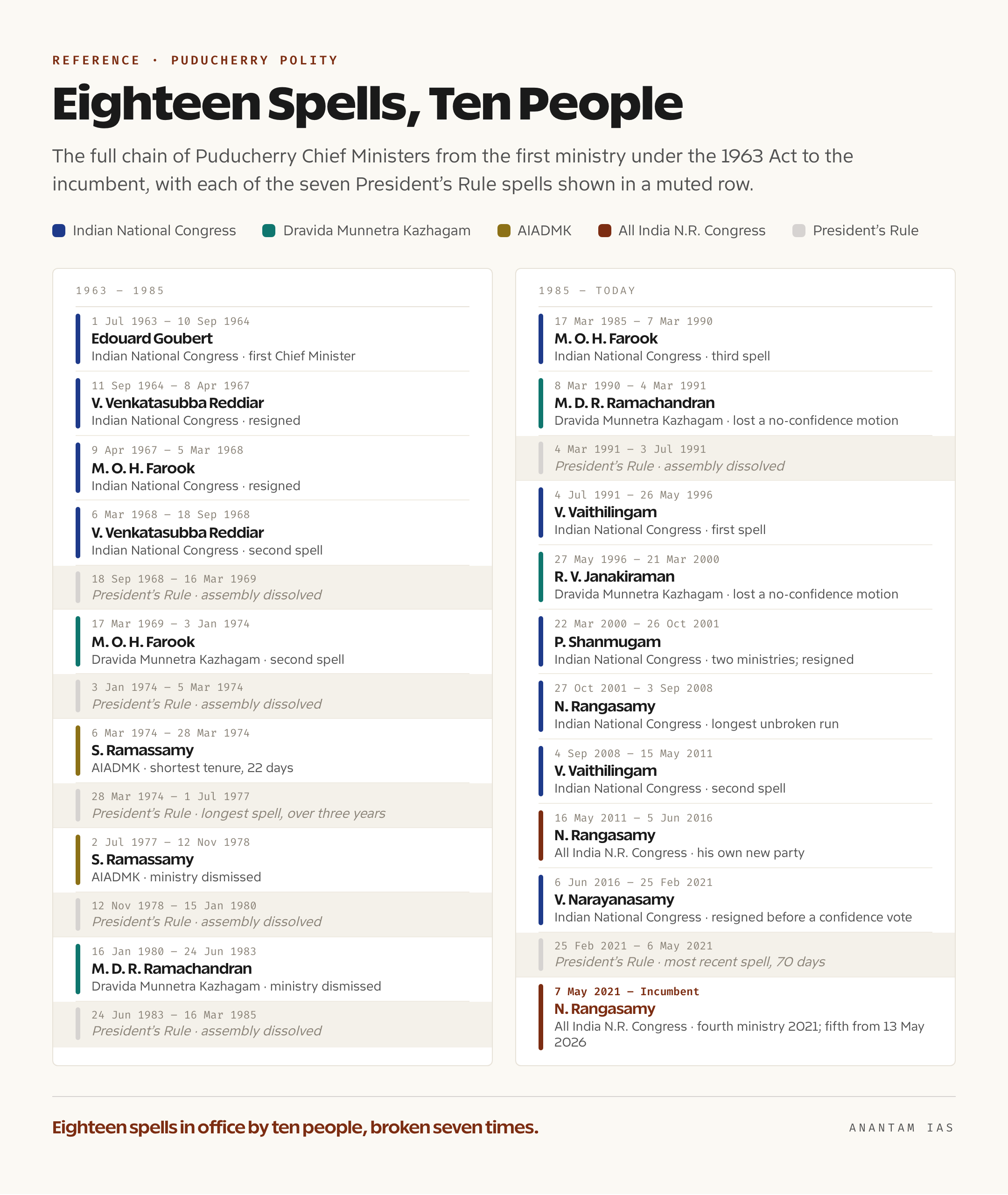
Each row below is one continuous spell in office. Where a Chief Minister formed a fresh ministry after an election without leaving office, the spell is shown once and noted. President’s Rule rows are marked in bold.
| # | Name | Term Start | Term End | Party | Notes |
|---|---|---|---|---|---|
| 1 | Edouard Goubert | 1 July 1963 | 10 September 1964 | Indian National Congress | First Chief Minister; earlier Chief Counsellor, 1956-58 |
| 2 | V. Venkatasubba Reddiar | 11 September 1964 | 8 April 1967 | Indian National Congress | Resigned |
| 3 | M. O. H. Farook | 9 April 1967 | 5 March 1968 | Indian National Congress | Resigned |
| 4 | V. Venkatasubba Reddiar | 6 March 1968 | 18 September 1968 | Indian National Congress | Second spell; resigned |
| — | President’s Rule | 18 September 1968 | 16 March 1969 | — | Assembly dissolved |
| 5 | M. O. H. Farook | 17 March 1969 | 3 January 1974 | Dravida Munnetra Kazhagam | Second spell; fell to a no-confidence motion |
| — | President’s Rule | 3 January 1974 | 5 March 1974 | — | Assembly dissolved |
| 6 | S. Ramassamy | 6 March 1974 | 28 March 1974 | AIADMK | Shortest tenure, 22 days |
| — | President’s Rule | 28 March 1974 | 1 July 1977 | — | Longest spell, over three years |
| 7 | S. Ramassamy | 2 July 1977 | 12 November 1978 | AIADMK | Second spell; ministry dismissed |
| — | President’s Rule | 12 November 1978 | 15 January 1980 | — | Assembly dissolved |
| 8 | M. D. R. Ramachandran | 16 January 1980 | 24 June 1983 | Dravida Munnetra Kazhagam | Ministry dismissed |
| — | President’s Rule | 24 June 1983 | 16 March 1985 | — | Assembly dissolved |
| 9 | M. O. H. Farook | 17 March 1985 | 7 March 1990 | Indian National Congress | Third spell |
| 10 | M. D. R. Ramachandran | 8 March 1990 | 4 March 1991 | Dravida Munnetra Kazhagam | Second spell; fell to a no-confidence motion |
| — | President’s Rule | 4 March 1991 | 3 July 1991 | — | Assembly dissolved |
| 11 | V. Vaithilingam | 4 July 1991 | 26 May 1996 | Indian National Congress | First spell |
| 12 | R. V. Janakiraman | 27 May 1996 | 21 March 2000 | Dravida Munnetra Kazhagam | Fell to a no-confidence motion |
| 13 | P. Shanmugam | 22 March 2000 | 26 October 2001 | Indian National Congress | Two ministries; resigned |
| 14 | N. Rangasamy | 27 October 2001 | 3 September 2008 | Indian National Congress | Two ministries; resigned |
| 15 | V. Vaithilingam | 4 September 2008 | 15 May 2011 | Indian National Congress | Second spell |
| 16 | N. Rangasamy | 16 May 2011 | 5 June 2016 | All India N.R. Congress | Second spell, with his own new party |
| 17 | V. Narayanasamy | 6 June 2016 | 25 February 2021 | Indian National Congress | Resigned before a confidence vote |
| — | President’s Rule | 25 February 2021 | 6 May 2021 | — | Most recent spell, 70 days |
| 18 | N. Rangasamy | 7 May 2021 | Incumbent | All India N.R. Congress | Fourth ministry 2021; fifth from 13 May 2026 |
The first three decades are a study in instability: six of the seven President’s Rule spells fall between 1968 and 1991, two ministries were dismissed outright, three fell to no-confidence motions, and one lasted twenty-two days. From 1991 onward the territory has completed almost every assembly term, and since 2001 the office has been held by only four people. Rangasamy’s dominance since then is the single largest fact in the table.
Longest-Serving and Most Notable Chief Ministers
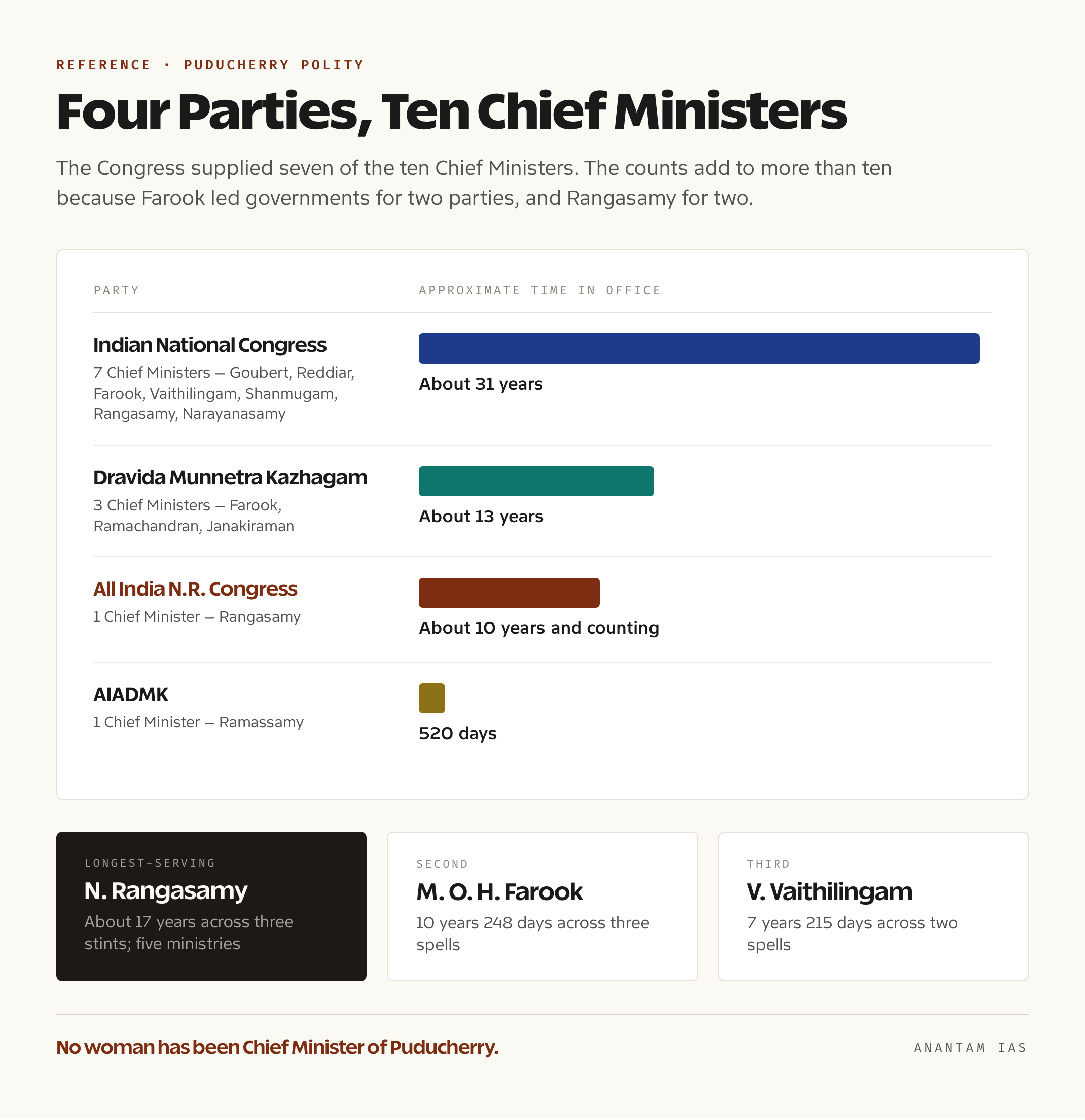
N. Rangasamy is comfortably the longest-serving Chief Minister of Puducherry, with roughly seventeen years in office across three stints — 2001 to 2008, 2011 to 2016, and 2021 to the present. His longest unbroken run is the six years and 312 days from October 2001 to September 2008. M. O. H. Farook is second with 10 years and 248 days across three spells, and V. Vaithilingam third with 7 years and 215 days across two.
Edouard Goubert was the first Chief Minister, from 1 July 1963. His career is the territory’s founding story in miniature: he had led the pro-merger movement in French India, served as Chief Counsellor of the transitional administration from 1956 to 1958, and then headed the first ministry under the 1963 Act. No woman has been Chief Minister of Puducherry.
Four tenures stand out. Goubert’s, for carrying the territory from French administration into the Indian constitutional framework — the de facto transfer had happened in 1954 and the de jure cession only in 1962. Farook’s, because he held the office under two different parties across three decades and remains the benchmark for a Puducherry politician’s longevity. M. D. R. Ramachandran’s, because both his ministries ended abruptly and his career maps the exact period when the Lieutenant Governor’s dismissal power was used most freely. And Rangasamy’s, because he quit the Congress in 2011 to found the All India N.R. Congress, won the election that same year, and has since turned a personal following into the territory’s dominant party.
How Power Has Shifted: Party Trends in Puducherry
Puducherry’s party politics has always been an extension of Tamil Nadu’s, with one local twist. The Congress supplied most of the early Chief Ministers, the Dravidian parties broke through from 1967 onward, and since 2011 a home-grown party has held the top job.
| Party | Chief Ministers | Approximate Time in Office |
|---|---|---|
| Indian National Congress | 7 (Goubert, Reddiar, Farook, Vaithilingam, Shanmugam, Rangasamy, Narayanasamy) | About 31 years |
| Dravida Munnetra Kazhagam | 3 (Farook, Ramachandran, Janakiraman) | About 13 years |
| All India N.R. Congress | 1 (Rangasamy) | About 10 years and counting |
| AIADMK | 1 (Ramassamy) | 520 days |
The counts add to more than ten because Farook led governments as a Congress and then a DMK Chief Minister, and Rangasamy as a Congress and then an AINRC one. Two realignments define the arc. The first was 1967, when the DMK’s Tamil Nadu sweep carried into Puducherry and ended unbroken Congress control. The second was 2011, when Rangasamy left the Congress, formed the AINRC and won outright — and then 2021, when his alliance with the Bharatiya Janata Party replaced the Congress-DMK government. That alliance was renewed at the 2026 election, which the National Democratic Alliance won with 18 of the 30 elected seats on a record turnout of just under 90 per cent.
Records and Quick Facts
- Total individuals who have served: 10
- Total ministries: 21, across 18 separate spells in office
- First Chief Minister: Edouard Goubert, from 1 July 1963
- Longest-serving: N. Rangasamy, about 17 years across three stints
- Longest unbroken term: N. Rangasamy, 27 October 2001 to 3 September 2008 — 6 years, 312 days
- Shortest tenure: S. Ramassamy’s first ministry, 6 to 28 March 1974 — 22 days
- Shortest tenure by a single-ministry Chief Minister: Edouard Goubert, 1 year and 71 days
- Most ministries by one person: N. Rangasamy, 5
- President’s Rule spells: 7 — 1968-69, 1974, 1974-77, 1978-80, 1983-85, 1991 and 2021, totalling about seven years and four months
- Longest President’s Rule: 28 March 1974 to 1 July 1977, 3 years and 95 days
- Women Chief Ministers: none so far
- Assembly strength: 30 elected members plus up to 3 nominated; seat of government at Puducherry
One count needs care. Several listings put the number of President’s Rule spells at eight by including the vacancy from 25 October 1958 to 8 September 1959, which fell in the pre-1963 Chief Counsellor period, before the office of Chief Minister existed. Counting only spells after 1 July 1963, the figure is seven.
FAQ
Who is the current Chief Minister of Puducherry? N. Rangasamy of the All India N.R. Congress, in office continuously since 7 May 2021. He was sworn in for a fifth ministry on 13 May 2026 after the NDA won the 2026 assembly election.
Who was the first Chief Minister of Puducherry? Edouard Goubert, who took office on 1 July 1963, the day the Government of Union Territories Act, 1963 came into force. He had earlier served as Chief Counsellor of the transitional administration.
Who has been the longest-serving Chief Minister of Puducherry? N. Rangasamy, with about seventeen years across three stints since 2001. M. O. H. Farook is second at 10 years and 248 days.
How many Chief Ministers has Puducherry had? Ten individuals since 1963, forming twenty-one ministries across eighteen separate spells. The territory has also been under President’s Rule seven times.
How is the Chief Minister of Puducherry appointed, and how is it different from a state? Puducherry is a Union Territory with a legislature under Article 239A, so the President appoints the Chief Minister and ministers, not a Governor under Article 164. The Lieutenant Governor is the administrator acting for the President, several subjects including police and land stay with the Union, and disagreements between the ministry and the Lieutenant Governor are referred to the President under the Government of Union Territories Act, 1963.
Practice Questions
Practice MCQs
- The office of Chief Minister of Puducherry was created by which law? (a) The States Reorganisation Act, 1956 (b) The Government of Union Territories Act, 1963 (c) The Puducherry Administration Act, 1962 (d) The North-Eastern Areas (Reorganisation) Act, 1971 Answer: (b) The Act was passed on 10 May 1963 and came into force on 1 July 1963, creating the legislative assembly and the office of Chief Minister.
- Which constitutional provision allows Parliament to create a legislature and Council of Ministers for a Union Territory such as Puducherry? (a) Article 164 (b) Article 239AA (c) Article 239A (d) Article 371 Answer: (c) Article 239A was inserted by the Fourteenth Amendment in 1962. Article 239AA is the separate provision that applies to Delhi.
- Who was the first Chief Minister of Puducherry? (a) V. Venkatasubba Reddiar (b) M. O. H. Farook (c) Edouard Goubert (d) S. Ramassamy Answer: (c) Edouard Goubert took office on 1 July 1963 and served until 10 September 1964.
- Who is the longest-serving Chief Minister of Puducherry? (a) M. O. H. Farook (b) N. Rangasamy (c) V. Vaithilingam (d) V. Narayanasamy Answer: (b) N. Rangasamy has held office for about seventeen years across three separate stints since 2001.
- How many times has President’s Rule been imposed in Puducherry since the office of Chief Minister was created in 1963? (a) Five (b) Six (c) Seven (d) Nine Answer: (c) Seven spells, the most recent running from 25 February to 6 May 2021.
Tell Google you want more of this.
Add Anantam IAS as a preferred sourceOne tap, and this site shows up more often in your own Top Stories, AI Overviews and AI Mode. Remove it any time.