The quantitative revolution was the shift, through the 1950s and 1960s, from a geography that described regions to one that sought spatial laws using statistics and models. It changed what counted as a geographical question, and it provoked four distinct critiques that between them define the discipline’s modern shape. Understanding the revolution matters less than understanding what each critique said it had left out.
What the Revolution Was Reacting Against
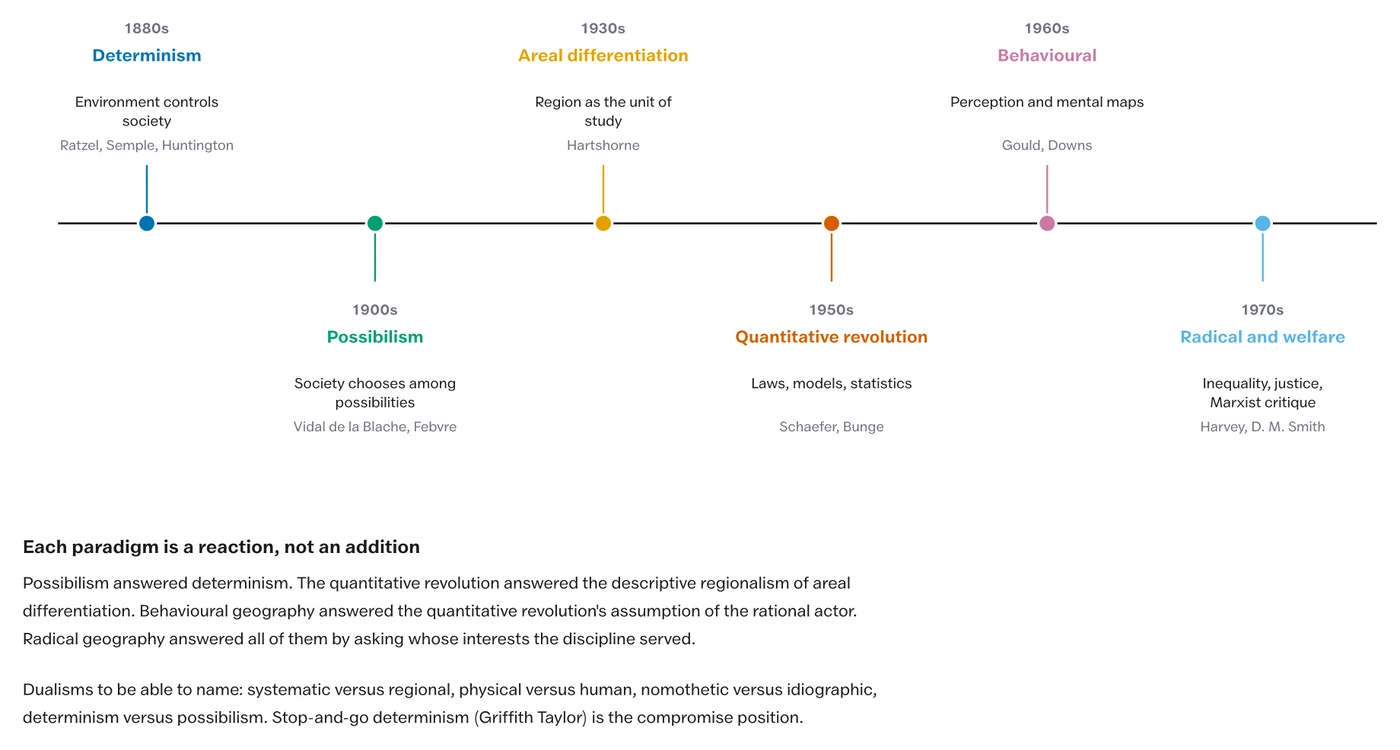
Pre-war geography was dominated by regional description: the exhaustive account of a single area’s physical setting, economy and society, in the tradition Richard Hartshorne codified as areal differentiation. Its weaknesses had become obvious.
- It produced no generalisations. Each region was treated as unique, so nothing learned in one place transferred to another.
- It was untestable. Descriptions could be fuller or thinner but not right or wrong.
- It made geography look unscientific beside economics and sociology, which mattered institutionally when university funding was at stake.
Fred Schaefer’s 1953 paper attacking Hartshorne’s exceptionalism, the claim that geography was methodologically unlike other sciences, is conventionally taken as the opening move.
What It Introduced
- Statistical method: correlation, regression, nearest-neighbour analysis, factor analysis, and significance testing applied to spatial data.
- Model building, including the recovery of Von Thünen, Weber and Christaller, whose work had been largely ignored in the English-speaking world.
- The search for spatial laws, principally distance decay, the gravity model and the rank-size regularity.
- Systems thinking, treating a region as a set of stocks, flows and feedbacks rather than as a described whole.
The achievement was real: geography acquired methods that could be checked, results that could be compared across places, and a body of theory. The cost was equally real, and four critiques set it out.
The Behavioural Critique
Behavioural geography objected that the models assumed an economically rational actor with perfect information, and that real people have neither. Its substitutes are worth naming precisely.
- People act on perceived environments, not objective ones, and the gap between the two is measurable through mental maps.
- They satisfice rather than optimise, in Herbert Simon’s term: they take the first acceptable option rather than search for the best.
- They rank places by space preference, which predicts migration and residential choice better than distance or income alone.
The critique is corrective rather than destructive. It keeps the modelling project and replaces its behavioural assumption with a more defensible one.
The Humanistic Critique
Humanistic geography made a stronger objection: that quantification does not merely simplify human experience but excludes what matters most about it. Its central concepts, from Yi-Fu Tuan and Edward Relph, are the discipline’s most distinctive contribution to the humanities.
- Space is abstract and interchangeable; place is space invested with meaning by the people who know it.
- Topophilia is the affective bond between a person and a place.
- Sense of place is the distinctive identity a location holds in lived experience, and placelessness is its erosion by standardised landscapes.
The method is phenomenological rather than statistical, and the objection to it is the obvious one: its findings cannot be replicated or falsified. Its defenders answer that neither can the meaning of a house.
The Radical Critique
Radical geography, from David Harvey’s turn after Explanation in Geography to Social Justice and the City, argued that the revolution had produced technically sophisticated work on trivial questions while ignoring poverty, exploitation and the structures producing them.
- Spatial patterns are outcomes of capital accumulation, not of neutral locational logic.
- Describing a pattern without asking who benefits from it is a political act disguised as a neutral one.
- Geography should aim at changing unequal spatial arrangements, not only at explaining them.
Welfare geography, associated with David M. Smith, is the moderate wing of the same impulse: it asks who gets what, where, and at what cost, and insists the subfield be normative rather than merely descriptive.
Structuration: the Attempt to End the Quarrel
The behavioural and humanistic critiques emphasise individual agency; the radical critique emphasises structure. Structuration, borrowed from Anthony Giddens, refuses the choice: structure and agency constitute each other, since people act within structures that their actions simultaneously reproduce and alter.
Its geographical application is time geography, from Torsten Hägerstrand, which traces an individual’s path through space and time under three constraints: capability, what the body and its tools allow; coupling, the need to be with others; and authority, who controls access to a place at a time. It is a framework in which individual paths and social structures are visible in one diagram.
What Survived
The honest summary is that the revolution was neither defeated nor victorious. It was absorbed.
| What survived | What was abandoned |
|---|---|
| Statistical method as a routine tool | The claim that geography’s purpose is to find universal spatial laws |
| Model building, now used as a benchmark rather than a prediction | The economically rational actor with perfect information |
| Systems thinking and, later, GIS and spatial analysis | The pose of value-neutrality |
| Quantitative rigour as a standard of evidence | Exclusive reliance on quantification |
Geography did not choose between measurement and meaning. It ended up requiring both, and the argument about their proportions is the discipline’s normal condition.
What was the quantitative revolution in geography?
The shift through the 1950s and 1960s from regional description toward statistical method, model building and the search for spatial laws. Fred Schaefer’s 1953 attack on Hartshorne’s exceptionalism is conventionally taken as its opening move.
Why did geographers react against regional description?
Because it produced no generalisations, since each region was treated as unique; because its accounts could be fuller or thinner but not right or wrong; and because it made geography look unscientific beside economics and sociology.
What is behavioural geography?
The approach that explains spatial behaviour through how people perceive and evaluate their environment rather than through objective conditions. Its concepts include mental maps, satisficing rather than optimising, and space preference.
What is the difference between space and place?
In humanistic geography, space is abstract and interchangeable while place is space invested with meaning by the people who know it. Topophilia is the affective bond with a place, and placelessness is the erosion of that distinctiveness by standardised landscapes.
What did radical geography object to?
That the quantitative revolution produced technically sophisticated work on trivial questions while ignoring poverty and exploitation. David Harvey argued that spatial patterns result from capital accumulation, and that describing a pattern without asking who benefits is a political act disguised as a neutral one.
What is structuration in geography?
Giddens’s account, imported into geography, that social structure and individual agency constitute each other rather than one determining the other. Its geographical application is Hägerstrand’s time geography, which traces individual paths under capability, coupling and authority constraints.
Practice Questions
Prelims
1. The 1953 paper attacking exceptionalism in geography was written by
- (a) Richard Hartshorne
- (b) Fred Schaefer
- (c) David Harvey
- (d) Peter Haggett
Answer: (b)
2. Satisficing, as against optimising, is associated with
- (a) Yi-Fu Tuan
- (b) Herbert Simon
- (c) Torsten Hägerstrand
- (d) David M. Smith
Answer: (b)
3. Topophilia was introduced by
- (a) Edward Relph
- (b) Yi-Fu Tuan
- (c) Anthony Giddens
- (d) David Harvey
Answer: (b)
4. The three constraints in Hägerstrand’s time geography are
- (a) distance, cost and time
- (b) capability, coupling and authority
- (c) space, place and placelessness
- (d) threshold, range and intensity
Answer: (b)
5. Welfare geography is chiefly associated with
- (a) David Harvey
- (b) David M. Smith
- (c) Ellen Semple
- (d) Griffith Taylor
Answer: (b)
Mains
- What was the quantitative revolution, and what was it reacting against? (10 marks)
- Explain the behavioural critique of locational models and the concepts it substituted. (10 marks)
- Distinguish between space and place, and assess the humanistic contribution to geography. (15 marks)
- “Radical geography made the discipline political.” Discuss. (15 marks)
- Examine structuration as an attempt to reconcile agency and structure in geographical explanation. (20 marks)
Tell Google you want more of this.
Add Anantam IAS as a preferred sourceOne tap, and this site shows up more often in your own Top Stories, AI Overviews and AI Mode. Remove it any time.