People are afraid of things they don’t understand. They don’t know how to relate. It threatens their security, their existence, their career, image.
Bill Laswell
A claim has been circulating that Anantam IAS “already had” the UPSC Civil Services Prelims 2026 questions — or that the paper was leaked to us — because some of our answer-key explanation articles showed a publish date from before the exam. We want to address this head-on, because it is both serious and false. Everything below can be verified by anyone, from a phone, in under a minute.
The short version: we solved the paper after it was held on 24 May 2026, exactly like every other institute. The early “published” dates some people saw were a deliberate editorial choice to organise a large series of explanations — not evidence of anything. The data inside our own website proves it, and we are publishing that data here.
Read it in very easy language with Grok AI
What actually happened
The UPSC Civil Services Preliminary Examination was held on 24 May 2026. Once the paper was in the public domain, our faculty did what we do every year: solved General Studies Paper-I, prepared a detailed answer key, and wrote a set of in-depth articles explaining each answer — the concept behind it, the elimination logic, and the source.
That is a large amount of content. Publishing dozens of detailed explanations at once, all stamped with the same date and time, would have fired off a flood of push notifications and newsletter emails to our subscribers in a single burst — and made the series hard to read in any sensible order. So we did something routine for a big content series: we backdated the publish dates of some (not all) of those articles so the explanations sat in a logical sequence and did not spam everyone on one day.
Two things are worth separating here. First, the freshly written explanations — created after the exam — are the only ones whose published dates we moved backward, purely to sequence the series. Second, we already had several articles on the site from before the exam — standing concept and topic pieces — which we did not backdate at all; we simply updated them with the relevant solutions and links. So an older publish date on our site means one of two ordinary things: a new explanation we sequenced into a series, or an existing article we refreshed. Neither involves any foreknowledge of the paper.
We will also be candid about one thing: we were moving fast to get solutions in front of aspirants while the paper was still fresh, and in that hurry we did not stop to consider how a backdated published date — shown on its own, without the updated date beside it — could be misread. That was an oversight, not an attempt to mislead. The moment we saw the confusion, we corrected it.
To be completely open about it: we still backdate articles today, for an entirely ordinary reason. Our content team is small, and we are working through a backlog — we are still filling in close to a year of current-affairs coverage, and we slot each piece into the date it actually belongs to rather than dumping the whole archive onto today’s feed at once. It is housekeeping, not concealment. We would far rather you know we do this than stumble on it later and wonder.
The part that got misread: “Published” vs “Updated”
This is the crux, so let us be precise. Every WordPress post carries two separate timestamps:
- Published date — the date shown on the post, which an author can set to any value mostly to organise their content in an order they prefer.
- Updated / Last-modified date — the date the content was actually written or last edited, which reflects real activity.
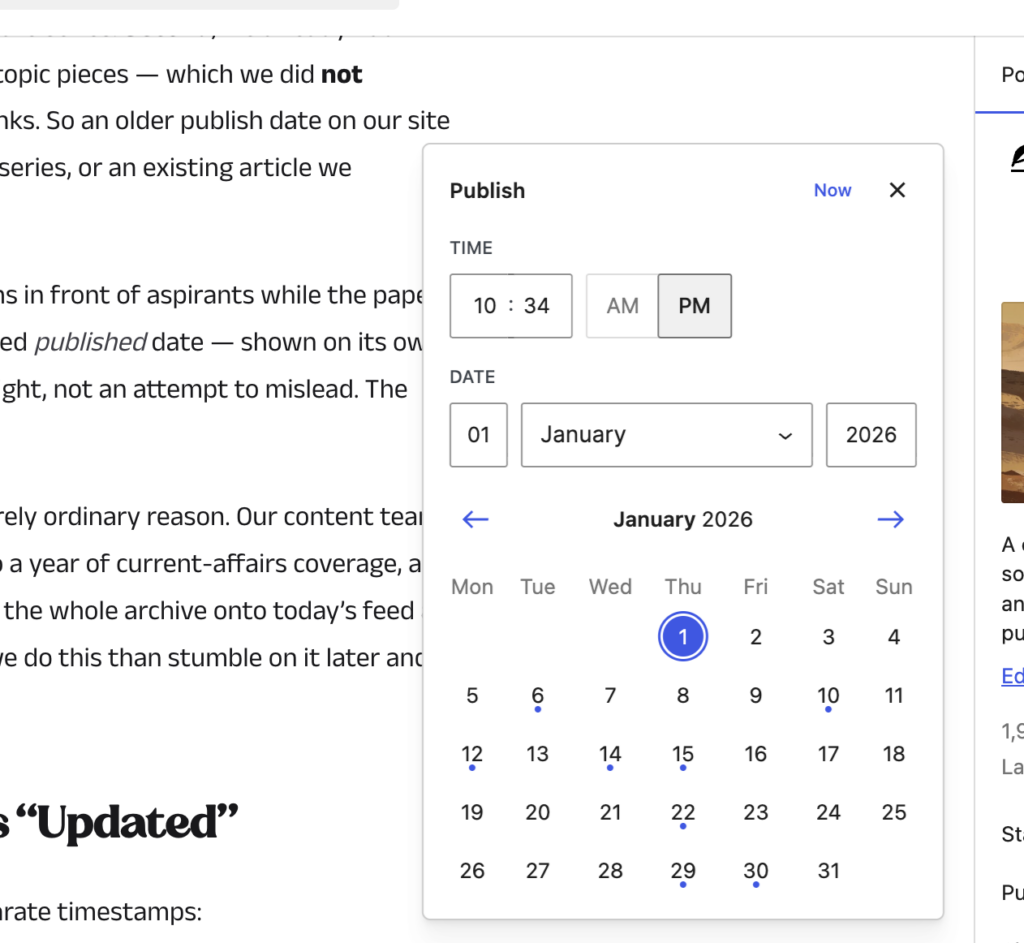
When we sequenced the new explanations, only the Published date was moved. The Updated date on every one of those posts stayed exactly where it truly was — after 24 May 2026 — because that is when the content was actually created and edited. Backdating the display date does not, and cannot, move the modified timestamp into the past. The system’s own record shows the work was done after the exam.
The post modified and published dates aren’t even focused on readers. These are just for the search engines and organising content. Many websites don’t even show either of these two.
IMPORTANT: The confusion arose because, at the time, our theme displayed only the Published date on each article — not the Updated date. So a screenshot of the visible date looked earlier than the exam, even though the post had genuinely been written afterward. We have since corrected this: every post now displays its Updated date if the post/page has been modified since the date of publication, which is the honest and more useful signal for time-sensitive content. That is the current state of all the answer-key articles.
The evidence, from our own database
We are not asking you to take our word for it. There were 66 explanation articles in the batch written after the exam. Every one of them carries an Updated date of 24–25 May 2026 — right after the paper — no matter what Published date it shows. Here is a representative sample, taken directly from the site:
| Post ID | Explanation article | Published date (shown) | Updated date (real work) |
|---|---|---|---|
| 26190 | Indus River and Antecedent Drainage | 30 Dec 2025 | 24 May 2026 |
| 26243 | Madhav National Park: India’s 58th Tiger Reserve | 8 Nov 2025 | 24 May 2026 |
| 26289 | Nobel Prize in Physics 2025 | 9 Oct 2025 | 24 May 2026 |
| 26318 | Zero FIR under BNSS 2023, Section 173 | 4 Feb 2026 | 25 May 2026 |
| 27038 | Transformer Cooling Methods | 12 May 2026 | 25 May 2026 |
The full list — all 66 articles, with their post IDs, the Published dates they show, and the real Updated dates — is available to download and check for yourself:
If a backdated date were proof of foreknowledge, our “Nobel Prize in Physics 2025” explanation would imply we knew the 2026 question paper back in October 2025. That is obviously not how any of this works.
The clincher: post IDs cannot be backdated
This is the strongest proof, and it needs no trust in us at all. WordPress gives every post a permanent, strictly incremental ID the moment it is first created. ID number 100 is created before ID 101, always. You can change the date a post displays, but you can never lower an ID that has already been issued — the counter only moves forward, with time.
So we can read the true creation order straight off the IDs. Here is how the counter actually climbed on our site:
| When the article was really created | Post ID (on our site) |
|---|---|
| A genuine article from October 2025 | ~3,500 |
| Genuine articles from April 2026 | 20,500 – 21,900 |
| The last article finalised before the 24 May exam | ~26,151 |
| The post-exam answer-key explanations (created 24–25 May) | 26,159 – 27,038 |
| Genuine articles from June 2026 | 28,714 – 33,008 |
| The newest post on the site today | 33,008 |
Now put the two together. Our “Nobel Prize in Physics 2025” explanation displays a Published date of 9 October 2025. But our genuine October-2025 articles carry IDs around 3,500. This post’s ID is 26,289 — a number the counter only reached on 24 May 2026. An ID cannot travel back in time. The post was created on 24 May 2026 and simply given an earlier display date. Every one of the 66 explanation articles tells the same story: a backdated Published date, an ID in the late-May-2026 range, and an Updated date of 24–25 May 2026. Two independent signals — the ID and the Updated date — both say the same thing the leak theory cannot survive.
How you can verify all of this yourself
- Look at the Updated date. Every answer-key article now shows when it was last modified — and for all of them, that date is after 24 May 2026.
- View the page source or open Developer Tools. The page’s metadata and structured data carry the
dateModifiedvalue. It is right there in the HTML — no special access required. - Compare the post IDs. Open any answer-key explanation and any article genuinely published before the exam. The explanation’s ID is higher — because it was created later. A backdated date can fake a calendar; it cannot lower an ID that was already issued after the exam.
A quick look using any of these would have shown what really happened. A few accounts chose the viral route — an old “Published”-date screenshot with a leak accusation attached — over a thirty-second cross-check.
We reacted to the paper in public, in real time
Right after the exam, our faculty worked through the entire General Studies paper — question by question — in a public live session on YouTube. It was an unscripted first reading: no prepared answer key in hand and no sources lined up in advance, just our team opening the paper and reasoning through it on camera. That is how people behave when they are seeing a paper for the first time — not how anyone holding it in advance ever would.
We also made light of just how unpredictable the paper was, in two short videos — the reaction of people genuinely caught off guard by the questions:
None of this is the behaviour of an institute that knew the questions. It is the behaviour of teachers meeting the paper for the first time, in front of everyone.
On the leak allegation, plainly
Let us be unambiguous: the paper was not leaked to us, and we did not have the questions in advance. That is a false and serious allegation — it implies a criminal act — and it has no basis. We solved the 2026 Prelims paper after it was publicly available, the same way every honest institute did. The early publish dates were about organising a content series and sparing our subscribers a wall of notifications. Nothing more.
Few Questions to Ask Yourself
- Why 66 Questions instead of 100 questions? (Or 82 questions as they are virally claiming)
- Why all published dates are different like spanning over 7 months? Did UPSC give us 66 questions over 7 span of months like 1 question every fourth-day? Did UPSC have questions set 7 months ago?
- If we ever did such a thing, would we showcase that to the world?
- Did Anantam IAS claim that X number of questions were asked in the UPSC Prelims 2026 from our material?
- Why the leak claims came out on the date of UPSC Prelims 2026 results announcement date?
- Why no input was taken from the coaching itself? Did the claimant reach out to coaching itself? (No they didn’t.)
- We have 4000+ pages, and we are publishing dozens of articles every. Aren’t we free to manage our content the right way so that the content is easily discoverable?
Our commitment
We have built Anantam IAS on getting things right for aspirants — and that includes being straight with you when something we did was open to misreading. Backdating the publish dates of a series, and updating older articles, are both ordinary editorial practices; showing only the Published date — and rushing without thinking it through — was the oversight, and we have fixed it. The underlying facts never changed.
Everyone who has reached out to us about this has been walked through exactly what happened, and the matter has, for the most part, been put to rest. We are grateful to the aspirants who asked us directly rather than assuming the worst.
If you still have doubts, we welcome the scrutiny: check the updated dates, read the source, compare the IDs. And if you would like any of it walked through, write to us at [email protected] and we will point you to exactly where to look. Any technical person can check the webpages’ history and revisions using the Wayback Machine publicly available on the internet and/or the SSH access to the server that we will provide privately.
— Team Anantam IAS
Tell Google you want more of this.
Add Anantam IAS as a preferred sourceOne tap, and this site shows up more often in your own Top Stories, AI Overviews and AI Mode. Remove it any time.