In March 2026, a thirty-one-year-old man named Harish Rana became the first person in India to die through a court-sanctioned withdrawal of life support. He had spent roughly eight years in a permanent vegetative state after a fall from the fourth floor of a building near his university left him with a catastrophic head injury. His ageing parents, who had nursed him through those years, asked the courts to let him go. On 11 March 2026, a Supreme Court bench permitted the withdrawal of the artificial feeding keeping him alive; he was shifted to AIIMS Delhi and died on 24 March. It was a quiet, sorrowful end to a case that had travelled from a high court that said no to a Supreme Court that finally said yes — and it turned a principle that had existed only on paper for eight years into a lived reality.
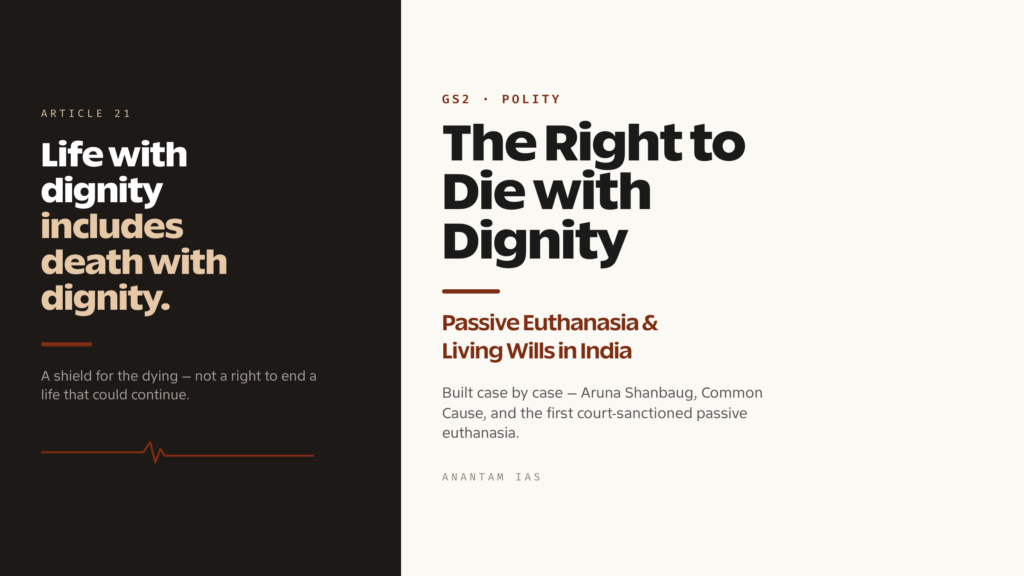
That principle is the right to die with dignity, and it is one of the most subtle ideas in Indian constitutional law. It does not mean a right to suicide, and it does not legalise a doctor injecting a lethal dose. What it means is narrower and more humane: that a person whose life has become only the mechanical prolongation of a hopeless condition should not be forced to endure that prolongation, and that the law will let nature take its course with dignity. For a UPSC aspirant, this sits at the heart of GS Paper 2 — the expanding reach of Article 21, the creative role of the judiciary, and the still-unfinished work of Parliament. It also rewards the candidate who can hold the distinctions straight, because almost every public confusion about euthanasia comes from blurring them.
What the Right to Die with Dignity Actually Means
Start with the source, because everything flows from it. Article 21 of the Constitution says no person shall be deprived of life or personal liberty except by procedure established by law. For decades the courts read “life” generously — not mere animal existence, but life with dignity, drawing in clean air, livelihood, privacy and shelter. The right to die with dignity is simply the final chapter of that reasoning: if the Constitution protects a dignified life, it must also protect a dignified death, because the manner of one’s dying is part of the life one has lived. A patient kept breathing for years by tubes and machines, with no prospect of recovery and no ability to consent, is being denied dignity in exactly the way Article 21 was meant to prevent.
It is vital to separate this from a “right to die.” Those sound the same; they are not. A right to die would mean a right to end a life that could otherwise continue — the territory of suicide and active killing. The right to die with dignity is about how an already-dying process is allowed to unfold when medicine can no longer cure, only delay. The Supreme Court drew this line sharply long ago. In P. Rathinam (1994) it had briefly suggested that the right to life included a right to die, striking down the criminalisation of attempted suicide. But in Gian Kaur v. State of Punjab (1996) a Constitution Bench overruled that view: the right to life, it held, does not include a right to extinguish life. Yet the same judgment planted the seed for everything that followed, observing that the right to a dignified life could include the right to a dignified process of dying for someone already in the throes of death. That single sentence became the doorway through which passive euthanasia later walked.
So the right to die with dignity is best understood as a shield, not a sword. It does not hand anyone a weapon to end a life. It shields a dying patient — and the doctors and family acting in good faith — from being compelled to drag out a futile, undignified existence against the patient’s own wishes. Keeping that framing precise is the difference between a confused answer and a clean one.
Active Versus Passive Euthanasia — the Distinction That Decides Everything
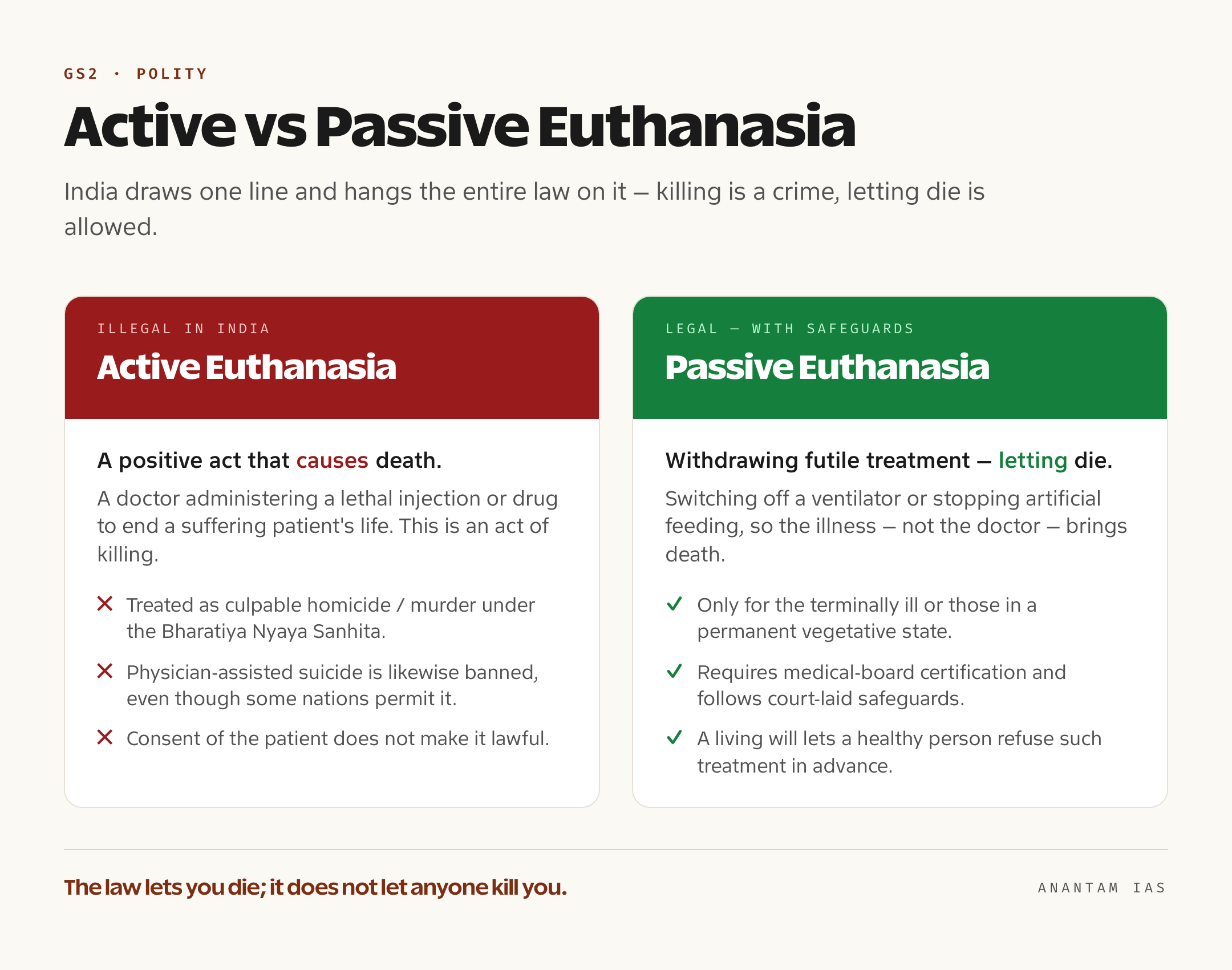
Now the distinction every aspirant must be able to draw in their sleep, because Indian law hangs on it entirely. Euthanasia — from the Greek for “good death” — splits into two kinds. Active euthanasia is a positive act that causes death: a doctor administering a lethal injection or drug to end a suffering patient’s life. Passive euthanasia is the withholding or withdrawal of life-sustaining treatment — switching off a ventilator, or stopping artificial feeding — so that the underlying illness, not the doctor’s hand, brings about death. The first is an act of killing; the second is letting die. India treats them as morally and legally worlds apart.
Active euthanasia remains a crime in India, full stop. Under the Bharatiya Nyaya Sanhita, the criminal code that replaced the Indian Penal Code in 2024, deliberately causing another person’s death is culpable homicide or murder, and consent does not turn it into something lawful. Physician-assisted suicide — where a doctor supplies the means and the patient performs the final act — is likewise illegal here, even though a handful of countries such as the Netherlands and Belgium, which legalised active euthanasia in 2002, permit it under strict conditions. India has deliberately not gone there. The fear is misuse — pressure on the poor, the elderly and the disabled to “choose” death to relieve families or save costs — and that fear has kept the line firm.
Passive euthanasia is the narrow exception the courts have carved out, and only within tight limits. It is lawful only for a patient who is terminally ill or in a permanent vegetative state, where recovery is medically impossible, and only by withdrawing treatment that is merely prolonging the dying. Even the word “treatment” had to be defined, and that definition became the crux of the most recent case. The law’s whole architecture — the medical boards, the living wills, the safeguards — exists to make sure passive euthanasia never quietly slides into active killing. Get this one distinction right and most of the topic falls into place.
From Aruna Shanbaug to Common Cause — How the Law Was Built
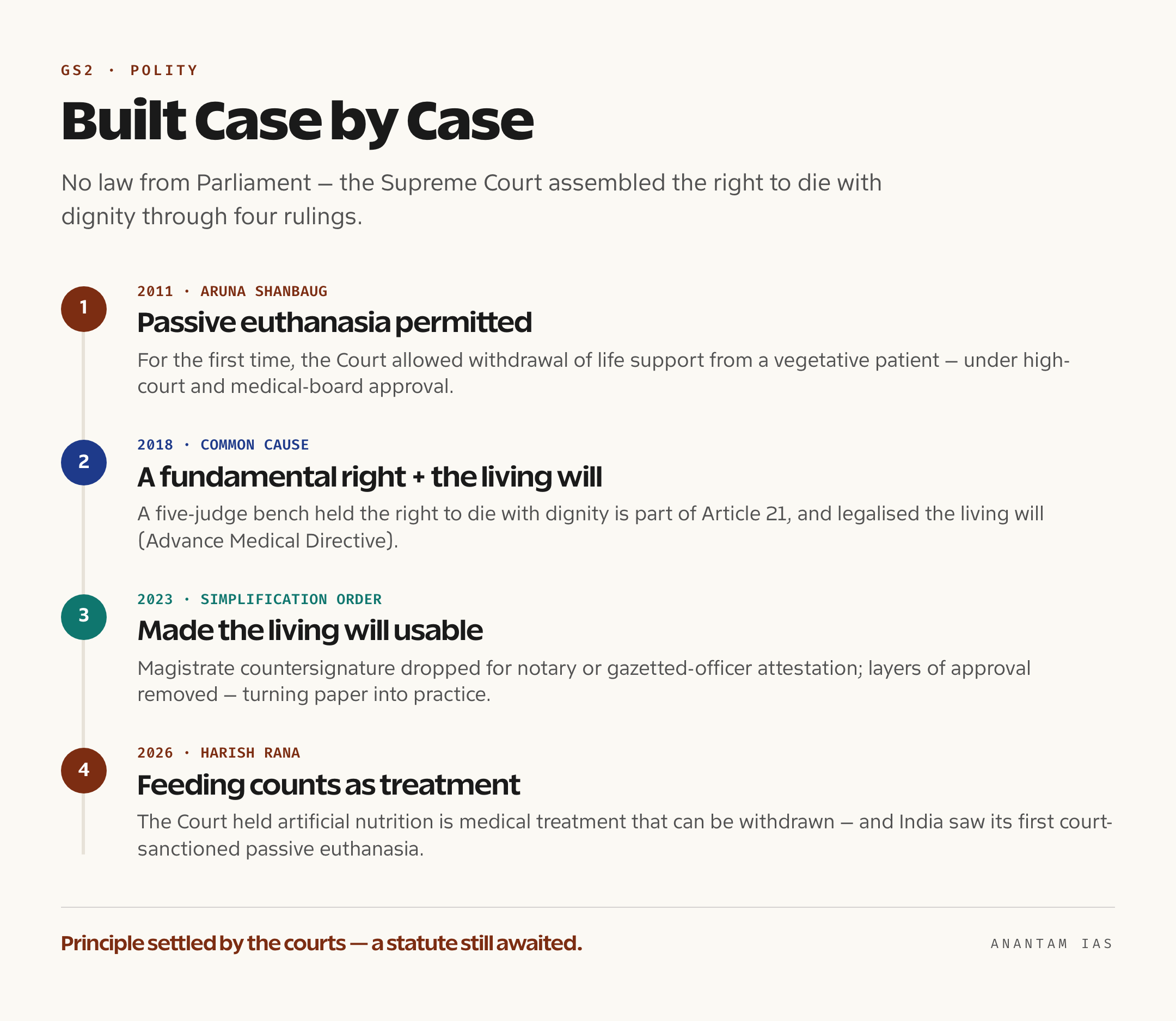
The law here was not written by Parliament; it was assembled by the Supreme Court, case by tragic case, and the story begins with a nurse named Aruna Shanbaug. In 1973, while working at Mumbai’s KEM Hospital, she was sexually assaulted and strangled with a chain that cut oxygen to her brain, leaving her in a permanent vegetative state. She remained that way for over four decades. In 2011, a petition sought to end the artificial feeding keeping her alive. The Supreme Court refused in her specific case — the hospital nurses had chosen to care for her, and there was no one with standing to demand her death — but the judgment was a landmark anyway. For the first time, the Court formally permitted passive euthanasia in India, laying down that life support could be withdrawn from a terminally ill or vegetative patient with the approval of a high court and a panel of doctors. Aruna Shanbaug herself died of pneumonia in 2015, never having been the subject of euthanasia, but the doctrine bearing her name had been born.
The Aruna Shanbaug framework, though historic, was clumsy — it routed every case through the high courts and left living wills in limbo. The cleaner, more famous ruling came seven years later. In Common Cause v. Union of India, decided on 9 March 2018, a five-judge Constitution Bench led by Chief Justice Dipak Misra did two big things. First, it held unambiguously that the right to die with dignity is a fundamental right under Article 21 — elevating the principle from a court-made guideline to a constitutional guarantee. Second, and more practically, it legalised the living will, also called an Advance Medical Directive: a document in which a person of sound mind, while healthy, sets out in advance that they do not want to be kept alive by artificial means if they later fall into a terminal or vegetative state and cannot speak for themselves. The living will lets your earlier, considered self decide for your later, voiceless self — autonomy stretched across time.
But the 2018 judgment came wrapped in safeguards so heavy they nearly strangled it. To make a living will valid, you needed two witnesses, the countersignature of a Judicial Magistrate First Class, and a tangle of certifications; to act on one, two separate medical boards and another magistrate had to sign off. In five years, almost no one managed to register a living will, and the right existed mostly on paper. So in January 2023, the same Constitution Bench, hearing a plea to fix its own creation, modified the rules to make them workable. The magistrate’s countersignature was dropped in favour of attestation before a notary or gazetted officer; a person could now name more than one guardian to take the decision; copies were to be lodged with the family doctor and local authorities; and the second magistrate’s approval was removed, with hospital-constituted medical boards doing the certifying instead. The 2023 order is the unglamorous but crucial step that turned the living will from a theoretical right into something an ordinary person could actually use.
The Harish Rana Case and What It Settled
That brings the story to its most recent and most clarifying chapter. Harish Rana’s parents had first gone to the Delhi High Court in 2024, asking to withdraw the Ryle’s tube — a nasal feeding tube — through which their permanently vegetative son was being kept alive. The High Court said no, and its reasoning exposed a genuine gap in the law. Rana was not on a ventilator; he was breathing on his own. The only thing sustaining him was artificial nutrition. Remove the feeding tube, the court reasoned, and he would starve — and deliberately starving a patient looked less like withdrawing life support and more like actively causing death. On that logic, his was not a case of passive euthanasia at all, and the petition was dismissed.
The Supreme Court took a different and, for the law, decisive view. On 11 March 2026, a bench of Justices J.B. Pardiwala and K.V. Viswanathan held that clinically assisted nutrition and hydration — feeding through a tube such as a Ryle’s or PEG tube — is itself a form of medical treatment, not basic care like spooning food into someone’s mouth. Administering it, the Court noted, requires clinical judgment and regular medical monitoring; it is a medical intervention. And because it is treatment, it can be withdrawn in a vegetative patient’s best interest, just like a ventilator, when continuing it is medically futile. This closed the very loophole the High Court had relied on. It meant that the right to die with dignity reaches even patients who are not on dramatic machinery but are kept alive only by artificial feeding — a far larger group of real cases. Thirteen days after that order, Harish Rana died at AIIMS, the first Indian to do so under a court-cleared withdrawal of treatment.
The case is significant beyond its sad facts because it shows both the strength and the limit of judge-made law. The strength: the courts kept refining the doctrine until it actually worked, defining “treatment” precisely so that compassion did not founder on a technicality. The limit, and the more important lesson for an answer, is what the case quietly screamed — that eight years after Common Cause, India still has no law from Parliament on the subject. A grieving family had to climb from a high court to the Supreme Court, over many months, to win the right the Constitution supposedly already guaranteed. The right to die with dignity exists; the everyday machinery to exercise it without a court battle does not. That gap between principle and access is where the governance debate now lives.
For Your Mains Answer
This is a high-value theme for GS Paper 2, which covers the Constitution, fundamental rights, the role of the judiciary, and the separation of powers between the legislature and the courts. It maps onto questions on Article 21 and its expanding judicial interpretation, on judicial activism versus legislative inaction, and on the rights of vulnerable groups. It is also a natural fit for GS Paper 4 (Ethics), where end-of-life decisions, patient autonomy, dignity and the duties of doctors are textbook dilemmas. The skill examiners reward is precision: keep the distinctions clean and pair the constitutional principle with the named cases.
How to Build the Answer
Open with the principle, not the cases — define the right to die with dignity as a facet of Article 21, and immediately separate it from a “right to die.” Then walk the distinction between active and passive euthanasia, making clear only the latter is legal and only within limits. Lay the cases as a chain: Gian Kaur (1996) drew the line, Aruna Shanbaug (2011) permitted passive euthanasia under guidelines, Common Cause (2018) made it a fundamental right and legalised living wills, the 2023 order made the procedure usable, and Harish Rana (2026) extended it to artificial feeding and produced the first actual case. Close by judging the system — strong on principle, weak on access, and waiting on Parliament.
Common Mistakes to Avoid
Don’t conflate the right to die with dignity with a right to suicide or active euthanasia — that single slip wrecks the answer. Don’t say euthanasia is legal in India without qualifying it as passive only, and only for terminal or vegetative patients. Don’t credit Parliament with any of this; the entire edifice is judge-made. And don’t forget the 2023 simplification — many candidates jump straight from 2018 to the present and miss the step that made living wills actually workable.
A Compact Answer Spine
Article 21 → life with dignity includes death with dignity (a shield, not a right to suicide) → Gian Kaur 1996 draws the line → active euthanasia and assisted suicide stay illegal (BNS) → passive euthanasia (withdrawing futile treatment) allowed → Aruna Shanbaug 2011 (guidelines, high-court route) → Common Cause 2018 (fundamental right + living will/Advance Medical Directive, five-judge bench, CJI Dipak Misra) → 2023 order simplifies the living-will process → Harish Rana 2026 (CANH is medical treatment; first court-sanctioned death) → verdict: principle settled, statutory framework still missing.
Diagram or Flowchart Idea
Sketch a simple two-branch tree: “Euthanasia” splitting into “Active / assisted suicide — ILLEGAL” and “Passive — LEGAL with safeguards,” with the passive branch flowing into a short horizontal timeline of four dated nodes (2011 → 2018 → 2023 → 2026). A clean fork-plus-timeline like this communicates the entire legal position in one glance and is quick to draw.
A Balanced-Conclusion Line
A line that lands the marks: “India’s right to die with dignity is a quietly radical achievement of Article 21 jurisprudence — compassionate, carefully bounded, and entirely the work of the courts; what remains is for Parliament to convert a hard-won principle into an accessible statutory right, so that dignity in death no longer depends on the length of a family’s litigation.”
How to Use Data Without Cramming
You need only a handful of anchors, not a case digest: four years (2011, 2018, 2023, 2026), the two case names (Aruna Shanbaug, Common Cause), the term Advance Medical Directive or living will, and the 2026 holding that artificial feeding counts as medical treatment. Attribute them plainly — “as the Constitution Bench held in Common Cause in 2018″ — rather than scattering names without dates.
FAQ
Is euthanasia legal in India? Only passive euthanasia, and only within strict limits. Active euthanasia — a doctor administering a lethal dose — and physician-assisted suicide remain crimes under the Bharatiya Nyaya Sanhita. Passive euthanasia, meaning the withdrawal or withholding of life-sustaining treatment from a terminally ill or permanently vegetative patient with no hope of recovery, is legal under safeguards laid down by the Supreme Court in Aruna Shanbaug (2011) and Common Cause (2018).
What is a living will or Advance Medical Directive? It is a document in which a competent adult records, in advance, that they do not wish to be kept alive by artificial means if they later become terminally ill or fall into a permanent vegetative state and can no longer communicate. The Supreme Court legalised living wills in Common Cause (2018) and simplified the procedure to make them in a January 2023 order — replacing magistrate countersignatures with notary or gazetted-officer attestation and removing layers of approval.
How is the right to die with dignity linked to Article 21? The courts read Article 21’s guarantee of “life” as life with dignity. In Gian Kaur (1996) the Supreme Court held that this dignified life could include a dignified process of dying for someone already dying, and in Common Cause (2018) a Constitution Bench held outright that the right to die with dignity is a fundamental right under Article 21. It is a shield protecting a dignified death, not a right to end a life that could otherwise continue.
Why was the Harish Rana case important? Harish Rana, in a permanent vegetative state for about eight years, was kept alive only by a feeding tube, not a ventilator. In March 2026 the Supreme Court held that artificial nutrition and hydration is itself a medical treatment that can be withdrawn in the patient’s best interest — closing a loophole that had treated tube-feeding as basic care. He became the first person in India to die under a court-sanctioned withdrawal of treatment, showing both the reach of the law and the absence of an everyday legal process not requiring a court battle.
Practice Questions
Prelims MCQs
- With reference to euthanasia in India, which of the following is correct?
(a) Both active and passive euthanasia are legal under safeguards
(b) Only passive euthanasia is legal, while active euthanasia remains a crime
(c) Only active euthanasia is legal for terminally ill patients
(d) All forms of euthanasia are banned
Answer: (b) Passive euthanasia — withdrawing or withholding life support — is legal under safeguards, while active euthanasia and assisted suicide remain criminal. - The right to die with dignity has been recognised by the Supreme Court as a part of which fundamental right?
(a) Article 14
(b) Article 19
(c) Article 21
(d) Article 25
Answer: (c) The Court read the right to die with dignity into Article 21’s guarantee of the right to life with dignity, notably in Common Cause v. Union of India (2018). - Which judgment first formally permitted passive euthanasia in India under court-supervised guidelines?
(a) P. Rathinam v. Union of India (1994)
(b) Gian Kaur v. State of Punjab (1996)
(c) Aruna Shanbaug v. Union of India (2011)
(d) K.S. Puttaswamy v. Union of India (2017)
Answer: (c) The 2011 Aruna Shanbaug judgment allowed passive euthanasia for the first time, subject to high-court and medical-board approval. - A “living will” or Advance Medical Directive in India allows a person to:
(a) Donate organs after death
(b) Refuse, in advance, life-sustaining treatment if later terminally ill or vegetative
(c) Choose active euthanasia in case of terminal illness
(d) Transfer property before death
Answer: (b) It records, in advance, a competent person’s refusal of artificial life support should they later become terminally ill or permanently vegetative and unable to communicate. - The 2026 Supreme Court ruling in the Harish Rana case held that:
(a) Active euthanasia is permissible for vegetative patients
(b) Clinically assisted nutrition and hydration is a medical treatment that may be withdrawn
(c) Living wills are unconstitutional
(d) Only Parliament can permit passive euthanasia
Answer: (b) The Court held that artificial nutrition and hydration is medical treatment, not basic care, and may be withdrawn in a vegetative patient’s best interest.
Mains Practice Questions
- “The right to die with dignity is a shield, not a sword.” Examine how the Supreme Court has located this right within Article 21 while keeping it distinct from a right to die. (15 marks, 250 words)
- Distinguish between active and passive euthanasia, and critically analyse why Indian law permits the latter while prohibiting the former. (15 marks, 250 words)
- Trace the evolution of passive euthanasia law in India from Aruna Shanbaug (2011) to the Harish Rana case (2026). What does this trajectory reveal about the relationship between judicial creativity and legislative inaction? (15 marks, 250 words)
- Discuss the concept of the “living will” or Advance Medical Directive. Why did the 2023 simplification of its procedure become necessary, and what concerns must guide its use? (10 marks, 150 words)
- End-of-life decisions sit at the intersection of autonomy, dignity and the risk of misuse. Evaluate the ethical and governance challenges India faces in framing a comprehensive law on passive euthanasia. (15 marks, 250 words)
Tell Google you want more of this.
Add Anantam IAS as a preferred sourceOne tap, and this site shows up more often in your own Top Stories, AI Overviews and AI Mode. Remove it any time.