A funding instrument that hides the donor from the public but not from the party in power isn’t transparency. It’s the appearance of it. That was the quiet flaw at the heart of electoral bonds, and on 15 February 2024 a five-judge Constitution Bench of the Supreme Court said so, unanimously, in Association for Democratic Reforms v. Union of India. The scheme was struck down. But the money it moved is still in the system, no replacement architecture has been legislated, and the bigger question, how India should fund its politics without buying its policy, is exactly as open as it was the day before the verdict.
So the strike-down didn’t close the file. It reopened the harder one. The real subject is the permanent tension between two things a democracy can’t do without: parties need money to run, and voters need to know where that money comes from. Electoral bonds tried to resolve that tension by hiding one side of it. The Court said you can’t. What comes next is still unwritten.
The Issue, Framed
The fight here was never about whether parties should raise money. They obviously must. The fight is about how much the voter is allowed to know about who is paying, and what that money might be buying.
Let’s fix the vocabulary first, because half the confusion around this topic comes from loose language. An electoral bond was an interest-free bearer instrument, like a banknote, that any individual or company could buy from the State Bank of India in fixed denominations and hand to a registered political party, which then encashed it. The buyer’s name sat with the bank under KYC rules. The public never saw it. So on paper the donation was anonymous, and that anonymity was the whole selling point and the whole problem at once.
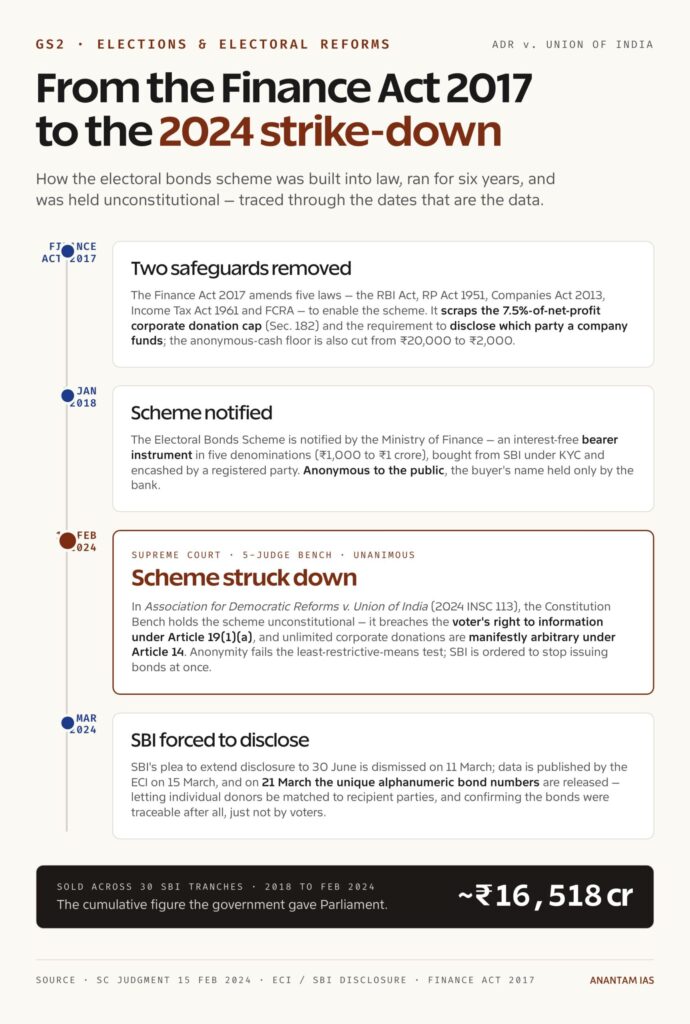
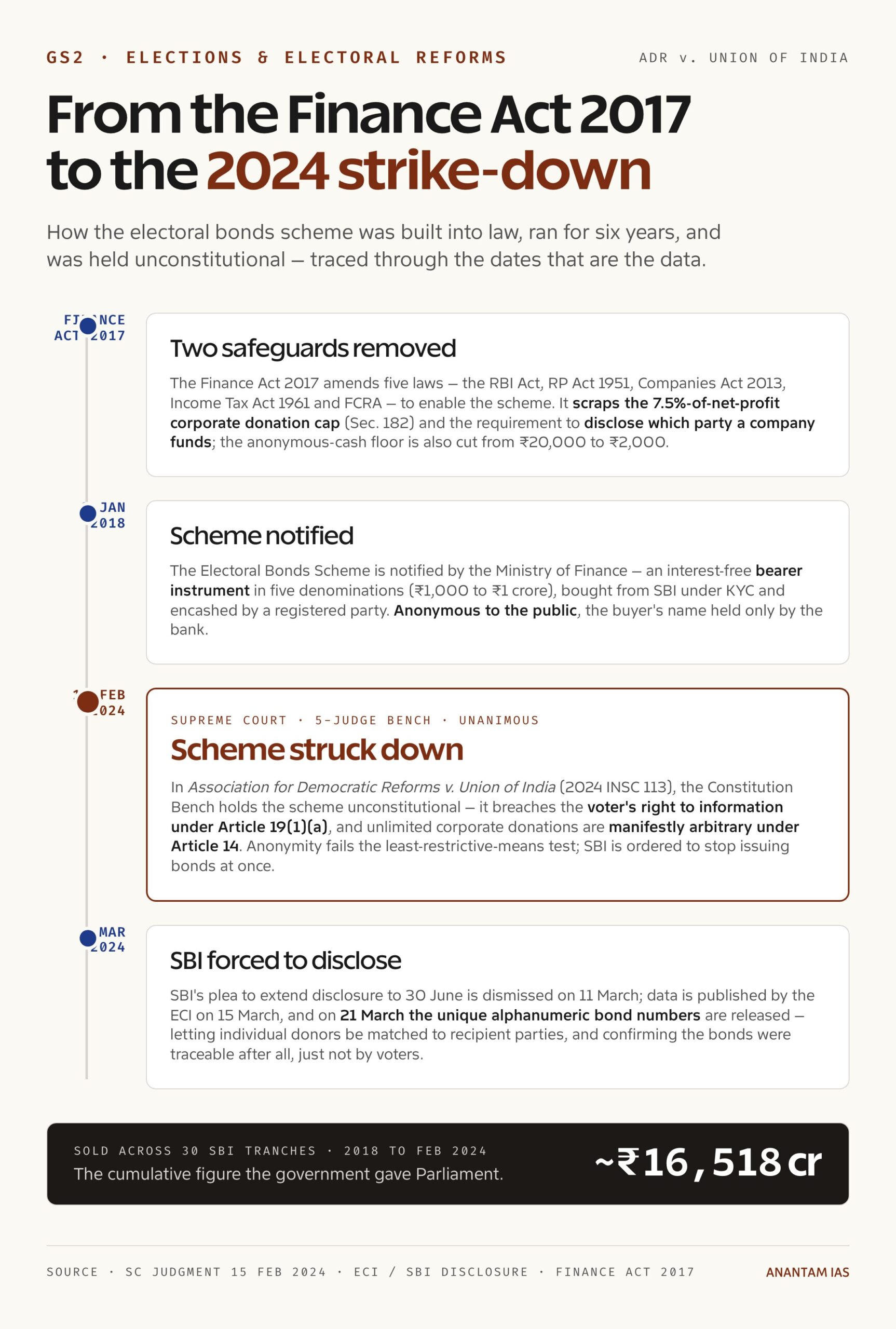
The instrument arrived through an unusual door. The Finance Act, 2017 notified the Electoral Bonds Scheme into existence on 2 January 2018, and to make room for it Parliament amended five separate laws, the Reserve Bank of India Act, the Representation of the People Act 1951, the Companies Act 2013, the Income Tax Act 1961, and the Foreign Contribution (Regulation) Act. Two of those changes mattered most. The Companies Act had capped a company’s political giving at 7.5% of its average net profit over three years and forced it to disclose which party it funded. The Finance Act 2017 scrapped both the cap and the disclosure. And Section 29C of the RP Act 1951 was amended to let parties skip declaring any donor who gave through bonds.
Two more terms anchor the whole debate. The right to information under Article 19(1)(a) isn’t a separate clause in the Constitution; it’s the voter’s freedom of speech and expression, which the Court has long read to include the right to know about those who seek to govern, because you can’t vote meaningfully on what you can’t see. And quid pro quo, literally “this for that,” is the worry that a large secret donation buys a policy favour, a contract, a licence, a softened regulation, in return. Hold those two ideas together, the voter’s right to see and the danger of secret exchange, and you have the spine of the entire case.
One more piece of context. Bonds didn’t replace a clean system; they replaced an already-leaky one, where cash donations below ₹20,000 went undeclared. The Finance Act 2017 even cut that anonymous-cash floor from ₹20,000 to ₹2,000, framed as tightening transparency at the small-donation end. So the scheme was sold as a clean-up. The Court found it made one part of the system darker, not lighter.
What the Data Says
The numbers are where you slow down, because the scale is the argument. Across 30 tranches between 2018 and February 2024, electoral bonds worth about ₹16,518 crore were sold through SBI, a figure the government itself gave Parliament. That’s not pocket change moving through politics. That’s a parallel funding system the size of a mid-cap company’s market value, running for six years with the public locked out of the donor list.
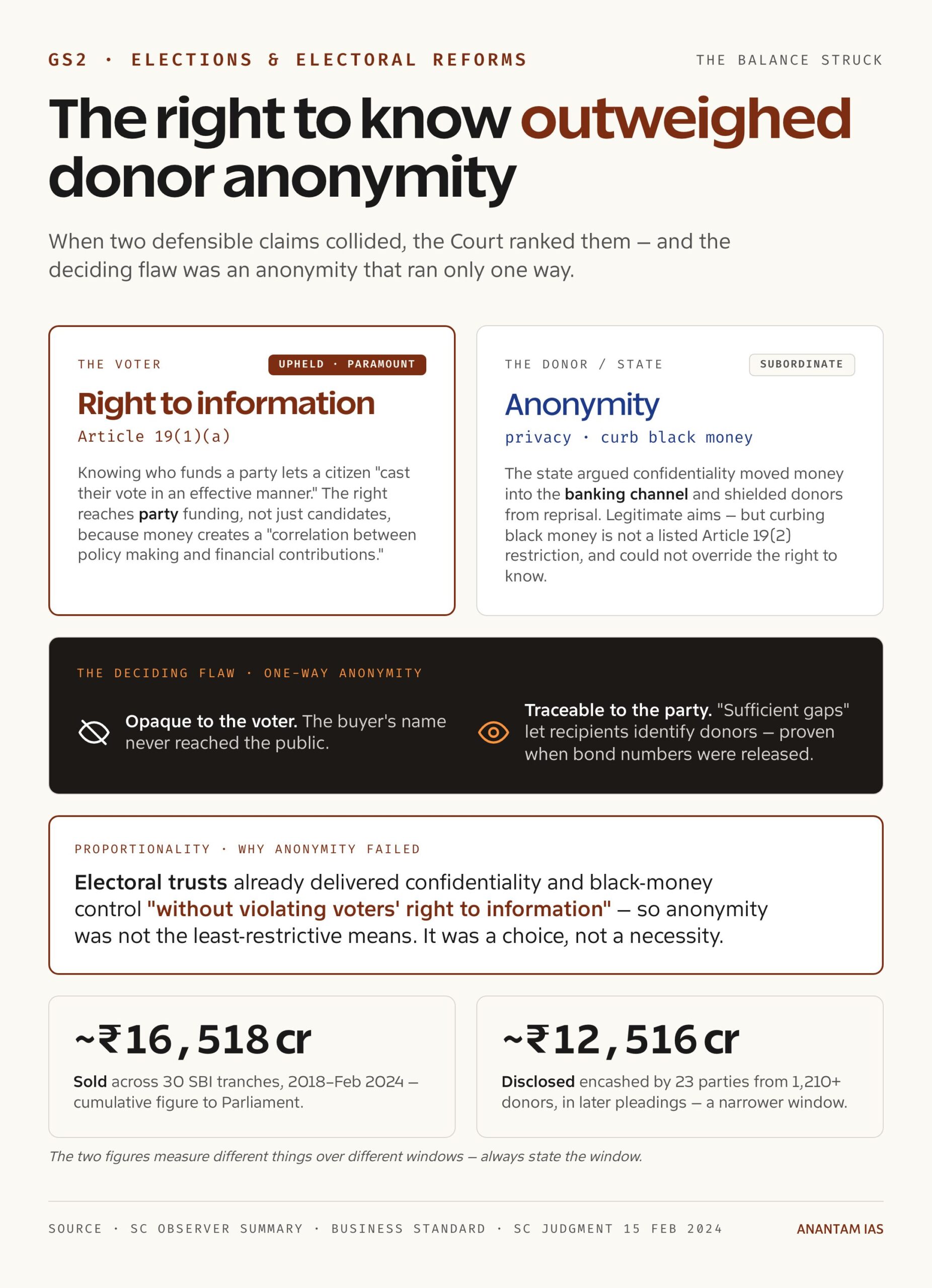
Now handle the second number carefully, because this is exactly where answers go wrong. When pleas later asked the Court to order a probe, the pleadings cited about ₹12,516 crore received by 23 parties from over 1,210 donors, with 21 donors giving more than ₹100 crore each. The ₹16,518 crore and the ₹12,516 crore don’t match because they aren’t measuring the same thing. The first is the cumulative amount sold; the second is the disclosed encashed figure in the litigation, over a narrower window. So cite both, label both, and never collapse them into one tidy total. The honest line is that the exact figure depends entirely on which window you pick.
The party-wise split, drawn from the ECI disclosure of bonds encashed after 12 April 2019, shows how concentrated the money was. The BJP received ₹6,060.51 crore, the single largest share; the AITC ₹1,609.53 crore; the INC ₹1,421.86 crore. State these as data, not as accusation. The point for an answer isn’t which party got how much. It’s that bonds let any of these flows happen in public darkness, and that the ruling party of the day, whichever it is, has the structural advantage in a system built on secrecy.
The donor side tells its own story. The largest reported corporate buyers included Future Gaming and Hotels at roughly ₹1,300 crore, Megha Engineering & Infrastructures, and Qwik Supply Chain, and several big buyers had reportedly faced enforcement-agency scrutiny around the same period. Treat that last detail as reported, not proven. But the pattern is what feeds the quid-pro-quo worry, and why the matching exercise later mattered so much.
Two institutions had flagged all of this before a single bond was sold. The RBI, in January 2017, recorded “severe apprehensions,” warning that bonds were susceptible to illicit financial activity and lacked transparency. The Election Commission of India, in 2017, formally opposed the anonymity features and warned they could increase the flow of illicit funds into politics. So the regulator of money and the regulator of elections both objected on the record, years before the Court did. That isn’t hindsight. It’s a warning the system overrode.
The Case For
The scheme had a real rationale, and a strong answer states it at full strength before knocking it down. Pretending the government had no case is lazy, and an examiner can tell.
Start with the cleanest argument: move political money into the banking channel. Before bonds, a large slice of party funding came as untraceable cash, suitcases nobody could audit. Bonds could be bought only through a KYC-compliant bank account and encashed only by a registered party into a designated account. So every rupee, in principle, entered through a bank and left through a bank. The pitch was that this drags donations out of the shadow economy and into a system that at least the bank and the regulator can see.
The second argument followed from the first: curb black money. The government argued that promising donors confidentiality would push them to give “white” money through legal channels rather than cash, and told the Court that contributions had shifted toward the banking system. The logic was that a donor who fears exposure gives cash; a donor who’s promised anonymity gives a clean, taxed cheque. Anonymity, on this view, was the price of formalising the money.
Third, donor privacy as protection. The state defended confidentiality as shielding contributors from retaliation, the worry that a company funding one party gets punished by another when power changes hands. In a system where parties control contracts and clearances, that fear isn’t imaginary. So the privacy claim wasn’t pure cover; it spoke to a genuine vulnerability of the donor.
And fourth, the companion reform: cutting the anonymous-cash ceiling from ₹20,000 to ₹2,000, a reduction to a tenth of the old threshold, framed as tightening transparency at the bottom end even as bonds opened a new channel at the top. Taken together, the case for the scheme was that it formalised a messy, cash-heavy system and gave donors a reason to stay legal. The trouble, as the Court found, was the price tag: the voter’s right to know.
The Case Against
Here’s what the rationale walks past. A funding channel isn’t judged only by whether the money is “white.” It’s judged by whether the citizen who casts the vote can see who’s paying the people asking for that vote. On that test, electoral bonds failed, and the Court’s reasoning is the heart of this topic.
The foundation was the voter’s right to information under Article 19(1)(a). The Court held that information about party funding lets voters “cast their vote in an effective manner,” and that this right extends to who funds the party, not just the individual candidate, because money creates a “correlation between policy making and financial contributions”. So the right to know wasn’t a soft preference the state could trade away. It was a constitutional right that anonymity directly cut against.
Then came the flaw that quietly sank the whole thing: the anonymity was asymmetric. Bonds were opaque to the public, but the Court found “sufficient gaps in the Scheme which enable political parties to know the particulars of the contributions”. So the donation was secret from the voter and potentially visible to the recipient party, exactly backwards from what transparency requires. And when the matching data came out, this stopped being theory.
The disclosure timeline made the gap concrete. The judgment ordered SBI to stop issuing bonds at once and hand the data to the ECI. SBI asked for an extension to 30 June 2024, claiming it needed to decode 22,217 bonds; on 11 March 2024 the Court dismissed that plea, ordered disclosure by 12 March, and warned of contempt. The ECI published the data on 15 March 2024, and on 21 March 2024 it uploaded the unique alphanumeric bond numbers that allowed individual donors to be matched to recipient parties. That matching exercise proved the asymmetry the Court had only inferred: the bonds were traceable after all, just not by the people voting.
On the corporate side, the Court found separate, manifest arbitrariness under Article 14, the guarantee that the state won’t act in a way that’s clearly unreasonable. Scrapping the 7.5% profit cap treated companies like ordinary citizens, ignored that even loss-making firms could now donate unlimited sums, and removed a safeguard against shell-company funnelling. And unlimited corporate giving, the Court said, “is antithetical to free and fair elections because it allows certain persons/companies to wield their clout and resources to influence policy making,” undermining the principle of one person, one vote. That’s the quid pro quo worry in the Court’s own words.
The proportionality test sealed it. Borrowing the framework from Modern Dental College, the Court asked whether anonymity was the least-restrictive way to achieve the state’s goal, and answered no: electoral trusts already offered the same confidentiality and the same black-money control “while also not violating voters’ right to information”. An electoral trust is a registered non-profit that pools donations from many contributors and distributes them to parties under disclosure norms, breaking the direct donor-to-party link without hiding the money from the public. So a cleaner tool already existed. Anonymity wasn’t necessary; it was a choice. And Justice Sanjiv Khanna, concurring, put the deeper point plainly: transparency, not secrecy, is the cure for the defects of democracy.
The Deeper Structural Read
Step back from the bonds themselves and the real fault line shows up. This was never a debate between transparency and corruption, where one side wears the white hat. It’s a structural clash between two legitimate needs, and the Court chose which one yields when they collide.
Parties genuinely need money. Campaigns, offices, staff, travel, the whole machinery of mass politics costs enormous sums the Constitution doesn’t fund, and a democracy that pretends otherwise just pushes the funding underground. That’s the case the bonds spoke to, and it’s real. But the voter’s right to know is the thing that makes a vote informed rather than blind. When those two needs collide, the Court said the right to know wins, because secrecy in funding corrodes the very election the funding is supposed to contest. That ranking, transparency over the convenience of donors and parties, is the structural takeaway, and it’ll outlast this particular scheme.
There’s a separation-of-powers layer too, and it cuts both ways. The Court striking down a funding scheme passed by Parliament is judicial review doing its job, testing a law against fundamental rights. But notice how the scheme arrived: through the Finance Act 2017, passed as a Money Bill, which under Article 110 the Rajya Sabha can’t effectively block. Critics argued that routing a sweeping change to election-funding law through the money-bill door bypassed the upper house and dodged scrutiny. The validity of that route was referred to a larger bench in related litigation and wasn’t finally settled in this judgment, so treat it as open, not closed. But the design lesson stands: a structural reform smuggled through a procedural shortcut invites exactly the legitimacy challenge that followed.
And here’s the part that should bother a future administrator most. Strike down the scheme and you’ve removed the instrument, not the demand. The money parties needed didn’t evaporate on 15 February 2024. The system simply reverted to the pre-2018 framework, anonymous cash up to ₹2,000 and electoral trusts, with no new transparency architecture in its place. So the strike-down created a vacuum, and a vacuum in political funding doesn’t stay empty. It fills with whatever channel is least visible. A court can declare a bad answer unconstitutional. It can’t legislate the good one. That job sits with Parliament, and Parliament hasn’t done it.
That’s why the most important fact about this topic is the one that isn’t a fact yet: as things stand, there’s no replacement. The proportionality test told us anonymity wasn’t the least-restrictive means. It didn’t tell us what the right means looks like, and that gap is where every serious answer has to point.
What Should Be Done
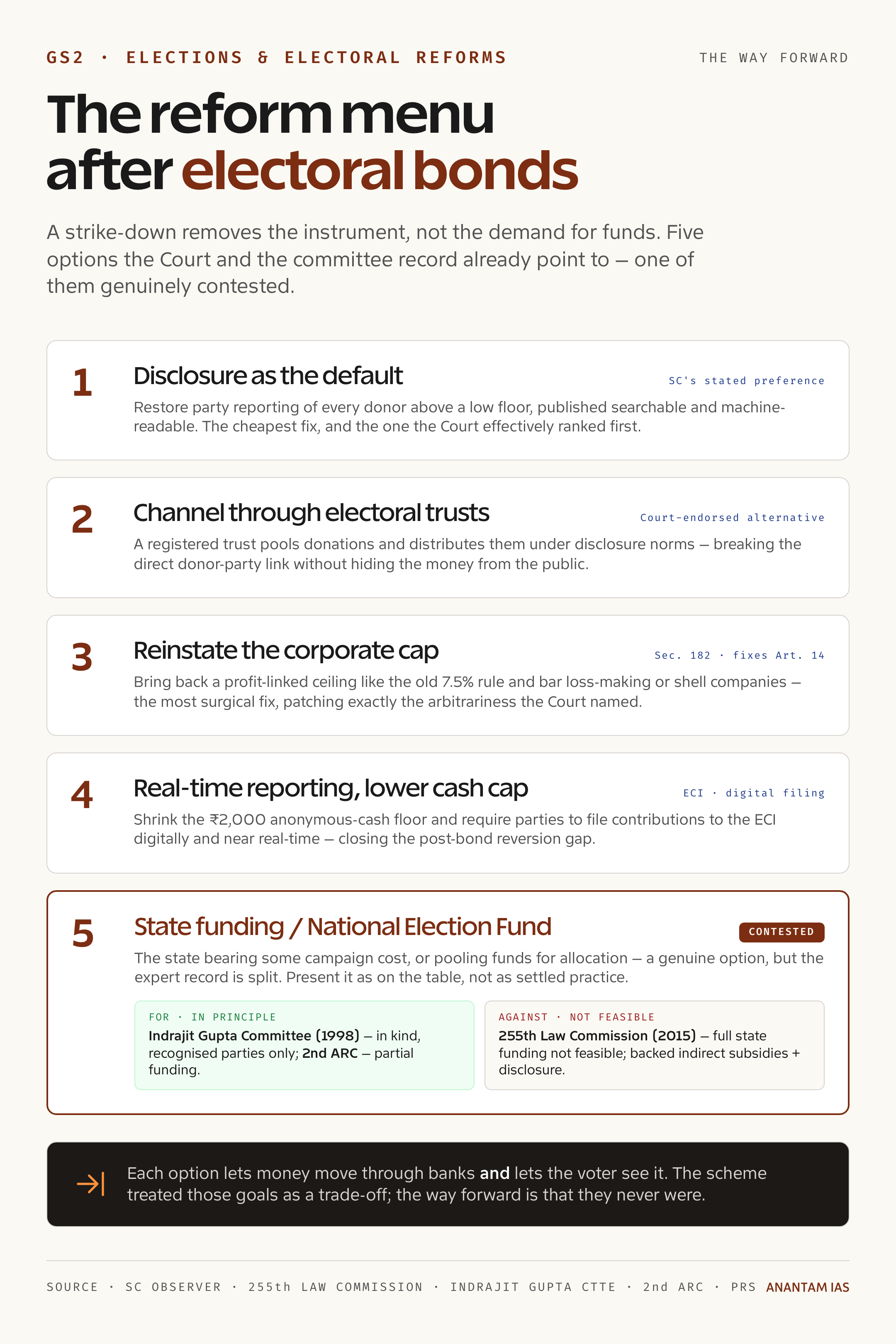
So what does a clean funding system actually look like? Not a vague plea for “transparency,” but a menu of options that the committees, the Court, and the institutional record already point to. Here are six, attributed and weighted honestly.
- Make disclosure the default, with a low threshold. Restore and strengthen party reporting of every donor above a small floor, published in a searchable, machine-readable form. This is the option the Court itself effectively preferred when it ranked the right to know over donor anonymity. It’s also the cheapest fix going. You can find the broader case for institutional transparency in our work on the Election Commission’s independence, because the body that runs elections is the natural home for a real-time disclosure portal.
- Channel donations through electoral trusts. An electoral trust pools contributions and distributes them under disclosure norms, breaking the direct donor-party link without hiding the money from the public. The Court flagged trusts as already offering confidentiality and black-money control without breaching the right to know, which makes them a ready-made, judicially endorsed alternative rather than a fresh experiment.
- Reinstate the corporate cap and bar shell-company giving. Bring back a profit-linked ceiling like the old 7.5% rule, and block loss-making or paper companies from donating at all. This directly repairs the Article 14 defect the Court named, the arbitrariness of letting any company, profitable or not, real or shell, give without limit. It’s the most surgical fix, because it patches exactly what the Court struck.
- Lower or abolish the anonymous-cash floor and report in near-real-time. The ₹2,000 cash window is the obvious back door once bonds are gone. Shrink it, and require parties to file contributions to the ECI digitally and close to real time, not in an annual lump that lands long after the votes are counted. This closes the post-bond reversion gap that the strike-down left wide open.
- Treat state funding as a serious option, but a contested one. The idea of the state bearing some campaign cost has a long pedigree. The Indrajit Gupta Committee (1998) endorsed it in principle, but only for recognised parties and, in the short term, in kind rather than cash. The 2nd ARC recommended partial state funding to curb illegitimate expenditure. But the 255th Law Commission Report (2015) found full state funding not feasible and backed indirect subsidies plus disclosure reform instead. So present state funding, and the recurring idea of a pooled National Election Fund, as a genuine reform on the table, not as settled best practice. The expert consensus is split, and an honest answer says so.
- Reopen the money-bill question, on principle. A structural reform to election funding shouldn’t be able to skip the Rajya Sabha through the Article 110 shortcut. Whatever the final word on the bonds route, funding law deserves full bicameral scrutiny, and the same logic about procedural integrity runs through our discussion of Parliament’s declining scrutiny.
Every one of these strengthens, rather than weakens, the formalisation the bonds were meant to deliver. You can move money through banks and let the voter see it. The scheme treated those two goals as a trade-off. They never were.
For Your Mains Answer
This is a high-value GS2 topic. It pulls together fundamental rights, the Representation of the People Act, constitutional bodies, judicial review, and the money-bill controversy in a single frame, and it rewards an answer that handles a politically charged subject with neutral, attributed precision.
GS paper mapping: GS2: Salient features of the Representation of the People’s Act; functions and responsibilities of constitutional bodies; separation of powers and judicial review; government policies and transparency in governance; Fundamental Rights.
PSIR (Optional) relevance: Paper I draws on the political economy of money in politics, party-system financing, and corporate influence as a pressure group. The deeper theory link is political equality versus economic inequality, the “one person, one vote” ideal set against concentrated wealth, and the place of the informed citizen in democratic theory. On the Indian side, it connects to judicial review and the basic-structure adjacency of free and fair elections.
Likely question frames:
- The voter’s right to information and the confidentiality of political donors are both defensible claims. Examine how the Supreme Court resolved this tension in ADR v. Union of India (2024), and assess what the strike-down left unresolved.
- “Anonymity in political funding is incompatible with free and fair elections.” Critically analyse with reference to the electoral bonds judgment and the available reform alternatives.
- Discuss the structural problem of money in Indian politics. Why does striking down a single instrument leave the deeper problem intact?
Quotable data and cases:
- Association for Democratic Reforms v. Union of India, 15 February 2024 (2024 INSC 113), a five-judge Constitution Bench, unanimous, struck the scheme down under Article 19(1)(a) and Article 14.
- About ₹16,518 crore in bonds sold across 30 tranches via SBI, 2018 to Feb 2024 (figure to Parliament); about ₹12,516 crore the disclosed encashed figure in later pleadings, with 21 donors giving over ₹100 crore each. State the window.
- The Finance Act 2017 scrapped the 7.5%-of-net-profit corporate donation cap and the donor-disclosure requirement, and cut the anonymous-cash floor from ₹20,000 to ₹2,000.
- The Court held electoral trusts already offered the same goals “without violating voters’ right to information,” so anonymity failed the least-restrictive-means test.
- The RBI (Jan 2017) and the ECI (2017) both objected on the record before the scheme launched.
Keywords to use: Article 19(1)(a), right to information, Article 14 manifest arbitrariness, proportionality test, electoral bonds, electoral trusts, Section 182 Companies Act, Section 29C RP Act 1951, money-bill route, quid pro quo, state funding of elections, National Election Fund.
Syllabus linkages: Representation of the People Act; constitutional and statutory bodies; judicial review; transparency and accountability; Fundamental Rights; basic structure and free and fair elections.
Balanced conclusion line: The Court answered the narrow question, that secret funding can’t override the voter’s right to know, but it left the broad one open; until Parliament builds a transparent, capped, well-disclosed funding system, India will keep treating the symptom of money in politics while the disease quietly finds a new channel.
How to Build the Answer
Open with the tension, not a definition. The sharp first line is that parties need money and voters need to know its source, and electoral bonds tried to resolve that by hiding one half of it. That single sentence shows the examiner you’ve grasped both the policy need and the rights problem. Drop the definition of electoral bonds into the second sentence, not the first.
Bring data in early, but ration it. A strong first body paragraph can carry three figures: about ₹16,518 crore sold, the BJP’s ₹6,060.51 crore as the largest share, and the RBI and ECI objecting before launch. Then say what they prove, that the scale was systemic and the warnings were ignored. UPSC rewards the move from fact to inference far more than the fact itself.
Steelman the scheme before you criticise it. Spend two or three lines on the genuine case, moving money into the banking channel, curbing untraceable cash, before you turn to the Article 19(1)(a) and Article 14 reasoning. An answer that only quotes the strike-down reads like a press clipping. An answer that explains why a reasonable government tried this, and why it still failed the proportionality test, reads like analysis.
Group the way forward; never scatter it. Cluster the reforms, default disclosure, electoral trusts, a reinstated corporate cap, a lower cash floor with real-time reporting, contested state funding, and the money-bill question. Name the actor for each, Parliament, the ECI, the Court. Use the topic’s own vocabulary so the answer sounds like governance analysis, not a recap.
Close on the unfinished business. The reliable move here is “the Court answered the narrow question but left the broad one open.” That lets you show judgment, that a strike-down removes an instrument, not the demand for funds, which is the single insight that separates a top answer from a competent one.
Common Mistakes to Avoid
- Don’t turn the answer into a verdict on parties. Cite the party-wise figures as data, never as an accusation against any named party. The examiner is testing your neutrality as much as your knowledge.
- Don’t merge the two money figures. ₹16,518 crore (sold) and ₹12,516 crore (disclosed encashed) measure different things over different windows. Conflating them signals you didn’t read carefully.
- Don’t stop at “it was struck down.” The marks are in the reasoning, right to information, asymmetric anonymity, proportionality, Article 14, and in what the strike-down left unsolved.
- Don’t present state funding as the obvious fix. Both the Indrajit Gupta Committee and the 255th Law Commission had reservations. Flag it as contested.
- Don’t forget the structural point. Removing a scheme without replacing it creates a vacuum that fills with the least visible channel. Name that gap.
A Compact Answer Spine
- Introduction: Open with the funding-versus-transparency tension in one line; define electoral bonds and the right to information in the next.
- Evidence: Use two or three attributed figures and tie each to a policy implication.
- Arguments: The case for the scheme (banking channel, curbing cash), then the Court’s case against (Article 19(1)(a), asymmetric anonymity, Article 14, proportionality). Keep both fair.
- Structural diagnosis: Parties need money, voters need to know; the Court ranked the right to know first, but the strike-down left a funding vacuum.
- Way forward: Four to five grouped reforms, each with a clear actor; flag state funding as contested.
- Conclusion: Adapt the balanced conclusion line to the exact question wording.
Diagram or Flowchart Idea
For a 15-marker, draw one causal chain, not a decorative web. The cleanest format: Finance Act 2017 (cap removed, disclosure dropped) → bonds notified 2018 → anonymous to public, traceable to party → Article 19(1)(a) breach + Article 14 arbitrariness → struck down 2024 → funding vacuum → reform menu. The examiner reads that logic in seconds.
For a 10-marker, skip the diagram and use a two-column table instead: “Voter’s right to know (Art 19(1)(a))” against “Donor confidentiality / black-money curb,” with the Court’s resolution in a final row. It’s faster to evaluate under time pressure and does more analytical work than a flowchart.
Ethics and Governance Angle
Add one ethical line even in a GS2 answer. The deeper ethical claim here is informational: a citizen can only consent to be governed by people whose backers she can see. Secret funding doesn’t just risk corruption; it disables the informed consent a democracy runs on. That’s the move from “bonds were opaque” to “opacity erodes the citizen’s capacity to choose.”
Then convert the value into design. Don’t just say “ensure transparency.” Say how: a searchable real-time disclosure portal, a capped corporate contribution, electoral trusts instead of bearer instruments, citizenship-grade due process for any donor scrutiny. That’s the shift from moral language to administrative maturity, and it’s exactly what the examiner rewards on a governance question.
A sentence pattern that travels across topics: “The aim was legitimate, but its legitimacy depended on means the Constitution could accept.” It credits the government’s intent to formalise funding without handing it a blank cheque on secrecy.
How to Use Data Without Sounding Mechanical
Use fewer numbers than you know. Three well-explained figures beat ten scattered ones. Lead with the scale (about ₹16,518 crore sold), use a second for concentration (BJP’s ₹6,060.51 crore as the largest share), and use a third to expose the design flaw (21 donors gave over ₹100 crore each). One scale figure, one concentration figure, one risk figure is usually enough.
Never leave a statistic standing alone. Follow it with “this means” or “the implication is.” The ₹16,518 crore means a parallel funding system the size of a large firm ran with the public locked out. That tiny move turns a fact sheet into analysis, and analysis is what gets marked.
Always state the window when you quote a funding number, because the sources genuinely differ. Saying “about ₹16,518 crore sold, against about ₹12,516 crore disclosed in later pleadings” shows the examiner you understand the data rather than parroting one headline. Precision about uncertainty is itself a mark of competence.
Finish with a single question: could a tired examiner follow this in one pass? If a line sounds impressive but does no work, cut it and replace it with a fact, a cause, a consequence, or a reform. That habit is what separates an answer that feels informed from one that feels memorised.
FAQ
Why did the Supreme Court strike down the electoral bonds scheme?
In ADR v. Union of India (15 February 2024), a five-judge Constitution Bench unanimously held the scheme unconstitutional. It violated the voter’s right to information under Article 19(1)(a), because donor anonymity stopped citizens from knowing who funds parties, and the removal of the corporate donation cap was manifestly arbitrary under Article 14. The Court also found the anonymity wasn’t the least-restrictive means, since electoral trusts already offered confidentiality without hiding the money from the public.
What was the corporate donation cap that the scheme removed?
Under Section 182 of the Companies Act 2013, a company could donate no more than 7.5% of its average net profit over the preceding three years, and had to disclose which party it funded. The Finance Act 2017 scrapped both the cap and the disclosure, allowing unlimited and undisclosed corporate giving, including by loss-making and potentially shell companies. The Court restored the principle behind the cap by striking the removal down under Article 14.
How much money moved through electoral bonds?
About ₹16,518 crore in bonds were sold across 30 tranches via SBI between 2018 and February 2024, the cumulative figure the government gave Parliament. A narrower disclosed-encashed figure of about ₹12,516 crore appeared in later pleadings, covering a different window and reaching 23 parties from over 1,210 donors. The two numbers measure different things, so the window always has to be stated.
What replaced electoral bonds after the strike-down?
Nothing yet. The system reverted to the pre-2018 framework, anonymous cash donations up to ₹2,000 and electoral trusts, with no new transparency architecture legislated. That’s the core of the unfinished problem: the Court removed a flawed instrument but couldn’t design its replacement, leaving the deeper question of transparent, capped, well-disclosed political funding for Parliament to answer.
Tell Google you want more of this.
Add Anantam IAS as a preferred sourceOne tap, and this site shows up more often in your own Top Stories, AI Overviews and AI Mode. Remove it any time.