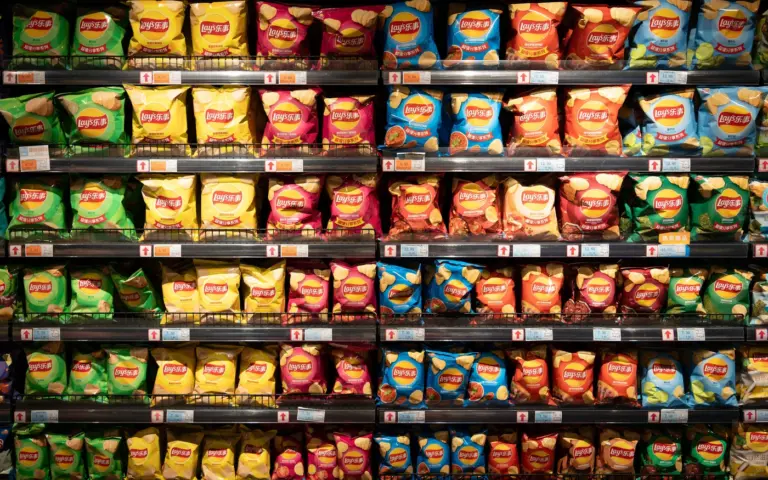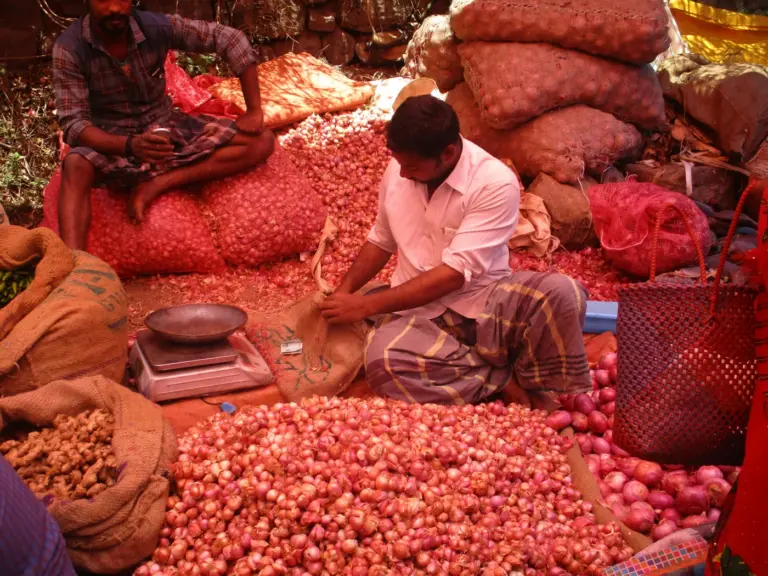

Agritech — the application of technology to agriculture, horticulture, aquaculture and animal husbandry — has emerged as one of the most dynamic startup ecosystems in India. As of 2025-26, India hosts ~3,000 agritech startups that have collectively raised over USD 4-5 billion in venture funding, providing solutions across inputs, mechanisation, advisory, financing, marketing, traceability, and post-harvest infrastructure. NASSCOM's earliest mapping in 2020 identified six core agritech segments — inputs, mechanisation, finance, resource maximisation, productivity enhancement, and agricultural marketing — each represented by Indian unicorns or near-unicorns: DeHaat, Ninjacart, WayCool, AgroStar, Cropin, Stellapps, Jumbotail, BigHaat, Fasal, JaiKisan, BharatRohan.
For UPSC, agritech is a GS-III topic at the junction of agriculture, technology, startup ecosystem, doubling farmers' income, food security and digital India. Prelims has tested specific examples from the NASSCOM framework. Mains has asked how agritech can transform Indian agriculture and what policy support it needs.
What is Agritech?
Agritech is the products, services, or applications that improve input-output processes across the agricultural value chain. According to NASSCOM, agritech can drive comprehensive transformation through:
- Mobile applications for advisory, marketplace, finance.
- Drones and unmanned aerial vehicles for spraying, surveillance.
- IoT sensors for soil moisture, leaf wetness, climate monitoring.
- AI and Machine Learning for yield prediction, disease detection, satellite analysis.
- Big Data analytics for supply chain optimisation.
- Blockchain for traceability and quality certification.
- Precision agriculture through GPS-guided machinery.
- Hydroponics, aeroponics, vertical farming for controlled environment agriculture.
- Cold chain technology for perishables.
- Robotics and automation in greenhouses.
- E-commerce platforms for direct farm-to-consumer sales.
Background: Why Agritech Matters for India
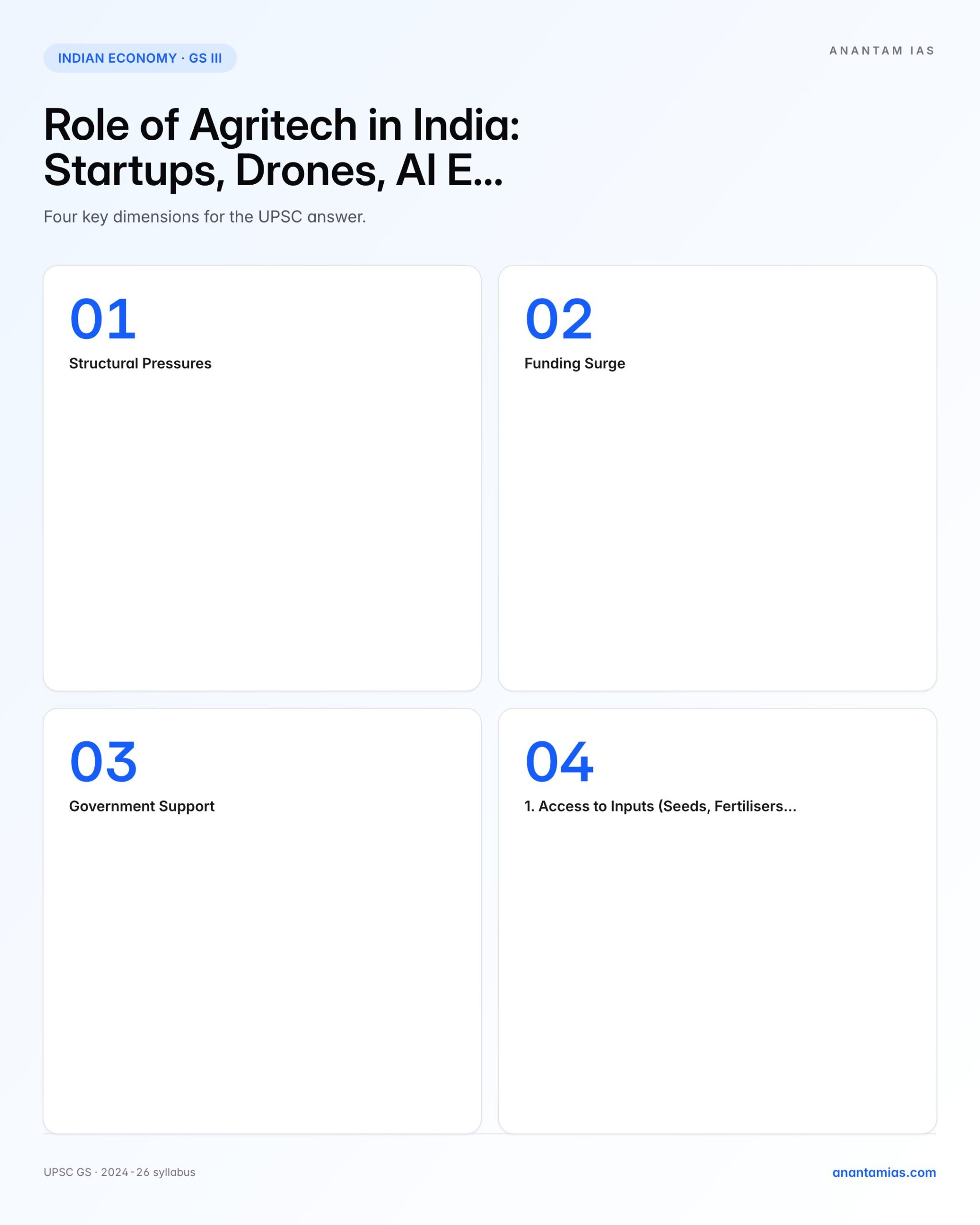
Structural Pressures
- 86% small/marginal farmers with 1.08 ha average holding can't afford individual technology.
- Agriculture's GDP share is 17% but employment share is 46% — productivity gap.
- Post-harvest losses of 20-25% in horticulture, 5-10% in grains.
- Imbalanced fertilisation, water inefficiency, pesticide overuse — calls for precision.
- Information asymmetry in markets — farmers lose 40-60% of consumer rupee to intermediaries.
- Climate vulnerability — 52% of net sown area is rainfed.
Funding Surge
- Indian agritech crossed USD 4 billion in cumulative funding by 2024.
- Major investors: Sequoia, Tiger Global, Lightspeed, Accel, Omnivore, Bertelsmann, Blue Earth Capital.
- Unicorns: DeHaat, Ninjacart, WayCool, Cropin (some); near-unicorns: AgroStar, Jumbotail, Stellapps, BigHaat.
- Hubs: Bengaluru, Hyderabad, Pune, Mumbai, Delhi-NCR, Ahmedabad.
Government Support
- Agriculture Accelerator Fund — Rs 500 crore announced in Budget 2023-24.
- Bharat AgriTech Foundation — launched 2025 to incubate agritech startups.
- Production Linked Incentive (PLI) for drones under MoCA.
- Namo Drone Didi — Rs 1,261 crore (2024-26).
- Digital Agriculture Mission — Rs 2,817 crore.
- Atal Innovation Mission — agri-startups under AIM.
- Rashtriya Krishi Vikas Yojana (RKVY) — RAFTAAR component for entrepreneurship.
Components: NASSCOM's Six-Segment Agritech Framework
1. Access to Inputs (Seeds, Fertilisers, Machinery, Pesticides)
Examples:
- BharatRohan — drone surveillance + precision input recommendations.
- AgroStar — direct-to-farmer agri-input e-commerce.
- DeHaat — full-stack model with input procurement, advisory, market linkage.
- BigHaat — online marketplace for inputs.
Mechanism: Mobile apps deliver agricultural inputs at the farmer's doorstep, often with AI-recommended product matching based on crop and soil conditions.
2. Mechanisation as a Service
Examples:
- Goldfarm — Uber-like model for tractor and farm-equipment rental.
- EM3 Agri Services — pay-per-use farm machinery.
- TractorJunction — tractor marketplace.
- FarmEasy — equipment rental platform.
Mechanism: Small farmers cannot afford to own tractors or harvesters. On-demand rental democratises mechanisation.
3. Access to Loans and Insurance
Examples:
- JaiKisan — alternative credit scoring for farmers using transaction history.
- Samunnati — agri-finance NBFC focused on FPOs and value chains.
- Jai Kisan, Khetigaadi, Kisht — digital credit access.
- Stellapps — dairy farmer credit through milk supply data.
Mechanism: Credit scoring uses alternate data (sale history, milk delivery, satellite imagery) to assess farmers without traditional collateral.
4. Resource Maximisation (Water, Fertiliser, Energy)
Examples:
- Fasal — IoT-based platform using AI and Big Data to optimise water, fertiliser, pesticide.
- CropIn — SaaS platform for plot-level analytics.
- Ayekart, AgNext — quality and resource management.
- Skymet — weather analytics.
Mechanism: Sensors, satellite imagery, and AI provide plot-specific advisories for optimal input use.
5. Enhancing Productivity
Examples:
- NITI Aayog's Precision Agriculture Pilot using AI for crop productivity.
- Microsoft FarmBeats — IoT + AI for smallholder farms.
- Cropin — yield prediction using satellite data.
- AgriBegri — farm management software.
- Kheyti — affordable greenhouse-in-a-box for small farmers.
Mechanism: Combine soil, weather, market, and crop data to recommend interventions.
6. Agricultural Marketing
Examples:
- Ninjacart — connects farmers directly with retailers (B2B).
- WayCool — full-stack farm-to-retail logistics.
- DeHaat — input plus output marketing.
- Otipy — direct farm-to-consumer (D2C).
- Crofarm/Otipy — Tier-1 city D2C.
- MeraKisan — organic produce D2C.
Mechanism: Digital platforms aggregate demand and supply, eliminating multiple intermediaries.
Benefits of Agritech for Indian Agriculture
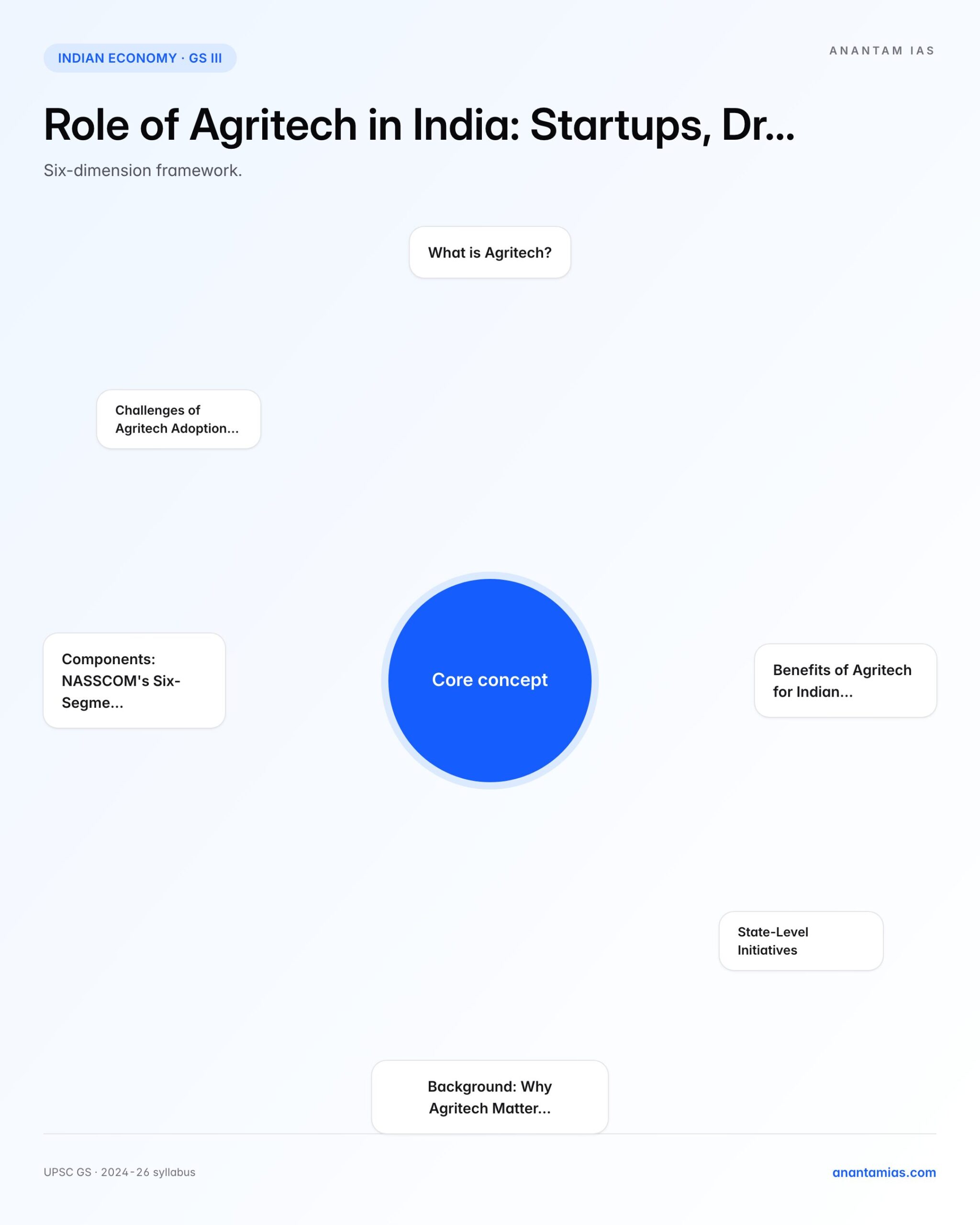
- Bridges information asymmetry — direct access to advisory, prices, weather.
- Improves access to inputs at lower cost via aggregated procurement.
- Increases productivity through precision agriculture (15-30% yield gains in pilots).
- Reduces post-harvest losses through cold chain monitoring and direct-to-retail logistics.
- Improves farmer's share of consumer rupee from 25-30% to 40-55%.
- Enables credit access through alternative data scoring.
- Promotes sustainable farming through resource efficiency.
- Empowers women farmers through SHG-linked agritech models.
- Generates rural employment — agritech startups are major rural-tech employers.
- Drives crop diversification through D2C demand for niche produce.
- Boosts export competitiveness through traceability and quality control.
- Doubles farmers' income by integrating multiple value-chain interventions.
Challenges of Agritech Adoption in India
Farmer-Level Adoption
- Smartphone penetration ~60% rural; older farmers digitally hesitant.
- Trust deficit with new technology — early adopters needed to demonstrate ROI.
- Vernacular language coverage uneven across apps.
Funding Volatility
- Agritech VC funding cooled post-2022 globally; Indian agritech funding fell 50% in 2023-24.
- Path to profitability challenging for low-margin agriculture.
- Unit economics of D2C models difficult.
Fragmented Landholdings
- Per-farmer revenue is low; agritech needs FPO-level aggregation.
- FPOs cover only ~5% of farmers — slow scaling.
Regulatory and Policy Gaps
- Drone airspace regulations evolving but not fully streamlined.
- AgriStack data access for private agritech needs framework.
- Digital land records uneven across states.
- GST and credit complications for agritech invoicing.
Quality and Standards
- Spurious products masquerading as "smart agritech".
- Lack of standardised performance benchmarks.
Dependence on Connectivity
- Rural 4G/5G still uneven.
- Power supply intermittent.
- IoT scalability depends on ground infrastructure.
Linkage with Public Schemes
- Many agritech startups operate in parallel to government schemes rather than integrated with them.
- Last-mile reach to small farmers needs convergence with KVKs, ATMA.
State-Level Initiatives
| State | Initiative |
|---|---|
| Maharashtra | Mahaagri Tech Fund; Smart Agriculture Mission |
| Karnataka | Rs 100 crore agritech fund; Bengaluru hub |
| Andhra Pradesh | Rythu Bharosa Kendra integration with agritech |
| Telangana | T-Hub agritech vertical |
| Gujarat | iCreate-led agritech support |
| Punjab | PAU-led precision farming pilots |
| Tamil Nadu | TANSIM agritech initiatives |
| Madhya Pradesh | Digital Agriculture Mission state pilots |
Recent Developments (2024-2026)
| Year | Update |
|---|---|
| 2023 | Budget announces Agriculture Accelerator Fund (Rs 500 crore) |
| 2024 | Cumulative agritech funding crosses USD 4 billion in India |
| 2024 | Namo Drone Didi scaled to 15,000 women SHGs |
| Budget 2024-25 | Drone PLI; AgriStack integration with agritech |
| 2025 | Bharat AgriTech Foundation launched as nodal incubator |
| 2025 | DeHaat, Ninjacart, WayCool continue scaling; new categories — vertical farming, lab meat |
| Budget 2025-26 | Rs 1,000 crore for agritech accelerator and skill programmes |
| 2025-26 | AI-based pest forecasting rolled out in 100 KVKs in partnership with agritechs |
| 2026 | Krishi GPT chatbot launched in 22 languages via Bhashini-agritech collaboration |
Reforms and Way Forward
- Scale up the Agriculture Accelerator Fund to Rs 5,000 crore over 5 years.
- Mandate API-level integration between agritech and AgriStack/PMFBY/e-NAM.
- Drone airspace clarity under DGCA — expand Type Certification for agriculture drones.
- Skill development through ICAR institutes, ASCI, agritech-led training.
- Convergence with FPOs — every FPO should partner with an agritech.
- Rural Bharatnet rollout — fibre to every panchayat by FY27.
- Subsidise agritech subscriptions for small/marginal farmers via DBT.
- Quality benchmarks and certification for agritech products through QCI.
- PPP for cold-chain under PMKSY with agritechs operating warehouses.
- Data privacy framework under DPDP Act 2023 for AgriStack-agritech data sharing.
- Insurance for agritech failures — IoT sensor warranties, drone crash insurance.
- Export-oriented agritech — APEDA-led promotion of Indian agritech in Africa, ASEAN, GCC.
- Vertical farming and protected cultivation — agritech-driven hub-and-spoke models in metros.
Government Schemes and Budget Allocations (2025-26)
- Agriculture Accelerator Fund: Rs 500 crore + scaling.
- Bharat AgriTech Foundation: incubation hub.
- Namo Drone Didi: Rs 1,261 crore (2024-26).
- Digital Agriculture Mission: Rs 2,817 crore through FY26; Rs 700 crore in 2025-26.
- PLI for drones: under Civil Aviation; Rs 120 crore.
- RKVY-RAFTAAR: agripreneurship component.
- AIF (Agriculture Infrastructure Fund): Rs 1.25 lakh crore corpus.
- PMFME: micro-food processing convergence.
- Atal Innovation Mission: agri-incubators.
- AgriStack: foundation infrastructure.
Mains Answer Hook
A high-scoring GS-III answer should: (a) frame agritech as the digital interface between farmer and value chain; (b) describe the NASSCOM six-segment framework (inputs, mechanisation, finance, resource max, productivity, marketing) with Indian examples; (c) cite scale — 3,000 startups, USD 4+ billion funding, multiple unicorns; (d) flag funding volatility, fragmented landholdings, last-mile reach as challenges; (e) propose policy support — Bharat AgriTech Foundation, AgriStack APIs, drone clarity, FPO convergence.
Use: "Agritech is to Indian agriculture what fintech was to Indian banking — the layer that converts a fragmented sector into an addressable digital market."
Prelims Pointers
- Agritech: technology applied to agriculture, horticulture, aquaculture.
- NASSCOM framework: six segments — inputs, mechanisation, finance, resource max, productivity, marketing.
- Examples: BharatRohan (drones), Goldfarm (mech), JaiKisan (finance), Fasal (resource), Ninjacart (marketing).
- Cumulative funding: ~USD 4 billion in Indian agritech.
- Agriculture Accelerator Fund: Rs 500 crore (Budget 2023-24).
- Namo Drone Didi: 15,000 women SHGs; Rs 1,261 crore.
- Digital Agriculture Mission: Rs 2,817 crore over FY24-FY26.
- Indian agritech unicorns: DeHaat, Ninjacart, WayCool, Cropin (subset).
- Implementing ministry: Department of Agriculture & Farmers Welfare; with MoCA for drones.
- State leaders: Maharashtra, Karnataka, AP, Telangana.
FAQ on Agritech in India
What is agritech?
The application of technology — drones, IoT, AI, mobile apps, blockchain, robotics — to agriculture, horticulture, aquaculture, and animal husbandry.
How many agritech startups are in India?
Approximately 3,000 active agritech startups as of 2025-26, with cumulative funding of ~USD 4-5 billion.
What is the NASSCOM agritech framework?
Six segments — Access to Inputs, Mechanisation, Loans/Finance, Resource Maximisation, Productivity Enhancement, and Agricultural Marketing.
What is the Agriculture Accelerator Fund?
A Rs 500 crore fund announced in Budget 2023-24 to support agritech startups and rural enterprises.
What is Bharat AgriTech Foundation?
A 2025 nodal body to incubate, fund, and scale agritech startups in collaboration with ICAR, NABARD, and the private sector.
How does agritech help small farmers?
Through aggregated input procurement, on-demand machinery, alternative credit scoring, advisory apps, and direct buyer linkages — all of which improve income and reduce input costs.
Agritech is rewiring how Indian agriculture operates. For UPSC, anchor your answers in the NASSCOM six-segment framework, the USD 4 billion funding base, named examples (BharatRohan, Goldfarm, JaiKisan, Fasal, Ninjacart, DeHaat), and the Agriculture Accelerator Fund. Pair these with Bharat AgriTech Foundation, Namo Drone Didi, and Digital Agriculture Mission for a Mains-grade answer that hits both depth and currency.
Tell Google you want more of this.
Add Anantam IAS as a preferred sourceOne tap, and this site shows up more often in your own Top Stories, AI Overviews and AI Mode. Remove it any time.