The Russian Revolution 1917 was the two-stage upheaval that toppled the three-hundred-year-old Romanov dynasty in February-March 1917, set up a short-lived parliamentary Provisional Government, and was followed in October-November 1917 by the Bolshevik seizure of power under Vladimir Ilyich Lenin. Out of it came the world’s first self-proclaimed socialist state, the Union of Soviet Socialist Republics, formally constituted in December 1922. The Russian Revolution 1917 reshaped twentieth-century politics more deeply than any event between the French Revolution and the Second World War.
For UPSC General Studies Paper I on world history, the Russian Revolution 1917 is a guaranteed mains theme. It connects to the causes and consequences of the First World War, to the rise of fascism, to the Cold War, and directly to the Indian freedom struggle through the influence of Marxism on Bhagat Singh, M. N. Roy, Jawaharlal Nehru and the formation of the Communist Party of India in 1925. This article walks through tsarist autocracy and the 1905 prelude, the wartime collapse of February 1917, Lenin’s April Theses, the October seizure of power, the Civil War of 1918 to 1921, the New Economic Policy and the formation of the USSR, and what 1917 meant for Indian nationalism.
Quick Facts
- Two phases: February Revolution (8 to 15 March 1917 in the Gregorian calendar, 23 February to 2 March in the old Russian Julian calendar) and October Revolution (7 to 8 November 1917 Gregorian, 25 to 26 October Julian).
- Romanov rule: 1613 to 1917. Last tsar: Nicholas II.
- Key leaders: Vladimir Lenin, Leon Trotsky, Joseph Stalin, Alexander Kerensky (Provisional Government), Tsar Nicholas II.
- Ideology: Marxism-Leninism, including Lenin’s theory of imperialism and the vanguard party.
- Civil War: 1918 to 1921, between the Bolshevik Red Army (Trotsky) and the White Armies plus foreign intervention by Britain, France, the United States and Japan.
- State formed: Union of Soviet Socialist Republics (USSR), 30 December 1922.
- Indian link: Communist Party of India founded at Tashkent in October 1920 and at Kanpur in 1925.
The Tsarist Autocracy: Structural Weakness
The Russian Revolution 1917 is incomprehensible without the long crisis of the Romanov state. By 1900 Russia was an empire of 130 million people stretched across Eurasia, ruled by a tsar who claimed divine and absolute authority. There was no parliament, no civil rights and no legal political parties. The Orthodox Church, the army and the bureaucracy were the three pillars of regime support.
Peasant Question
About 80 percent of Russians were peasants. Serfdom had been formally abolished in 1861 by Alexander II, but the emancipation settlement saddled the freed peasants with redemption payments and tied them to the village commune (the mir or obshchina). The land hunger of the peasantry was the central social fact of late tsarist Russia. Prime Minister Pyotr Stolypin’s reforms of 1906 to 1911 tried to create a layer of independent yeomen farmers but were cut short by his assassination in 1911 and by the war.
Industrial Working Class
Late tsarist Russia industrialised at remarkable speed after 1890 under finance ministers Sergei Witte and Vladimir Kokovtsov, financed by French and Belgian capital. By 1914 Russia was the world’s fifth-largest industrial economy, but its proletariat was concentrated in giant factories in St Petersburg, Moscow, Baku and the Donbass. Workers earned low wages, lived in barracks and had no legal right to strike or unionise. This concentration made revolutionary mobilisation comparatively easy.
Political Parties
Three major opposition currents emerged. The Socialist Revolutionaries (SRs), founded in 1901, drew on the Narodnik tradition and looked to the peasantry. The Russian Social Democratic Labour Party split at its 1903 Brussels-London congress into Bolsheviks under Lenin (favouring a disciplined revolutionary vanguard) and Mensheviks under Martov (favouring a mass democratic party). The Constitutional Democrats (Kadets) of Pavel Milyukov were liberal constitutionalists who wanted a parliamentary monarchy.
1905: Dress Rehearsal
The Russo-Japanese War of 1904 to 1905 ended in Russian humiliation at Tsushima and Mukden. On Bloody Sunday, 22 January 1905 (Gregorian), Tsarist troops fired on a peaceful workers’ procession led by Father Gapon outside the Winter Palace in St Petersburg, killing over a hundred and igniting the 1905 Revolution. Strikes, peasant land seizures and naval mutinies (the Potemkin at Odessa) shook the regime. Soviets, or workers’ councils, formed in St Petersburg with Leon Trotsky as deputy chair.
Nicholas II conceded the October Manifesto of 1905, which created a Duma or parliament and a limited bill of rights. The Fundamental Laws of 1906 then revoked much of what the Manifesto promised. The first two Dumas were dissolved. The third and fourth (1907 to 1917) were elected on a curtailed franchise weighted to landowners. The 1905 settlement satisfied no one. Lenin called 1905 the dress rehearsal for 1917.
February Revolution: The Tsar Falls
By 1917 Russia had been at war for two and a half years against Germany and Austria-Hungary, with three and a half million dead and wounded. The army was short of rifles and shells. Inflation had quadrupled bread prices. Tsar Nicholas II took personal command at the front in 1915, leaving the empress Alexandra and her confidant Grigori Rasputin to manage civilian government. Rasputin was assassinated by aristocrats in December 1916.
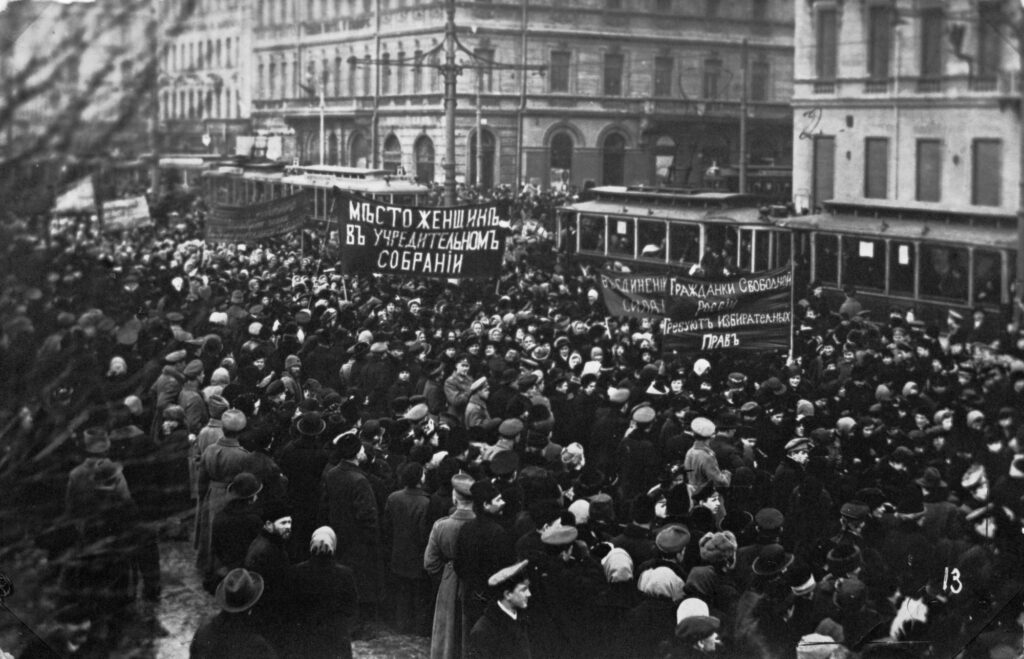
On International Women’s Day, 8 March 1917 (23 February in the old Russian calendar, which is why this is the February Revolution), women textile workers and bread queues in Petrograd merged with striking metal workers. Within five days the Petrograd garrison mutinied and joined the demonstrators. The Duma formed a Provisional Committee. The Petrograd Soviet of Workers’ and Soldiers’ Deputies reconvened in the Tauride Palace. On 15 March 1917 Tsar Nicholas II abdicated for himself and his haemophiliac son Alexei in favour of his brother Grand Duke Michael, who refused the crown. Three centuries of Romanov rule ended in a week.
Dual Power
Power now rested in two institutions sitting in the same building. The Provisional Government, led first by Prince Lvov and then by the SR lawyer Alexander Kerensky, claimed formal authority. The Petrograd Soviet, dominated initially by Mensheviks and SRs, commanded the real loyalty of the soldiers and workers. The Soviet’s Order Number 1 of 14 March 1917 told troops to obey their officers only if the orders did not contradict the Soviet, effectively neutering the Provisional Government’s military authority.
The Provisional Government made two fateful decisions. It continued the war on the Allied side, hoping to retain French and British financial support. And it postponed land reform to a future Constituent Assembly. Both choices alienated soldiers and peasants and opened the door to a second revolution.
Lenin’s April Theses
Vladimir Ilyich Lenin had been in exile in Zurich. The German government, calculating that a Bolshevik return would knock Russia out of the war, allowed him to cross Germany in a sealed train. He arrived at Petrograd’s Finland Station on 16 April 1917 (3 April Julian) and announced his April Theses: no support for the Provisional Government, end the war, transfer all land to peasant committees, all power to the soviets, nationalise the banks, replace the standing army with armed workers. The slogan distilled to Peace, Bread, Land and All Power to the Soviets.
Most Bolsheviks, including Lev Kamenev and Joseph Stalin, had been cooperating with the Provisional Government on the line that Russia was not yet ripe for socialist revolution. Lenin overturned the party’s position within weeks. Trotsky returned from New York in May and joined the Bolsheviks formally in July.
July Days and Kornilov Affair
The Provisional Government’s June 1917 offensive against Germany collapsed. Spontaneous demonstrations in Petrograd in early July (the July Days) were suppressed; Lenin fled to Finland and Trotsky was briefly jailed. In late August General Lavr Kornilov, the army commander-in-chief, marched on Petrograd in what Kerensky portrayed as a counter-revolutionary coup. Kerensky armed the Bolshevik-led Red Guards to defend the capital. Kornilov’s attempt collapsed but Kerensky’s authority never recovered, and the Bolsheviks emerged armed and rehabilitated.
The Petrograd Soviet elected a Bolshevik majority on 31 August 1917 (18 August Julian). Moscow followed within a week. Trotsky became chairman of the Petrograd Soviet on 8 October 1917 (25 September Julian). The slogan All Power to the Soviets was now a programme for taking power.
October Revolution: The Bolsheviks Seize Power
On the night of 7 to 8 November 1917 (25 to 26 October Julian), the Military Revolutionary Committee of the Petrograd Soviet, led operationally by Trotsky, occupied bridges, railway stations, the telephone exchange and the State Bank. The cruiser Aurora fired a blank round at the Winter Palace on the evening of 7 November as the signal for the assault. The Provisional Government, meeting in the Malachite Hall, was arrested in the early hours of 8 November. Kerensky fled in a car borrowed from the United States embassy.
The Second All-Russian Congress of Soviets, meeting that night, ratified the seizure of power. Mensheviks and right-SR delegates walked out. Lenin announced the new Soviet government, the Council of People’s Commissars (Sovnarkom), with himself as chair, Trotsky as commissar for foreign affairs and Stalin as commissar for nationalities. The Congress passed Lenin’s Decree on Peace (calling for immediate armistice) and Decree on Land (abolishing private property in land and transferring it to peasant committees) within twenty-four hours.
Constituent Assembly Dissolved
Elections for the Constituent Assembly, scheduled before October, were held in November 1917. The SRs won 410 seats to the Bolsheviks’ 175. The Assembly met for one day on 18 January 1918 and was dissolved the next morning by a sailor of the Red Guard. The Bolsheviks ruled by decree through the Sovnarkom and the Cheka, the political police founded under Felix Dzerzhinsky in December 1917.
Brest-Litovsk
On 3 March 1918, Soviet Russia signed the Treaty of Brest-Litovsk with Germany. Russia surrendered Poland, Finland, Estonia, Latvia, Lithuania, Belarus, Ukraine and parts of the Caucasus, losing a third of its population, half its industry and most of its coal. Lenin called it a Brest peace, the price of survival. Eight months later Germany itself surrendered and the treaty was nullified, but the territorial losses framed the next twenty years of Soviet foreign policy.
Civil War, 1918 to 1921
Anti-Bolshevik forces ranged from monarchist generals (Denikin in the south, Kolchak in Siberia, Yudenich near Petrograd) to Mensheviks, SRs, Czech legionaries and foreign expeditionary forces from Britain, France, the United States, Japan and Italy that landed at Archangel, Murmansk, Vladivostok, the Black Sea and the Caspian. The Bolsheviks held the central industrial core around Moscow, where the capital had moved in March 1918.
Trotsky, as Commissar for War, built the Red Army from scratch, conscripting former tsarist officers as military specialists watched by political commissars. The Red Army grew from 300,000 in 1918 to over five million by 1920. By 1921 the Whites had collapsed, foreign troops had withdrawn and Bolshevik power was extended across most of the former tsarist empire.
War Communism
Domestic policy during the Civil War, known as War Communism, requisitioned grain from peasants without payment, nationalised all industry, imposed labour discipline and tried to abolish money. It kept the cities fed and the army supplied, but at catastrophic cost. The famine of 1921 to 1922 in the Volga region killed an estimated five million people. The Kronstadt sailors’ revolt of March 1921, by men who had been the cutting edge of October 1917, demanded soviets without Bolsheviks. It was suppressed but it forced Lenin’s hand.
The New Economic Policy and the USSR
At the Tenth Party Congress in March 1921, Lenin announced the New Economic Policy (NEP). Forced grain requisition was replaced by a tax in kind. Peasants could sell surplus on the market. Small private industry, retail and consumer trade were re-legalised. The state retained the commanding heights, including heavy industry, banking, transport and foreign trade. NEP was a strategic retreat that allowed agriculture and consumer industry to recover by 1926 to 1928. Lenin called it a serious and long-term policy. After Lenin’s death in January 1924, Joseph Stalin abolished NEP at the end of the 1920s in favour of forced collectivisation and the Five-Year Plans.
Formation of the USSR
On 30 December 1922, four constituent republics, Russia (RSFSR), Ukraine, Belarus and the Transcaucasian Federation, signed the Treaty of Union creating the Union of Soviet Socialist Republics. The 1924 Soviet Constitution formalised a federal structure with the right of secession on paper. The USSR eventually included fifteen union republics by 1956. The Communist Party of the Soviet Union (CPSU) controlled the state through parallel party organs at every level.
Ideological Influence on India
The Russian Revolution 1917 reached India through three channels. First, returning Indian revolutionaries: M. N. Roy met Lenin at the Second Comintern Congress in 1920, debated him on the colonial question and helped found the Communist Party of India at Tashkent in October 1920. Second, books and journals: Lenin’s Imperialism: The Highest Stage of Capitalism and Marx’s Capital circulated in clandestine Indian editions through the 1920s. Third, mass politics: the Bombay textile strike of 1928, the Meerut Conspiracy Case of 1929 to 1933, the formation of the Hindustan Socialist Republican Association by Bhagat Singh and his comrades all drew on Soviet inspiration.
Bhagat Singh’s prison reading list included Lenin and Trotsky. Jawaharlal Nehru visited Moscow in 1927 with his father Motilal and described his impressions in Soviet Russia (1928). Nehru’s planning model, the Bombay Plan’s competitor, and the Five-Year Plans of independent India after 1951 carried Soviet DNA. M. N. Roy later broke with the Comintern and developed his own theory of Radical Humanism.
For the older nationalist generation, the Russian Revolution 1917 was a vindication that empires could fall. After the Russian example, no Indian could write off the freedom struggle as utopian. The repressive logic of British rule, captured in the Jallianwala Bagh massacre of 1919, looked even less defensible against the Soviet promise of national self-determination for non-Russian peoples. Leaders from Bal Gangadhar Tilak, who praised the Russian peasants in his last newspaper writings, to Subhas Chandra Bose, who went to Moscow seeking aid, found in 1917 a usable counter-example to British liberal imperialism.
Historiography
Soviet historiography under Stalin treated October as the inevitable victory of the proletariat led by an infallible party. Western liberal historians like Richard Pipes (The Russian Revolution, 1990) read October as a coup by a small armed minority. Social historians from the 1970s, notably Sheila Fitzpatrick and Orlando Figes (A People’s Tragedy, 1996), restored the agency of workers, peasants and soldiers. Marxist historians like Eric Hobsbawm (Age of Extremes, 1994) saw 1917 as the defining event of the short twentieth century. A UPSC answer should hold these in tension: October was both a disciplined Bolshevik action and a popular insurrection in a context the Provisional Government had lost.
Why It Matters for UPSC
Three frames recur. First, comparison: French Revolution 1789 versus Russian Revolution 1917, or the Russian and Chinese Revolutions of 1917 and 1949. Second, causation: structural weaknesses of the Romanov state plus the catalyst of World War I plus the personality and theory of Lenin. Third, consequence: rise of fascism in response, the Comintern’s role in colonial movements, the Cold War, planning economics and the influence on Indian socialism. A strong answer cites Lenin’s April Theses by name, the dates and meaning of the February and October revolutions, the Civil War and NEP, the formation of the USSR in 1922, and the Indian linkage through M. N. Roy, Nehru and Bhagat Singh.
Frequently Asked Questions
What caused the Russian Revolution 1917?
Tsarist autocracy without legal political channels, the unresolved peasant land question after the 1861 emancipation, brutal industrial conditions in fast-growing cities, the humiliations of the 1904-05 war and 1905 revolution, and above all the catastrophic costs of the First World War, which killed three and a half million Russians and starved the cities by 1917.
What is the difference between the February and October Revolutions?
February (March 1917 in the Gregorian calendar) overthrew the tsar and set up a parliamentary Provisional Government and the Petrograd Soviet under dual power. October (November 1917) was the Bolshevik seizure of power from the Provisional Government, led by Lenin and Trotsky, that established the Council of People’s Commissars and a one-party Soviet state.
What were Lenin’s April Theses?
A ten-point programme Lenin announced on his return from Swiss exile in April 1917: no support for the Provisional Government, immediate end to the war, all land to peasant committees, all power to the soviets, nationalise the banks, abolish the standing army. They distilled into the slogans Peace, Bread, Land and All Power to the Soviets.
Who led the October Revolution?
Vladimir Lenin set the strategy. Leon Trotsky, as chairman of the Petrograd Soviet and head of its Military Revolutionary Committee, ran the operational seizure of power on 7 to 8 November 1917. Joseph Stalin was a member of the Bolshevik central committee but played a secondary role in October itself.
What was the Russian Civil War?
The 1918-1921 war between the Bolshevik Red Army under Trotsky and the White Armies of monarchists, liberals and right-SRs, supported by foreign expeditionary forces from Britain, France, the United States and Japan. The Bolsheviks won by holding the central industrial core, by Trotsky’s organisational skill and by deep peasant suspicion of a White restoration.
What was the New Economic Policy (NEP)?
The economic reform Lenin announced at the Tenth Party Congress in March 1921. Forced grain requisition was ended, peasants could sell surplus on the market, small private industry and retail were re-legalised, but heavy industry, banking and foreign trade stayed in state hands. NEP was abandoned by Stalin from 1928 in favour of forced collectivisation.
When was the USSR formed?
The Union of Soviet Socialist Republics was formed by treaty on 30 December 1922, uniting Russia (RSFSR), Ukraine, Belarus and the Transcaucasian Federation. The 1924 Soviet Constitution formalised the federal structure. The USSR eventually included fifteen union republics and dissolved in December 1991.
How did the Russian Revolution 1917 influence Indian nationalism?
Directly through M. N. Roy, who met Lenin and helped found the Communist Party of India at Tashkent in 1920. Indirectly through circulation of Lenin and Marx among Indian revolutionaries like Bhagat Singh, through Nehru’s Soviet visit in 1927 and his planning-economy vision, and through the broader demonstration that European empires were not eternal. The Comintern’s anti-colonial line strengthened the radical wing of Indian nationalism in the 1920s and 1930s.
Tell Google you want more of this.
Add Anantam IAS as a preferred sourceOne tap, and this site shows up more often in your own Top Stories, AI Overviews and AI Mode. Remove it any time.