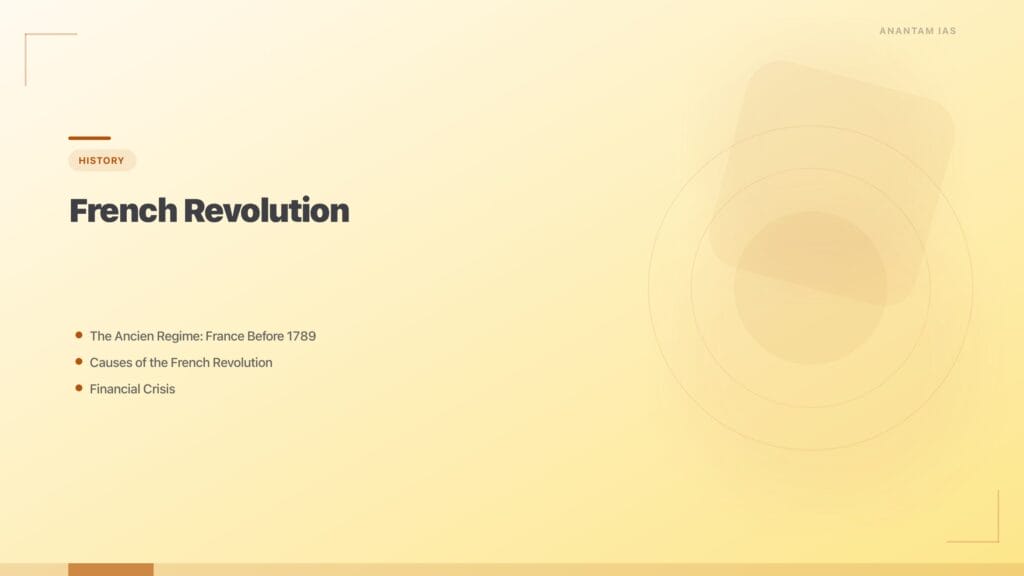
The French Revolution (1789–1799) destroyed the European old order — absolute monarchy, feudal privileges, and the divine right of kings — and replaced it with the principles of popular sovereignty, citizenship, and constitutional government. Its slogan, “Liberté, Égalité, Fraternité” (Liberty, Equality, Fraternity), directly shaped the Preamble of the Indian Constitution.
For UPSC, the French Revolution appears in World History (GS1), where it is typically paired with the Industrial Revolution and the American Revolution. More importantly, it is the intellectual ancestor of concepts that underpin the Indian Constitution — fundamental rights, secularism, republicanism, and the social contract.
Pre-Revolution France: The Three Estates
French society was divided into three "Estates" — a feudal classification that determined legal rights, tax obligations, and political power.
| Estate | Composition | % of Population | Privileges |
|---|---|---|---|
| First Estate | Clergy (Catholic Church) | ~0.5% | Exempt from taxes; owned ~10% of land; collected tithes |
| Second Estate | Nobility (aristocracy) | ~1.5% | Exempt from most taxes; held feudal rights over peasants; dominated military and administrative posts |
| Third Estate | Everyone else — peasants, urban workers, bourgeoisie (merchants, lawyers, professionals) | ~98% | Paid almost all taxes; had no political power; subject to feudal obligations |
The system was absurd by any rational standard: 2% of the population held almost all political power and paid almost no taxes, while 98% bore the entire tax burden and had no representation.
Within the Third Estate, there was further stratification. The bourgeoisie (educated professionals, merchants, industrialists) were wealthy and literate but lacked political power proportional to their economic importance. They became the revolutionary leadership.
Causes of the French Revolution
Social Causes
- Rigid feudal hierarchy with no social mobility
- Resentment of aristocratic privilege by the growing bourgeoisie
- Peasant anger at feudal dues, tithes, and labour obligations (corvée)
- Inequality before the law — nobles could not be tried in ordinary courts
Economic Causes
- France was bankrupt — decades of wars (including support for the American Revolution) had emptied the treasury
- Tax system was regressive — the poor paid more; the rich were exempt
- Bread prices rose sharply due to poor harvests (1788 was catastrophic)
- The government's debt had reached approximately 50% of annual revenue in interest payments alone
Political Causes
- Absolute monarchy — Louis XVI ruled by divine right with no constitutional checks
- The Estates-General (parliament) had not been convened since 1614 — 175 years of unrepresented governance
- Administrative corruption and inefficiency
- The king's inability to push through fiscal reforms against noble opposition
Intellectual Causes (The Enlightenment)
The philosophes provided the intellectual ammunition:
| Thinker | Key Idea | Significance |
|---|---|---|
| John Locke | Natural rights (life, liberty, property); government by consent | Philosophical basis for revolution against tyranny |
| Jean-Jacques Rousseau | Social Contract — sovereignty belongs to the people; "general will" | Directly influenced revolutionary ideology |
| Montesquieu | Separation of powers (executive, legislative, judicial) | Influenced the revolutionary constitution and later the Indian Constitution |
| Voltaire | Freedom of speech and religion; critique of Church and aristocracy | Attacked the intellectual foundations of the old order |
The American Revolution (1776)
The success of the American Revolution demonstrated that a colonial people could overthrow their rulers and establish a republic. French soldiers who had fought in America (including Lafayette) brought revolutionary ideas home.
Key Events: Timeline
| Year | Event | Significance |
|---|---|---|
| May 5, 1789 | Estates-General convened at Versailles | First time in 175 years; Third Estate demands equal representation |
| June 17, 1789 | Third Estate declares itself the National Assembly | Claims to represent the nation, not just one estate |
| June 20, 1789 | Tennis Court Oath | National Assembly swears not to disband until a constitution is written |
| July 14, 1789 | Storming of the Bastille | Symbol of royal tyranny falls; revolution becomes popular |
| August 4, 1789 | Abolition of feudal privileges | Nobility and clergy surrender their special rights |
| August 26, 1789 | Declaration of the Rights of Man and of the Citizen | "Men are born and remain free and equal in rights" — the revolution's manifesto |
| October 1789 | Women's March on Versailles | Royal family forced to move from Versailles to Paris |
| 1791 | Constitutional monarchy established | King retained but with limited powers; National Assembly held legislative power |
| April 1792 | War with Austria and Prussia | External threat radicalised the revolution |
| August 1792 | Storming of the Tuileries Palace | Monarchy effectively overthrown |
| September 1792 | French Republic declared | End of monarchy; France becomes a republic |
| January 21, 1793 | Execution of Louis XVI | King guillotined; shocks European monarchies |
| 1793–1794 | Reign of Terror | Robespierre and the Committee of Public Safety; ~17,000 officially executed |
| July 27, 1794 | Thermidorian Reaction | Robespierre arrested and executed; Terror ends |
| 1795–1799 | The Directory | Moderate republican government; unstable |
| November 9, 1799 | Napoleon's coup (18 Brumaire) | Napoleon Bonaparte seizes power; revolution effectively ends |
Key Concepts
Popular Sovereignty
The revolution established that political authority comes from the people, not from God or hereditary right. This was a fundamental break with European political tradition.
Declaration of the Rights of Man (1789)
This document — influenced by the American Declaration of Independence and Enlightenment philosophy — declared:
- All men are born free and equal in rights
- Natural rights: liberty, property, security, resistance to oppression
- Law is the expression of the general will
- Freedom of speech and religion
- Taxation only by consent
For UPSC, compare this with the Indian Constitution's Fundamental Rights (Part III).
End of Feudalism
The August 4, 1789 decrees abolished:
- Feudal dues and obligations
- Tithes to the Church
- Noble privileges
- Inequality before the law
This was the most complete social revolution Europe had seen — it destroyed the legal foundations of the old order.
The Reign of Terror (1793–94)
The radical phase, led by Maximilien Robespierre and the Jacobins, demonstrated the revolution's darkest potential. In the name of defending the republic against internal and external enemies, the Committee of Public Safety executed thousands — including many former revolutionaries.
The Terror raised questions that remain relevant: Can a revolution justify unlimited violence to preserve itself? When does revolutionary justice become tyranny? These are valuable themes for UPSC Essay.
Impact on the World
Spread of Nationalism
The revolution introduced the idea that each "nation" (defined by language, culture, and shared identity) had the right to self-governance. This nationalism spread across Europe and eventually the world — including India.
End of the Old Regime
European monarchies were permanently weakened. Even where monarchs survived, they could no longer claim absolute divine right. Constitutional government became the norm.
Napoleon and the Code Civil
Napoleon's legal reforms — the Napoleonic Code (1804) — spread revolutionary principles (equality before the law, property rights, secular government) across Europe. The Code influenced legal systems worldwide, including in parts of India under French colonial influence (Puducherry).
Influence on Subsequent Revolutions
The French Revolution inspired:
- The Haitian Revolution (1791–1804)
- Latin American independence movements (1810s–1820s)
- The Revolutions of 1848 across Europe
- Russian Revolution (1917)
Impact on India
The French Revolution's influence on India was intellectual rather than direct:
Constitutional principles: The Preamble's "Liberty, Equality, Fraternity" comes directly from the French revolutionary slogan. The Constituent Assembly was conscious of this inheritance.
Influence on Indian leaders:
- Tipu Sultan planted a "Tree of Liberty" at Srirangapatna and corresponded with revolutionary France
- Indian nationalists in the 19th and 20th centuries cited the revolution as proof that oppressive systems could be overthrown
- The idea that sovereignty belongs to the people — central to the Indian independence movement — has French revolutionary roots
Comparison for UPSC Mains:
| Aspect | French Revolution | Indian Independence Movement |
|---|---|---|
| Duration | 10 years (1789–1799) | ~90 years (1857–1947) |
| Method | Violent overthrow | Primarily non-violent (with exceptions) |
| Leadership | Bourgeoisie initially, then radical Jacobins | Middle-class intelligentsia under Congress |
| Outcome | Republic → Napoleon → restored monarchy → republic again | Democratic republic (stable since 1950) |
| Key ideas adopted | Liberty, Equality, Fraternity | Same — enshrined in Preamble |
UPSC Relevance
GS1 (World History): Causes and consequences of the French Revolution; comparison with American and Russian revolutions; nationalism.
GS2 (Polity): French revolution's influence on the Indian Constitution — Preamble, Fundamental Rights, republicanism.
Essay: Liberty vs. order, revolution and violence, lessons of the Terror.
Key Prelims facts:
- Storming of the Bastille: July 14, 1789
- Declaration of Rights of Man: August 26, 1789
- Three Estates system
- Execution of Louis XVI: January 21, 1793
- Reign of Terror: 1793–94 (Robespierre)
- Napoleon's coup: November 9, 1799
- Key thinkers: Rousseau, Montesquieu, Voltaire
- Liberty, Equality, Fraternity → Indian Constitution Preamble
Tell Google you want more of this.
Add Anantam IAS as a preferred sourceOne tap, and this site shows up more often in your own Top Stories, AI Overviews and AI Mode. Remove it any time.