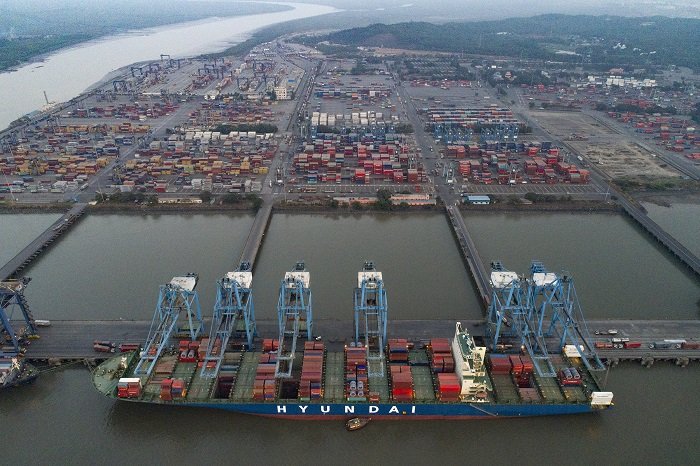
The Sagarmala Programme is the Government of India’s flagship initiative for port-led development. Announced in March 2015 and approved by the Union Cabinet on 25 March 2015, the Sagarmala Programme aims to harness India’s 7,517-km coastline, 14,500 km of navigable waterways and strategic Indian Ocean location to reduce logistics costs, modernise ports, develop coastal economic zones, build coastal communities, and integrate inland waterways with the maritime economy. In 2025 the Ministry of Ports, Shipping and Waterways launched Sagarmala 2.0, the next-decade evolution of the programme with sharper focus on green ports, multi-modal logistics, cruise tourism and shipbuilding.
The Sagarmala Programme rests on the simple observation that ports drive trade, trade drives growth, and growth radiates inland through hinterland connectivity. China built coastal special economic zones along the same logic in the 1980s and 1990s. India, with roughly 95 per cent of its trade by volume and 70 per cent by value moving through ports, had under-invested in coastal infrastructure for decades.
Origins and Vision
The phrase Sagarmala — literally “garland of the sea” — was first used by Atal Bihari Vajpayee in 2003 when he proposed a coastal development framework. The Sagarmala Programme as launched in 2015 institutionalised the idea under the Ministry of Ports, Shipping and Waterways (then called the Ministry of Shipping). The vision is to reduce logistics costs for export-import and domestic trade by 30-40 per cent of GDP equivalent, by 2030.
The Four Pillars of Sagarmala
The Sagarmala Programme is organised around four pillars:
- Port modernisation and new ports — capacity expansion, mechanisation, deepening drafts
- Port connectivity enhancement — rail, road, inland waterways and pipelines linking ports to hinterlands
- Port-led industrialisation — coastal economic zones (CEZ) and smart industrial port cities
- Coastal community development — skill development, fisheries, port-tourism, women’s livelihood programmes
A fifth, more recent pillar — coastal shipping and inland water transport — has been folded in to push modal shift away from road haulage.
Institutional Architecture
The Sagarmala Programme is implemented by the Ministry of Ports, Shipping and Waterways through the Sagarmala Development Company Limited (SDCL), a special purpose vehicle set up under the Companies Act, 2013, with an authorised capital of Rs 1,000 crore. State-level Sagarmala Committees, headed by chief secretaries, coordinate at the state level. The apex body is the National Sagarmala Apex Committee (NSAC), chaired by the Union Shipping Minister.
National Perspective Plan
A National Perspective Plan was prepared in 2016 and updated in 2020 and 2025. The plan now lists over 800 projects worth more than Rs 5.5 lakh crore, of which projects worth over Rs 1.5 lakh crore have been completed and the rest are under implementation or development.
Major Ports of India
India’s port network has 12 major ports (managed by the central government) and over 200 non-major ports (managed by state maritime boards). The 12 major ports are:
- Kandla / Deendayal (Gujarat)
- Mumbai (Maharashtra)
- Jawaharlal Nehru Port (JNPT, Navi Mumbai)
- Mormugao (Goa)
- New Mangalore (Karnataka)
- Cochin (Kerala)
- V O Chidambaranar / Tuticorin (Tamil Nadu)
- Chennai (Tamil Nadu)
- Kamarajar / Ennore (Tamil Nadu)
- Visakhapatnam (Andhra Pradesh)
- Paradip (Odisha)
- Kolkata + Haldia (West Bengal)
The 13th major port — Vadhavan in Maharashtra’s Palghar district — was approved by the Union Cabinet in June 2024 and is being developed as a green-field deep-draft port that will rival Colombo and Singapore for transhipment.
Vizhinjam International Seaport
Although classified as a non-major port (Kerala state), Vizhinjam, developed by the Adani Group, was commissioned in 2024 as India’s first true transhipment terminal capable of handling the largest container ships. Its emergence is a Sagarmala Programme outcome of national importance.
Sagarmala 2.0 (2025)
The Sagarmala Programme entered its second decade with a refreshed agenda announced at the Maritime India Vision conference in early 2025. Sagarmala 2.0 focuses on:
Green Ports
All major ports to source 60 per cent of their power from renewable energy by 2030. Shore power, hydrogen bunkering pilots, and electrification of port equipment.
Shipbuilding and Repair Hubs
India ranks 22nd globally in shipbuilding. Sagarmala 2.0 sets up dedicated shipbuilding clusters at Cochin, Kandla, Visakhapatnam, Andaman and Kolkata, with the goal of taking India into the global top ten by 2047.
Cruise Tourism
Mumbai, Cochin, Goa, Chennai and Visakhapatnam are being upgraded as cruise terminals. Domestic river-cruise routes on the Ganga (MV Ganga Vilas) and Brahmaputra are being expanded.
Inland Waterways and Coastal Shipping
Connecting National Waterway 1 (Ganga), NW-2 (Brahmaputra) and the proposed NW network with coastal ports to shift cargo from road to water. The objective is a five-fold increase in coastal cargo by 2030.
Coastal Berth Scheme
Financial assistance to non-major ports for berths, breakwaters and dredging.
Logistics Cost and the Sagarmala Goal
India’s logistics cost is estimated at 13-14 per cent of GDP (versus 8 per cent in advanced economies). Of this, port-related and hinterland-connectivity inefficiencies account for a major slice. The Sagarmala Programme aims to bring logistics cost down to under 10 per cent of GDP by 2030, contributing alongside the PM GatiShakti National Master Plan and the National Logistics Policy 2022.
Coastal Economic Zones (CEZs)
CEZs are spatial industrial clusters that anchor port-linked manufacturing. Fourteen CEZs have been identified across the coastline — for example, CEZ-1 stretches from Diu to Daman covering Gujarat-Maharashtra, while CEZ-3 covers the Mumbai-JNPT region. Each CEZ will host CEU (Coastal Economic Unit) sectors like petrochemicals, food processing, electronics, and steel.
Coastal Community Development
A core pillar that often gets less attention than infrastructure. Sagarmala has trained over 800,000 coastal residents (fishermen, fish-vendors, port workers and women’s collectives) in skill programmes. Fishing harbour modernisation, financial inclusion, and aquaculture livelihoods are major sub-themes.
Sagarmala and the Blue Economy
India’s blue economy — fisheries, shipping, ports, marine tourism, deep-sea mining, marine biotechnology and offshore renewables — is currently about 4 per cent of GDP and targeted to grow to 7-8 per cent by 2030 under the Draft National Blue Economy Policy. The Sagarmala Programme is the spine of that policy.
Linkages with Other Schemes
- PM Gati Shakti — multimodal connectivity master plan
- National Logistics Policy 2022 — overarching cost-reduction framework
- Bharatmala — highway corridors that feed port hinterlands
- Pradhan Mantri Matsya Sampada Yojana (PMMSY) — fisheries development
- Make in India — including shipbuilding and marine equipment
Achievements (as of 2025)
- Cargo handled at major ports: 855 million tonnes (2024-25) vs 581 million tonnes (2014-15)
- Average turnaround time at major ports cut from 4.0 days to 2.0 days
- Container traffic up by 70 per cent at JNPT
- Over Rs 5.5 lakh crore of projects identified, Rs 1.5 lakh crore completed
- World Bank Logistics Performance Index 2023 — India ranks 38, up from 54 in 2014
Challenges
- Land acquisition for CEZs
- Environmental clearance for new ports in ecologically sensitive zones (Vadhavan faces opposition)
- Inter-state coordination between maritime states
- Securing private investment for non-major port upgrades
- Climate-resilient port design against rising sea levels
Strategic Dimension
Beyond economics, the Sagarmala Programme has a strategic dimension. India’s Indo-Pacific outreach (SAGAR doctrine — Security and Growth for All in the Region) draws on a modernised port network for naval logistics, humanitarian assistance, and connectivity with island neighbours like Maldives, Sri Lanka, Mauritius and Seychelles. Sagarmala-built infrastructure underpins India’s Maritime India Vision 2030 and Amrit Kaal Vision 2047.
Frequently Asked Questions
What is the Sagarmala Programme?
The Sagarmala Programme is the Government of India’s flagship initiative for port-led development, launched in 2015 to modernise ports, improve connectivity, build coastal economic zones, and develop coastal communities.
Which ministry implements the Sagarmala Programme?
The Ministry of Ports, Shipping and Waterways implements the Sagarmala Programme. The Sagarmala Development Company Limited (SDCL) acts as the special purpose vehicle.
What are the four pillars of Sagarmala?
Port modernisation, port connectivity enhancement, port-led industrialisation through coastal economic zones, and coastal community development. A fifth pillar — coastal shipping and inland water transport — has since been added.
What is Sagarmala 2.0?
Sagarmala 2.0 is the next-decade vision of the Sagarmala Programme launched in 2025, focused on green ports, shipbuilding hubs, cruise tourism, inland waterways and a five-fold increase in coastal cargo by 2030.
How many major ports does India have?
India has 12 major ports managed by the central government. Vadhavan in Maharashtra, approved in 2024, will become the 13th. Over 200 non-major ports are managed by state maritime boards.
What is a Coastal Economic Zone (CEZ)?
A CEZ is a spatial industrial cluster anchored by a major port, designed to host port-linked manufacturing (petrochemicals, food processing, steel, electronics). Fourteen CEZs have been identified along the Indian coastline.
How does Sagarmala link to the blue economy?
The blue economy spans fisheries, shipping, ports, coastal tourism and marine biotechnology. The Sagarmala Programme is the infrastructure spine that supports India’s blue economy target of 7-8 per cent of GDP by 2030.
What is the Maritime India Vision?
Maritime India Vision 2030 (announced 2021) is the strategic roadmap for India’s maritime sector. It sets targets for cargo handling, port capacity, shipbuilding share and inland waterways — all delivered through the Sagarmala Programme.
Tell Google you want more of this.
Add Anantam IAS as a preferred sourceOne tap, and this site shows up more often in your own Top Stories, AI Overviews and AI Mode. Remove it any time.