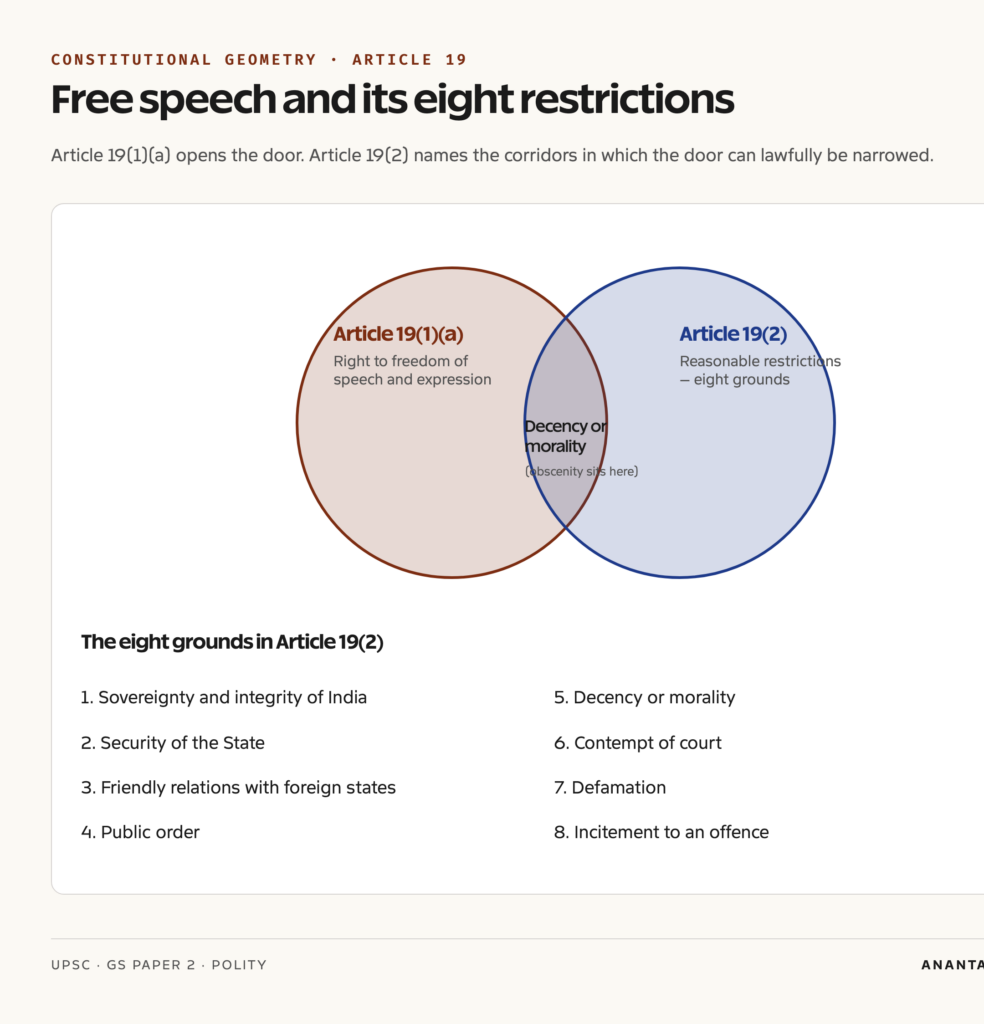
Indian free speech doctrine sits on a narrow ledge. Article 19(1)(a) of the Constitution guarantees every citizen the right to freedom of speech and expression. Article 19(2) qualifies that guarantee with eight categories of reasonable restriction, including “decency or morality.” Obscenity sits inside the decency-or-morality category and is therefore one of the constitutional grounds on which speech can be lawfully restricted. The hard question, which Indian courts have wrestled with for sixty years, is where the line falls between speech that is merely distasteful and speech that crosses into obscenity that the criminal law can prosecute.
The Supreme Court returned to this question in 2025 when it granted interim protection from arrest to Ranveer Allahabadia and other content creators facing First Information Reports over a comedy show clip. The Court flagged the content as “vulgar” but emphasised that arrests are a drastic step in the territory of artistic expression. The bench reiterated a principle that successive judgments have built up: public intolerance or offence is not a constitutional ground for criminal sanction. Only content that meets the legal threshold of obscenity can be prosecuted under Sections 294 and 296 of the Bharatiya Nyaya Sanhita or Section 67 of the Information Technology Act. Vulgarity, as a constitutional matter, is generally protected.
This guide walks through the doctrinal architecture of free speech and reasonable restrictions, the evolution of the obscenity test from the Hicklin standard to the modern Community Standards Test, the relevant statutes that operationalise the constitutional limit, and the prelims and mains pointers an aspirant should carry into the examination hall.
Quick Facts on Artistic Freedom and Obscenity
Article 19(1)(a) guarantees freedom of speech and expression to all citizens. Article 19(2) lists eight grounds of reasonable restriction: security of the state, friendly relations with foreign states, public order, decency or morality, contempt of court, defamation, incitement to an offence, and sovereignty and integrity of India. Obscenity is constitutionally restrictable under the “decency or morality” ground. The original Hicklin Test of 1868, drawn from English law, allowed prosecution if any isolated part of a work could deprave or corrupt vulnerable readers. The Indian Supreme Court replaced the Hicklin Test with the Community Standards Test in Aveek Sarkar vs. State of West Bengal, 2014. The current statutory provisions are Sections 294 and 296 of the Bharatiya Nyaya Sanhita, which replaced Sections 292 and 294 of the Indian Penal Code, and Section 67 of the Information Technology Act, 2000. In 2025, the Supreme Court granted interim protection from arrest to content creators facing FIRs over a comedy show clip, holding that public outrage cannot override the constitutional protection of expression.
What Artistic Freedom Means under Article 19(1)(a)
Article 19(1)(a) protects “freedom of speech and expression.” The Supreme Court has read this textually narrow phrase as covering a wide range of expressive activity: oral and written speech, artistic and creative expression, theatrical and film performance, comedy and satire, journalistic reporting, academic inquiry, advertising in some contexts, and silent symbolic expression. The protection runs to citizens; non-citizens have a narrower derivative protection, primarily through Article 21.
Artistic freedom is one of the most fully protected zones within Article 19(1)(a). Indian courts have consistently held that creative work, including controversial or provocative work, cannot be restricted merely because some viewers find it offensive. The Supreme Court has emphasised that intolerance of unconventional expression is the symptom that artistic freedom exists to address. The standard of restriction is high, and the burden of justifying any restriction sits on the state.
Background and Historical Context
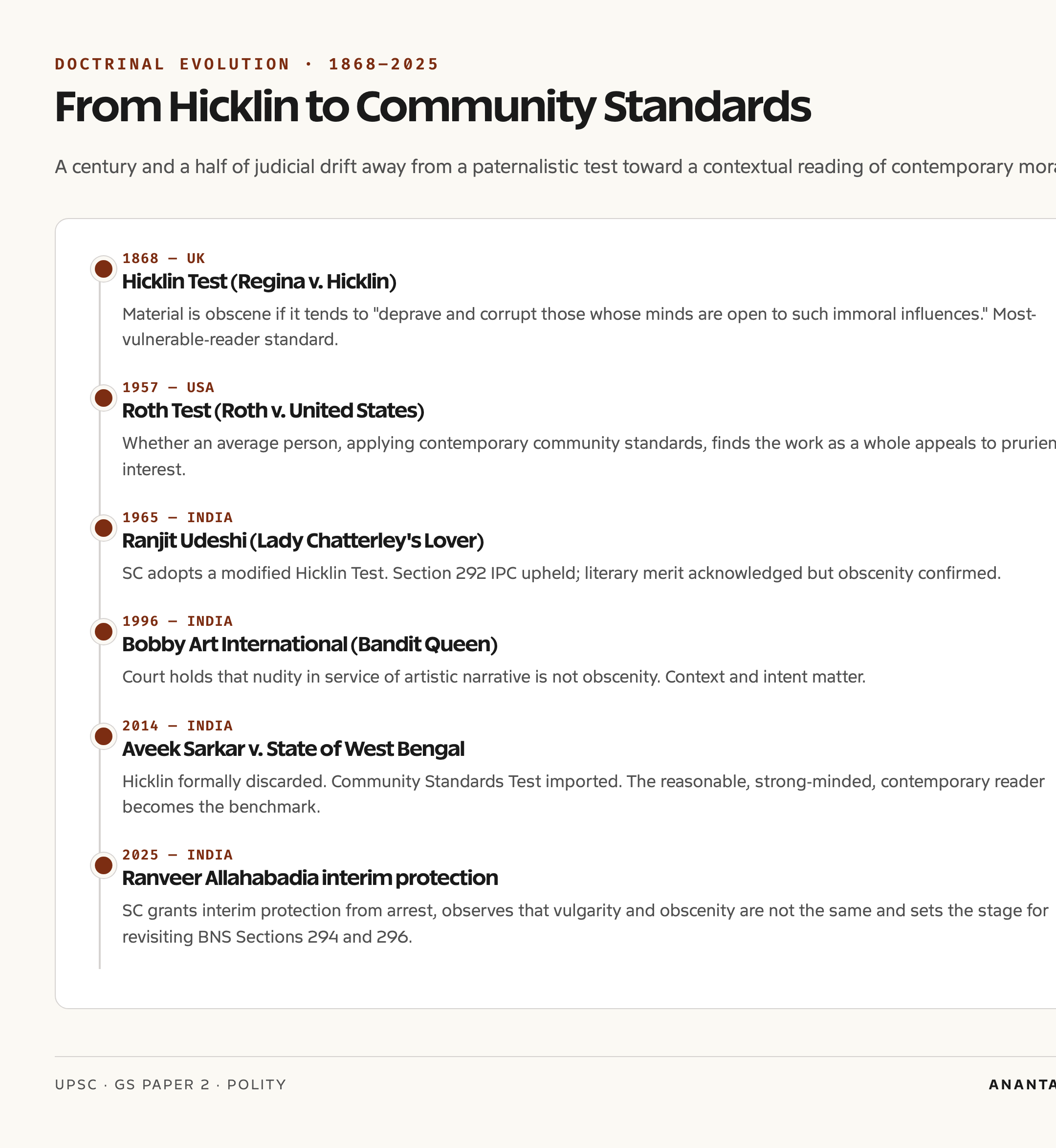
Indian obscenity doctrine begins with the colonial inheritance of the Hicklin Test. Regina vs. Hicklin, decided by the Court of Queen’s Bench in 1868, created a doctrine that allowed prosecution if any part of a work, taken in isolation, had a tendency to deprave and corrupt vulnerable readers, including children. The test was subjective, expansive, and gave prosecutors enormous discretion. Indian courts applied the Hicklin standard in the early decades of the Republic. The most famous Indian application came in Ranjit Udeshi vs. State of Maharashtra in 1965, where the Supreme Court upheld the obscenity conviction over the sale of D.H. Lawrence’s “Lady Chatterley’s Lover.”
The doctrinal shift began in the late 1990s. In Bobby Art International vs. Om Pal Singh Hoon in 1996, the Supreme Court refused to ban the film “Bandit Queen” despite explicit depiction, holding that the work had to be judged as a whole and against contemporary community standards. The shift was completed in Aveek Sarkar vs. State of West Bengal in 2014, where the Supreme Court formally rejected the Hicklin Test and adopted the Community Standards Test. The case involved a photograph of tennis player Boris Becker and his then partner that had appeared in a German magazine and been reprinted in Indian publications. The Court held that the photograph could not be considered obscene by the standard of the average reasonable Indian reader.
For the broader free speech and constitutional rights context, see our explainers on fundamental rights and the fundamental rights deep dive which traces the doctrinal evolution.
The Constitutional Framework
The structure of Article 19 follows a two-step pattern. Article 19(1)(a) creates the right to freedom of speech and expression. Article 19(2) then specifies eight grounds on which the state can impose reasonable restrictions on that right. The eight grounds are security of the state, friendly relations with foreign states, public order, decency or morality, contempt of court, defamation, incitement to an offence, and sovereignty and integrity of India. The last ground, sovereignty and integrity, was added by the Sixteenth Amendment, 1963.
Three doctrinal principles structure the analysis of any restriction. The first is that restrictions must be “reasonable,” which the Supreme Court has interpreted as requiring proportionality, narrow tailoring, and the absence of arbitrary or excessive scope. The second is that restrictions must fall within one of the eight enumerated grounds. The state cannot invent a new category of restriction outside Article 19(2). The third is that the burden of justifying a restriction lies on the state, not on the speaker. The state must demonstrate that a restriction is necessary, that it falls within an enumerated ground, and that it is the least restrictive means available.
The Vulgarity vs Obscenity Distinction
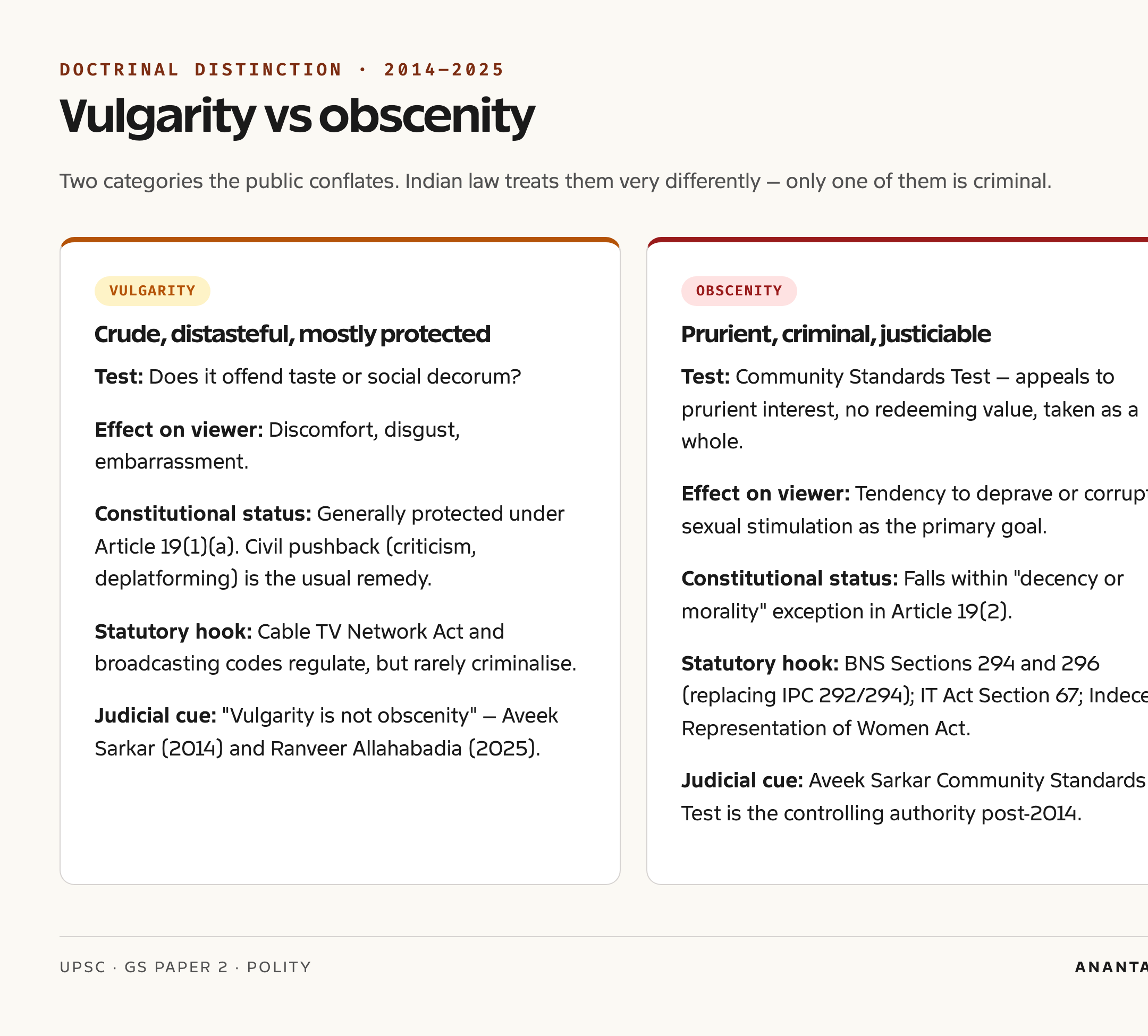
Indian law distinguishes between vulgarity, which is generally protected, and obscenity, which is criminal. Vulgarity refers to conduct that is crude, coarse, or lacking refinement. The constitutional position is that vulgar expression, while it may offend social conventions, does not lose the protection of Article 19(1)(a) unless it crosses into obscenity. Obscenity, in contrast, refers to content that appeals to “prurient interest,” meaning content designed to provoke lustful desire, and that has the tendency to “deprave and corrupt” the mind of the reader or viewer.
The legal bite is in the threshold. A comedy show clip that uses crude language or shocks audience conventions does not become obscenity merely because it offends. The state would have to show that the work, judged as a whole and against contemporary community standards, appeals primarily to prurient interest and tends to deprave and corrupt. The threshold is high precisely because lower thresholds would convert ordinary popular culture into criminal liability and would chill creative expression across the board.
The Hicklin Test to Community Standards Test Shift
The Hicklin Test had three features that the Indian Supreme Court eventually rejected. First, it allowed prosecution based on isolated parts of a work, ignoring the work as a whole. Second, it benchmarked the work against the most vulnerable possible reader, including children. Third, it gave the prosecution and the trial court enormous discretion in identifying corrupting content. The cumulative effect was that almost any explicit material could be prosecuted under the Hicklin standard.
The Community Standards Test, formalised in Aveek Sarkar in 2014, reverses each of these features. The work must be judged as a whole. The benchmark is the average reasonable adult, applying contemporary community standards. The prosecution must show that the work, taken integrally and judged by the average viewer, appeals to prurient interest. The shift moves Indian doctrine closer to the Roth Test of the United States Supreme Court of 1957, which similarly rejected the Hicklin standard in American law, and to the more recent Miller Test of 1973, which refined the American standard.
Statutory Framework: BNS, IPC, and IT Act
The criminal law of obscenity in India runs through three statutes. The Bharatiya Nyaya Sanhita, 2023, which replaced the Indian Penal Code, retains the obscenity provisions in Sections 294 and 296. Section 294 of the BNS punishes the sale or distribution of obscene books, pamphlets, drawings, paintings, or films. Section 296 of the BNS punishes obscene acts or songs in any public place to the annoyance of others. The substantive content of these provisions is largely the same as Sections 292 and 294 of the Indian Penal Code that they replaced.
The Information Technology Act, 2000, supplements the BNS for electronic content. Section 67 of the IT Act punishes the publication or transmission of obscene material in electronic form, with imprisonment up to three years on first conviction and up to five years on subsequent conviction. Section 67A is a separate, more stringent provision that punishes the publication or transmission of sexually explicit material, and Section 67B targets child sexual abuse material with even harsher penalties.
It is important to distinguish obscenity from other categories of criminalised speech. Defamation is both a civil wrong and a criminal offence under Sections 356 and 357 of the BNS. Hate speech is a category that exists in jurisprudence but is not defined as such in the BNS or the earlier Indian Penal Code; its closest statutory cognates are provisions on promoting enmity between groups under Section 196 of the BNS.
The 2025 Ranveer Allahabadia Order
The 2025 ruling came in the context of multiple FIRs filed against content creators including Ranveer Allahabadia over a comedy show clip that had gone viral. The petitioners approached the Supreme Court seeking protection from arrest. The bench granted interim protection. The reasoning that emerged in the Court’s observations had three threads. First, the content might be characterised as vulgar but that characterisation alone does not establish obscenity. Second, criminal proceedings, particularly arrest, are a drastic step that should not be deployed against creative or expressive content unless the criminal threshold is clearly met. Third, public outrage or perceived offence does not, on its own, override the constitutional guarantee of Article 19(1)(a).
The judgment did not finally adjudicate whether the content in question was obscene. It granted interim relief and asked the parties to argue the merits in the regular course. The constitutional principle the Court reiterated, however, has settled implications. State action against creative work must clear a high threshold; the threshold is set by Article 19(2), the Aveek Sarkar Community Standards Test, and the requirement of proportionality. None of these can be displaced by the volume of public complaint.
Why It Matters
The ruling matters for three reasons. First, it draws a clear procedural line on arrests in expression cases. Even where an FIR has been registered, the police must satisfy a high threshold before depriving an artist of liberty. The principle protects the broad zone of cultural production, including comedy, satire, theatre, and online content, from the chilling effect of pre-trial detention.
Second, it consolidates the jurisprudence built up over the past thirty years that places the Community Standards Test at the centre of Indian obscenity law. Lower courts and police agencies have not always applied the test consistently. Repeated reaffirmation by the Supreme Court strengthens the doctrinal floor.
Third, it engages with the contemporary digital ecosystem. The dispute arose over content distributed through online platforms. The Court’s reasoning therefore confirms that the Article 19(1)(a) framework, the Aveek Sarkar test, and the proportionality standard apply to digital content with the same force as they apply to print, film, and theatre. The ecosystem is new; the constitutional standard travels.
Comparative Look
The American doctrine on obscenity, after Roth and Miller, sits on three components: whether the average person, applying contemporary community standards, would find that the work as a whole appeals to prurient interest; whether the work depicts sexual conduct in a patently offensive way under state law; and whether the work, taken as a whole, lacks serious literary, artistic, political, or scientific value. The Indian Community Standards Test borrowed substantially from this framework but does not include the third “serious value” prong as a separate statutory requirement, although Indian courts have read serious value considerations into the overall judgment.
The European Court of Human Rights has developed a doctrine under Article 10 of the European Convention on Human Rights that gives a “margin of appreciation” to member states on obscenity but requires proportionality in any restriction. The British framework under the Obscene Publications Act, 1959, retains a “deprave and corrupt” test but reads it through contemporary social attitudes and the “public good” defence under Section 4. The Indian doctrine sits closer to the American than the British model, but with the proportionality and reasonable-restriction discipline of Article 19(2).
Challenges and Open Questions
Three challenges sit ahead. The first is the digital platform context. Online distribution makes content reach much larger and more diverse audiences than print or film, which complicates the application of “community standards” when the relevant community is global rather than local. The second is the FIR-based enforcement model. Police-driven prosecutions begin before any judicial assessment of the content, and the threat of multiple FIRs across states can chill expression even when no single prosecution succeeds. The third is the question of who counts as the “average reasonable person.” Indian society is diverse along religion, caste, region, language, and class, and a single community standard may not adequately capture that diversity.
These challenges connect to wider debates about platform regulation, the internet shutdowns and digital rights framework, and the proper balance between free expression and other social interests. The Supreme Court’s continued engagement with the doctrine, through cases like the 2025 Ranveer Allahabadia order, will refine the operational standard.
Prelims Pointers
Article 19(1)(a) protects free speech and expression. Article 19(2) lists eight grounds of reasonable restriction. The eight grounds are security of the state, friendly relations with foreign states, public order, decency or morality, contempt of court, defamation, incitement to an offence, and sovereignty and integrity of India. Obscenity falls under “decency or morality.” The Hicklin Test of 1868 was the original common-law standard, applied by India in Ranjit Udeshi (1965). The Community Standards Test was formally adopted by the Supreme Court in Aveek Sarkar vs. State of West Bengal, 2014. Statutory provisions: BNS Section 294 (sale of obscene material), Section 296 (obscene acts in public). IT Act Section 67 (electronic obscenity, three years first conviction). Defamation is both civil and criminal. Hate speech is not defined in any Indian statute. The 2025 Ranveer Allahabadia order granted interim protection from arrest, holding that public outrage does not override Article 19(1)(a).
A common trap statement: “Freedom of speech under Article 19(1)(a) is absolute for stand-up comedians.” This is incorrect; Article 19(1)(a) is subject to the eight reasonable restrictions in Article 19(2). Another trap: “The Hicklin Test is the current Indian standard for obscenity.” This is incorrect; it was replaced by the Community Standards Test in Aveek Sarkar in 2014.
Mains Practice Questions
- The Supreme Court’s evolving doctrine on obscenity reflects a deliberate shift from a paternalist to a liberal reading of free expression. Discuss with reference to the Hicklin Test, the Aveek Sarkar judgment, and the 2025 Ranveer Allahabadia order. (GS Paper 2, 250 words)
- Distinguish between vulgarity and obscenity in Indian constitutional law and assess the implications of the distinction for digital content regulation. (GS Paper 2, 250 words)
- Examine Article 19(2) as the constitutional framework for restricting free speech and bring out the proportionality standard developed by the Indian Supreme Court. (GS Paper 2, 150 words)
- Critically analyse the use of Section 67 of the Information Technology Act in regulating online creative content and its implications for artistic freedom. (GS Paper 2, 150 words)
Way Forward
The doctrine has settled in its core. The implementation challenge is now operational. Three reform directions are commonly debated. The first is procedural protection against multi-state FIRs in expression cases, where a single piece of content can trigger criminal proceedings in multiple jurisdictions and produce chilling effects independent of any individual prosecution’s outcome. Consolidation of FIRs at one location and clearer pre-arrest threshold guidelines for police would address part of the problem.
The second is platform-level safe harbours that protect creators of expressive content from coordinated complaint campaigns that lack legal merit. The third is judicial training on the Community Standards Test, especially in lower courts where the doctrinal sophistication of Aveek Sarkar is not always reflected in initial orders. Together, these reforms would convert the constitutional protection into operational practice. For a parallel exploration of how digital platforms interact with the rights-and-restrictions framework, see our analysis of the copyright fair dealing and ANI vs YouTubers case.
Frequently Asked Questions
What did the Supreme Court hold in the 2025 Ranveer Allahabadia matter?
The Supreme Court granted interim protection from arrest to Ranveer Allahabadia and other content creators facing multiple FIRs over a comedy show clip. The Court flagged the content as vulgar but held that arrests are a drastic step in the territory of expression. It reiterated that public outrage or perceived offence does not, on its own, override the constitutional guarantee under Article 19(1)(a). The matter was kept open for adjudication on the merits.
What is the difference between vulgarity and obscenity in Indian law?
Vulgarity refers to conduct that is crude, coarse, or lacks refinement. It is generally protected under the freedom of speech guarantee. Obscenity refers to content that appeals to prurient interest and has the tendency to deprave and corrupt the mind. Obscenity is criminal under Section 294 and 296 of the Bharatiya Nyaya Sanhita and Section 67 of the Information Technology Act. Vulgar expression, while distasteful, does not become criminal merely because it offends.
What is the Hicklin Test and is it still applied in India?
The Hicklin Test, drawn from Regina vs. Hicklin (1868), allowed prosecution if any isolated part of a work had a tendency to deprave and corrupt vulnerable readers. The Indian Supreme Court applied the Hicklin standard in Ranjit Udeshi vs. State of Maharashtra (1965) but rejected it in Aveek Sarkar vs. State of West Bengal (2014). The current Indian standard is the Community Standards Test, which judges the work as a whole by the standard of the average reasonable person.
What is the Aveek Sarkar Community Standards Test?
The Aveek Sarkar test asks whether the work, judged as a whole and benchmarked against the average reasonable adult applying contemporary community standards, appeals to prurient interest. It rejects the Hicklin focus on isolated parts and on the most vulnerable possible reader. The test was adopted by the Supreme Court in Aveek Sarkar vs. State of West Bengal in 2014 and is the current Indian standard for obscenity.
What are the eight grounds under Article 19(2)?
The eight grounds of reasonable restriction listed in Article 19(2) are: security of the state, friendly relations with foreign states, public order, decency or morality, contempt of court, defamation, incitement to an offence, and sovereignty and integrity of India. Obscenity is restrictable under the “decency or morality” ground. The list is exhaustive; the state cannot invent new grounds outside Article 19(2).
Which sections of the Bharatiya Nyaya Sanhita criminalise obscenity?
Section 294 of the Bharatiya Nyaya Sanhita punishes the sale or distribution of obscene books, pamphlets, drawings, paintings, or films. Section 296 punishes obscene acts or songs in any public place to the annoyance of others. These provisions replaced Sections 292 and 294 of the Indian Penal Code, with substantially the same content.
What does Section 67 of the IT Act, 2000, cover?
Section 67 of the Information Technology Act, 2000, punishes the publication or transmission of obscene material in electronic form. The penalty is imprisonment up to three years and a fine on first conviction, and up to five years on subsequent conviction. Section 67A is a separate provision for sexually explicit material with stricter penalties, and Section 67B targets child sexual abuse material with the most severe penalties.
Is freedom of speech absolute for stand-up comedians and content creators?
No. Freedom of speech under Article 19(1)(a) is subject to the eight reasonable restrictions in Article 19(2). Comedians and content creators enjoy the same constitutional protection as any other expressive worker, but they are also subject to the same boundaries. Content that crosses the obscenity threshold under the Aveek Sarkar test, that defames a specific individual, or that incites violence can be lawfully restricted.
Is hate speech defined in Indian statutory law?
No. There is no statutory definition of “hate speech” in the Bharatiya Nyaya Sanhita, the earlier Indian Penal Code, or any other statute. The closest cognates are Section 196 of the BNS, which punishes promoting enmity between groups, and provisions on assault on religious feelings. Indian courts have used the term “hate speech” descriptively, but it is not a legal category with a fixed statutory test.
How does the 2025 ruling affect future content moderation and prosecutions?
The 2025 ruling does not change the substantive law of obscenity. It reinforces a procedural principle that arrests in expression cases require a high threshold and cannot be driven by public outrage. Going forward, police agencies and lower courts are expected to apply the Aveek Sarkar Community Standards Test more carefully before initiating arrest in content-related FIRs. The ruling also signals that the Supreme Court will continue to provide pre-trial relief in expression cases where the criminal threshold is not clearly met.
Tell Google you want more of this.
Add Anantam IAS as a preferred sourceOne tap, and this site shows up more often in your own Top Stories, AI Overviews and AI Mode. Remove it any time.