The ANI vs YouTubers dispute, decided in stages by the Delhi High Court through 2024 and 2025, is the clearest test the Indian courts have given Section 52 of the Copyright Act in nearly a decade. A national news agency sued a clutch of independent YouTube channels for using its bulletins in commentary videos. The defendants pleaded fair dealing for criticism, review and news reporting. ANI added defamation and trademark disparagement to the mix. The Court refused a blanket takedown and instead ordered surgical removal of specific defamatory portions. The judgment matters far beyond YouTube, because it draws the cleanest line yet between copyright as a property right and copyright as a tool for silencing criticism.
This guide unpacks Section 52, situates the ANI ruling within the wider doctrinal map, compares Indian fair dealing with American fair use, and lays out the prelims and mains traps. Along the way it engages with the de minimis defence, the Civic Chandran three factor test, and the special status of broadcast reproduction rights under Section 37, which often surface in IPR comparison questions.
Quick Facts: Fair Dealing in India
- Statutory source: Section 52 of the Copyright Act 1957.
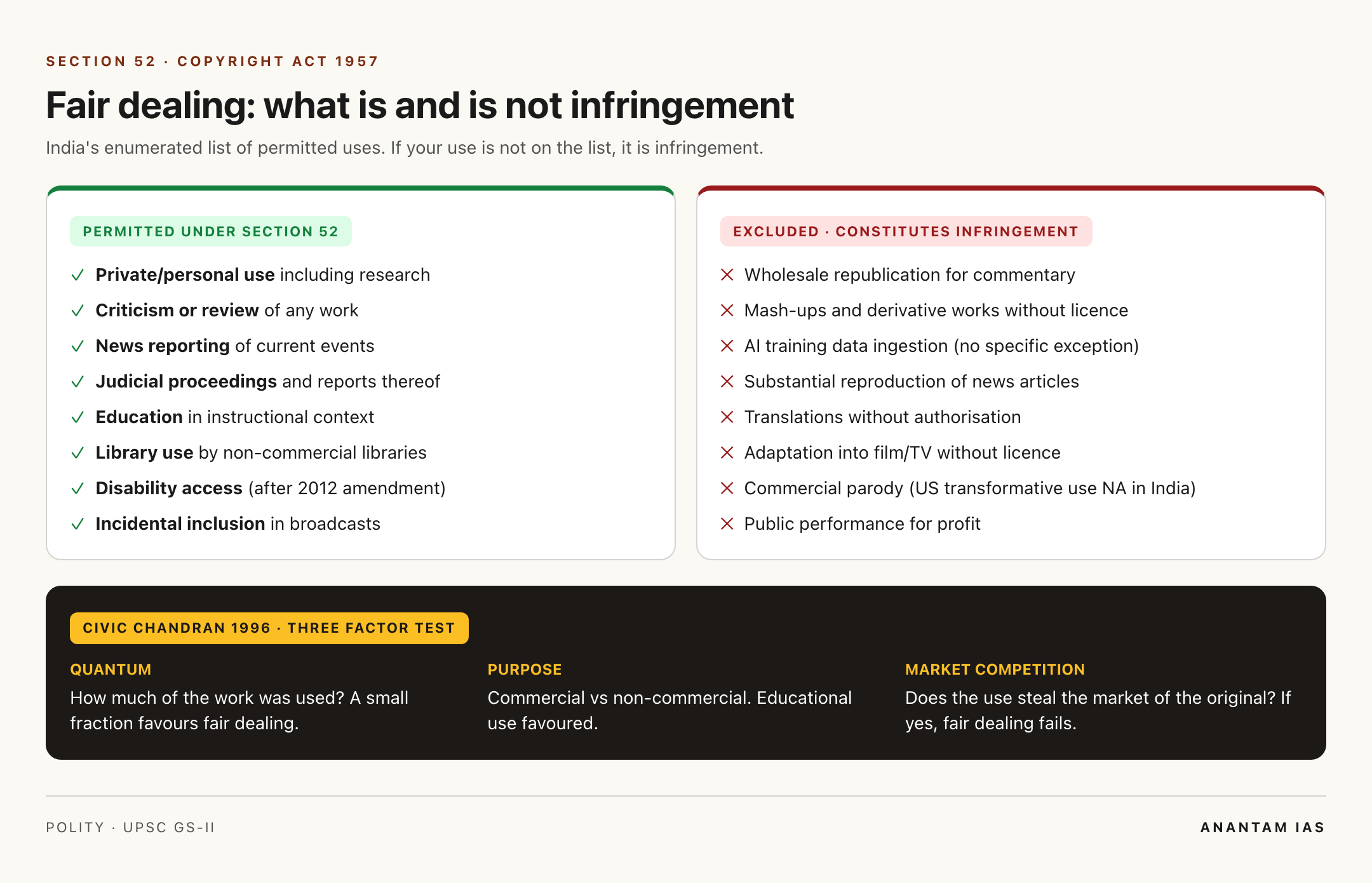
- Nature: an exhaustive, enumerated list of permitted uses, not a general open ended doctrine.
- Key permitted uses: private or personal use including research, criticism or review, news reporting of current events, judicial proceedings, education.
- Term not defined: the Act lists exceptions but does not define fair dealing itself.
- Indian three factor test (Civic Chandran 1996): quantum, purpose, and market competition.
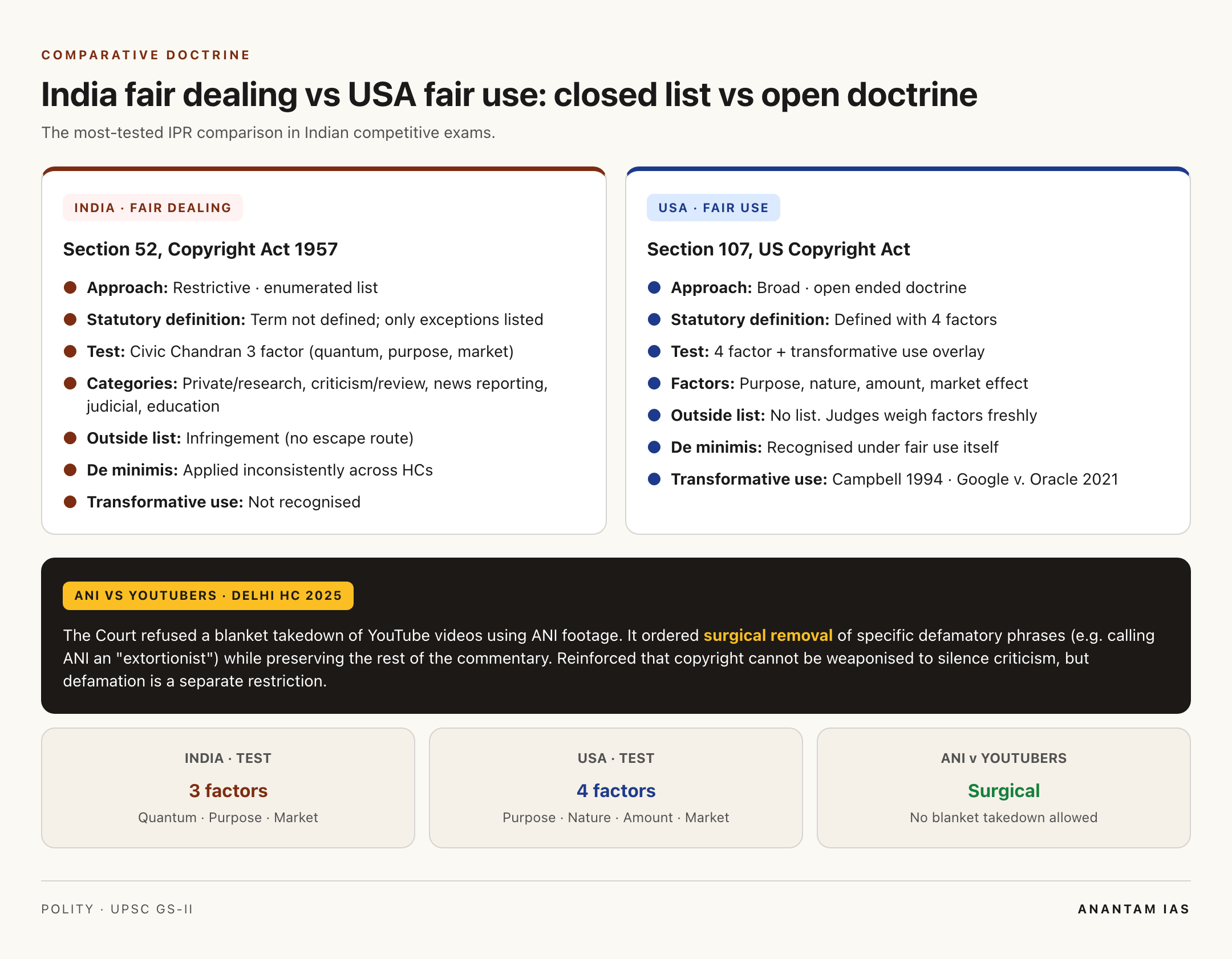
- US contrast: fair use under 17 USC 107 is open ended with four factors and a transformative use overlay.
- ANI vs YouTubers (Delhi HC, 2025): refused blanket takedown, ordered surgical removal of defamatory portions only.
What Is Fair Dealing
Fair dealing is the Indian counterpart of the American fair use doctrine, but with a tighter cut. It is an exception to the exclusive rights of a copyright owner under Section 14, which include reproduction, public performance, communication to the public, translation and adaptation. When a use falls within Section 52, no permission is needed, no royalty is owed, and no infringement claim lies.
The crucial point is that fair dealing in India is enumerated. If the use is not on the list, it is infringement, however reasonable the use might appear to a Western lawyer. American fair use, by contrast, sets out four factors and trusts judges to apply them flexibly to any new context, from rap parody to AI training data. Indian courts have softened the rigidity through doctrines like de minimis non curat lex and the Civic Chandran three factor test, but they have not displaced the underlying enumeration.
Background and Historical Context
The Copyright Act 1957 was modelled on the United Kingdom Copyright Act 1956. Section 52 imported the British fair dealing approach, where the user must show that the use falls into one of the listed categories. The original Section 52 had a short list, expanded over four amendment cycles, most recently in 2012. The 2012 amendment added rights for performers, brought in disability access exceptions, modernised the wording on news reporting, and added clauses on incidental inclusion of copyrighted material in broadcasts.
The leading judicial gloss is Civic Chandran vs C. Ammini Amma, decided by the Kerala High Court in 1996. The Court there laid down the three factor test that Indian courts have used ever since. The Supreme Court has not yet pronounced authoritatively on the doctrine, leaving High Courts to develop it case by case. The ANI dispute, the Wiley vs Rameshwari Photocopy decision of the Delhi High Court in 2016, and the Eastern Book Company vs Modak case of 2008 are the four most cited modern decisions.
Key Provisions of the Copyright Act
Section 14 sets out the exclusive rights of the copyright owner. For literary, dramatic and musical works these rights include reproduction, issue of copies, public performance, communication to the public, translation and adaptation. For cinematograph films and sound recordings the rights include making copies, sale and rental, and communication to the public.
Section 52 carves out the fair dealing exceptions. The most cited sub clauses are 52(1)(a) for private and research use plus criticism and review, and 52(1)(b) for news reporting. Both include the explicit phrase “fair dealing with any work,” signalling that the use must be reasonable in extent. Other sub clauses cover education, libraries, judicial proceedings, sound recordings of literary works for blind users, and incidental inclusion in broadcasts.
Section 37 gives broadcast reproduction rights a separate twenty five year term. News agencies and broadcasters rely heavily on this section, which was at the heart of the ANI claim. The fair dealing carve outs in Section 52 apply to these broadcast rights too, so a YouTuber using an ANI clip can plead Section 52 against a Section 37 claim.
Section 38A and 38B provide performer’s rights and moral rights for performers, separately from the producer’s copyright in the recording. These often interact with personality rights, which we cover in our personality rights guide.
Why Fair Dealing Matters
Three reasons explain why fair dealing has become a hot topic. The first is the explosion of secondary creators on YouTube, Instagram and X who build commentary, satire and review around primary content owned by news agencies, film studios and music labels. The second is the rise of generative AI, which raises new questions about whether training data ingestion is fair dealing and which Indian courts will have to answer in the next two years. The third is the chilling effect concern. Copyright strikes from large rights holders can silence smaller voices well before any court evaluates the merits, because YouTube and other platforms remove content first and ask questions later under safe harbour rules.
The ANI ruling addresses precisely this third concern. By refusing a blanket takedown and ordering only surgical removal of the specifically defamatory text, the Delhi High Court signalled that copyright is not a substitute for defamation law, and that overbroad strikes will not be rubber stamped.
Detailed Analysis: The ANI vs YouTubers Ruling
ANI brought a composite suit against multiple YouTubers, alleging copyright infringement for using its news footage, defamation for calling ANI an “extortionist” and a “propaganda outlet,” and trademark disparagement for use of its logo in mocking thumbnails.
The defendants ran three defences. The first was Section 52(1)(a), arguing that their videos were criticism or review of ANI’s journalism. The second was Section 52(1)(b), arguing that the clips were used to report on current events, including ANI’s own conduct as a news source. The third was the de minimis defence, arguing that the actual ANI footage in each impugned video was a tiny fraction of the total runtime.
The Delhi High Court accepted the first two defences in principle but distinguished between the copyright claim and the defamation claim. On copyright, the Court held that using clips for genuine commentary on the conduct of a news agency is fair dealing, especially where the clips are limited in length and the commentary adds substantial value. On defamation, the Court held that calling ANI an “extortionist” without proof was actionable, and ordered redaction of those specific phrases while preserving the rest of each video.
The order is also notable for what it did not do. It did not block channels. It did not deindex videos. It did not give ANI an automatic standing as a victim of copyright weaponisation in future disputes. It cabined the relief to the specific defamatory passages, signalling that copyright cannot be used to silence the broader commentary.
Comparative Framework: Fair Dealing vs Fair Use
The comparison with American fair use is one of the most tested patterns in Indian competitive exams.
Fair dealing in India operates as a closed list. The categories are private and research use, criticism or review, reporting of current events, judicial proceedings, education, library use and a handful of others. If the use is not on the list, it is infringement. Within each category, the court still applies a reasonableness test, drawing on the Civic Chandran three factor analysis: how much was used, for what purpose, and whether the use competes with the original in the market.
Fair use in the United States operates as an open ended doctrine under Section 107 of the US Copyright Act. The four factors are the purpose and character of the use, the nature of the copyrighted work, the amount used relative to the whole, and the effect on the market for the original. Since Campbell vs Acuff Rose in 1994, courts have layered a transformative use inquiry on top, asking whether the new use adds new expression or message. Google vs Oracle in 2021 extended this approach to software API copying.
The practical difference is that American courts can reach novel cases like AI training, mash up videos and image search engines without statutory amendment, while Indian courts are stuck within Section 52. Reform proposals have repeatedly suggested adopting an open ended fair use clause in India, but Parliament has not moved.
Challenges and Criticism
Three substantive criticisms recur. The first is the chilling effect. Because Section 52 is enumerated, secondary creators face uncertainty whenever their use does not fit a listed category. Even when a use is clearly fair, the time and cost of defending an infringement claim can shut down a small channel. The second is the de minimis gap. Indian courts apply the maxim inconsistently, with some accepting tiny uses as outside copyright entirely and others insisting that any unauthorised use of copyrighted expression triggers liability. The third is the safe harbour interaction. The IT Rules 2021 require platforms to take down content within thirty six hours of a notice, but they do not require evaluation of fair dealing first, so even valid fair dealing uses get removed before any judicial scrutiny.
The ANI ruling addresses the chilling effect but leaves the safe harbour interaction unresolved. The takedown still happened first, the judicial evaluation came later, and the YouTubers had to absorb the reputational and revenue cost in between.
Prelims Pointers
- Section 52 of the Copyright Act 1957 is the source of fair dealing exceptions.
- Section 14 grants exclusive rights to the copyright owner.
- Section 37 gives broadcast reproduction rights a twenty five year term.
- The term fair dealing is not defined in the Act.
- The Civic Chandran 1996 three factor test asks: quantum, purpose, market competition.
- De minimis non curat lex means the law does not concern itself with trifles.
- Indian fair dealing is exhaustive and enumerated; American fair use is open ended.
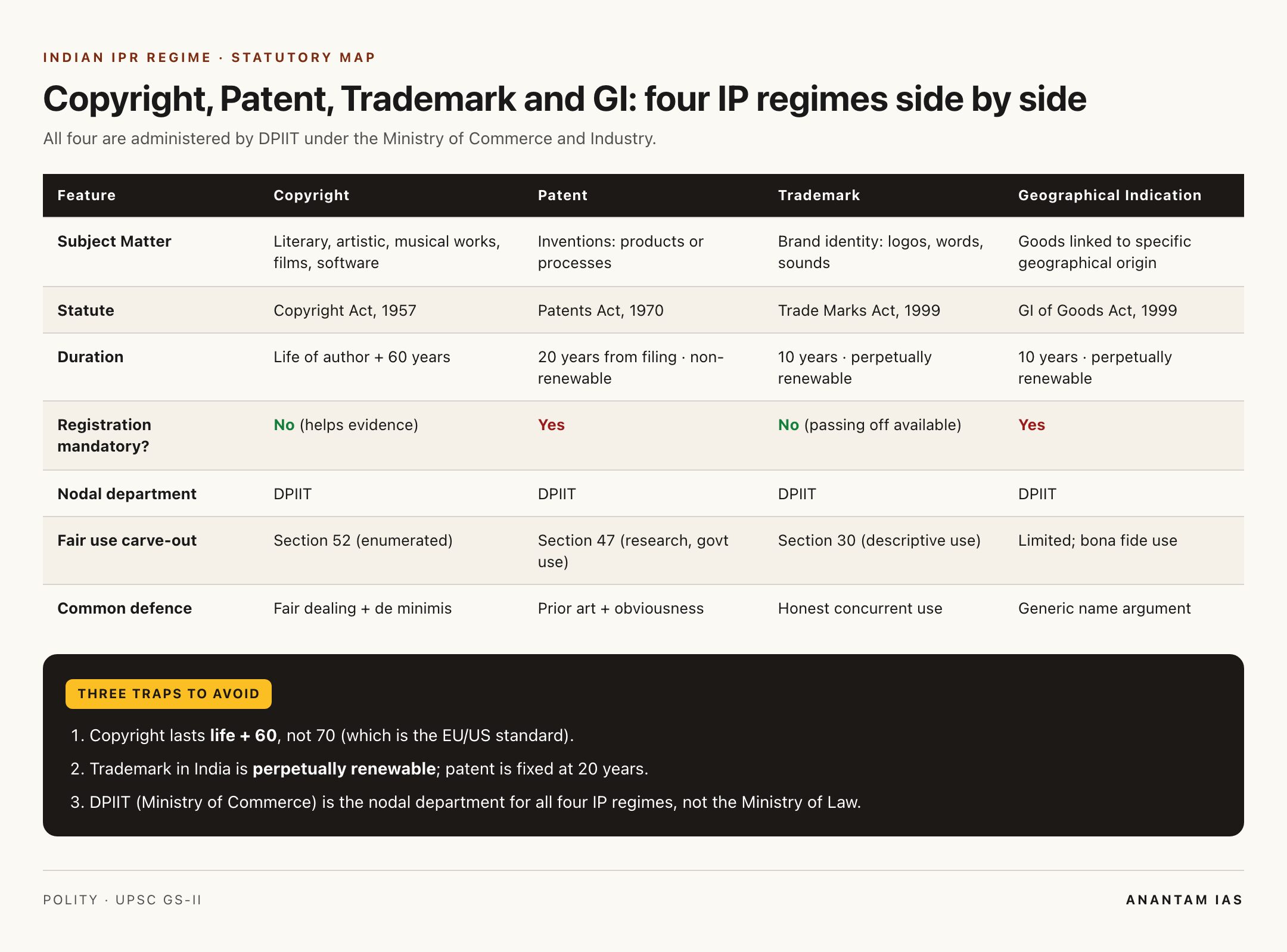
- DPIIT under the Ministry of Commerce and Industry is the nodal department for copyright.
- Copyright protection lasts for the life of the author plus sixty years.
- Registration is not mandatory for copyright; it is mandatory for patents and GI.
Mains Practice Questions
- The Indian fair dealing doctrine is procedurally narrow but substantively flexible. Critically examine this claim with reference to Civic Chandran and the ANI vs YouTubers ruling. (GS Paper 2, 250 words)
- Should India replace the enumerated Section 52 list with an open ended fair use clause modelled on US Section 107? Discuss in light of the rise of generative AI and secondary creators. (GS Paper 2, 250 words)
- Discuss the interaction between copyright fair dealing and the safe harbour provisions of the IT Rules 2021. (GS Paper 2, 150 words)
- Examine the Delhi High Court’s surgical removal approach in ANI vs YouTubers as a model for balancing reputation and free speech. (GS Paper 2, 150 words)
Way Forward
A measured reform package would do four things. Parliament could amend Section 52 to add an open ended residuary clause, similar to the Israeli 2007 fair use formulation, that allows courts to recognise new fair uses by analogy. The Ministry of Electronics and Information Technology could amend the IT Rules to require a basic fair dealing evaluation before takedown, perhaps by requiring rights holders to certify that the use is not protected by Section 52. The Copyright Office could publish guidance on de minimis, removing the inconsistency between High Courts. And the Supreme Court could finally take up a fair dealing matter directly, settling the Civic Chandran three factor test as binding national doctrine. Until these changes arrive, the ANI ruling stands as the cleanest line in the sand: copyright protects creative work, not reputational discomfort, and fair dealing for criticism is a real defence, not a paper one.
Frequently Asked Questions
Is the term fair dealing defined in the Copyright Act?
No. The Act lists exceptions in Section 52 but does not define fair dealing as a phrase. Courts have interpreted it through the Civic Chandran three factor test.
Is using a five second clip from a movie always fair dealing?
Not always. The de minimis defence may apply, but courts also look at whether the clip is the heart of the work and whether the use competes with the original. A short clip from a song’s chorus might fail fair dealing even though it is brief.
What is the difference between fair dealing and fair use?
Fair dealing in India is a closed list of permitted uses. Fair use in the United States is an open ended doctrine with four factors. Both look at extent and purpose, but fair use is more flexible.
Did the Delhi High Court ban YouTubers in the ANI case?
No. The Court refused a blanket takedown and ordered only surgical removal of specific defamatory phrases, preserving the rest of the commentary.
Can news reporting always rely on fair dealing?
News reporting of current events is protected under Section 52(1)(b), but the use must still be reasonable in extent. Wholesale republication of a copyrighted news story would not be fair dealing even with attribution.
Does fair dealing apply to broadcast reproduction rights?
Yes. The Section 52 exceptions apply to all copyright rights including broadcast reproduction rights under Section 37.
Is registration of copyright mandatory in India?
No. Copyright exists from the moment of creation. Registration with the Copyright Office assists evidentiary proof but is not required for protection.
Who is the nodal authority for copyright in India?
The Department for Promotion of Industry and Internal Trade under the Ministry of Commerce and Industry. The same department oversees patents, trademarks and GIs.
What is the term of copyright protection?
For literary, dramatic and musical works, it is the lifetime of the author plus sixty years from the year of death. For films and sound recordings, it is sixty years from publication.
Can AI training on copyrighted text be fair dealing in India?
Indian courts have not yet ruled. The current Section 52 list does not include a research mining exception of the kind some other jurisdictions have introduced. Reform proposals are under discussion.
Tell Google you want more of this.
Add Anantam IAS as a preferred sourceOne tap, and this site shows up more often in your own Top Stories, AI Overviews and AI Mode. Remove it any time.