Seagrass and seaweed are often spoken of in the same breath, sometimes even used interchangeably in everyday conversation, but they belong to completely different parts of the tree of life. Seagrass is a true flowering plant. Seaweed is an alga. The differences between them go all the way down to cellular biology and reach all the way up to global climate policy, because seagrass meadows are among the most efficient blue carbon sinks on the planet, while seaweed cultivation is a fast-growing pillar of India’s blue economy.
For a UPSC aspirant, the seagrass-versus-seaweed distinction is the kind of high-yield clarification that the Prelims regularly turns into a multiple-choice question. It also opens up a serious Mains conversation about marine biodiversity, the coastal regulation framework, and the policy push for blue carbon as a recognised category in India’s nationally determined contributions under the Paris Agreement.
Quick Facts on Seagrass vs Seaweed
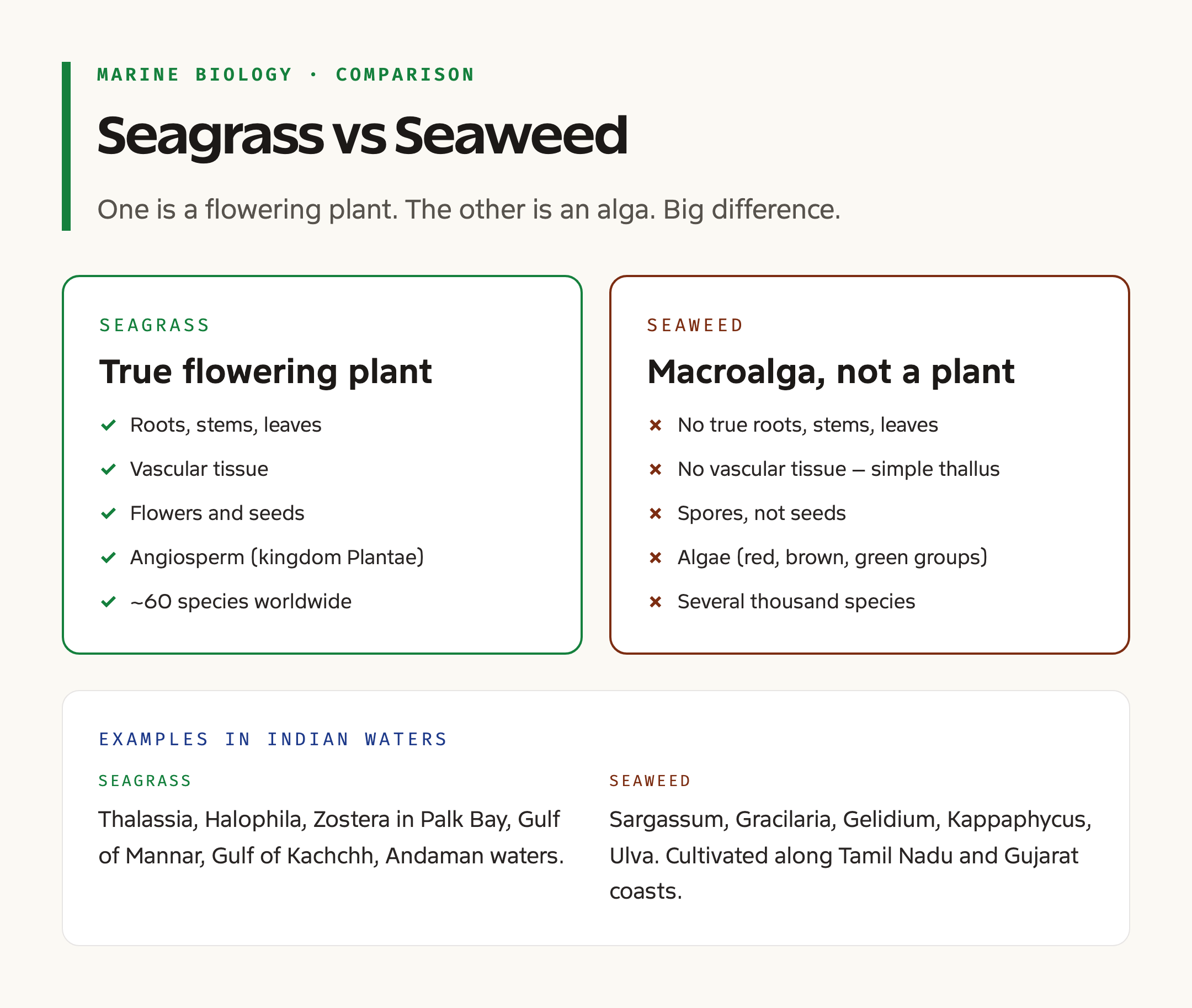
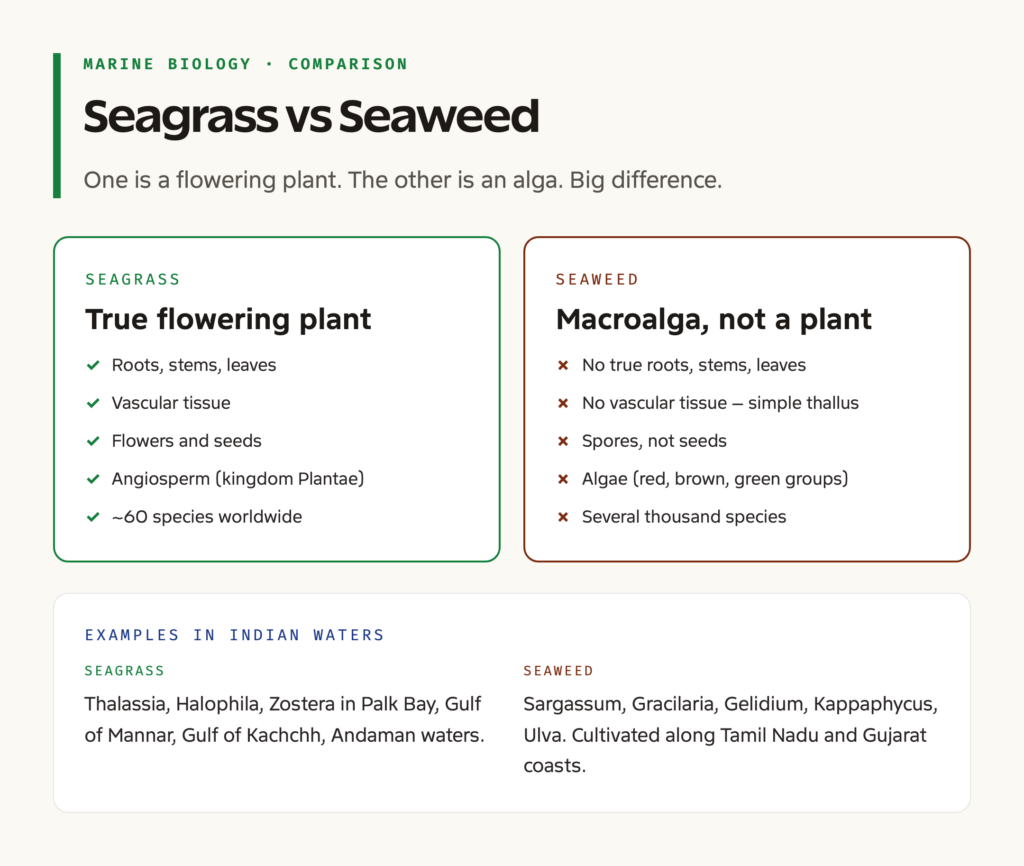
Seagrass and seaweed are both marine photosynthetic organisms, but they belong to fundamentally different biological kingdoms. Seagrass consists of around 60 species of true flowering plants, classified as angiosperms, which evolved from terrestrial flowering plants and returned to the sea around 100 million years ago. Seaweeds are macroalgae, several thousand species belonging to three main groups: red algae, brown algae, and green algae, none of which are true plants.
Seagrass meadows in India are concentrated along the Tamil Nadu coast, especially Palk Bay and the Gulf of Mannar, with smaller meadows in the Gulf of Kachchh and the Andaman and Nicobar Islands. Seaweed cultivation is concentrated along the Tamil Nadu and Gujarat coasts, with the Pradhan Mantri Matsya Sampada Yojana funding seaweed parks at scale. The recent recognition of India’s Dugong Conservation Reserve by the IUCN highlights how seagrass underpins one of the country’s most fragile marine megafauna.
What Seagrass and Seaweed Are
Background and Historical Context
Plants and algae diverged from a common ancestor more than a billion years ago. Algae stayed in the water. Land plants colonised continents around 470 million years ago. Roughly 100 million years ago, a small group of flowering plants made the unusual journey back to the sea and gave rise to what we now call seagrasses. They retained the defining features of land plants, including roots, stems, leaves, vascular tissue for transporting water and sugars, and the ability to flower and produce seeds.
Seaweeds, by contrast, never left the water and never developed any of those structures. A seaweed is essentially a sheet, ribbon, or branched body of cells, called a thallus, that absorbs water and nutrients directly across its surface. It anchors itself to a substrate using a structure called a holdfast that looks like roots but does not absorb anything. Seaweeds reproduce through spores, not seeds.
Indian fisheries science has worked with seaweed for over a century, starting with the cultivation of agar-yielding red algae like Gelidium and Gracilaria along the Tamil Nadu coast. Seagrass research is younger, with serious mapping and ecology work picking up only after the 1980s. Read this against the wider story of biodiversity in India and the coastal regulation framework.
Key Differences in Biology
The differences begin at the cellular level and ripple outward.
Seagrass is a true plant. It has roots that anchor the plant in sandy or muddy seabed and absorb water and nutrients. It has stems and leaves arranged in a definite pattern, with vascular tissue that moves water and sugars between them. It flowers, often inconspicuously, and produces seeds that disperse through water. It needs sunlight, so seagrass cannot grow in deep or turbid water.
Seaweed has no roots, no stems, no leaves, and no vascular tissue in the strict sense. The body is a thallus that may look superficially like a leafy plant but is structurally undifferentiated. It does not flower and does not produce seeds. It reproduces through spores or fragmentation. Seaweeds can grow on rocks, reefs, shells, ropes, and other hard surfaces, and many species tolerate a wider range of light conditions than seagrass.
Seagrass examples include Thalassia, Halophila, and Zostera, found in places like Palk Bay, the Gulf of Mannar, and the Gulf of Kachchh. Seaweed examples include Sargassum and Turbinaria among brown algae, Gracilaria, Gelidium, and Kappaphycus among red algae, and Ulva and Caulerpa among green algae.
Why the Distinction Matters
The distinction matters first for ecology. Seagrass meadows form the foundation of a specific kind of marine ecosystem: shallow, sandy, sunlit coastal waters where dugongs, green sea turtles, seahorses, and a long list of fish species depend directly or indirectly on the meadow for food, shelter, and spawning. Lose the meadow and you lose the ecosystem. Seaweeds support a different kind of ecosystem, often associated with rocky shores, kelp forests at higher latitudes, and tropical reef systems.
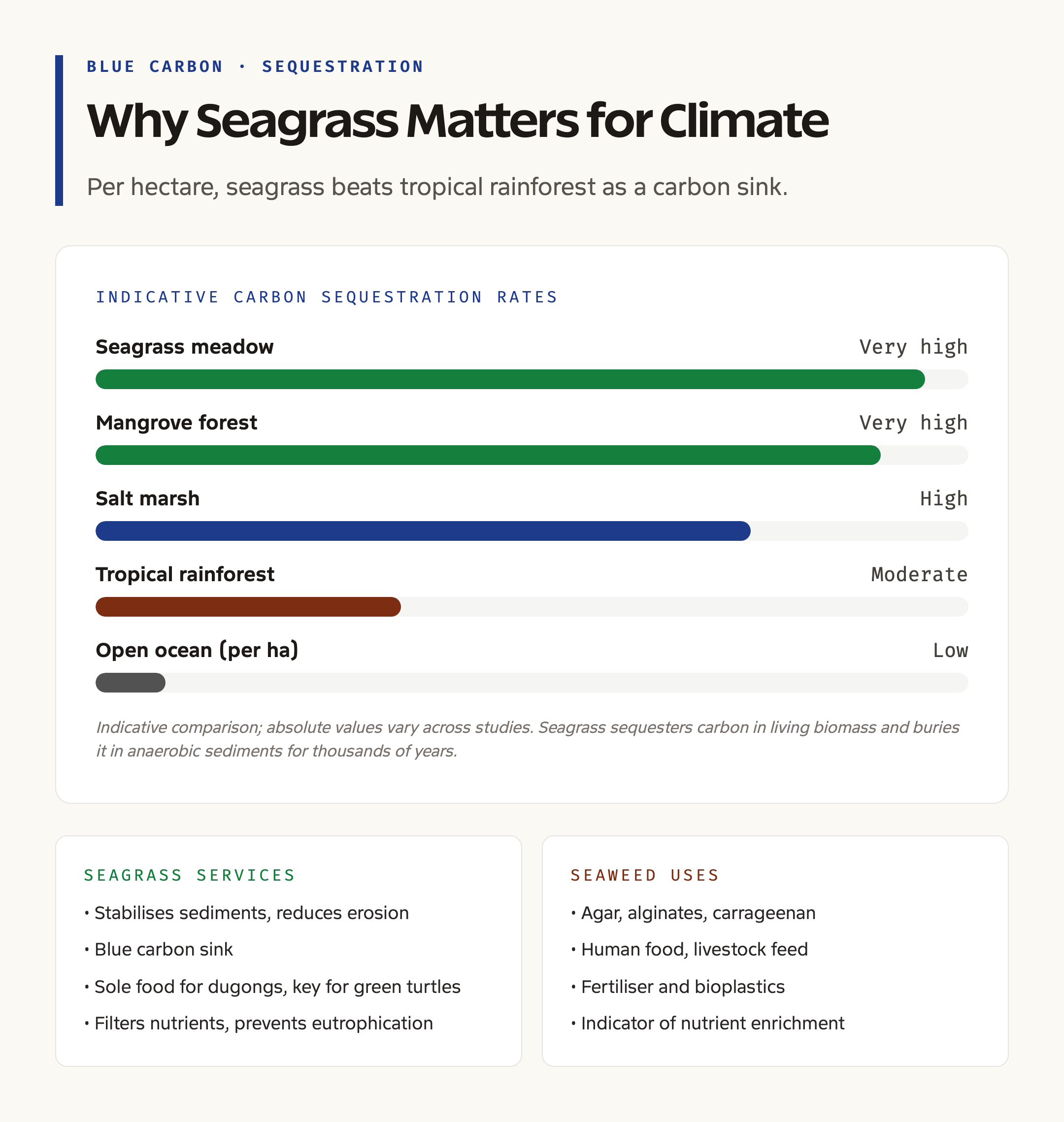
It matters second for blue carbon. Seagrass meadows sequester carbon in their biomass and in the sediments below them at rates many times higher than terrestrial forests on a per-hectare basis. The carbon they bury in anaerobic sediment can stay there for thousands of years. Seaweeds also sequester carbon, but they typically do not bury it in long-term sinks unless their detritus reaches deep ocean basins.
It matters third for policy. Seagrass meadows in India are protected under the Wildlife Protection Act when they fall inside conservation reserves like Palk Bay, and under the Coastal Regulation Zone notification when they fall inside CRZ areas. Seaweed cultivation, by contrast, is regulated as an aquaculture activity and is actively promoted by the Pradhan Mantri Matsya Sampada Yojana. Confusing the two leads to bad policy decisions.
Detailed Analysis: Ecosystem Services
Seagrass meadows provide four primary ecosystem services. First, they stabilise sediments by binding sand and mud with their roots, reducing coastal erosion and protecting shorelines from wave damage. Second, they sequester blue carbon, with rates several times higher than tropical rainforests on a per-hectare basis. Third, they support food webs, providing the only food source for dugongs and a major food source for green sea turtles, while their canopy and root systems shelter juvenile fish. Fourth, they filter nutrients, taking up nitrogen and phosphorus that would otherwise contribute to coastal eutrophication.
Seaweeds provide a different mix of services. They are primary producers in rocky-shore and reef ecosystems, the basis of food webs that include sea urchins, fish, and sea otters where those species occur. They yield commercially valuable products including agar, alginates, and carrageenan, which underpin a large food and pharmaceutical industry. They are nutritionally rich and increasingly cultivated for human food. They can absorb excess nutrients in eutrophic coastal waters, providing a partial solution to nutrient pollution. The presence of certain seaweed species, particularly fast-growing species like Ulva and Sargassum, is itself an indicator of nutrient enrichment.
Comparative Look: Seagrass vs Seaweed
| Feature | Seagrass | Seaweed |
|---|---|---|
| Type | True flowering plants, angiosperms | Algae, not plants |
| Structure | Roots, stems, leaves, vascular tissue | No true roots, stems, leaves; simple thallus |
| Habitat | Shallow, sandy, sunlit coastal waters | Rocky shores, reefs, tidal zones, attached by holdfast |
| Sunlight | High requirement, needs clear water | Moderate, varied light tolerance |
| Reproduction | Flowers and seeds | Spores and fragmentation |
| Examples | Thalassia, Halophila, Zostera | Sargassum, Gracilaria, Gelidium, Ulva |
| Ecological Role | Stabilise sediments, blue carbon, dugong food | Primary producers, food, fertiliser, industrial extracts |
| Indicator Of | Healthy clear-water coastal ecosystem | Often indicator of nutrient enrichment |
This is also where the topic links to the broader story of marine pollution and the protection of mangrove ecosystems. Seagrass, mangroves, and salt marshes together make up the three pillars of blue carbon, all of them protected under different combinations of Indian and international law.
Challenges Facing Seagrass and Seaweed in India
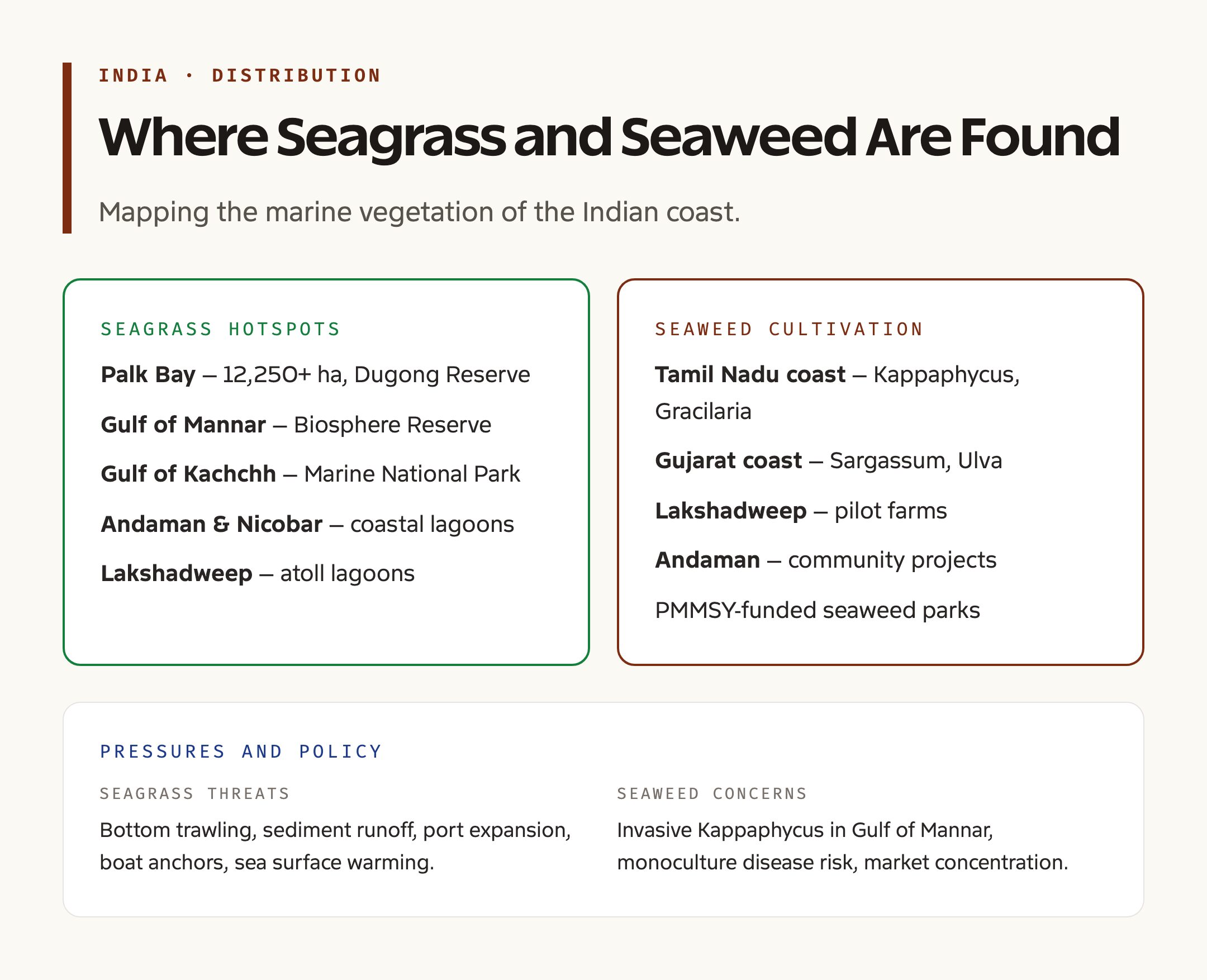
Seagrass faces five main pressures in India. Bottom trawling physically tears up meadows. Sediment runoff from agriculture and construction reduces the light available for photosynthesis. Coastal development including port expansion eliminates shallow water habitat. Boat anchors damage individual patches over time. Climate change brings rising sea surface temperature and ocean acidification, both of which stress meadows.
Seaweed cultivation faces a different set of challenges. Some commercially cultivated species, including Kappaphycus alvarezii in the Gulf of Mannar, are non-native and can become invasive in nearby reef systems. Disease outbreaks in monoculture seaweed farms can wipe out an entire harvest. Markets for seaweed products are concentrated in a few buyers, leaving small farmers exposed to price shocks. And there is the broader regulatory question of how seaweed parks fit within the Coastal Regulation Zone framework.
Prelims Pointers
Seagrass is a true flowering plant, an angiosperm, with roots, stems, leaves, and vascular tissue. Seaweed is an alga without true roots, stems, or leaves. Seagrass examples in India include Thalassia, Halophila, and Zostera, found mainly in Palk Bay and the Gulf of Mannar. Seaweed examples include Sargassum, Gracilaria, Gelidium, and Ulva.
Seagrass is the only food of the dugong, Dugong dugon, which is on Schedule I of the Wildlife Protection Act, 1972 and Vulnerable on the IUCN Red List. India’s Dugong Conservation Reserve in Palk Bay was recognised by the IUCN in 2025. Seagrass meadows are highly efficient blue carbon sinks. Seaweed cultivation in India is supported by the Pradhan Mantri Matsya Sampada Yojana.
Mains Questions on Seagrass and Seaweed
Distinguish between seagrass and seaweed and discuss their respective roles in the marine ecosystems of India. Examine the importance of seagrass meadows in coastal carbon sequestration and biodiversity conservation. Evaluate the regulatory and policy framework for seaweed cultivation under India’s blue economy strategy.
A complete answer would treat seagrass primarily as a conservation and climate asset, treat seaweed primarily as a livelihood and industrial asset, and acknowledge that both face overlapping pressures from coastal pollution, port development, and climate change. The connection to the Dugong Conservation Reserve and the IUCN recognition gives the answer a contemporary anchor.
Way Forward
The route forward involves four reforms. The first is national mapping of seagrass meadows using satellite remote sensing and ground truthing, building on the work already done by the Space Applications Centre and the Wildlife Institute of India. The second is formal recognition of seagrass blue carbon under India’s nationally determined contributions, similar to the way mangroves are now counted.
The third is regulation of seaweed cultivation to prevent invasion of non-native species into reef systems, with mandatory environmental impact assessment for new seaweed parks. The fourth is community-based management, with fisher cooperatives empowered to monitor seagrass meadows and earn carbon credits for restoration.
Seagrass and seaweed look similar from a boat. The policy responses they require are very different. India’s marine future depends on getting the distinction right.
Frequently Asked Questions
What is the main difference between seagrass and seaweed?
Seagrass is a true flowering plant, an angiosperm, with roots, stems, leaves, and vascular tissue. Seaweed is an alga, with no true roots, stems, or leaves and no vascular tissue. The two belong to fundamentally different biological kingdoms.
Are seagrasses related to land grasses?
No. Despite the name, seagrasses are not closely related to terrestrial grasses. They are flowering plants that returned to the sea around 100 million years ago and evolved a body plan adapted to fully submerged life.
What are some examples of seagrass found in India?
Thalassia, Halophila, and Zostera are the main genera found in Indian waters, with the largest meadows in Palk Bay and the Gulf of Mannar along the Tamil Nadu coast.
What are some examples of seaweed found in India?
Sargassum and Turbinaria among brown algae, Gracilaria, Gelidium, and Kappaphycus among red algae, and Ulva and Caulerpa among green algae. Cultivation is concentrated along the Tamil Nadu and Gujarat coasts.
Why are seagrass meadows called blue carbon sinks?
Seagrass meadows sequester carbon in their biomass and bury it in anaerobic sediments below the seabed. The buried carbon can stay there for thousands of years. Per hectare, the rate of carbon sequestration in seagrass meadows is several times higher than in tropical rainforests.
What is the connection between seagrass and dugongs?
Dugongs feed almost exclusively on seagrass. India’s only Dugong Conservation Reserve in Palk Bay protects more than 12,250 hectares of seagrass meadows. Loss of seagrass means loss of dugongs.
Is seaweed an indicator of pollution?
Some species of seaweed, particularly fast-growing genera like Ulva and certain Sargassum populations, can bloom in response to nutrient enrichment from agricultural runoff or sewage. Their presence in unusual abundance is often used as an indicator of coastal eutrophication.
Is seaweed cultivation legal in India?
Yes. Seaweed cultivation is regulated as an aquaculture activity and is actively promoted under the Pradhan Mantri Matsya Sampada Yojana, which funds seaweed parks and capacity building. New farms within Coastal Regulation Zone areas require clearance.
Can seaweed be invasive?
Yes. Some commercially cultivated species, including Kappaphycus alvarezii introduced for carrageenan production, have been shown to invade and damage native reef systems in the Gulf of Mannar. Cultivation rules now require buffer distances from sensitive reef areas.
Why is sunlight a more critical factor for seagrass than for seaweed?
Seagrasses are true plants with relatively high photosynthetic light requirements. They need clear shallow water with full daylight reaching the seabed. Seaweeds, while also photosynthetic, include species adapted to lower light conditions and can grow in deeper or shaded habitats.
Tell Google you want more of this.
Add Anantam IAS as a preferred sourceOne tap, and this site shows up more often in your own Top Stories, AI Overviews and AI Mode. Remove it any time.