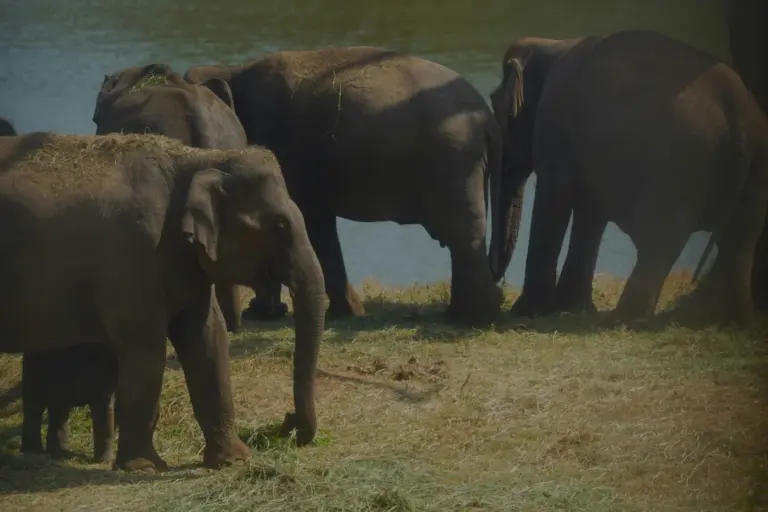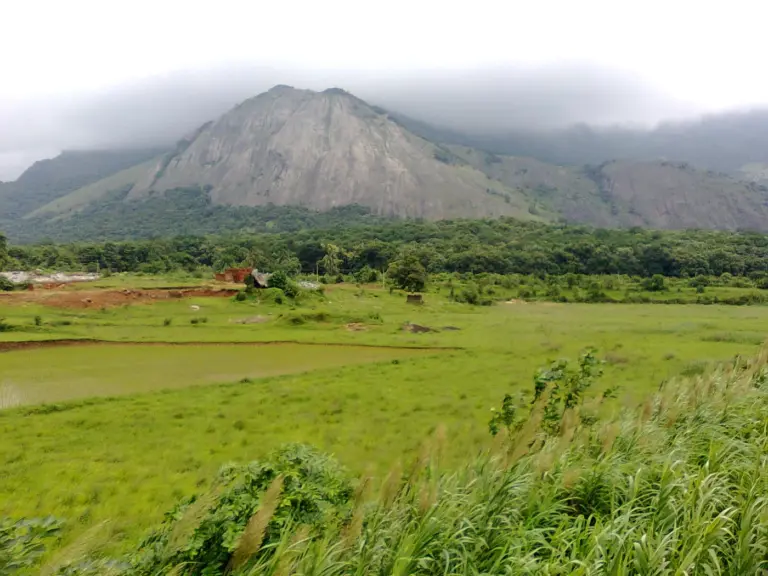

Simlipal National Park (also spelled Similipal) is one of India's most important protected areas, located in the Mayurbhanj district of Odisha in the north-eastern corner of the state. A tiger reserve under Project Tiger, a biosphere reserve under the UNESCO Man and the Biosphere Programme, and a national park, Simlipal is a rare ecological unit that combines dense sal forests, numerous waterfalls, and a remarkable concentration of Asian elephants and Bengal tigers, including the world's only known population of melanistic (pseudo-melanistic) tigers. For UPSC aspirants, Simlipal is a textbook case of layered conservation categories, tribal coexistence and climate vulnerability.
Location and Extent
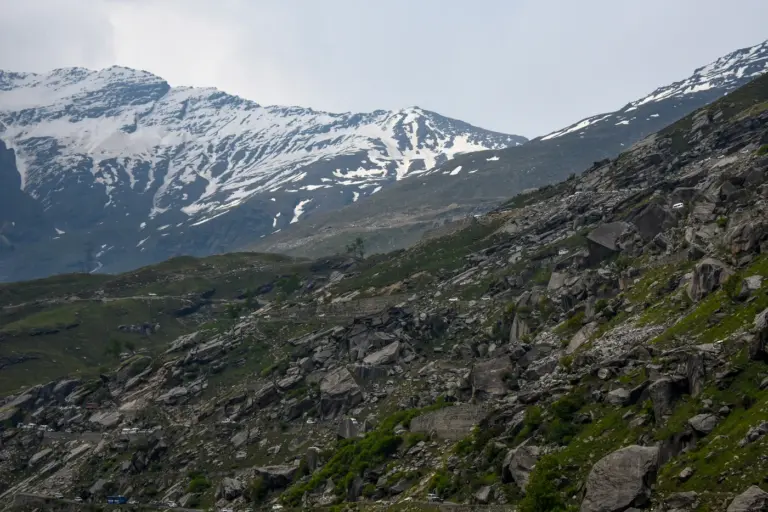
Simlipal lies in the Eastern Ghats, at the confluence of the Chhotanagpur plateau and the coastal plains.
- State – Odisha.
- District – Mayurbhanj.
- Coordinates – roughly 21-22 deg N latitude.
- Elevation – ~300 m to over 1,150 m (Khairiburu peak).
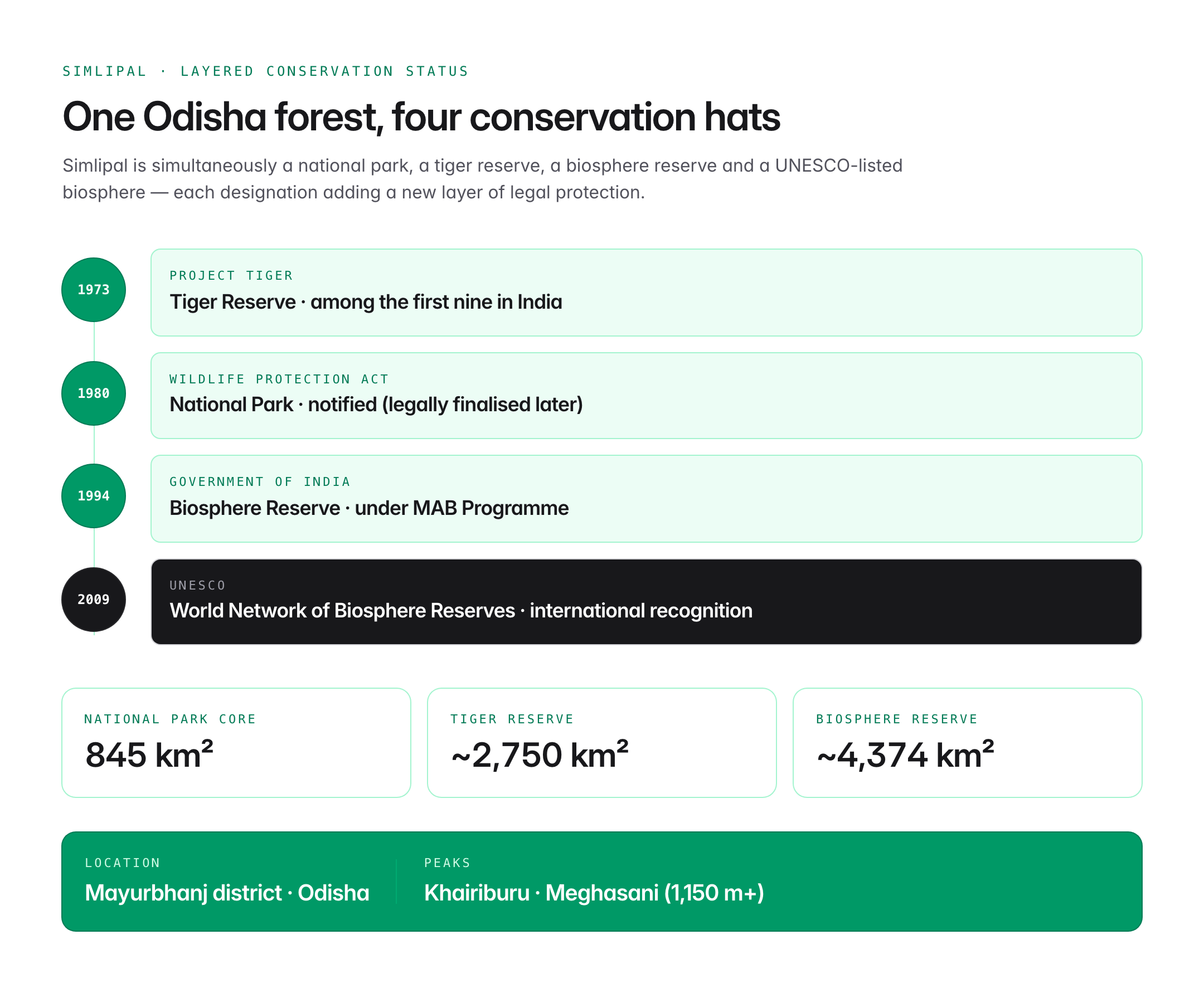
Its conservation status is layered:
| Designation | Year |
|---|---|
| Tiger Reserve (Project Tiger) | 1973 (among the first nine) |
| National Park | Notified in 1980 (legally finalised later) |
| Biosphere Reserve | 1994 |
| UNESCO World Network of Biosphere Reserves | 2009 |
The core area of the national park is around 845 sq km, the tiger reserve covers about 2,750 sq km, and the biosphere reserve, including buffer and transition zones, spans roughly 4,374 sq km.
Topography and Rivers
Simlipal's landscape is one of rolling hills and deep forests, with peaks such as Khairiburu and Meghasani rising above 1,150 m. The reserve is the source of several important rivers that drain into the Bay of Bengal, including:
- Budhabalanga
- Salandi
- Palpala
- Khadkei
Famous waterfalls within the reserve include Barehipani Falls (one of India's tallest tiered falls) and Joranda Falls.
Flora
Simlipal supports a range of forest types driven by altitude and rainfall:
- Northern tropical moist deciduous forests – dominated by sal (Shorea robusta).
- Tropical semi-evergreen patches along streams.
- High-level sal forests at higher elevations.
- Grasslands – locally called meadows, important for herbivores.
Over 1,000 species of plants have been recorded, with many medicinal and ethnobotanically important species collected by local tribes. Orchids, ferns and bryophytes add to the richness, especially in moist valleys.
Fauna
Simlipal's fauna is among the richest in the Eastern Ghats.
| Group | Representative Species |
|---|---|
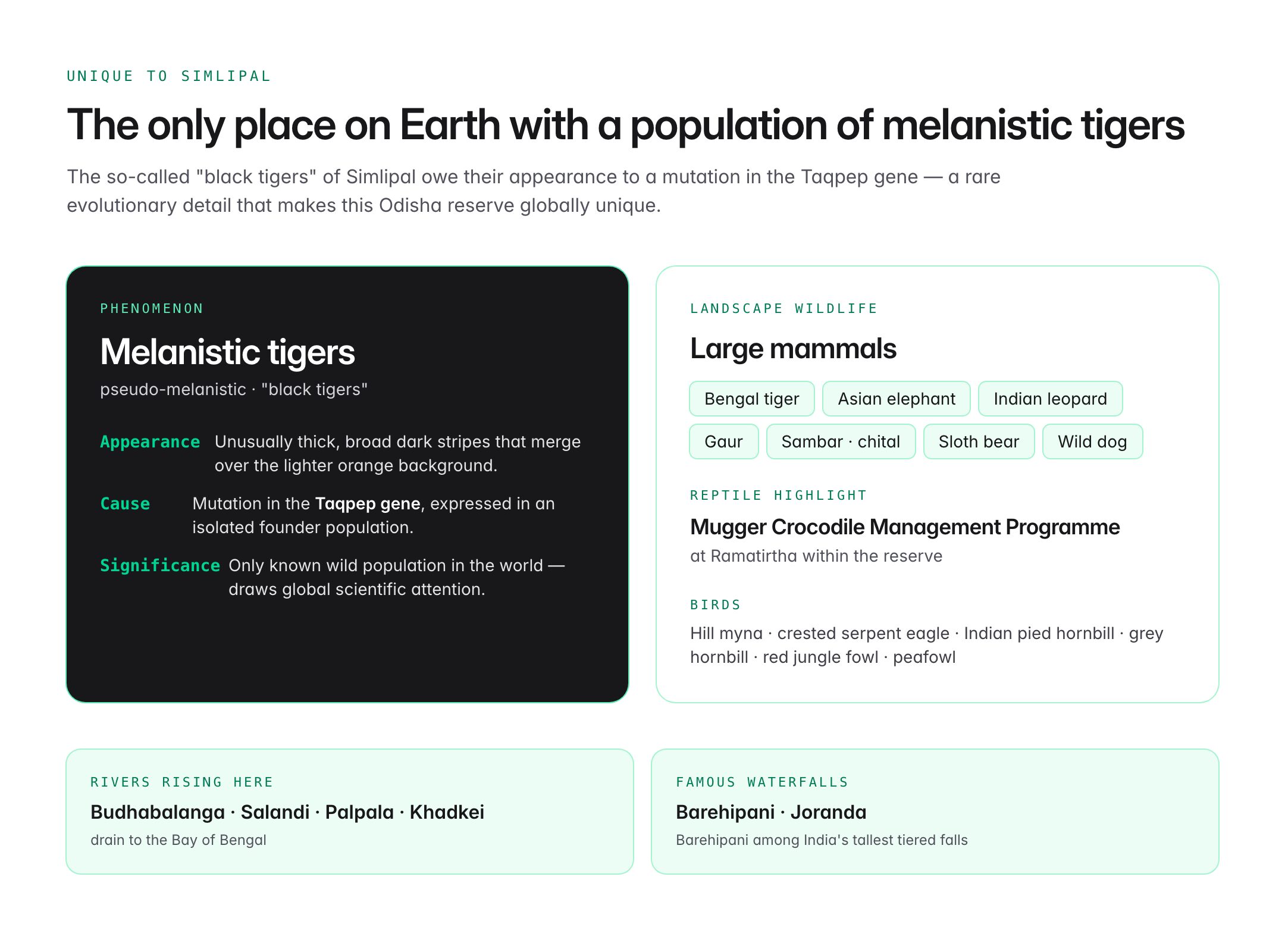
| Large mammals | Bengal tiger (including melanistic tigers), Asian elephant, Indian leopard, gaur, sambar, chital, mouse deer, barking deer, sloth bear, wild dog |
| Primates | Rhesus macaque, Hanuman langur |
| Smaller carnivores | Jungle cat, leopard cat, civets, mongooses |
| Birds | Hill myna, crested serpent eagle, Indian pied hornbill, grey hornbill, red jungle fowl, peafowl |
| Reptiles | King cobra, Indian rock python, mugger crocodile, monitor lizards |
| Amphibians/Fish | Several endemic Eastern Ghats frogs; freshwater fish in reserve streams |
Melanistic Tigers
Simlipal is the only known site in the world with a population of melanistic (pseudo-melanistic) tigers, sometimes called "black tigers". These tigers have unusually thick, broad dark stripes that merge over the lighter background, caused by a mutation in the Taqpep gene. The phenomenon has drawn global scientific attention and makes Simlipal unique among tiger landscapes. It is home to a dedicated conservation approach that includes the Mugger Crocodile Management Programme at Ramatirtha.
Tribal Communities and Livelihoods
The Simlipal landscape is deeply entwined with tribal life. Key communities include:
- Santhal – the largest tribe of the region.
- Kolha, Bathudi, Bhumij, Gond, Munda, Sahara – other significant tribal groups.
- Mankirdia and Khadia – recognised as Particularly Vulnerable Tribal Groups (PVTGs).
Tribals depend on non-timber forest produce such as sal seeds, mahua flowers, kendu leaves, honey and medicinal plants. The Forest Rights Act, 2006 provides a framework for recognising individual and community rights. Conservation policy in Simlipal has attempted to balance rights with core-area protection through buffer zoning, eco-development committees and alternative livelihood support.
Significance
Simlipal matters on multiple conservation axes:
- Tiger conservation – one of the original Project Tiger reserves, it anchors tiger population recovery in eastern India.
- Elephant conservation – part of the Mayurbhanj Elephant Reserve, a key habitat for Asian elephants in Odisha.
- Biosphere function – watersheds for major rivers of northern Odisha.
- Genetic uniqueness – home to melanistic tigers.
- Cultural value – embedded in the lives of several tribal communities.
- Scientific value – reference landscape for Eastern Ghats biodiversity.
Challenges and Threats
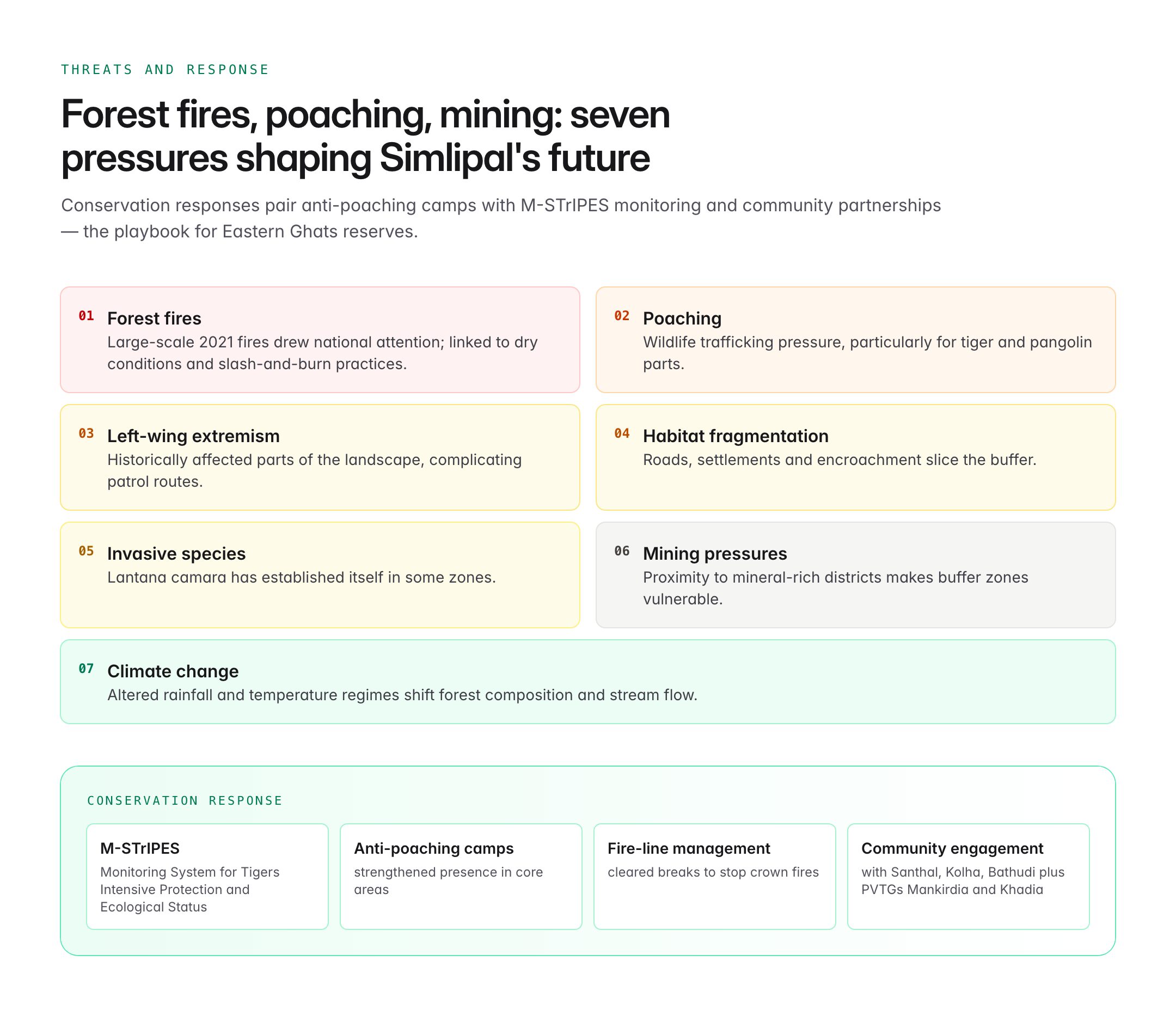
Simlipal faces several stresses:
- Forest fires – large-scale fires in 2021 drew national attention, linked to dry conditions and traditional slash-and-burn practices.
- Poaching and wildlife trafficking – particularly for tiger and pangolin parts.
- Left-wing extremism – historically affected parts of the landscape, complicating patrolling.
- Habitat fragmentation – roads, settlements and encroachment.
- Invasive species – Lantana camara in some zones.
- Mining pressures – proximity to mineral-rich districts makes buffer zones vulnerable.
- Climate change – altered rainfall and temperature regimes.
Conservation responses include strengthened anti-poaching camps, use of M-STrIPES (Monitoring System for Tigers – Intensive Protection and Ecological Status), fire-line management, community engagement and tourism regulation.
Management Framework
Simlipal is managed under several overlapping legal and policy frameworks:
- Wildlife (Protection) Act, 1972 – basis for national park and tiger reserve status.
- Project Tiger (1973) and the National Tiger Conservation Authority (NTCA).
- Project Elephant (1992).
- Biological Diversity Act, 2002.
- Forest (Conservation) Act, 1980.
- Forest Rights Act, 2006.
- UNESCO MAB Programme – biosphere reserve governance.
Core-buffer zoning restricts human activity in core areas, while the buffer and transition zones allow regulated use and livelihoods.
UPSC Relevance
Prelims focus
- State and district: Odisha, Mayurbhanj.
- Year Project Tiger status: 1973; Biosphere Reserve status: 1994; UNESCO MAB network: 2009.
- Major rivers: Budhabalanga, Salandi.
- Waterfalls: Barehipani, Joranda.
- Unique population of melanistic tigers.
- Associated reserves: Mayurbhanj Elephant Reserve; surrounding reserves Hadgarh and Kuldiha share landscape connectivity.
- PVTGs: Mankirdia, Khadia.
Mains GS-III angle
Use Simlipal in answers on:
- Tiger conservation and NTCA oversight.
- Elephant corridors in eastern India.
- Biosphere reserves and the three-zone model.
- Forest fires and disaster-conservation interface.
- FRA implementation in tiger reserves.
- Mining versus conservation in Eastern Ghats.
Sample PYQ angle – questions on "India's biosphere reserves" or "tiger conservation challenges" map directly. A good answer notes the unique melanistic tiger population, the layered conservation status, and Simlipal's role within the Eastern Ghats biogeographic zone.
Simlipal is a concentrated study in Indian conservation – ecology, tribes, policy and uniqueness packed into one landscape – making it a must-know for environment-focused UPSC aspirants.
Tell Google you want more of this.
Add Anantam IAS as a preferred sourceOne tap, and this site shows up more often in your own Top Stories, AI Overviews and AI Mode. Remove it any time.