In the warm coastal waters of the Indo-Pacific, hundreds of small requiem shark species cruise the reef edges and shallow shelves at the bottom of the food chain rather than the top. The slit-eye shark is one of these. It is a slim, fast, narrow-eyed predator named for the elongated horizontal slit that gives its eye its distinctive appearance. It seldom features in shark documentaries, but it is one of the most ecologically important small sharks in the Indian Ocean and Western Pacific because of how widely distributed and how heavily fished it is.
Conservation biologists have flagged the slit-eye shark as Near Threatened on the IUCN Red List. The reasons are familiar across the global shark family: incidental capture in artisanal and trawl fisheries, the demand for shark meat and fins in regional markets, and habitat degradation in mangrove-lined estuaries and nearshore reefs. India, with its long coastline and large artisanal fishing fleet, is one of the principal range states.
For UPSC, the slit-eye shark is a useful entry point into the wider conversation about marine biodiversity in Indian waters, the IUCN Red List framework, and India’s evolving regime of shark and ray protection under the Wildlife (Protection) Act, 1972 and the CITES treaty. This guide builds out every layer.
Quick Facts
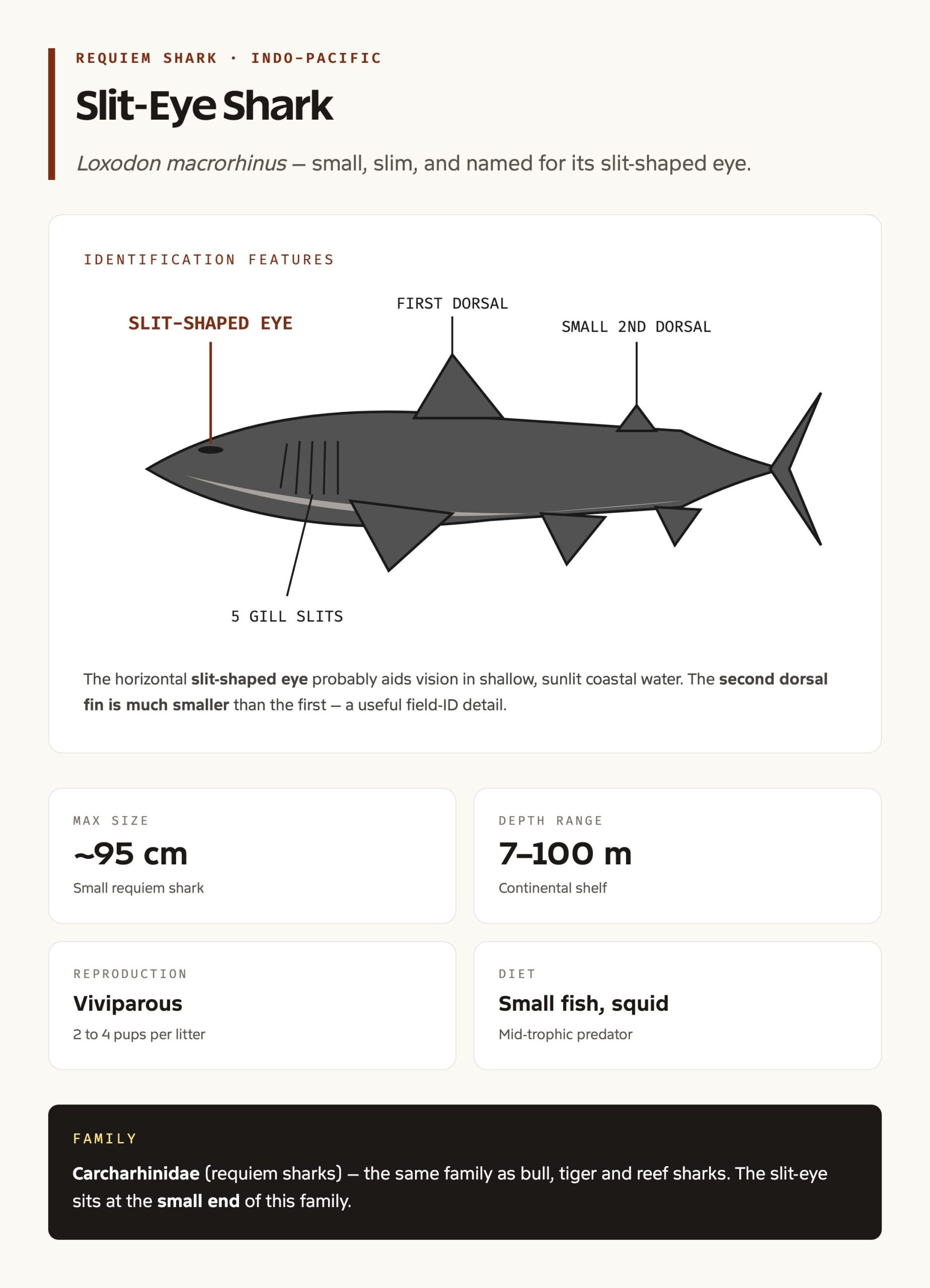
- Scientific name: Loxodon macrorhinus
- Family: Carcharhinidae (requiem sharks)
- Common name: Slit-eye shark, sliteye shark
- Origin of name: From the elongated, slit-like horizontal eye opening
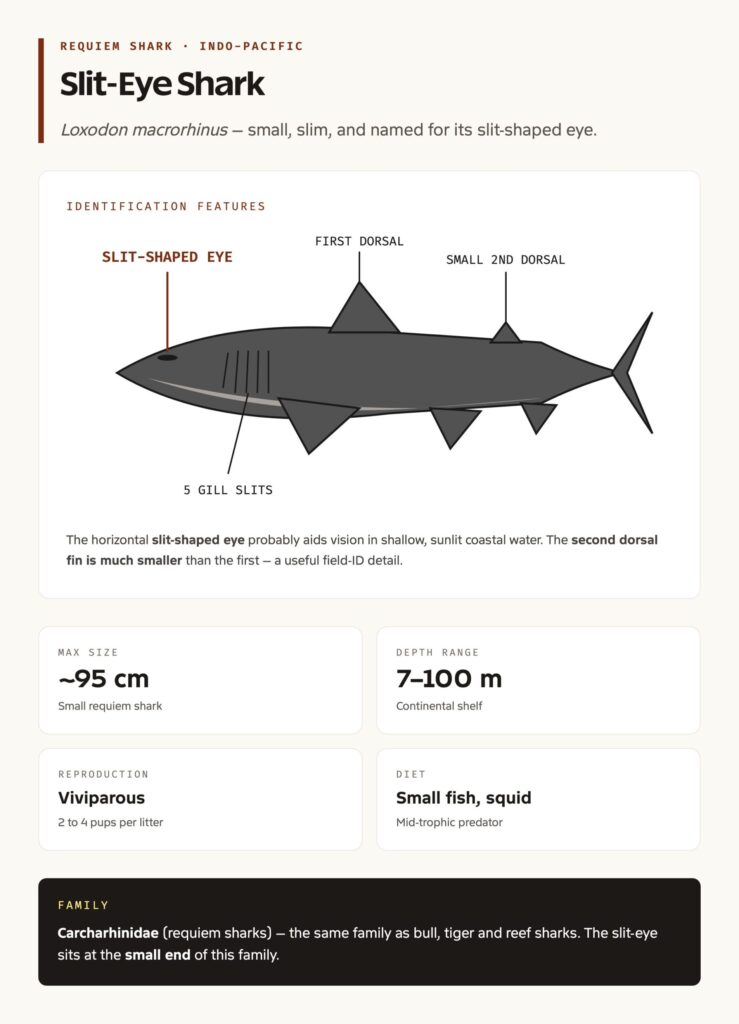
- Maximum length: About 95 to 100 cm
- Habitat: Coastal and continental shelf waters, typically 7 to 100 metres deep
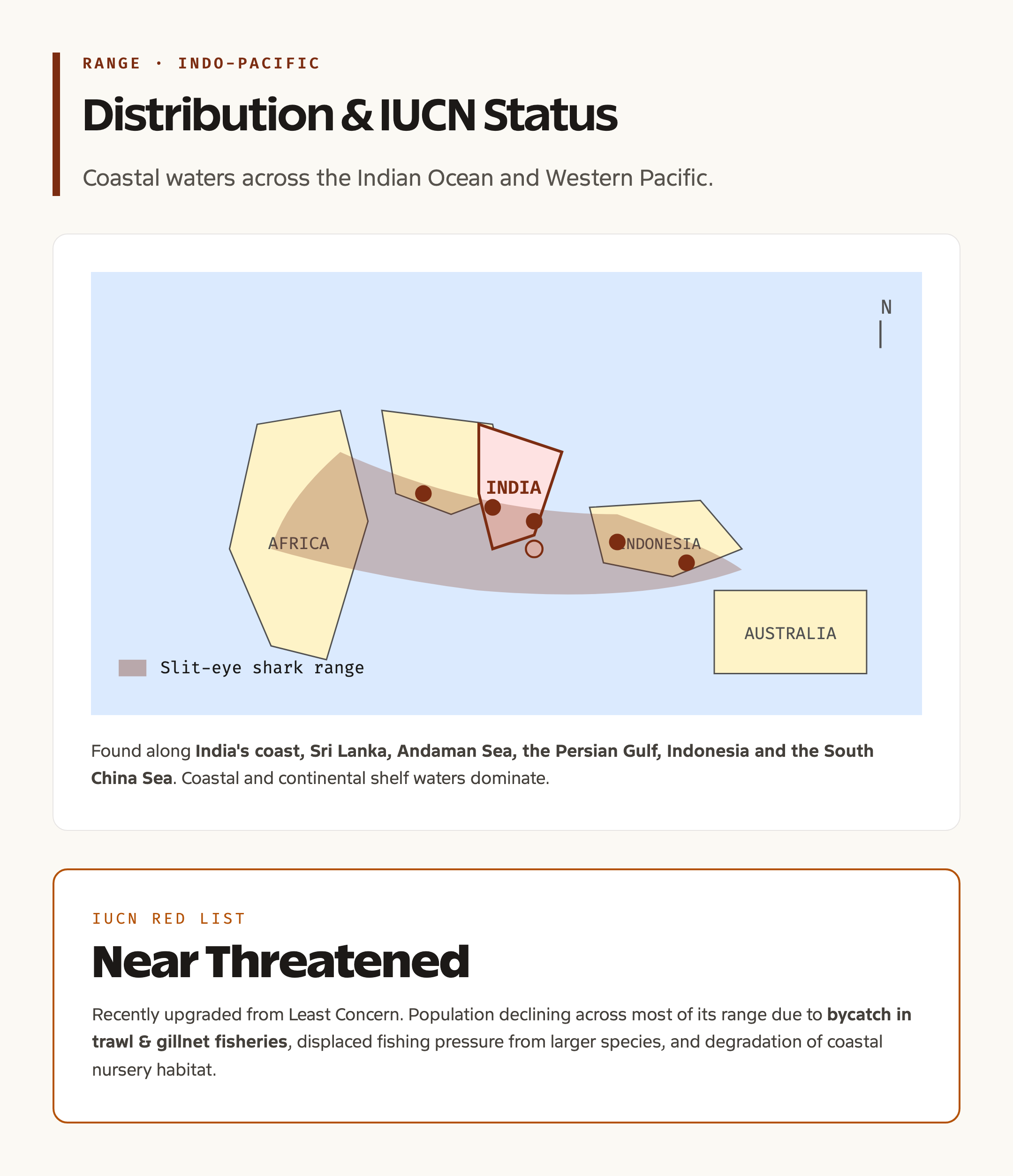
- Range: Indian Ocean and Western Pacific, including the Indian coast, Sri Lanka, the Andaman Sea, the Persian Gulf, Indonesia, and the South China Sea
- Diet: Small bony fish, cephalopods (squid and octopus), and crustaceans
- Reproduction: Viviparous (placental); typically 2 to 4 pups per litter
- IUCN Red List: Near Threatened
- CITES listing: Not currently listed (unlike whale sharks and oceanic whitetips)
- India’s relevance: Caught as bycatch in coastal trawl and gillnet fisheries; not specifically protected under WPA Schedules
What Is the Slit-Eye Shark
The slit-eye shark is a small member of the requiem shark family, the same family that includes the more famous tiger sharks, bull sharks, and reef sharks. Unlike its larger relatives, Loxodon macrorhinus is at the small end of the size spectrum. Adults rarely exceed a metre. Their bodies are slim and torpedo-shaped, well adapted for fast manoeuvring in shallow water rather than long open-ocean cruising.
The most distinctive feature is in the name. The eye opening is elongated horizontally into a narrow slit, which most likely improves vision in horizontally streaming light environments such as shallow coastal waters where sunlight refracts heavily across the surface. The snout is long, the body grey-brown with a paler belly, and the second dorsal fin is much smaller than the first.
Their ecological role is that of a mid-tier coastal predator. They eat small fish like sardines and anchovies, small squid, and crustaceans. In return they are prey for larger sharks, marine mammals, and increasingly for human nets. As small viviparous (placental) sharks, they have low reproductive output: a typical litter is just two to four pups, born after a gestation that may last a year. This biology makes them extremely vulnerable to fishing pressure. Once a population is depleted, recovery is slow and uncertain.
Background and Historical Context
The slit-eye shark was first formally described in the nineteenth century, but for most of the twentieth century it was lumped together with other small requiem sharks in regional catch statistics. Indian and Sri Lankan fishery records typically reported “small sharks” as a single category until the late 1990s, when species-level recording began under FAO guidance and the IUCN Shark Specialist Group’s regional assessments.
Globally, sharks moved up the conservation agenda in the 1990s. The collapse of several oceanic shark populations, driven by the soaring demand for shark fin in East Asian markets, prompted the FAO International Plan of Action for the Conservation and Management of Sharks (IPOA-Sharks) in 1999. Countries with large shark fisheries, including India, were urged to develop National Plans of Action. India released its NPOA-Sharks in 2014.
The slit-eye shark’s trajectory has tracked this larger pattern. Its IUCN status was upgraded from Least Concern to Near Threatened in the 2020s, reflecting accumulating evidence of population decline across most of its range, especially in the Western Indian Ocean and the South China Sea. The species is still locally common in some Indian coastal waters, but landings data show falling catch-per-unit-effort in several states.
Sharks Found in Indian Waters
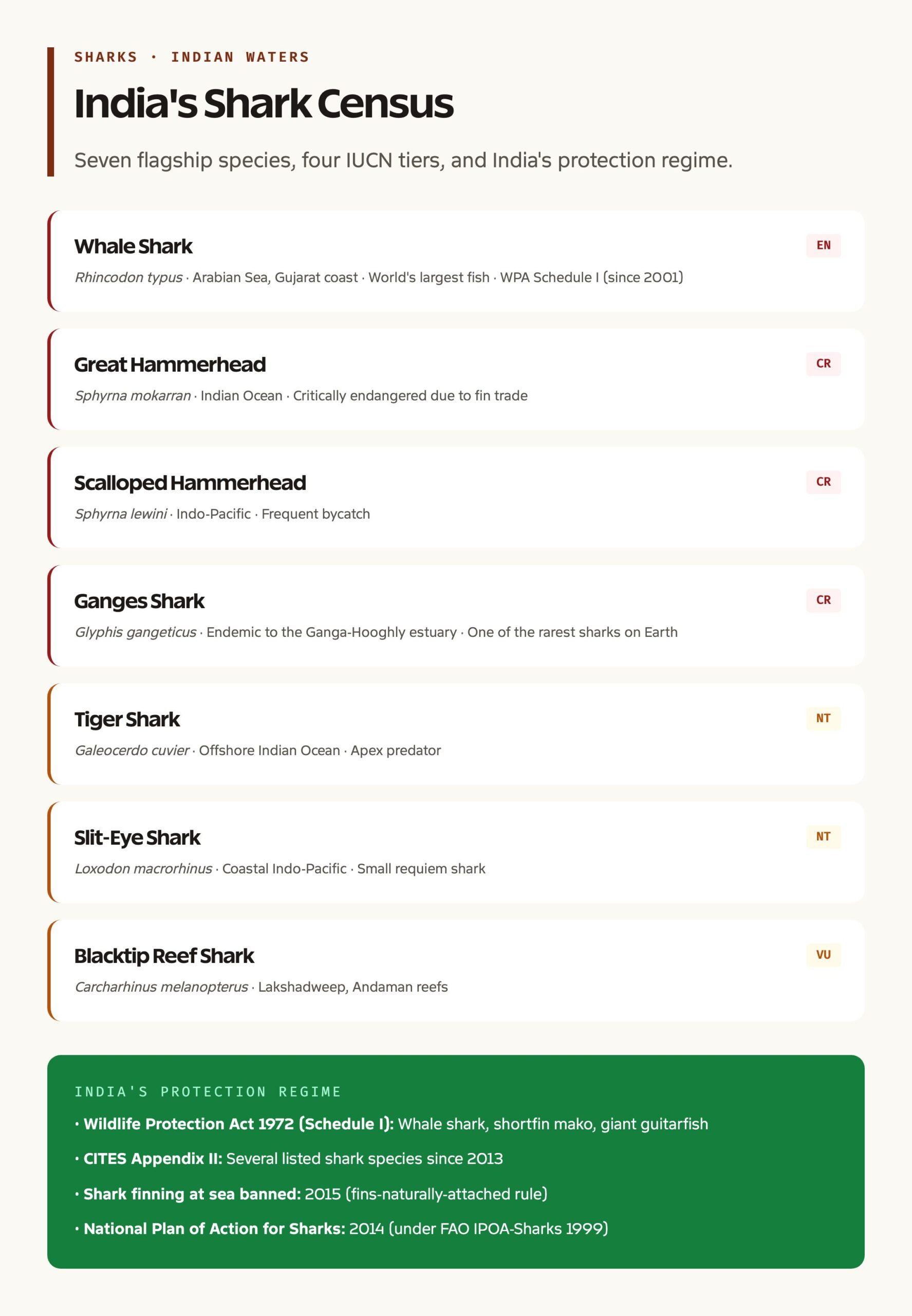
India’s marine biodiversity includes more than 110 species of sharks and rays. Several are now flagship conservation species. The whale shark (Rhincodon typus), the world’s largest fish, is found primarily off the Gujarat coast and is Endangered under IUCN. The great hammerhead (Sphyrna mokarran) and scalloped hammerhead (Sphyrna lewini) are Critically Endangered, primarily because of fin trade pressure. The Ganges shark (Glyphis gangeticus), one of the rarest sharks in the world, is endemic to the Ganga-Hooghly estuary and is also Critically Endangered.
The blacktip reef shark (Carcharhinus melanopterus) is associated with the coral reefs of Lakshadweep and the Andamans, classified as Near Threatened. The tiger shark (Galeocerdo cuvier) ranges across the offshore Indian Ocean and is also Near Threatened. The bull shark (Carcharhinus leucas) is uniquely tolerant of freshwater and has been recorded in the Hooghly and Mahanadi rivers. The slit-eye shark sits in this same ecological tier as the smaller, coastal, fast-reproducing species, but with the same vulnerability profile because of incidental capture.
Key Provisions: Shark Protection in India
India’s framework for shark protection rests on three pillars. The first is the Wildlife Protection Act, 1972, which lists certain sharks and rays in Schedule I, the highest protection category. The whale shark was added to Schedule I in 2001. The shortfin mako, the giant guitarfish, and several others have been added in subsequent amendments. Sharks listed in Schedule I cannot be hunted, traded, or possessed.
The second pillar is CITES, the Convention on International Trade in Endangered Species, to which India is a party. Several shark species have been listed in CITES Appendix II since 2013, requiring documented sustainable trade. India has aligned its export controls with CITES rulings.
The third pillar is fisheries management. The Department of Fisheries under the Ministry of Fisheries, Animal Husbandry, and Dairying issues advisories and regulations on shark catch, particularly the prohibition of shark finning at sea (2015) and the requirement that sharks be landed with fins naturally attached. The Marine Fisheries Regulation Acts of coastal states impose seasonal closures and gear restrictions that indirectly protect sharks.
The slit-eye shark itself is not on Schedule I and is not separately listed under CITES. Its protection therefore depends on the broader fisheries regulatory framework, which is uneven in implementation across states.
Why It Matters
Sharks like the slit-eye are essential to the structural integrity of coastal ecosystems. As mid-trophic predators, they regulate populations of small bony fish and squid. When shark numbers fall, prey populations can explode in unpredictable ways, sometimes triggering cascades that hit commercial fisheries down the line. The classic example is the collapse of bay scallop fisheries on the US East Coast after large coastal sharks were depleted, which freed cownose rays to consume the scallops in massive numbers.
In Indian waters, the slit-eye shark and its close relatives have a similar but understudied role. Their decline could affect the dynamics of small-pelagic fisheries that millions of artisanal fishers depend on. The economic logic and the ecological logic point in the same direction: maintaining shark populations is a prerequisite for stable coastal fisheries.
There is also a global biodiversity argument. The Indo-Pacific is one of the world’s richest marine regions, and India shares this biological inheritance. Loss of shark species is a permanent loss of evolutionary lineage that has been refining itself for over 400 million years.
Detailed Analysis: Threats and Population Trends
The principal threat to the slit-eye shark is bycatch. Coastal trawl fisheries targeting prawns and small bony fish routinely catch slit-eye sharks as a non-target species. Gillnet fisheries off the Indian coast also take significant numbers. Artisanal hook-and-line fisheries are less destructive but still contribute to the total catch.
A second pressure is targeted small-shark fisheries that have grown in some states as larger species have declined. Once whale sharks, hammerheads, and oceanic whitetips became scarce or protected, fishing effort shifted toward the smaller and unprotected species. The slit-eye shark is one of the species that absorbed this displaced fishing pressure.
Habitat degradation matters too. The slit-eye shark prefers shallow shelf waters, often near mangroves and estuaries. The widespread loss of mangrove ecosystems along the Indian coast, particularly in Gujarat, Tamil Nadu, and the Sundarbans periphery, has reduced the nursery habitat available for juvenile sharks of many species.
Climate change adds a long-term layer. Ocean warming is shifting the distribution of small pelagic prey. The acidification of surface waters affects the biological cues that sharks use for navigation and reproduction. These pressures, layered onto direct fishing mortality, push the population trajectory in one direction.
Comparative Perspective: Slit-Eye Shark vs Other Indian Shark Species
| Shark Species | Scientific Name | Habitat / Indian Region | IUCN Status | Notable feature |
|---|---|---|---|---|
| Slit-eye shark | Loxodon macrorhinus | Indo-Pacific coastal waters | Near Threatened | Small, slit-shaped eye |
| Whale shark | Rhincodon typus | Arabian Sea, Gujarat coast | Endangered | World’s largest fish; WPA Schedule I |
| Great hammerhead | Sphyrna mokarran | Indian Ocean (coastal & offshore) | Critically Endangered | Heavy fin trade pressure |
| Scalloped hammerhead | Sphyrna lewini | Indo-Pacific, Indian coast | Critically Endangered | Common bycatch species |
| Blacktip reef shark | Carcharhinus melanopterus | Coral reefs (Lakshadweep, Andaman) | Vulnerable | Reef-associated |
| Tiger shark | Galeocerdo cuvier | Offshore Indian Ocean | Near Threatened | Apex predator |
| Ganges shark | Glyphis gangeticus | Ganga-Hooghly estuary | Critically Endangered | Endemic; one of the rarest sharks |
The comparison shows that the slit-eye shark is far from the most threatened species in Indian waters, but its vulnerability is rising. Its smaller size and lower commercial value historically afforded it some protection through neglect. That cushion is shrinking as fishing effort shifts.
Challenges in Conservation
The first challenge is data. India’s shark fisheries data are still patchy by species. Landings statistics often aggregate small sharks together, making species-level population trends hard to track. The Central Marine Fisheries Research Institute has improved species-level monitoring at major landing centres, but coverage is far from comprehensive.
The second challenge is enforcement. Shark finning at sea is banned, but inspection capacity at landing centres is limited. Shark fins continue to be exported from India, mostly to Hong Kong and Singapore, often through trans-shipment routes that are hard to audit.
The third challenge is the economic dependence of artisanal fishers on shark catch. For many small-scale operators, sharks are a significant component of household income. Conservation measures that simply ban catch without offering livelihood alternatives are politically and ethically problematic.
Prelims Pointers
- The slit-eye shark’s scientific name is Loxodon macrorhinus
- It belongs to the Carcharhinidae family (requiem sharks)
- Found in the Indian Ocean and Western Pacific
- IUCN Red List status: Near Threatened
- The whale shark is Endangered and protected under WPA Schedule I in India (added 2001)
- The Ganges shark is Critically Endangered and endemic to the Ganga-Hooghly estuary
- The Great Hammerhead and Scalloped Hammerhead are both Critically Endangered
- India released its National Plan of Action for Sharks in 2014 (under FAO IPOA-Sharks 1999)
- Shark finning at sea is banned in India (2015)
- Several sharks are listed in CITES Appendix II (regulated trade)
Mains Practice Questions
- Discuss the threats faced by sharks in Indian waters and evaluate the adequacy of the regulatory regime under the Wildlife Protection Act and CITES. (250 words)
- Explain the ecological role of mid-trophic shark species and analyse the impact of their decline on coastal fisheries. (150 words)
- Examine the role of habitat protection — particularly mangroves and estuaries — in shark conservation along the Indian coastline. (150 words)
- Discuss the relationship between artisanal fisheries livelihoods and marine biodiversity conservation, with reference to small-shark species in Indian waters. (250 words)
Way Forward
A species-level monitoring system is the first priority. Landings data must be disaggregated to species level at major centres, with verification at smaller landing points through systematic sampling. The Central Marine Fisheries Research Institute is the natural lead agency, in partnership with state fisheries departments.
Listing reviews under WPA and CITES should be scientifically driven and revisited periodically. The slit-eye shark may not warrant Schedule I status, but a precautionary lower-tier listing could be considered if monitoring confirms continued decline.
Ecosystem-based fisheries management is the broader frame. Closed seasons, gear restrictions, and marine protected areas should be designed to protect shark nursery grounds, not just commercial target species. Mangrove restoration in the Gujarat, Tamil Nadu, and Andhra coasts directly supports juvenile shark survival.
Livelihood transitions are the human side of the story. Artisanal fishers should have access to alternative livelihoods, value-added fisheries products, and sustainable certification schemes that pay a premium for non-shark catch. The Pradhan Mantri Matsya Sampada Yojana provides one channel for this.
Frequently Asked Questions
What is a slit-eye shark?
The slit-eye shark, Loxodon macrorhinus, is a small requiem shark of the Indo-Pacific characterised by an elongated horizontal slit-shaped eye. It rarely exceeds one metre in length and is a coastal predator that feeds on small fish, squid, and crustaceans.
Where is the slit-eye shark found?
The slit-eye shark is distributed across the Indian Ocean and the Western Pacific, including coastal waters of India, Sri Lanka, the Andaman Sea, the Persian Gulf, Indonesia, and the South China Sea.
What is the IUCN status of the slit-eye shark?
The slit-eye shark is listed as Near Threatened on the IUCN Red List, reflecting evidence of population decline across much of its range due to fishing pressure and habitat loss.
Is the slit-eye shark protected in India?
The slit-eye shark is not specifically listed under any schedule of the Wildlife (Protection) Act, 1972, nor is it on a CITES appendix. Its protection depends on broader fisheries management measures, including the ban on shark finning at sea.
Which sharks are protected under Schedule I of the Wildlife Protection Act?
The whale shark was added to Schedule I in 2001. Several other sharks and rays, including the shortfin mako and giant guitarfish, have been added in subsequent amendments. Schedule I species cannot be hunted, traded, or possessed.
What is the rarest shark in Indian waters?
The Ganges shark (Glyphis gangeticus) is endemic to the Ganga-Hooghly estuary and is one of the rarest sharks in the world, listed as Critically Endangered on the IUCN Red List.
What is shark finning, and is it legal in India?
Shark finning is the practice of cutting fins off a shark and discarding the body at sea. It has been prohibited in India since 2015. Sharks must be landed with fins naturally attached, allowing species-level monitoring of the catch.
What is the National Plan of Action for Sharks (NPOA-Sharks)?
India released its NPOA-Sharks in 2014 under the framework of the FAO International Plan of Action for the Conservation and Management of Sharks (IPOA-Sharks, 1999). It outlines measures for monitoring, regulation, and habitat protection.
Why are sharks ecologically important?
Sharks regulate prey populations as mid- and apex predators. Their decline can trigger cascading effects, including the collapse of commercial fisheries through trophic imbalance.
How does climate change affect sharks?
Ocean warming shifts the distribution of prey species, ocean acidification disrupts navigation and reproduction cues, and habitat degradation in warming coastal waters reduces nursery areas for juvenile sharks.
Tell Google you want more of this.
Add Anantam IAS as a preferred sourceOne tap, and this site shows up more often in your own Top Stories, AI Overviews and AI Mode. Remove it any time.