The Speaker of Lok Sabha is the constitutional head of the lower House of Indian Parliament — its presiding officer, its arbiter, and the guardian of its rules. Articles 93 to 97 of the Constitution lay out the office: how the Speaker is elected, how the Deputy Speaker takes over, how vacancies are filled, and what happens when the Speaker is herself a candidate for removal. The Speaker of Lok Sabha is not just a chairperson — she decides which questions are admissible, certifies whether a bill is a Money Bill, adjudicates disqualification petitions under the Anti-Defection Law, and casts the decisive vote when the House is tied (Article 100).
For UPSC Polity, the Speaker of Lok Sabha is a recurring high-yield topic. This guide walks through the constitutional articles, the election process, the full range of powers, the Pro Tem Speaker, and the notable Speakers from G.V. Mavalankar in 1952 to Om Birla in the 17th and 18th Lok Sabhas.
Constitutional Basis: Articles 93–97
Five articles govern the office:
- Article 93: The House of the People shall, as soon as may be, choose two members of the House to be the Speaker and Deputy Speaker.
- Article 94: Vacation of office — by ceasing to be a member, by resignation, or by removal through a resolution passed by a majority of “all the then members” of the House.
- Article 95: When the office of Speaker is vacant, the Deputy Speaker performs the duties. When both are vacant, the President appoints a member to act as Speaker.
- Article 96: The Speaker shall not preside when a resolution for her own removal is under consideration. She has the right to speak in and otherwise take part in the proceedings, and can vote in the first instance — but not in the case of an equality of votes on such a resolution.
- Article 97: Salaries and allowances of the Speaker and Deputy Speaker are charged on the Consolidated Fund of India — meaning they are non-votable, a guarantee of independence.
Election of the Speaker
The Speaker of Lok Sabha is elected by the Lok Sabha from amongst its members. The election is held as soon as may be after the first sitting of a new Lok Sabha. The President fixes the date and the Secretary-General conducts the election. Election is by simple majority of members present and voting.
In practice, the Speaker is almost always from the ruling party or coalition. By healthy convention, the ruling side proposes the Speaker and the Opposition is offered the Deputy Speaker — though the Deputy Speaker post has been vacant for the entire 17th Lok Sabha (2019–24) and remains vacant in the 18th Lok Sabha at the time of writing.
Term
The Speaker holds office from election until immediately before the first meeting of the new Lok Sabha after a general election. So a Speaker’s term is co-terminus with the House, with the practical wrinkle that she continues until the new Speaker is elected.
Removal
Under Article 94, the Speaker can be removed by a resolution passed by a majority of all the then members of the Lok Sabha — an absolute majority, not a special one. Fourteen days’ notice is required. No Speaker has ever been removed; only Speaker G.V. Mavalankar faced a removal motion that was withdrawn, and Speaker P.A. Sangma faced procedural pressure but no formal removal.
Powers of the Speaker
The Speaker of Lok Sabha carries a sprawling list of powers. They fall into five families.
1. Presiding Powers
- Presides over House sittings, maintains order, and decides questions of order.
- Admits or disallows questions, motions, resolutions, adjournment motions.
- Suspends or adjourns the House.
- Disciplines members — can order withdrawal, name members for grossly disorderly conduct (Rule 374A), and refer to the Privileges Committee.
2. Money Bill Certification (Article 110)
The Speaker of Lok Sabha certifies whether a bill is a Money Bill under Article 110(3). This is one of the most powerful — and most contested — Speaker powers. Once the Speaker certifies a bill as a Money Bill:
- Rajya Sabha can only make recommendations, which Lok Sabha may accept or reject.
- The bill cannot be sent to a Joint Sitting.
- Judicial review of the Speaker’s certification was held permissible only in narrow limits in Justice K.S. Puttaswamy v. Union of India (Aadhaar, 2018) and Rojer Mathew v. South Indian Bank (2019).
The Aadhaar Act 2016 and the Finance Acts of 2017–19 were passed as Money Bills, drawing criticism that the Speaker was effectively bypassing Rajya Sabha. See the money-bill-vs-finance-bill distinction.
3. Anti-Defection Adjudication
Under Paragraph 6 of the Tenth Schedule, the Speaker is the sole authority to decide defection disqualification petitions. The Supreme Court in Kihoto Hollohan (1992) held this decision is subject to judicial review on limited grounds, and in Keisham Meghachandra Singh (2020) directed that petitions be decided within a reasonable period — usually three months. The Speaker’s neutrality in this role remains a live debate.
4. Business and Committee Powers
- Chairs the Business Advisory Committee (allocates time).
- Chairs the General Purposes Committee and the Rules Committee.
- Nominates members to all Standing and most Ad-hoc Committees of the Lok Sabha.
- Appoints chairs of all Parliamentary Committees except those that elect their own.
- Presides over the Joint Sitting of both Houses convened under Article 108 to resolve deadlock on ordinary bills.
5. Casting Vote — Article 100
The Speaker does not vote in the first instance — she only casts a vote in the case of an equality of votes (a tie). This “casting vote” is decisive and is a deliberate design to keep the chair neutral while reserving the power to break a deadlock.
Pro Tem Speaker — Article 95(1) Read with Practice
The Pro Tem Speaker is the temporary presiding officer of the new Lok Sabha, appointed by the President under the practice flowing from Article 95(1). The Pro Tem is usually the senior-most member of the new House and is sworn in by the President. His two functions:
- Administer the oath to newly elected members.
- Preside over the election of the new Speaker.
Once the new Speaker is elected, the Pro Tem Speaker’s office ends. In the 18th Lok Sabha (2024), Bhartruhari Mahtab was appointed Pro Tem Speaker — a politically contested choice because by seniority the post should have gone to Kodikunnil Suresh.
Deputy Speaker
Under Article 93, the Lok Sabha elects a Deputy Speaker from its members. The Deputy Speaker presides when the Speaker is absent and exercises all the Speaker’s powers in such situations. The Deputy Speaker is removed and resigns the same way as the Speaker. By convention, the Deputy Speaker post goes to the Opposition — though this convention has lapsed since 2019.
Notable Speakers of Lok Sabha
G.V. Mavalankar (1952–1956)
The first Speaker of Lok Sabha and the architect of parliamentary procedure in independent India. Mavalankar had presided over the Constituent Assembly (Legislative) and brought continuity. His rulings on procedure form the foundation of the Practice and Procedure of Parliament (the “Mavalankar Manual”). Died in office in 1956.
M.A. Ayyangar (1956–1962)
Took over from Mavalankar; later elected Speaker in his own right.
N. Sanjiva Reddy (1967–1969, 1977)
The only Speaker to later become President of India. His tenure introduced the convention of the Speaker resigning from the parent party.
G.S. Dhillon (1969–1975)
Presided through the politically tumultuous pre-Emergency years.
Balram Jakhar (1980–1989)
Longest-serving Speaker — two full terms.
Rabi Ray (1989–1991)
Introduced Zero Hour reforms and pushed for committee reforms that led to the 1993 DRSC system.
Shivraj Patil (1991–1996)
Presided over the introduction of the 24 Departmentally Related Standing Committees in 1993 — one of the most consequential parliamentary reforms in independent India. See Parliamentary Committees in India.
P.A. Sangma (1996–1998)
First tribal Speaker of Lok Sabha.
G.M.C. Balayogi (1998–2002)
First Dalit Speaker; died in office in a helicopter crash.
Manohar Joshi (2002–2004)
Former CM of Maharashtra; presided through NDA-I to NDA-I closure.
Somnath Chatterjee (2004–2009)
Only CPI(M) Speaker; expelled from his party for refusing to resign during the 2008 confidence vote — a celebrated example of Speaker independence.
Meira Kumar (2009–2014)
First woman Speaker of Lok Sabha; daughter of Jagjivan Ram.
Sumitra Mahajan (2014–2019)
Second woman Speaker; longest-serving in the BJP era until then.
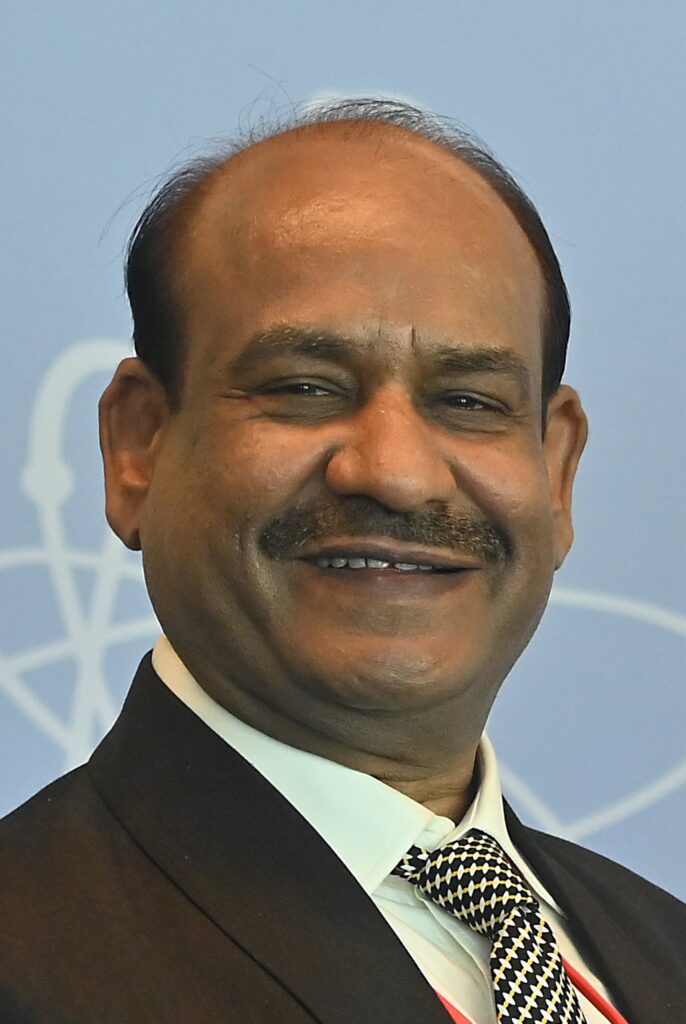
Om Birla (2019–2024, 2024–present)
Speaker through the 17th and now 18th Lok Sabha. Presided over the move to the new Parliament building in 2023, the suspension of 146 Opposition MPs in December 2023, and the rollout of Sansad Bhashini AI translation.
Independence and Conventions
The independence of the Speaker of Lok Sabha rests on a mix of constitutional design and convention:
- Salary charged on Consolidated Fund (Article 97).
- Cannot be removed except by absolute majority (Article 94).
- Resigns from parent party (Indian convention, inconsistently followed).
- Casting vote, not first vote (Article 100).
- Final on most procedural questions; judicial review limited to constitutional questions.
The British convention of the Speaker being re-elected unopposed regardless of which party is in power has not taken root in India. The result is that the Speaker, while constitutionally protected, remains politically attached to the ruling party — a structural strain that drives most debates about Money Bill certification and anti-defection adjudication.
Frequently Asked Questions
Under which articles is the Speaker of Lok Sabha governed?
Articles 93 to 97 of the Constitution govern the Speaker of Lok Sabha: election (93), vacation/removal (94), Deputy Speaker and acting Speaker (95), restriction on presiding when own removal is considered (96), and salaries charged on Consolidated Fund (97).
How is the Speaker of Lok Sabha elected?
The Speaker of Lok Sabha is elected by members of the Lok Sabha from amongst themselves, by simple majority of those present and voting, soon after the first sitting of a new Lok Sabha. The election is presided over by the Pro Tem Speaker.
What is the casting vote of the Speaker?
Under Article 100, the Speaker does not vote in the first instance but exercises a casting vote in the case of equality of votes — i.e., to break a tie. This keeps the chair neutral on most votes while preserving the power to resolve deadlock.
What is the Speaker’s role in Money Bill certification?
Under Article 110(3), the Speaker of Lok Sabha certifies whether a bill is a Money Bill. The certificate is conclusive in most respects, although the Supreme Court has held in Puttaswamy (2018) and Rojer Mathew (2019) that the certification is subject to limited judicial review.
Who appoints the Pro Tem Speaker?
The Pro Tem Speaker is appointed by the President of India at the start of a new Lok Sabha, traditionally the senior-most member of the new House. The Pro Tem administers oaths to new MPs and presides over the election of the new Speaker.
Who was the first Speaker of Lok Sabha?
G.V. Mavalankar was the first Speaker of Lok Sabha, elected in 1952. He had earlier presided over the Constituent Assembly (Legislative) and shaped foundational parliamentary procedure in independent India.
Can the Speaker be removed?
Yes. Under Article 94, the Speaker can be removed by a resolution of the Lok Sabha passed by a majority of all the then members of the House, after fourteen days’ notice. No Speaker has ever been removed through this process.
Who is the current Speaker of Lok Sabha?
Om Birla, MP from Kota (Rajasthan), is the current Speaker of Lok Sabha. He was first elected Speaker for the 17th Lok Sabha in June 2019 and re-elected for the 18th Lok Sabha in June 2024.
Tell Google you want more of this.
Add Anantam IAS as a preferred sourceOne tap, and this site shows up more often in your own Top Stories, AI Overviews and AI Mode. Remove it any time.