In September 2025, about 600 gigabytes of files spilled onto the open web from a Chinese company most people had never heard of. They were the blueprints of the Great Firewall — the machinery China uses to wall its 1.1 billion users off from the global internet — and they showed something newer and more unsettling than domestic censorship. The same filtering kit was being sold abroad, to Kazakhstan, Pakistan, Ethiopia and Myanmar, as a product: censorship in a box. A few months later, on 1 March 2026, a Russian decree came into force giving regulators the legal power to reroute the country’s traffic in real time and, if Moscow chooses, to cut its “RuNet” off from the rest of the world entirely. Two events, one direction of travel. The single, seamless internet that a generation grew up treating as a fact of nature is coming apart at the seams.
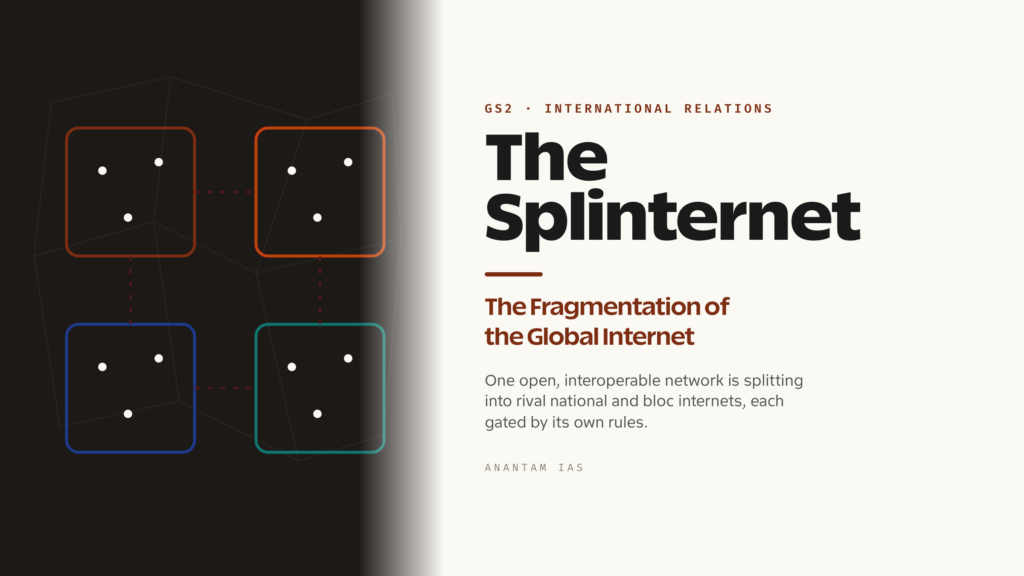
That breakup has a name — the splinternet — and it has quietly become one of the most important stories in international relations and technology governance. The word stitches together “splinter” and “internet,” and it describes the fragmentation of one open, global, interoperable network into many separate internets, each fenced off and governed by its own rules, values and access controls. For India, this is not a distant Western worry. It sits at the crossroads of GS2’s international-relations and governance syllabus — sovereignty, global commons, the digital economy, free speech and the regulation of Big Tech all run through it — and India is one of the few powers actively trying to chart a course between the open internet and the walled one. So it rewards an aspirant who can explain not just what the splinternet is, but why it is happening and where India stands inside it.
What the Splinternet Is and Why It’s Happening
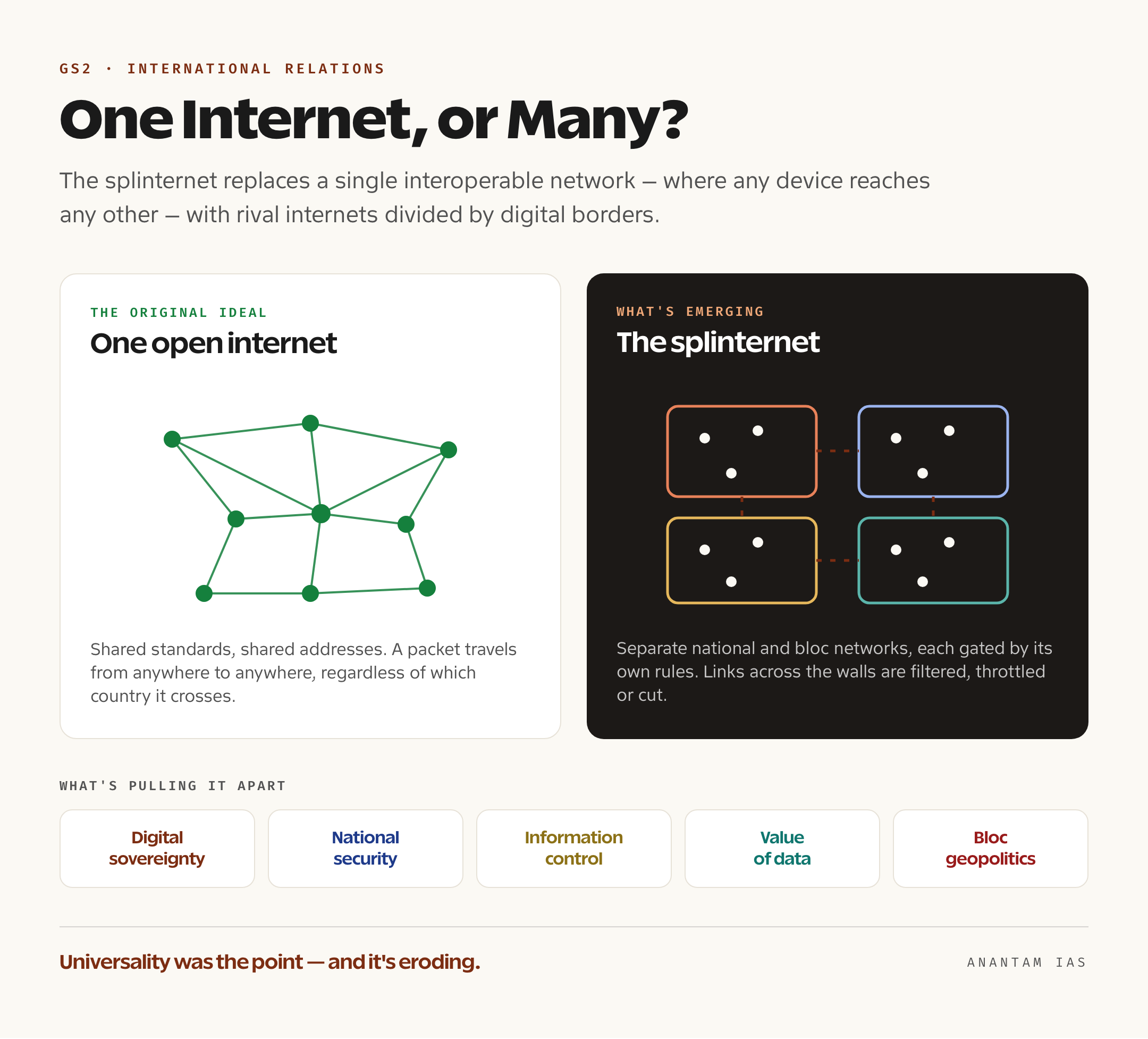
Start with what the internet was designed to be, because the splinternet is best understood as its negative. The internet was built as a single network of networks held together by shared, open standards — the same addressing system, the same domain names, the same protocols — so that a packet of data could travel from any device to any other regardless of which country, company or cable it passed through. Nobody owned it; a loose set of technical bodies kept it interoperable. That universality was the whole point, and it is exactly what is now eroding. A splinternet emerges when states, blocs or even companies erect barriers — technical, legal or commercial — that break this universality, so that what you can see, reach and do online depends on which side of a digital border you happen to be standing.
It helps to separate the layers where this fracture happens. At the deepest level is technical fragmentation — splits in the plumbing itself, like rival systems of internet addresses or a country routing its traffic through state-controlled chokepoints. Above that is governmental fragmentation — the censorship, blocking, shutdowns and data rules a state imposes within its borders, which is by far the most common form today. And at the top is commercial fragmentation — when private platforms and app stores carve the experience into regional walled gardens. Most of what people mean by “the splinternet” lives in that middle layer: the deliberate use of state power to decide what its citizens may access.
So why is it happening now, after three decades of an internet that mostly ignored borders? Several forces are pulling in the same direction at once. The first is digital sovereignty — the idea that a nation should control the data, infrastructure and information flows inside its territory just as it controls its land and airspace, rather than leaving them to foreign companies or a borderless commons. The second is national security, sharpened by fears of cyberattacks, foreign surveillance and the weaponisation of platforms. The third is information control — governments wanting to police speech, suppress dissent or block content they deem unlawful or destabilising. The fourth is the economic logic of data: as one of our companion pieces on data as a factor of production explains, data is now a strategic resource, and countries increasingly want it stored and processed at home. And underneath all of it is geopolitics — a world dividing into rival blocs whose mutual distrust now extends to the wires and code that connect them. Different societies simply hold different values about privacy, speech and the state’s role, and the internet, once it became the place where those values are contested, could not stay neutral.
The Four Models: How the Internet Is Splitting Into Blocs
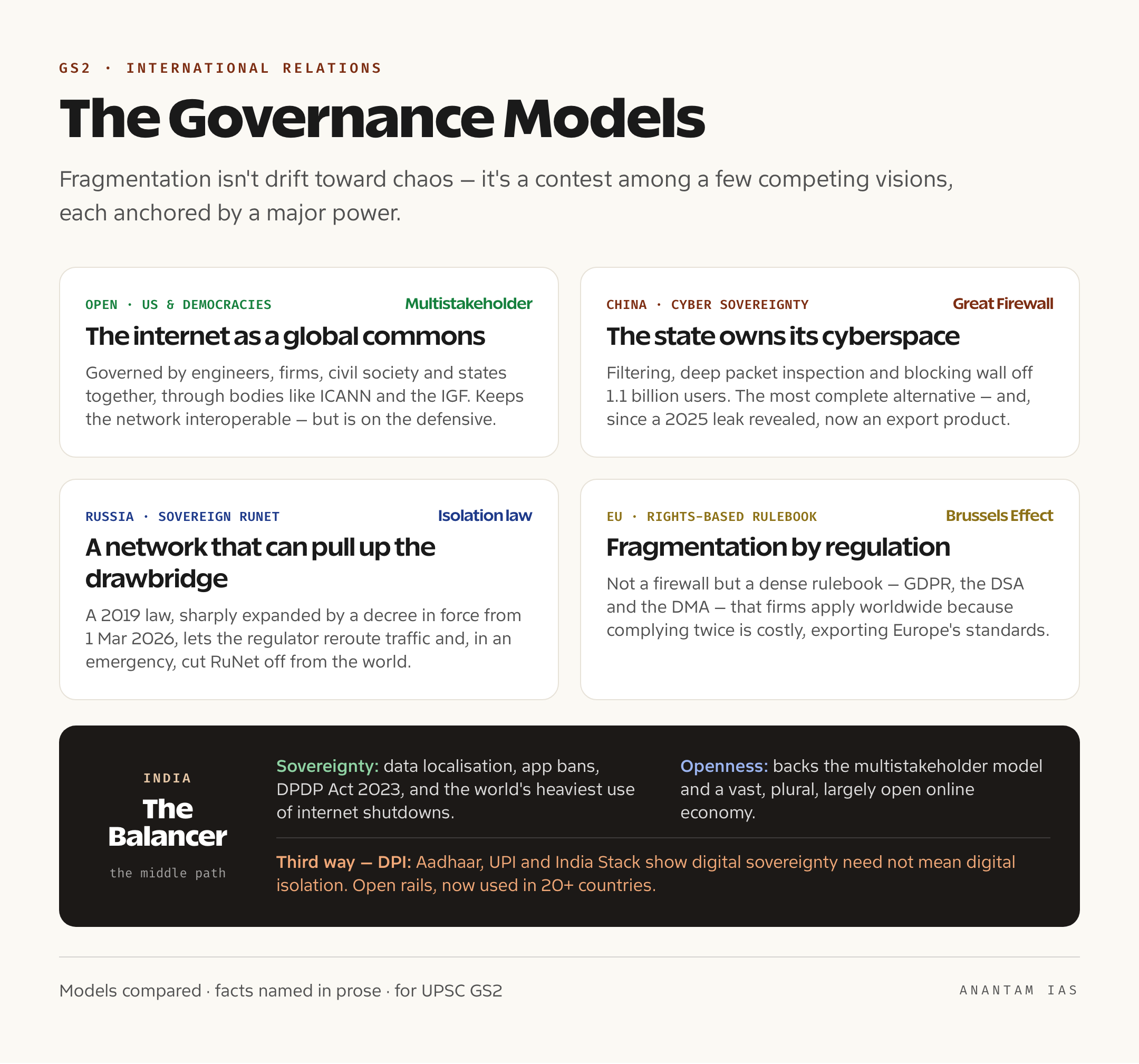
The cleanest way to grasp fragmentation is to see that the world is not drifting toward chaos but toward a handful of competing internet models, each anchored by a major power. The first is the open, multistakeholder model historically championed by the United States and much of the democratic world. Here the internet is treated as a global commons, governed not by governments alone but by a mix of engineers, companies, civil society and states working through technical bodies — the model that built the network and still, for now, keeps it interoperable. Its weakness is that it is increasingly on the defensive, struggling to answer states that see openness as a vulnerability.
The second model is China’s, and it is the most fully realised alternative. Beijing’s doctrine of cyber sovereignty holds that each state has the absolute right to govern its slice of cyberspace as it governs its territory — to decide what enters, what leaves and what its citizens may see. The instrument is the Great Firewall, a vast apparatus of filtering, deep packet inspection and blocking that screens out thousands of foreign sites and services and forces Chinese users onto domestic platforms instead. What the 2025 leak revealed is that this is no longer just a domestic wall — Chinese firms are now exporting the technology and the playbook to other governments, helping build a federated archipelago of state-controlled networks. The third model is Russia’s, which has been racing to catch up. Its “sovereign internet” law, first passed in 2019 and sharply expanded by a decree that took effect on 1 March 2026, requires operators to install state monitoring equipment and gives the regulator Roskomnadzor — working with the security services — legal authority to reroute traffic and, in an emergency, isolate RuNet from the global internet altogether. Moscow has tightened the architecture so that a handful of state-tied providers control most of the country’s addresses, the technical groundwork for pulling up the drawbridge.
The fourth model is the European Union’s, and it is different in kind. The EU is not trying to wall off its internet; it is trying to tame it through a dense rulebook rooted in rights — the General Data Protection Regulation (GDPR) on privacy, the Digital Services Act (DSA) on illegal content and platform accountability, and the Digital Markets Act (DMA) on the power of the biggest gatekeepers. This is fragmentation by regulation rather than by firewall, and it has a global reach often called the “Brussels Effect”: because complying separately is expensive, companies tend to apply Europe’s strict standards everywhere, exporting the rules well beyond the bloc. Around and between these poles sits a fifth, looser camp — a Global-South middle path that many developing countries, India prominent among them, are trying to define: digital sovereignty without digital isolation, control over one’s own data and infrastructure without sealing off the network or surrendering an open society.
The Mechanisms: How a Single Network Gets Cut Into Pieces
Fragmentation is not an abstraction; it runs on specific, identifiable tools, and naming them is what turns a vague answer into a sharp one. The most visible is the firewall — a national filtering system, like China’s, that inspects traffic and blocks whatever the state disallows, increasingly using deep packet inspection and machine learning to catch even the VPNs people use to climb over the wall. The bluntest tool is the internet shutdown — switching off mobile data or connectivity for a region or the whole country, usually during protests, exam periods or unrest. India is the world’s heaviest user of this instrument: by the count of the digital-rights group Access Now and its KeepItOn coalition, India imposed 84 shutdowns in 2024 and another 65 in 2025, year after year among the highest tallies on earth, with Manipur, Haryana and Jammu and Kashmir leading the count.
A third mechanism is the app ban — barring specific foreign applications on security or sovereignty grounds, as India did when it blocked TikTok and dozens of other Chinese apps in 2020, and as the United States has wrestled with over the same app since. A fourth, quieter but structurally deeper, is data localisation — the legal requirement that data about a country’s citizens be stored, and sometimes processed, on servers inside its borders. This is fragmentation by law rather than by firewall: it gives governments oversight and a measure of control, and it nudges the internet toward national data silos. India’s data-protection regime, which we cover in detail in our explainer on the DPDP Act 2023, carries exactly this localisation logic, and the rules notified in 2025 to operationalise it sharpened that debate.
Behind these visible mechanisms is a slower, more consequential fight over the rules of the game — and it has a name worth memorising: multistakeholder versus multilateral. The multistakeholder model, the one that built the internet, governs it through bodies like ICANN (which manages domain names and addresses) and the Internet Governance Forum, where governments sit alongside engineers, companies and civil society as equals. The multilateral model, pushed by China, Russia and like-minded states, wants governance handed instead to governments alone, ideally through a UN agency such as the International Telecommunication Union (ITU), where each state has a vote and there is no seat for civil society. This is the institutional battlefront of the splinternet, and it came to a head in December 2025, when the UN General Assembly concluded its twenty-year review of the World Summit on the Information Society — the “WSIS+20” process — and, after intense lobbying, reaffirmed the multistakeholder approach and gave the Internet Governance Forum a permanent mandate. It was a win for the open camp, but a contested one, and the pressure to shift authority to governments has not gone away. For the fuller architecture of this contest, our piece on internet governance maps the institutions and India’s stance in depth.
What Fragmentation Costs — and What It’s Meant to Protect
The splinternet is not a costless development, and a balanced answer weighs both sides. The most obvious loss is economic. A single global internet is a single global market — for trade, for cloud services, for software, for the free flow of data that modern commerce runs on. Cut it into compliance zones, each with its own data rules and localisation mandates, and the cost of operating across borders rises, small firms get squeezed out, and the efficiency that made the digital economy boom starts to leak away. The second cost is to innovation. The open internet let ideas, code and talent move freely; a fragmented one traps them inside national silos, slows the spread of research, and risks duplicating effort behind every wall. The third, and gravest, is to rights. The same tools that assert sovereignty — firewalls, shutdowns, surveillance equipment — are the tools of censorship and control, and once built they are easy to misuse. A shutdown that quells a riot also silences journalists and cuts off emergency services; a firewall that blocks malware also blocks dissent.
And there is a loss that is harder to price: the internet as a global commons, a shared space where a student in Patna and a researcher in Berlin draw on the same pool of human knowledge. Fragmentation chips away at that commons, and at the soft power and mutual understanding that flowed through it. Yet the drivers are not imaginary. States worry, with reason, about foreign surveillance, hostile influence operations, cyberattacks on critical systems, and the unchecked power of a few foreign platforms over their public square and their citizens’ data. The honest framing is a genuine trade-off — between the openness that creates value and the control that protects sovereignty and security — and the policy question is not whether to choose one pole, but how to hold the two in balance. That balancing act is precisely where India has tried to plant its flag.
India’s Position: The Balancer Between the Open and the Walled Internet
India does not fit neatly into any of the blocs, and that is the point — its position is best described as a deliberate balancer. On one side, India unmistakably embraces digital sovereignty. It bans foreign apps it judges a security risk, it pushes data localisation, it leads the world in internet shutdowns, and through the Digital Personal Data Protection Act of 2023 — whose operational rules were notified in November 2025 — it has asserted firm control over how its citizens’ data is handled, including by foreign companies serving the Indian market. These are sovereignty moves, and they place India closer to the “control” end of the spectrum than many Western democracies are comfortable with. On the other side, India has consistently backed an open, interoperable internet at the global level, sided with the multistakeholder model against the Russian-Chinese push for state-only governance, and built a vast, vibrant, largely open online economy at home. It wants the right to govern its own slice of the network without wanting to wall it off.
What makes India more than just another sovereignty-minded state is that it is offering a genuine third way, and the proof is its Digital Public Infrastructure. India Stack — Aadhaar for identity, UPI for payments, and the open data-exchange layers above them — is a model of digital development that is neither Silicon Valley’s corporate-platform capitalism nor China’s surveillance-driven state control. It is built on open standards, public rails and private innovation on top, and it is being exported on India’s own terms: UPI crossed 20 billion transactions in a single month in 2025, and the open-source identity platform that grew out of this approach is now in use in more than twenty countries. This lets India argue, credibly, that digital sovereignty need not mean digital isolation — that a country can own its data and its infrastructure, regulate Big Tech, and still keep its internet open, plural and connected to the world. Whether India can sustain that balance — reconciling its shutdown record and localisation push with its commitment to openness — is the real test, and it is the most interesting question an examiner can ask about the splinternet.
For Your Mains Answer
This is a high-value topic for GS Paper 2, which covers international relations, global groupings and agreements, the functioning of the polity, and the governance of rights and institutions — and it spills usefully into GS Paper 3 on internal security, cybersecurity and the digital economy. Questions on internet governance, digital sovereignty, the regulation of social media and Big Tech, data protection, and India’s foreign-policy positioning in technology forums can all be answered with this material. It is also a strong Essay theme on globalisation, sovereignty and the fate of the global commons. The skill examiners reward here is the one this article uses: define the concept cleanly, map the competing models, then place India inside the contest with a balanced verdict.
How to Build the Answer
Open by defining the splinternet against the original ideal of one open, interoperable internet — that contrast is your hook. Then move in a logical chain: the drivers (digital sovereignty, national security, information control, the value of data, geopolitics), the competing models (open multistakeholder, Chinese cyber sovereignty, Russian RuNet, EU regulatory, the Global-South middle path), the mechanisms (firewalls, shutdowns, app bans, data localisation, and the multistakeholder-versus-multilateral fight at the UN), and the consequences (for trade, innovation, rights and the commons). Land the answer on India as a balancer, with DPI as its distinctive contribution. That arc — define, drivers, models, mechanisms, costs, India — fits almost any framing of the question.
Common Mistakes to Avoid
Don’t treat the splinternet as purely a censorship story — fragmentation also happens through law (data localisation) and economics (regional platforms), not just firewalls. Don’t paint it as wholly bad; name the genuine security and sovereignty concerns that drive it, then weigh them. Don’t confuse multistakeholder with multilateral — they are opposites, and mixing them up is a giveaway. And don’t slot India into either camp: its whole significance is that it straddles them, embracing sovereignty while defending openness.
A Compact Answer Spine
Splinternet = the fragmentation of one open, interoperable global internet into rival national/bloc internets → drivers: digital sovereignty, national security, information control, data economics, geopolitics → models: open multistakeholder (US/democracies) vs cyber sovereignty (China’s Great Firewall, now exported) vs sovereign RuNet (Russia, isolation law from March 2026) vs EU rights-based rulebook (GDPR/DSA/DMA, “Brussels Effect”) vs Global-South middle path → mechanisms: firewalls, shutdowns (India: 84 in 2024, 65 in 2025), app bans, data localisation, and the multistakeholder-vs-multilateral fight (WSIS+20, Dec 2025, reaffirmed multistakeholder) → costs: trade, innovation, rights, the global commons → India: a balancer — sovereignty (DPDP, localisation, app bans, shutdowns) plus openness, with DPI/India Stack as a third-way model.
Diagram or Flowchart Idea
Draw one connected globe labelled “one open internet” on the left and a globe split into walled segments on the right, with an arrow between them tagged by the five drivers. Beside it, a simple two-by-two or a row of cards for the governance models, with India placed in the middle straddling “open” and “sovereign.” A visual like this communicates the whole argument — convergence to divergence, plus India’s straddle — at a glance.
A Balanced-Conclusion Line
A line that lands the marks: “The splinternet is less a sudden break than a slow drift from one shared network to many gated ones — and India’s task is to prove the rarest proposition of all, that a country can hold its digital sovereignty without abandoning the open internet, governing its own slice while keeping the commons alive.”
How to Use Data Without Cramming
You need only a handful of anchors, not a list: India’s 84 internet shutdowns in 2024 and 65 in 2025 (the heaviest use globally), Russia’s RuNet isolation decree taking effect on 1 March 2026, the December 2025 WSIS+20 reaffirmation of the multistakeholder model, and UPI’s 20-billion-transactions-a-month milestone as proof of India’s open alternative. Attribute them plainly — “by Access Now’s count,” “under the WSIS+20 outcome” — rather than scattering numbers without a source.
Frequently Asked Questions
What exactly is the splinternet?
The splinternet is the fragmentation of the single, open, interoperable global internet into many separate internets, each fenced off and governed by its own national or bloc rules, values and access controls. Instead of one network where any device can reach any other, you get a patchwork in which what you can see and do online depends on which country or bloc you are in — China’s firewalled internet, Russia’s sovereign RuNet, the EU’s heavily regulated sphere, and so on.
Why are countries fragmenting the internet?
Several forces push in the same direction: digital sovereignty (a state’s claim to control the data and infrastructure inside its borders), national security and fears of foreign surveillance or cyberattacks, the desire to control information and police speech, the strategic value of data as an economic resource, and a wider geopolitics that is splitting the world into rival blocs. Different societies also hold different values about privacy, speech and the state’s role, and those differences now shape the network itself.
What is the difference between multistakeholder and multilateral internet governance?
Multistakeholder governance, the model that built and still runs the internet, shares authority among governments, engineers, companies and civil society through bodies like ICANN and the Internet Governance Forum. The multilateral model, pushed by China, Russia and like-minded states, would hand control to governments alone, ideally through a UN body like the ITU where only states have a vote. This is the core institutional battle of the splinternet; in December 2025 the UN’s WSIS+20 review reaffirmed the multistakeholder approach.
Where does India stand on the splinternet?
India is a balancer. It embraces digital sovereignty — data localisation, app bans, the DPDP Act, and the world’s heaviest use of internet shutdowns — while at the global level it backs an open, interoperable internet and the multistakeholder model over state-only governance. Its distinctive contribution is Digital Public Infrastructure (Aadhaar, UPI, India Stack), a third-way model showing that a country can own its data and infrastructure without sealing off the network or surrendering an open society.
Practice Questions
Prelims MCQs
- The term “splinternet” most accurately refers to which of the following?
(a) The spread of high-speed satellite internet to remote regions
(b) The fragmentation of the single, open, global internet into separate national or bloc internets with different rules
(c) A new protocol that increases internet speed by splitting data packets
(d) The division of internet service providers among private companies
Answer: (b) The splinternet is the breakup of one interoperable global network into many fenced-off internets governed by different national or bloc rules. - The doctrine of “cyber sovereignty,” most strongly associated with China, holds that:
(a) The internet should be governed by a coalition of private technology companies
(b) Each state has the right to govern its own slice of cyberspace as it governs its territory
(c) No government should be allowed to regulate online content
(d) Cyberspace should be administered solely by the United Nations Security Council
Answer: (b) Cyber sovereignty asserts absolute state control over the national segment of cyberspace; China’s Great Firewall is its main instrument. - With reference to internet governance, the terms “multistakeholder” and “multilateral” are best distinguished as:
(a) Two names for the same UN-led model
(b) Multistakeholder shares authority among states, engineers, firms and civil society, while multilateral hands control to governments alone
(c) Multilateral involves only private companies, while multistakeholder involves only states
(d) Both exclude governments from any role
Answer: (b) The multistakeholder model (ICANN, IGF) shares governance broadly; the multilateral model, pushed by China and Russia, would give authority to states alone, often via the ITU. - “Data localisation,” a mechanism often linked to internet fragmentation, refers to:
(a) Translating websites into local languages
(b) A legal requirement that a country’s citizens’ data be stored, and sometimes processed, on servers within its borders
(c) Locating data centres only in coastal cities
(d) A ban on all cross-border internet traffic
Answer: (b) Data localisation mandates domestic storage and sometimes processing of data, fragmenting the internet through law rather than firewalls; it features in India’s DPDP framework. - The “WSIS+20” review concluded by the UN General Assembly in December 2025 is best described as:
(a) A treaty creating a single global internet regulator under the Security Council
(b) A twenty-year review of internet-governance principles that reaffirmed the multistakeholder model and a permanent Internet Governance Forum
(c) A ban on internet shutdowns worldwide
(d) An agreement to hand internet governance to the ITU
Answer: (b) The WSIS+20 review reaffirmed multistakeholder governance and gave the Internet Governance Forum a permanent mandate, resisting the push toward state-only control.
Mains Practice Questions
- “The single, open, global internet is fragmenting into rival national and bloc internets.” Examine the major drivers of this “splinternet” and discuss its implications for the global commons. (15 marks, 250 words)
- Compare and contrast the principal models of internet governance — the open multistakeholder model, the Chinese cyber-sovereignty model, and the EU’s rights-based regulatory model. Where does India position itself among them? (15 marks, 250 words)
- Internet fragmentation operates through firewalls, shutdowns, app bans and data localisation. Critically analyse these mechanisms with reference to India’s record, balancing the claims of sovereignty and security against rights and openness. (15 marks, 250 words)
- Distinguish between the “multistakeholder” and “multilateral” approaches to internet governance, and assess the significance of the 2025 WSIS+20 outcome for the future of an open internet. (10 marks, 150 words)
- “Digital sovereignty need not mean digital isolation.” In the light of India’s Digital Public Infrastructure, evaluate whether India offers a viable third path between the open internet and the walled one. (15 marks, 250 words)
Tell Google you want more of this.
Add Anantam IAS as a preferred sourceOne tap, and this site shows up more often in your own Top Stories, AI Overviews and AI Mode. Remove it any time.