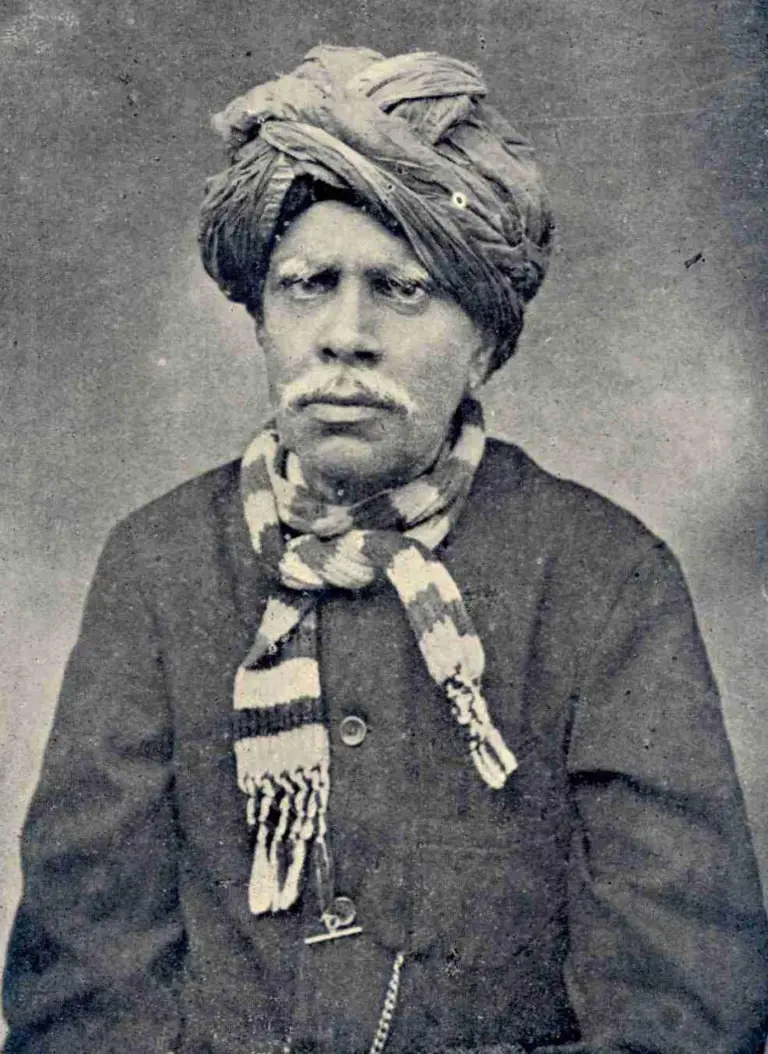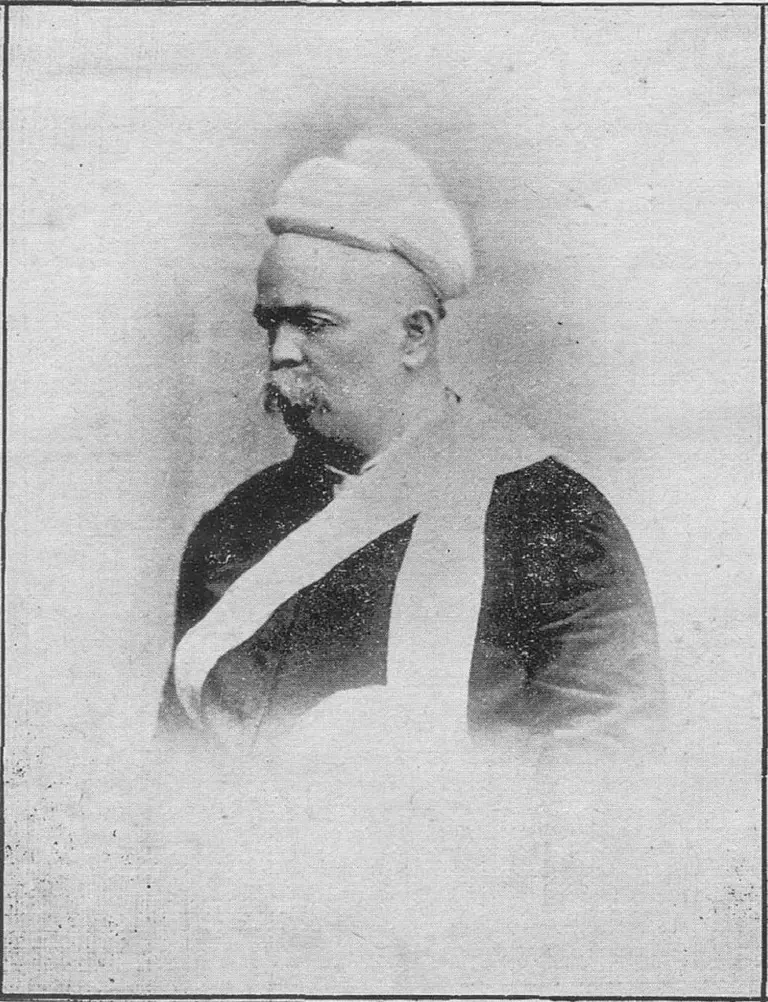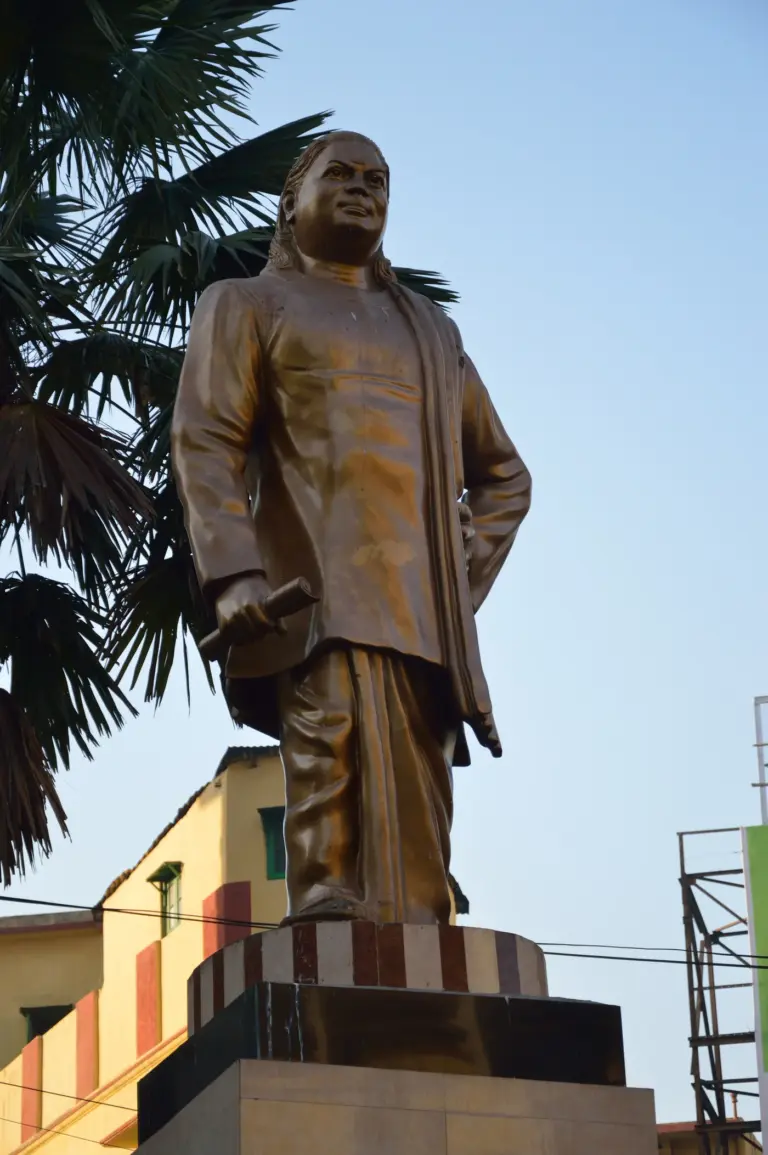
You have almost certainly memorized the slogan “One Caste, One Religion, One God for Man” and attached the name Sree Narayana Guru to it. What most notes never explain is why a single act, installing a stone in a river in 1888, was more radical than a hundred speeches, and how a barber-caste boy from Kerala became the spiritual authority who quietly dismantled the moral logic of untouchability in the south. Get that story straight and Narayana Guru stops being one more name in a list of reformers and becomes the clearest case study you have of reform through action rather than argument.
Who Sree Narayana Guru was
Sree Narayana Guru (1856-1928) was a Kerala philosopher, spiritual teacher, and social reformer who challenged caste not by attacking the scriptures from outside, but by claiming their authority from within. Born on 20 August 1856 at Chempazhanthi near Thiruvananthapuram into the Ezhava community, he grew up in a society where his caste was treated as unapproachable, barred from temples, from many schools, and from the roads that ran past upper-caste shrines. That lived humiliation, not abstract theory, is the root of everything he later did.
The word to fix first is Ezhava. This was a large community in Travancore and Cochin, engaged mainly in toddy-tapping and agriculture, classed low enough in the caste order that its members faced untouchability and were denied temple entry outright. Narayana Guru’s genius was to refuse the terms of that order while speaking its own religious language. He did not tell Ezhavas to abandon Hindu worship; he told them they had every right to it, and then he built the temples to prove it.
He was, in the fullest sense, a saint-reformer rather than a political organizer. He renounced worldly life, wandered as an ascetic, mastered Sanskrit and Vedanta, and eventually settled to teach. His authority came from perceived spiritual attainment, which is exactly why his social interventions landed with a force that a mere activist could never have summoned. When a recognized holy man consecrates a temple, orthodoxy cannot easily dismiss it.
The Aruvippuram consecration of 1888
The single most important act of his life was consecrating a Shiva idol at Aruvippuram in 1888, because a low-caste man performing a rite reserved for Brahmins struck at the very foundation of the caste system. On the night of Sivaratri in 1888, Narayana Guru waded into the Neyyar river, lifted a stone from a whirlpool pool, installed it as a Shiva idol, and consecrated it himself. For a man of the Ezhava caste to perform a prathishta, a temple consecration, was unthinkable, since that priestly function belonged exclusively to Brahmins.
The orthodoxy protested, asking by what right an Ezhava had installed a Shiva. His reply became one of the most quoted lines in the history of Indian reform: this was not a Brahmin’s Shiva but an Ezhava Shiva. In that single sentence he exposed the whole con. If God could be an Ezhava’s God, then the priestly monopoly on the sacred was a human invention, not a divine command. The act said what no argument could: a low-caste man had just done the holiest thing in the tradition, the sky had not fallen, and therefore the ban had never been sacred at all.
This is the part that trips up everyone, so slow down here. Narayana Guru’s method was not to reject Hinduism or ridicule idol worship the way some rationalist reformers did. It was to occupy the tradition and democratize it from the inside. He went on to consecrate dozens of temples across Kerala for communities denied entry elsewhere, giving them dignified spaces of their own. Later he grew bolder still, at some shrines installing a lamp or a mirror inscribed with “Om” in place of an idol, telling worshippers that the divine they sought was their own true self. The reformer was quietly walking his followers from ritual toward self-realization.
At Aruvippuram he left an inscription that reads like a manifesto for the whole life to come, describing an ideal place without the dividing walls of caste, where all live as brothers without a trace of enmity. That inscription, more than any pamphlet, is the seed of the famous motto.
One Caste, One Religion, One God for Man
The motto “One Caste, One Religion, One God for Man” compresses his entire philosophy into six words, and its meaning is more precise than it first looks. In Malayalam, “Oru jati, oru matham, oru daivam manushyanu,” it does not mean everyone should convert to one religion. It means humanity itself is the single caste, that religious differences are surface variations over one shared divinity, and that the ranking of human beings by birth is a fiction with no sanction in the God that all these traditions point to.
Read it beside another of his lines and it sharpens further. At the 1921 conference at Aluva he declared, in effect, that whatever a person’s religion, it is enough if that person becomes good, “Matamethayalum manushyan nannayal mathi.” Here is a reformer who reframes the entire question. The point of religion is ethical transformation, not tribal identity, and if the point is goodness, then caste and sectarian pride are simply beside it. This is why he is studied not only as a social reformer but as a moral philosopher, alongside the other Indian moral thinkers whose ideas the syllabus treats as living resources rather than museum pieces.
His constructive twin-slogan is just as examinable. The direction he gave his movement was to enlighten through education and strengthen through organization, a call taken up by the poet Kumaran Asan and the wider movement. Where an earlier reflex was to seek dignity by imitating upper-caste ritual, Narayana Guru pointed his community toward schools, self-respect, and collective institutions. That reorientation, from ritual anxiety to education and organization, is his most durable practical legacy.
SNDP Yogam and Ezhava upliftment
The Sree Narayana Dharma Paripalana (SNDP) Yogam, founded in 1903, turned a saint’s teaching into a mass organization, and it remains one of the most successful caste-reform bodies in Indian history. It was established with the initiative of Dr Palpu, the first Ezhava to qualify in Western medicine, who had felt the sting of caste discrimination in his own career despite his qualifications. Narayana Guru served as its first and lifelong president, while the celebrated poet Kumaran Asan became its first general secretary. The pairing mattered: a revered spiritual head, a professional organizer, and a literary voice, all aimed at the same goal.
The Yogam’s work was concrete and unglamorous, which is why it endured. It ran schools and encouraged Ezhava children into modern education, promoted industry and thrift, campaigned against wasteful ritual expenditure and social evils, and built temples where the community could worship with dignity. It also gave the Ezhavas something they had never possessed, a single organized voice that could petition the Travancore state for civil rights, temple entry, and access to public spaces. Community self-improvement and pressure on the state advanced together.
Place SNDP in the broader landscape of nineteenth-century reform and its distinctiveness stands out. The socio-religious reform movements of the era ranged from the Arya Samaj in the north to the Brahmo tradition in Bengal, and figures like Jyotiba Phule in Maharashtra attacked caste head-on through education and polemic. Narayana Guru’s movement shared their commitment to education and dignity, but his particular contribution was the fusion of spiritual legitimacy with mass organization, a combination that let reform reach ordinary villagers who would never have read a reformist tract.
The Vaikom Satyagraha link
Narayana Guru is inseparable from the Vaikom Satyagraha of 1924-25, the landmark movement demanding that lower castes be allowed to use the public roads around the Vaikom temple in Travancore. The immediate spark, tellingly, was an act of exclusion aimed at his own circle: leaders including Narayana Guru and Kumaran Asan, both Ezhavas, were among those barred from walking the temple approach roads. The satyagraha ran from 30 March 1924 to 23 November 1925 and became a defining episode in the long fight against untouchability, drawing national attention when Mahatma Gandhi visited and lent his support.
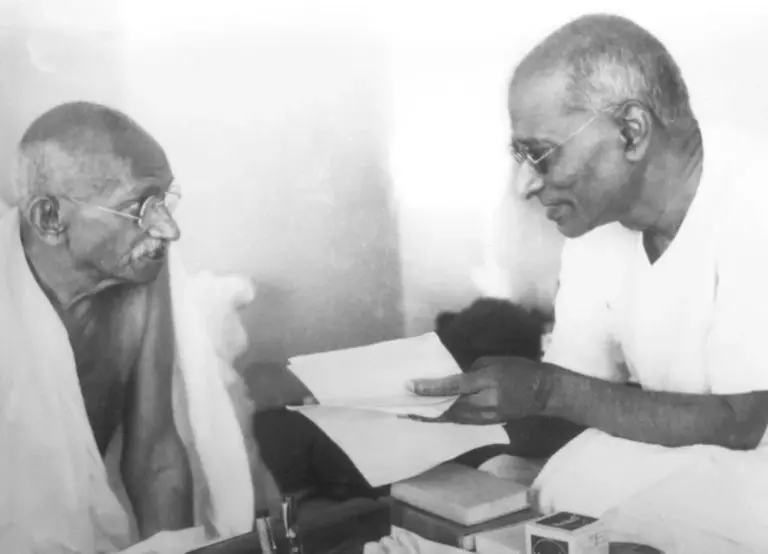
The Guru’s role was that of moral anchor rather than street commander. He gave the movement his blessing and the weight of his spiritual authority, opened the resources of his followers to it, and reportedly counselled a firm but nonviolent posture. When Gandhi came to Kerala in 1925 and met Narayana Guru at Sivagiri, the two discussed caste, temple entry, and the path to reform, a meeting of the national movement’s conscience with the south’s most respected anti-caste voice. Vaikom did not immediately open every road, but it cracked the taboo, seeded the temple-entry movement, and fed directly into the Temple Entry Proclamation of 1936 in Travancore that finally opened state temples to all Hindus.
Study Vaikom as a bridge episode. It connects the local, spiritual anti-caste work of Narayana Guru to the national civil-rights strand of the freedom struggle, and it sits naturally beside the wider reform movements and the constitutional attack on untouchability that reformers like B.R. Ambedkar would later carry into the Constitution itself.
Sivagiri, his final years, and legacy
His headquarters at Sivagiri near Varkala became the institutional and pilgrimage centre of the movement, and it anchors his legacy to this day. There he established the Sivagiri Math, ordained disciples, and set the annual Sivagiri pilgrimage on its path. He continued consecrating temples and teaching until his death on 20 September 1928, revered across Kerala and beyond as a saint who had changed the terms of social life.
Narayana Guru was also a prolific writer in Malayalam, Tamil, and Sanskrit, and his verse carries his philosophy more precisely than any biography. His Atmopadesa Satakam, a hundred verses of spiritual counsel, and the devotional Daiva Dasakam distil his non-dual vision that the divine and the self are one, which is the metaphysical ground beneath his social equality. Understanding this link matters: for Narayana Guru, caste hierarchy was not merely unjust, it was metaphysically false, because if one divinity underlies all beings then ranking them by birth is a category error. His social radicalism grew out of his Vedanta, not in spite of it, which places him in dialogue with a figure like Swami Vivekananda, who likewise drew practical social ethics from non-dual philosophy.
His influence is visible far beyond his lifetime. The Ezhava community’s transformation into an educated, organized, upwardly mobile group traces directly to his teaching and to the SNDP Yogam. More broadly, he offered Indian reform a distinctive template, spiritual rather than secular, constructive rather than merely critical, that continues to shape how the country debates the caste system and social justice.
His place in the Kerala renaissance
Narayana Guru was the towering figure of what historians call the Kerala renaissance, but he did not work alone, and knowing his contemporaries deepens any answer. His own teacher-figure and fellow reformer Chattampi Swamikal questioned Brahmin supremacy on scholarly grounds and encouraged Sanskrit learning among the excluded. In the same decades Ayyankali, working for the Pulaya community classed even lower than the Ezhavas, forced open roads and schools for those at the very bottom of the caste order. Read together, these three show a whole society in ferment, each reformer prising open a different door, with Narayana Guru supplying the spiritual authority that made the wider movement respectable to the orthodox.
What set his own contribution apart was the refusal to let reform curdle into mere imitation of upper-caste ways. Early in the movement, dignity was often sought by copying Brahminical ritual, adopting the sacred thread, elaborating temple ceremony, mirroring the very hierarchy that had excluded the community. Narayana Guru gently redirected that energy. At several shrines he replaced the conventional idol with a lamp or a polished mirror bearing the syllable “Om,” telling devotees that what they were really worshipping was their own true nature. The message was quietly revolutionary: you do not need a priest as an intermediary, because the divine you seek is already within you. It was Vedanta turned into a tool of social liberation.
That is why he belongs as much to the history of Indian thought as to the history of protest. His non-dual conviction that a single reality underlies all beings gave his social equality an unshakeable foundation, because a hierarchy of birth cannot stand if every person shares one divine essence. When you write about him, this is the thread to pull: his metaphysics and his social reform were never two projects but one, and the temples he built were arguments in stone.
How to study and apply this
Organize your notes around three dated anchors and you will never lose the thread: 1888 for the Aruvippuram consecration, 1903 for the founding of the SNDP Yogam, and 1924-25 for the Vaikom Satyagraha. Attach the “Ezhava Shiva” reply to the first, the Palpu-Kumaran Asan pairing to the second, and the Gandhi meeting at Sivagiri to the third. Those three scenes carry almost every factual question you are likely to face.
For the conceptual layer, hold onto what makes his method singular. Most reformers argued against caste. Narayana Guru acted against it, and did so from inside the religious tradition rather than outside it, which is why the phrase “reform through consecration, not confrontation” is worth writing at the top of your notes. In a Mains answer, that contrast, action versus argument, insider versus outsider, is the analytical point that lifts a response above a recitation of dates.
When you compare reformers, resist the flat list. Set Narayana Guru beside Jyotiba Phule and Ambedkar and let the differences teach you: Phule attacked Brahminical scripture directly and built schools, Ambedkar sought remedy in law and eventually in conversion, and Narayana Guru worked spiritually from within Hinduism to democratize the sacred. The comparison also invites the older bhakti and Sufi movements, whose devotional egalitarianism prefigured his message centuries earlier. Kerala Tourism’s dedicated portal and standard modern-history sources are reliable for dates and quotations, and the Malayalam originals of his mottos are worth learning in transliteration, since examiners love the precise wording.
Frequently Asked Questions
Who was Sree Narayana Guru?
Sree Narayana Guru (1856-1928) was a Kerala philosopher, spiritual leader, and social reformer from the Ezhava community who fought caste discrimination and untouchability, best known for the message “One Caste, One Religion, One God for Man.”
What is the significance of the Aruvippuram consecration of 1888?
In 1888, Narayana Guru consecrated a Shiva idol at Aruvippuram, an act traditionally reserved for Brahmins. By performing it as a low-caste man, he directly challenged the Brahminical monopoly over religion and asserted the spiritual equality of all castes.
What does “One Caste, One Religion, One God for Man” mean?
The motto means that humanity is a single caste, that religious differences overlay one shared divinity, and that ranking human beings by birth has no sanction in God. It was a call for human unity, not for conversion to any one faith.
What is the SNDP Yogam and when was it founded?
The Sree Narayana Dharma Paripalana Yogam was founded in 1903 on the initiative of Dr Palpu, with Narayana Guru as its lifelong president and the poet Kumaran Asan as first secretary. It worked for the education, organization, and upliftment of the Ezhava community.
What was Narayana Guru’s role in the Vaikom Satyagraha?
Narayana Guru gave moral and spiritual support to the Vaikom Satyagraha of 1924-25, which demanded that lower castes be allowed to use the roads around the Vaikom temple. He met Mahatma Gandhi at Sivagiri during the movement to discuss caste and temple entry.
How did Narayana Guru differ from other social reformers?
Unlike reformers who attacked religion from outside, Narayana Guru worked from within Hinduism, consecrating temples and reinterpreting worship to democratize the sacred. His social radicalism grew out of his non-dual Vedanta philosophy rather than opposing it.
What are Narayana Guru’s major literary works?
His major works include the Atmopadesa Satakam, a hundred verses of spiritual instruction, and the devotional Daiva Dasakam. His writings in Malayalam, Tamil, and Sanskrit express his vision of the unity of God and the self.
Where is Sivagiri and why is it important?
Sivagiri, near Varkala in Kerala, was Narayana Guru’s headquarters and the site of the Sivagiri Math. It remains the main pilgrimage centre associated with him, hosting the annual Sivagiri pilgrimage.
Practice Questions
1. Sree Narayana Guru is associated with the upliftment of which community?
a) Nadar
b) Ezhava
c) Nair
d) Namboodiri
Answer: b) Ezhava
2. The Aruvippuram consecration by Sree Narayana Guru took place in which year?
a) 1856
b) 1888
c) 1903
d) 1924
Answer: b) 1888
3. Who among the following was the first secretary of the SNDP Yogam?
a) Dr Palpu
b) Kumaran Asan
c) T.K. Madhavan
d) K.P. Kesava Menon
Answer: b) Kumaran Asan
4. The Vaikom Satyagraha of 1924-25 was primarily concerned with:
a) Abolition of the zamindari system
b) Access to public roads around a temple for lower castes
c) Widow remarriage
d) Land redistribution
Answer: b) Access to public roads around a temple for lower castes
5. Consider the following statements about Sree Narayana Guru. 1) He served as the lifelong president of the SNDP Yogam. 2) He authored the Atmopadesa Satakam. Which of the above is/are correct?
a) 1 only
b) 2 only
c) Both 1 and 2
d) Neither 1 nor 2
Answer: c) Both 1 and 2
- “Sree Narayana Guru reformed society not by rejecting religion but by reclaiming it.” Discuss this statement with reference to the Aruvippuram consecration and its social significance.
- Examine the contribution of the SNDP Yogam to the social and educational upliftment of the Ezhava community in Kerala.
- Analyze the role of Sree Narayana Guru in the Vaikom Satyagraha and its place in the wider struggle against untouchability.
- Compare the anti-caste approaches of Sree Narayana Guru, Jyotiba Phule, and B.R. Ambedkar, highlighting what was distinctive about each.
- “For Sree Narayana Guru, social equality was grounded in a philosophy of spiritual unity.” Evaluate this view with reference to his teachings and literary works.
The reason Sree Narayana Guru still repays close study is that he solved a problem most reformers only named. He wanted to end caste in a deeply religious society, and instead of fighting the religion he took possession of it, consecrating a stone in 1888 and letting the act do the arguing. Learn his three dated anchors, hold onto the insider method that set him apart, and you will be able to write about him not as a name on a list but as the reformer who proved that dignity, once claimed, cannot easily be taken back.
Tell Google you want more of this.
Add Anantam IAS as a preferred sourceOne tap, and this site shows up more often in your own Top Stories, AI Overviews and AI Mode. Remove it any time.