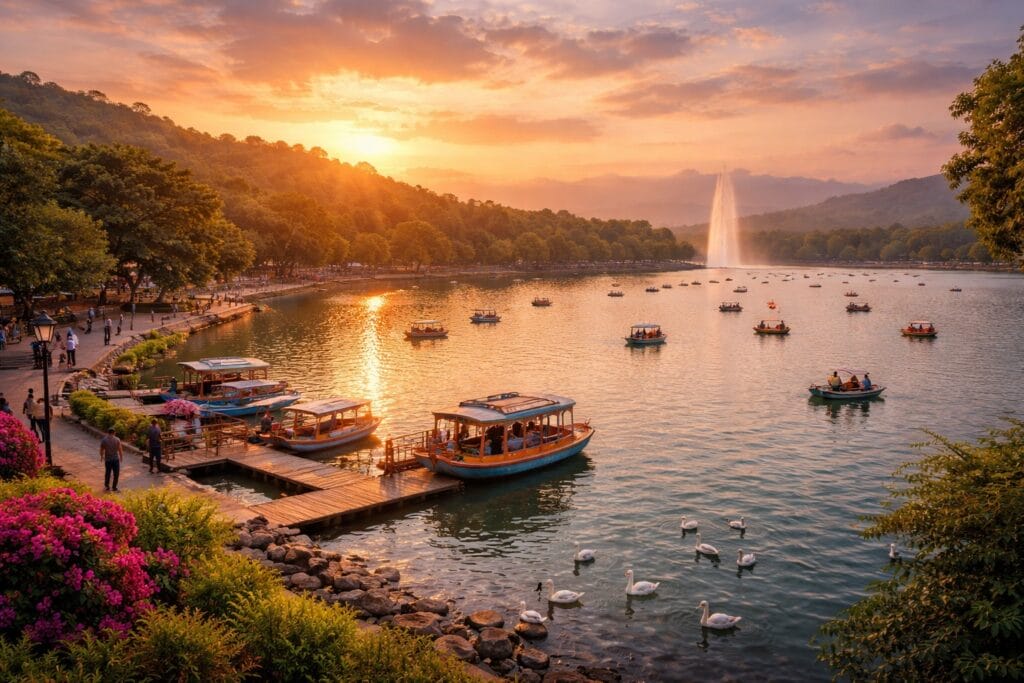
Sukhna Lake is a man-made reservoir in Chandigarh, created in 1958 by damming the seasonal Sukhna Choe at the foothills of the Shivalik Hills. It covers approximately 1.5 sq km at full capacity and sits at an altitude of about 320 metres. For UPSC, Sukhna is a case study in urban geography, wetland ecology, and catchment degradation in a planned city.
Quick Facts
| Parameter | Details |
|---|---|
| Lake Name | Sukhna Lake |
| State/UT | Chandigarh |
| District | Chandigarh |
| Type | Man-made (reservoir) |
| Area | ~1.5 sq km (at full capacity) |
| Maximum Depth | ~5 metres (reduced from ~8 m due to siltation) |
| Altitude | ~320 metres above sea level |
| Ramsar Status | Not a Ramsar site |
| UNESCO Status | Part of the Chandigarh Capitol Complex UNESCO World Heritage buffer zone |
| Key Feature | Artificial urban lake linked to Le Corbusier's planned-city design |
Location and Physical Setting
Sukhna Lake lies on the northeastern edge of Chandigarh, at the boundary where the Shivalik foothills meet the Punjab plains. The lake's water source is the Sukhna Choe, a seasonal stream that descends from the Shivalik range, along with direct catchment runoff from about 42 sq km of hill terrain.
This geographic position is the root of the lake's central problem. The Shivalik slopes are geologically fragile, composed of loosely consolidated sediments prone to erosion. Every monsoon, silt-laden runoff enters the lake.
How Sukhna Lake Was Created
The lake was built as part of the post-independence planned development of Chandigarh under architect Le Corbusier. An earthen embankment was constructed across the Sukhna Choe in 1958 to create a recreational water body for the new city.
| Historical Point | Detail |
|---|---|
| Year of creation | 1958 |
| City planner | Le Corbusier (Swiss-French architect) |
| Construction method | Earthen dam across Sukhna Choe |
| Original purpose | Recreation, landscape element, urban water body |
The Le Corbusier connection gives Sukhna Lake relevance beyond geography. It appears in questions on modern Indian architecture and post-independence city planning.
Ecological Significance
Sukhna Wildlife Sanctuary, notified in 1986 under the Wildlife Protection Act, covers the catchment area around the lake. It protects approximately 26 sq km of Shivalik scrubland and forest.
Biodiversity highlights:
- Over 150 bird species recorded, including migratory species such as Siberian duck, storks, cranes, and egrets during winter
- Mammals in the sanctuary include sambar deer, barking deer, wild boar, and Indian hare
- Fish species stocked for angling include common carp, silver carp, and grass carp
- The lake supports seasonal populations of painted storks and cormorants
Key threats:
- Siltation has reduced the lake's storage capacity by over 60% since 1958
- Catchment erosion from deforested and degraded Shivalik slopes
- Urban runoff carrying pollutants from Chandigarh's expansion
- Eutrophication from nutrient loading, leading to algal blooms in summer months
- Encroachment in the catchment zone reducing natural filtration
Tourism and Economic Importance
Sukhna Lake is Chandigarh's most visited public space. Key economic activities include:
- Boating: Rowing, paddling, and sailing managed by the Chandigarh Rowing Club; the lake has hosted national-level rowing events
- Promenade: A 1.5 km pedestrian walkway attracts thousands of daily visitors
- Garden of Silence and nearby Rock Garden (by Nek Chand) draw tourists year-round
- Fitness and recreation: Morning walkers, joggers, and yoga groups use the lakefront daily
- Annual events: The Chandigarh Carnival and Rose Festival are held near the lake
The lake's health directly affects Chandigarh's tourism revenue and quality of urban life, making environmental management an economic issue, not just an ecological one.
Environmental Problems of Sukhna Lake
| Problem | Mechanism | Impact |
|---|---|---|
| Siltation | Erosion from Shivalik slopes | Reduced water-holding capacity from ~8 m to ~5 m depth |
| Catchment degradation | Deforestation, mining, construction in hills | Increased sediment inflow |
| Eutrophication | Nutrient runoff from urban areas | Algal blooms, oxygen depletion |
| Urban pressure | Tourism overuse, waste generation | Water quality decline |
| Shrinking area | Progressive silt accumulation | Lake area reduced from original extent |
Remediation efforts include check dams in the catchment, afforestation drives, periodic desilting operations, and a 2019 Punjab and Haryana High Court order directing catchment protection. The Chandigarh Administration has also created a dedicated Sukhna Lake Conservation Authority.
Sukhna Lake as an Urban Geography Case Study
Sukhna demonstrates a key principle: planned cities are not ecologically self-sufficient. Chandigarh's grid may be architecturally controlled, but the lake's health depends on terrain, runoff, and erosion patterns in the Shivalik catchment that lies outside the city's administrative boundaries.
This creates a governance challenge. The catchment falls partly in Punjab and Haryana, while the lake is in Chandigarh (Union Territory). Inter-state coordination for catchment protection has been inconsistent.
For UPSC Mains, this is a strong answer point: urban water bodies require watershed-level governance, not just city-level management.
Comparison with Other Important Indian Lakes
| Lake | State | Type | Area (sq km) | Key Feature | Ramsar Status |
|---|---|---|---|---|---|
| Sukhna Lake | Chandigarh | Man-made | ~1.5 | Le Corbusier's planned city lake | No |
| Dal Lake | Jammu & Kashmir | Natural freshwater | ~18 | Houseboats, shikaras, floating gardens | No |
| Chilika Lake | Odisha | Brackish lagoon | ~1,100 | Largest brackish water lagoon in Asia | Yes (1981) |
| Wular Lake | Jammu & Kashmir | Freshwater | ~130 | Largest freshwater lake in India | Yes (1990) |
| Sambhar Lake | Rajasthan | Salt lake | ~230 | India's largest inland salt lake | Yes (1990) |
| Loktak Lake | Manipur | Freshwater | ~287 | Floating phumdis, Keibul Lamjao National Park | Yes (1990) |
UPSC Relevance
Prelims: Expect questions on lake type (man-made, not natural), location (Chandigarh, not Punjab), and association with Le Corbusier's city plan.
Mains applications:
- Urban wetlands and their role in city ecosystems (GS1: Geography)
- Catchment management and inter-state environmental governance (GS2: Governance)
- Environmental degradation of urban water bodies (GS3: Environment)
- Planned city ecology and limitations of top-down urban design (GS1/GS3)
Key Prelims fact: Sukhna Lake = Chandigarh + artificial lake + Shivalik foothills + Sukhna Choe + siltation problem + Le Corbusier.
Frequently Asked Questions
Where is Sukhna Lake located?
Sukhna Lake is located in Chandigarh, a Union Territory in northern India. It sits at the northeastern edge of the city, at the base of the Shivalik Hills, at an altitude of approximately 320 metres above sea level.
Is Sukhna Lake natural or artificial?
Sukhna Lake is artificial. It was created in 1958 by constructing an earthen dam across the seasonal Sukhna Choe stream. The lake was part of the planned development of Chandigarh under architect Le Corbusier.
Why is Sukhna Lake important?
Sukhna Lake serves as Chandigarh's primary recreational water body, an ecological buffer, and a wildlife sanctuary catchment area. It supports over 150 bird species and is a case study in urban wetland conservation and catchment management.
What is the main environmental problem of Sukhna Lake?
The primary problem is siltation caused by erosion in the Shivalik catchment. This has reduced the lake's depth from approximately 8 metres to about 5 metres, shrinking its water-holding capacity by over 60% since its creation.
Why is Sukhna Lake relevant for UPSC?
Sukhna Lake connects urban geography, wetland ecology, catchment management, and post-independence city planning in a single topic. It illustrates how planned cities depend on ecological systems beyond their administrative boundaries.
Tell Google you want more of this.
Add Anantam IAS as a preferred sourceOne tap, and this site shows up more often in your own Top Stories, AI Overviews and AI Mode. Remove it any time.