
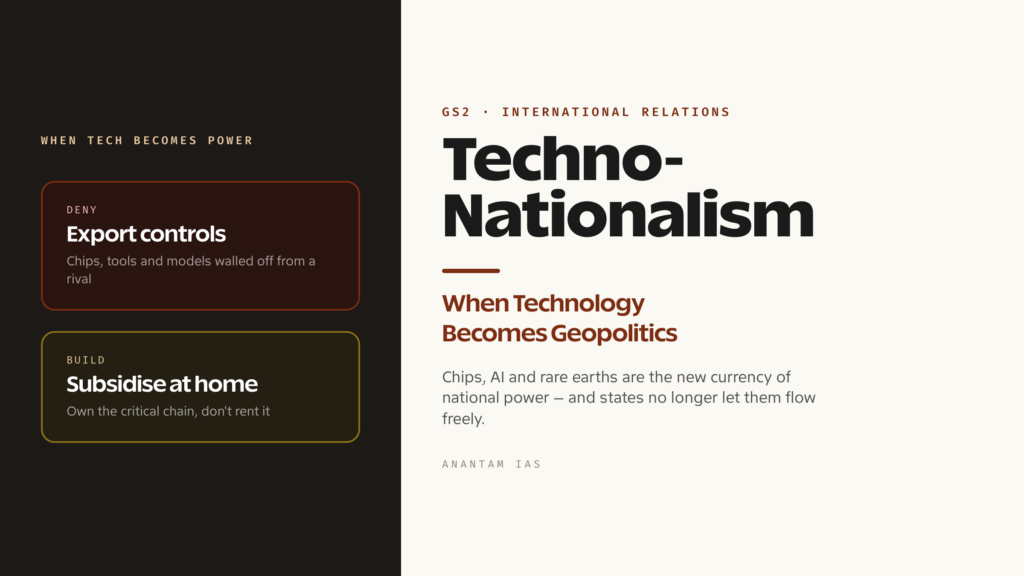
For most of the last forty years, the rich world told itself a comforting story about technology: that it wanted to flow. Capital, code, components and clever people would cross borders to wherever they were most useful, and everyone would grow richer together. A laptop designed in California, built from chips made in Taiwan and Korea, assembled in China and sold in Delhi was treated as proof that the system worked. Then, almost without anyone declaring it, the story flipped. Governments began to look at the same supply chain and see not efficiency but exposure — a web of dependencies that a rival could cut. The new instinct is to control technology, not share it; to ask of every advanced chip, model and mineral, “who owns this, and can they switch it off?” That instinct has a name. It is techno-nationalism, and it has quietly become one of the organising forces of twenty-first-century geopolitics.
For a UPSC aspirant, this is not a niche science-and-technology topic that lives in one corner of the syllabus. It cuts straight across GS Paper 2 — bilateral and global groupings, India’s relations with major powers, the effect of policies of developed countries on India’s interests — and reaches into the economy and internal security as well. The chip war between the United States and China, the scramble to indigenise semiconductors, India’s Atmanirbhar Bharat push and its critical-technology partnership with Washington are all surface ripples of the same deep shift. Understand techno-nationalism as a concept, and a dozen disconnected current-affairs items suddenly snap into a single, answerable pattern.
What Techno-Nationalism Means — and Why the World Turned
Start with a clean definition, because examiners reward one. Techno-nationalism is the idea that a country’s command of strategic technologies is inseparable from its national security, its economic prosperity and its geopolitical power — and that states should, for that reason, control, protect, promote and, when needed, weaponise those technologies rather than let them flow freely across borders. It treats a semiconductor or an AI model the way an earlier age treated a warship or an oilfield: as a strategic asset whose ownership decides who is strong and who is dependent.
The cleanest way to grasp it is by its opposite. The system techno-nationalism is replacing is best called techno-globalism — the belief, dominant after the Cold War, that technology is a global public good, that open markets allocate it best, and that interdependence makes conflict less likely because everyone is wired into everyone else. Under techno-globalism, a country happily bought its chips, its telecom gear and its software from wherever they were cheapest. Under techno-nationalism, that same dependence is recast as a vulnerability — a chokepoint a foreign government could use to coerce you. The shift is from “buy the best, wherever it’s made” to “make the critical things at home, or at least among friends you trust.”
Several forces tipped the balance. The first is the fusion of the civilian and the military: the very technologies that drive a modern economy — advanced chips, artificial intelligence, quantum computing — are the same ones that drive precision weapons, surveillance and code-breaking, so no state can treat them as purely commercial anymore. The second is China’s rise, and specifically its “Made in China 2025” drive to climb the value chain and dominate frontier industries, which convinced Washington that letting the best technology flow freely was helping a strategic rival. The third is the lesson of recent shocks — the pandemic that stranded supply chains, and a war in Europe that showed how fast economic links can be turned into weapons through sanctions. Put together, these pushed even the most open economies to ask a question they had stopped asking: should we really depend on a potential adversary for the things our power rests on? Once a government answers no, it is, by definition, a techno-nationalist.
The Strategic-Tech Battlegrounds and the Chip War
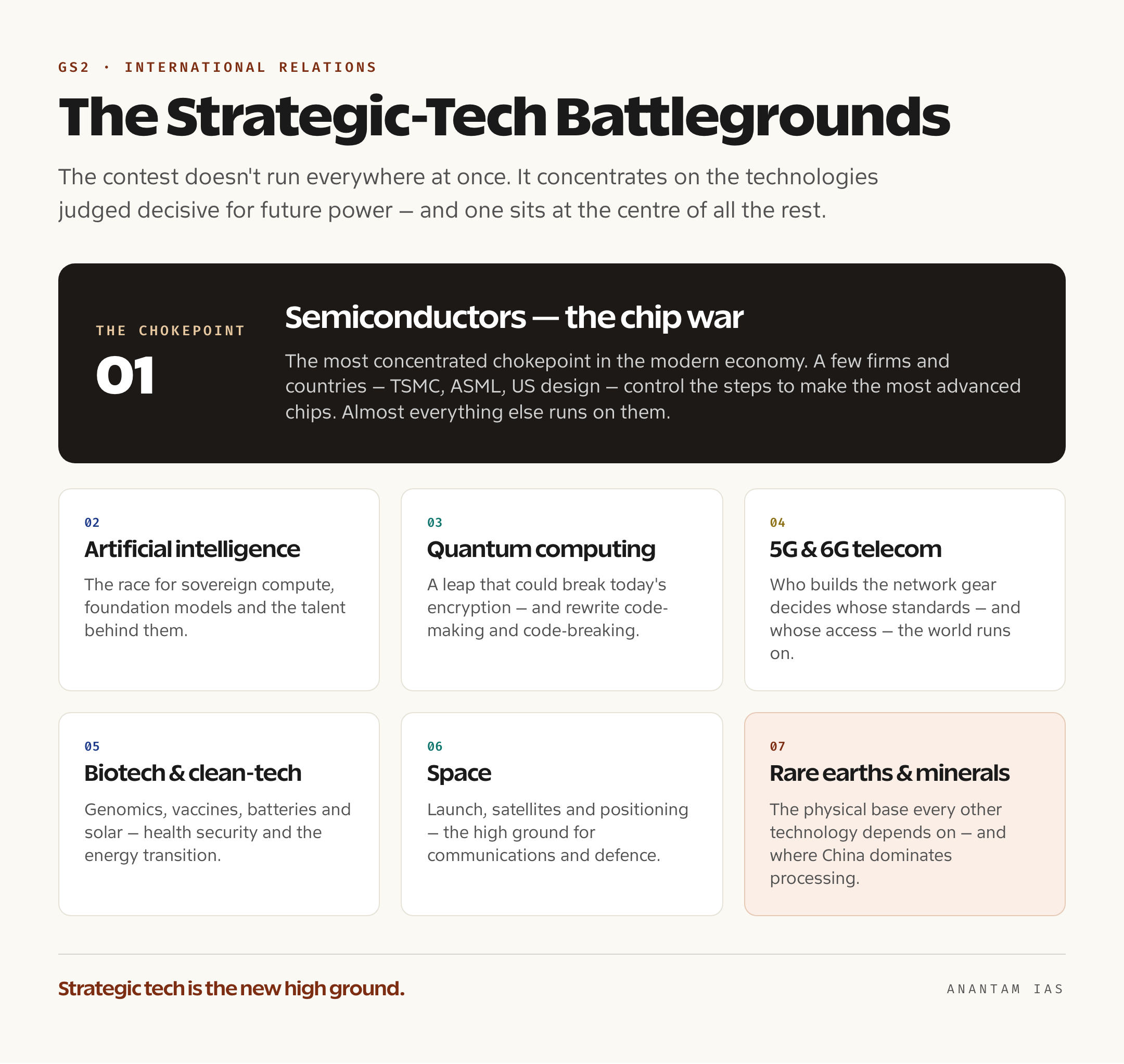
Techno-nationalism does not play out everywhere at once. It concentrates on a handful of “strategic” or “critical and emerging” technologies — the ones judged decisive for future power. Aspirants should be able to list them quickly: semiconductors, artificial intelligence, quantum computing, advanced telecom in 5G and 6G, biotechnology, clean-energy and battery technology, space, and the rare-earth elements and critical minerals that all of these physically depend on. Each is a front in the same wider contest, but one front towers over the rest, because almost everything else runs on it.
That front is semiconductors, and the struggle over it is what people mean by the chip war. Advanced chips are the single most concentrated chokepoint in the modern economy — a tiny number of firms and countries control the steps needed to make the most powerful ones. Taiwan’s TSMC fabricates the bulk of the world’s cutting-edge chips; the Netherlands’ ASML alone makes the extreme-ultraviolet lithography machines without which those chips cannot be etched; American firms dominate chip design and design software. The United States looked at this map and realised it held the high ground, and from October 2022 it began using that leverage: a sweeping set of export controls barring the sale of the most advanced AI chips and chip-making equipment to China, designed to freeze Beijing a generation behind in the technologies that feed its military. Washington tightened the screws repeatedly, adding dozens of Chinese firms — Huawei, the memory-maker YMTC, the toolmaker Naura and many others — to the Commerce Department’s Entity List, which bars them from buying American technology, with fresh batches added through 2025.
The wall has not been watertight, and that is itself a lesson. Far from killing China’s industry, the controls have galvanised it: Beijing poured state money into self-reliance, and China’s home-grown share of its own chip market climbed from around a quarter to roughly a third between 2024 and 2025, overshooting one of its own targets. The policy has also wobbled under commercial pressure — Washington banned Nvidia’s China-tailored H20 chips in early 2025, then allowed a version back later in the year under licence, even taking a cut of the sales. The lesson examiners like is the double edge: export controls can slow a rival, but they also hand it a powerful incentive to build its own ecosystem, and they strain the controlling country’s own companies, who lose a giant market. A chokepoint is real power, but it is power that erodes the moment you use it.
The Toolkit: How States Weaponise Technology
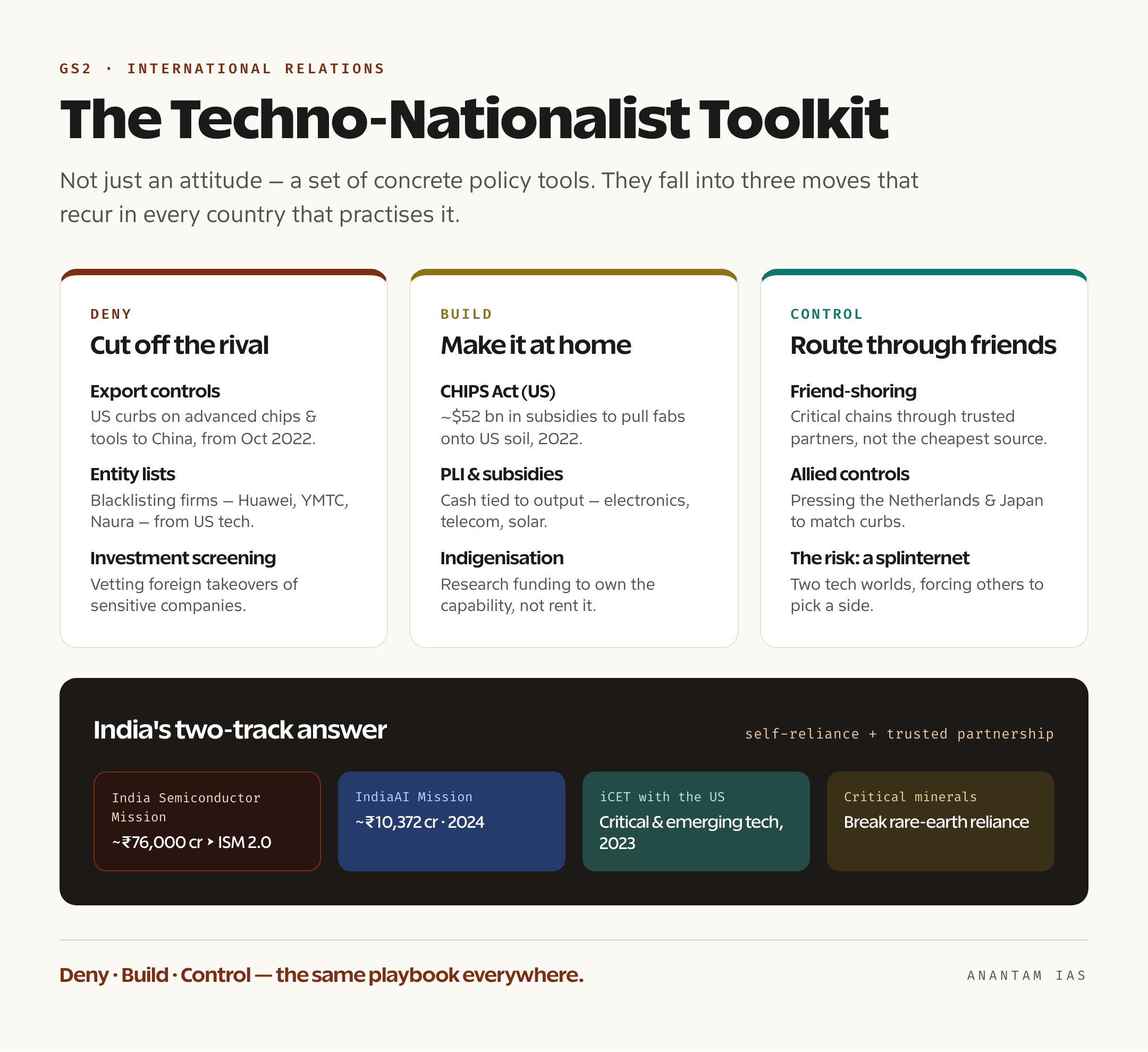
Techno-nationalism is not just an attitude; it is a set of concrete policy tools, and a good answer names them. They fall into three buckets — deny, build and control — and the same toolkit recurs in every country that practises it.
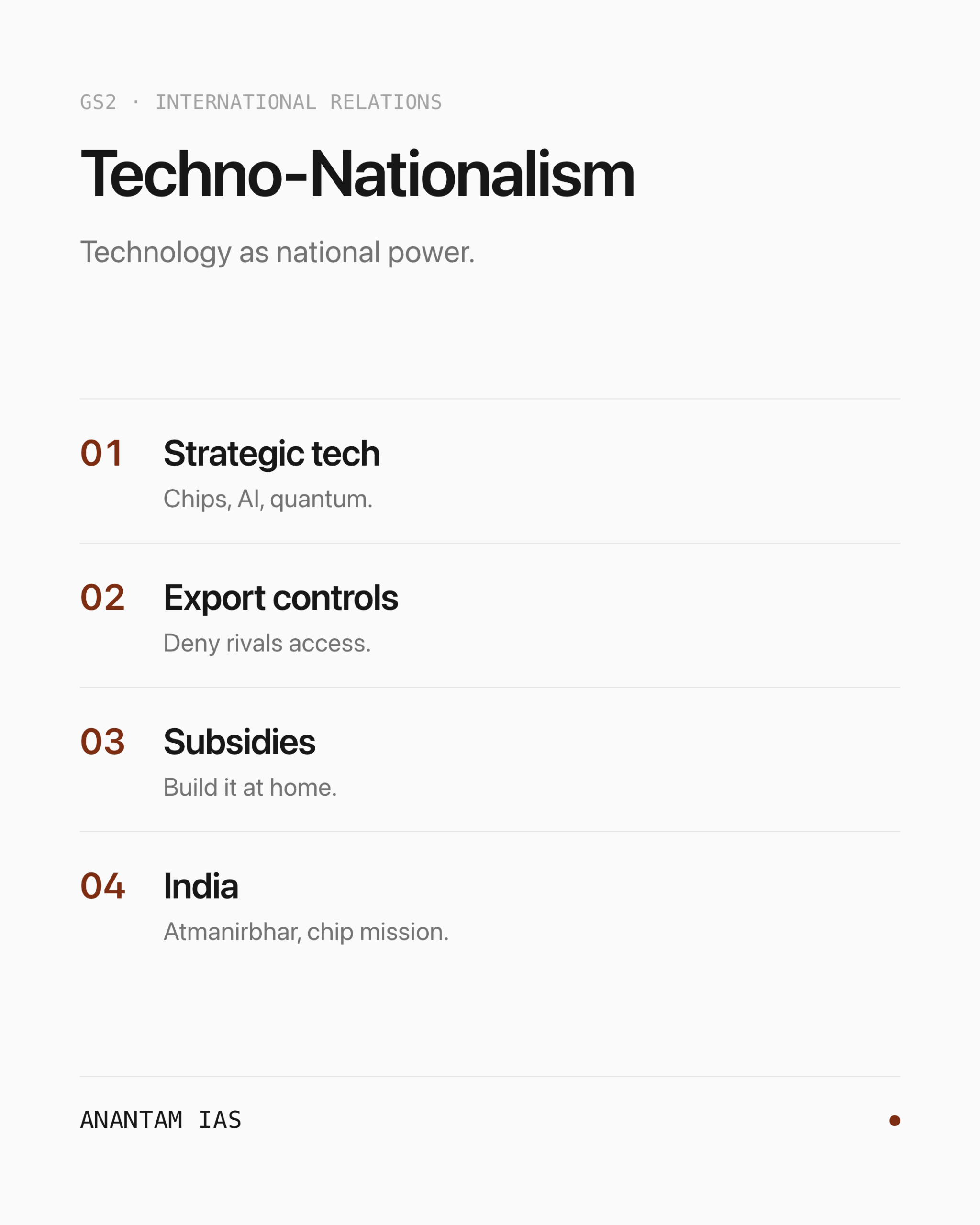
The first bucket is denial: stopping a rival from getting what it needs. Export controls are the sharpest instrument here — legal bans on selling specified technologies abroad, of which the American curbs on advanced chips to China are the defining example. Alongside them sit entity lists that blacklist named foreign firms, and investment screening, where a government vets or blocks foreign takeovers of sensitive companies to stop strategic technology from quietly changing hands. The second bucket is building — pouring public money into making the critical things at home. The flagship is the United States’ CHIPS and Science Act of 2022, which committed roughly fifty-two billion dollars in subsidies to pull chip manufacturing back onto American soil. Most major economies now run some version of this: state subsidies, production-linked incentives, research funding and outright indigenisation drives, all aimed at owning the capability rather than renting it. The third bucket is control over the network of allies and supply chains. Here the key idea is friend-shoring — deliberately routing critical supply chains through trusted partners rather than the cheapest source, so that a rival cannot hold them hostage. The United States has leaned on allies like the Netherlands and Japan to adopt matching export controls, turning a national policy into a coordinated bloc.
This is where the deepest worry comes in — the risk that the world’s single, interconnected technology system splits into two. Commentators call the digital version of this a splinternet: a future in which one internet, one set of technical standards, one app ecosystem and one stack of approved hardware sits behind an American-led wall, and a rival set behind a Chinese-led one, with much of the world forced to pick a side. The broader phenomenon is decoupling — the deliberate unwinding of the dense technology and supply-chain links that once bound the American and Chinese economies together. A full decoupling would be staggeringly expensive, so what is actually unfolding is messier and narrower, often called “de-risking”: untangling the most sensitive links — chips, AI, telecom, key minerals — while keeping the ordinary trade that both sides still need. For a middle power, the danger of a hard split is obvious. If the world fractures into two incompatible tech blocs, every country loses the efficiency of a single global market and is pressed to choose a camp, narrowing exactly the room for manoeuvre that a country like India prizes.
India’s Response: Self-Reliance, Chips and a Bet on Trusted Partners
India sits in the middle of this storm, and its strategy is a careful blend of two impulses — building its own capability and partnering with trusted friends, without surrendering its prized strategic autonomy. The umbrella idea is Atmanirbhar Bharat, the self-reliant-India vision that reframes economic policy around reducing dependence in critical sectors. In a techno-nationalist world, self-reliance stops being a slogan and becomes a security doctrine: the country wants to make, design and control the technologies its future rests on, rather than import them from anyone who might one day choose not to sell.
The sharpest expression of this is in chips. The India Semiconductor Mission, launched in 2021 with an initial outlay of around seventy-six thousand crore rupees, set out to build a domestic chip ecosystem from near-scratch — fabrication plants, assembly and packaging units, and design capability. It has begun to bear fruit: by late 2025 the government had approved around ten projects worth roughly 1.6 lakh crore rupees across six states, India’s first commercial chips were on the horizon, and the Union Budget moved towards a second phase, ISM 2.0, to deepen the push into equipment, materials and indigenous chip design. Running alongside it is a family of Production-Linked Incentive, or PLI, schemes — cash incentives tied to how much a firm actually manufactures in India — spanning electronics, telecom gear, solar and more, all aimed at pulling supply chains onto Indian soil. On the software frontier, the IndiaAI Mission, approved in 2024 with an outlay of about 10,372 crore rupees, is India’s answer to the AI race: a plan to build sovereign computing power with thousands of GPUs, indigenous foundation models, shared datasets and AI skilling, so that the country is a maker of artificial intelligence and not merely a user of someone else’s. You can read more on the India Semiconductor Mission and the IndiaAI Mission in the linked explainers.
The second impulse is partnership, and here the centrepiece is the relationship with the United States. The India-US Initiative on Critical and Emerging Technology, known as iCET and launched in 2023, is a deliberate effort to knit the two countries’ work together across semiconductors, AI, space, quantum, defence technology and more — India’s bid to position itself inside the trusted, friend-shored bloc as global supply chains are rewired away from China. The logic is plain: as American firms look for alternatives to Chinese manufacturing, India offers itself as the credible “China-plus-one” destination. The final strand is raw materials. Because every advanced technology ultimately depends on a handful of rare-earth elements and critical minerals — and because China dominates their mining and, even more, their processing — India has been building a critical-minerals strategy: securing overseas supplies, encouraging domestic exploration, and joining partner-country efforts to break the dependence. The vulnerability is real and recent, as the rare-earth squeeze led by China showed when export curbs rattled global industry. India’s answer is the same one running through its whole response: own more of the chain, and make sure the rest runs through friends rather than a rival.
For Your Mains Answer
This topic is a natural fit for GS Paper 2 — India and the world, bilateral and global groupings, India’s relations with major powers, and the effect of developed countries’ policies on India’s interests — and it spills usefully into GS Paper 3 on the economy, science and technology, and internal security, and into the Essay paper on themes of self-reliance, sovereignty and a fragmenting world order. The skill that scores is connecting the abstract concept to the concrete instruments and then to India’s specific position. Don’t just describe the chip war; explain what it reveals about how power now works, and where India fits.
How to Build the Answer
Move in a logical chain. Define techno-nationalism and contrast it with techno-globalism so the examiner sees you understand the shift, not just the buzzword. Then name the strategic technologies and zoom in on semiconductors as the central chokepoint. Lay out the toolkit — deny, build, control — with the chip-war export controls and the CHIPS Act as anchors. Flag the systemic risk of decoupling and a splinternet. Finally, bring it home to India: Atmanirbhar Bharat, the Semiconductor Mission, PLI, the IndiaAI Mission, iCET with the US, and the critical-minerals push, framed as self-reliance plus trusted partnership without abandoning strategic autonomy. That arc — concept, contrast, battlegrounds, tools, risk, India — answers almost any question on the theme.
Common Mistakes to Avoid
Don’t treat techno-nationalism as purely a science-and-technology issue; its heart is geopolitics and security, which is why it belongs in GS2. Don’t claim export controls have simply crushed China — show the double edge, that they also spurred its self-reliance and overshot some targets. Don’t present India as picking a side in a new Cold War; its position is hedging — building at home, partnering with trusted friends, guarding strategic autonomy. And don’t list India’s schemes without the logic that ties them together: each is a piece of the same effort to own the critical chain.
A Compact Answer Spine
Techno-nationalism = linking command of strategic tech to national security, prosperity and power → opposite of techno-globalism (free tech flows) → driven by civil-military fusion, China’s rise, pandemic and war shocks → battlegrounds: semiconductors (the chip war), AI, quantum, 5G/6G, biotech, clean-tech, rare earths → toolkit: deny (export controls, entity lists, screening), build (CHIPS Act, PLI, indigenisation), control (friend-shoring) → risk: US-China decoupling and a splinternet of two tech worlds → India: Atmanirbhar Bharat, India Semiconductor Mission + ISM 2.0, PLI, IndiaAI Mission, iCET with the US, critical-minerals strategy → verdict: self-reliance plus trusted partnership, without losing strategic autonomy.
Diagram or Flowchart Idea
Sketch a simple two-column “techno-globalism vs techno-nationalism” contrast, then a three-box flow labelled Deny → Build → Control with one example under each (export controls, CHIPS Act, friend-shoring). A clean visual like this shows the examiner you grasp both the shift and the instruments in a single glance.
A Balanced-Conclusion Line
A line that lands: “As technology becomes the new currency of geopolitics, India’s task is not to choose between self-reliance and partnership but to braid them — building sovereign capability in chips, AI and minerals while anchoring itself among trusted partners, so it shapes the emerging tech order rather than being shaped by it.”
How to Use Data Without Cramming
You need only a few sharp anchors, not a spreadsheet: October 2022 (the US chip export controls), the CHIPS Act’s roughly fifty-two billion dollars, the India Semiconductor Mission’s about seventy-six thousand crore rupees, and the IndiaAI Mission’s about 10,372 crore rupees. Attribute them plainly — “the US CHIPS Act of 2022”, “the Cabinet’s 2024 approval” — rather than scattering numbers without a source.
Frequently Asked Questions
What is techno-nationalism in simple terms?
It is the idea that a country’s control over strategic technologies — like semiconductors, AI and quantum computing — is directly tied to its national security, economic strength and geopolitical power. So instead of letting technology flow freely across borders, states try to control, protect, build and sometimes weaponise it. It is the opposite of techno-globalism, the older belief that technology is a global public good best shared through open markets.
What is the chip war between the US and China?
It is the central front of techno-nationalism. From October 2022, the United States imposed export controls barring the sale of the most advanced AI chips and chip-making equipment to China, aiming to keep Beijing a generation behind in technologies that also power its military. Washington added many Chinese firms to its Entity List. China responded by pouring money into self-reliance, and its domestic share of its own chip market rose from about a quarter to roughly a third between 2024 and 2025.
What is a splinternet, and why does it worry India?
A splinternet is a feared future in which the single global internet and technology system splits into two — one American-led and one Chinese-led, each with its own standards, hardware and app ecosystems — forcing other countries to pick a side. This is part of a wider US-China “decoupling.” It worries India because a hard split would shrink the open global market it benefits from and pressure it to choose a camp, narrowing the strategic autonomy it values.
How is India responding to techno-nationalism?
With a two-track strategy. It is building its own capability — through Atmanirbhar Bharat, the India Semiconductor Mission and its second phase, PLI manufacturing incentives, the IndiaAI Mission and a critical-minerals push. And it is partnering with trusted friends, above all through the India-US iCET initiative on critical and emerging technology, positioning itself as a credible “China-plus-one” hub. The aim is self-reliance plus trusted partnership, without surrendering strategic autonomy.
Practice Questions
Prelims MCQs
- Techno-nationalism is best described as which of the following?
(a) The free flow of technology across borders as a global public good
(b) Linking a nation’s command of strategic technologies to its security, prosperity and geopolitical power
(c) A treaty banning the military use of emerging technologies
(d) The transfer of obsolete technology to developing countries
Answer: (b) Techno-nationalism ties control over strategic technologies directly to national power, and is the opposite of techno-globalism. - The “chip war” primarily refers to a contest between which two countries over which technology?
(a) India and China over 5G telecom
(b) The United States and China over advanced semiconductors
(c) Japan and South Korea over display panels
(d) The United States and the European Union over quantum computing
Answer: (b) The chip war centres on US export controls restricting advanced semiconductors and chip-making equipment to China from October 2022. - The “Entity List,” frequently mentioned in the context of the chip war, is maintained by which country?
(a) China
(b) The United States
(c) The Netherlands
(d) India
Answer: (b) The US Commerce Department’s Entity List bars listed foreign firms, including several Chinese companies, from buying American technology. - With reference to “friend-shoring,” which statement is correct?
(a) Routing critical supply chains through trusted partner countries rather than the cheapest source
(b) Offshoring all manufacturing to the lowest-cost country
(c) A scheme to share rare-earth minerals freely with all nations
(d) Allowing rivals to invest in strategic industries
Answer: (a) Friend-shoring deliberately shifts critical supply chains to trusted allies so a rival cannot weaponise dependence. - Which of the following is the India-US partnership specifically focused on critical and emerging technologies?
(a) QUAD
(b) iCET
(c) I2U2
(d) BECA
Answer: (b) The India-US Initiative on Critical and Emerging Technology (iCET), launched in 2023, covers semiconductors, AI, space, quantum and defence technology.
Mains Practice Questions
- “Technology has become the new currency of geopolitics.” In light of the concept of techno-nationalism, examine how the control of strategic technologies is reshaping relations among major powers. (15 marks, 250 words)
- Distinguish between techno-globalism and techno-nationalism. What forces have driven the global shift from the former towards the latter? (10 marks, 150 words)
- The semiconductor “chip war” is the central front of contemporary techno-nationalism. Critically analyse the tools used in this contest and their double-edged consequences. (15 marks, 250 words)
- Discuss the risks that US-China technological decoupling and a possible “splinternet” pose for a middle power like India. How should India safeguard its interests? (15 marks, 250 words)
- Evaluate India’s response to a techno-nationalist world order, with reference to Atmanirbhar Bharat, the India Semiconductor Mission, the IndiaAI Mission and the iCET partnership. (15 marks, 250 words)
Tell Google you want more of this.
Add Anantam IAS as a preferred sourceOne tap, and this site shows up more often in your own Top Stories, AI Overviews and AI Mode. Remove it any time.