The total national park in India count stands at 106 national parks as of 2024, spread across nearly every state and union territory, covering around 44,402 sq km or roughly 1.35% of the country's geographical area. National parks are the highest category of protected areas under Indian wildlife law, where human activity is strictly restricted to preserve natural ecosystems, landscapes, and wildlife. From the snow leopards of Hemis to the one-horned rhinos of Kaziranga, these parks anchor India's conservation map. For UPSC aspirants, national parks are a recurring intersection of Environment, Geography, and Polity — tested in Prelims through species-location matches and in Mains through biodiversity governance questions.
What Is a National Park
A national park is an area notified under Section 35 of the Wild Life (Protection) Act, 1972 by a state government when it considers the area to be of adequate ecological, faunal, floral, geomorphological, or zoological significance. Within a national park:
- No human activity is permitted except those allowed by the Chief Wildlife Warden.
- No grazing of livestock is allowed.
- Boundaries cannot be altered except by a resolution of the State Legislature.
- Private land rights are not permitted, unlike in sanctuaries.
National parks differ from wildlife sanctuaries (lower restriction level) and biosphere reserves (UNESCO-linked, broader mandate including sustainable use).
How Many National Parks Does India Have
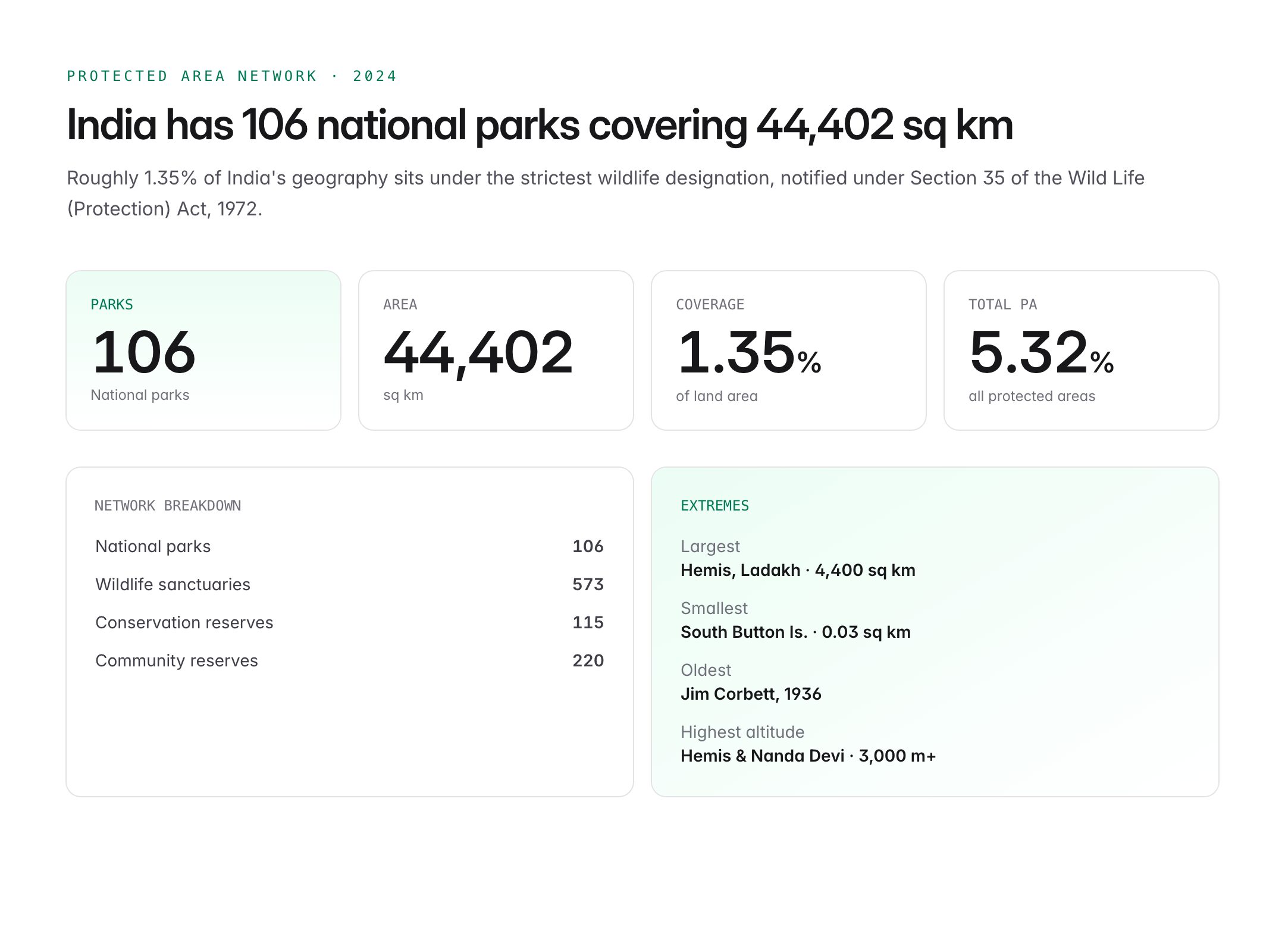
India notified its first national park in 1936 — then called Hailey National Park, now known as Jim Corbett National Park in Uttarakhand. The count has grown steadily since independence.
| Milestone | Year | Count |
|---|---|---|
| First national park (Hailey/Corbett) | 1936 | 1 |
| Wildlife Protection Act enacted | 1972 | ~5 |
| End of 20th century | 2000 | ~89 |
| Current total | 2024 | 106 |
The total protected area network includes 106 national parks, 573 wildlife sanctuaries, 115 conservation reserves, and 220 community reserves, together covering about 5.32% of India's geographical area.
State-Wise Distribution
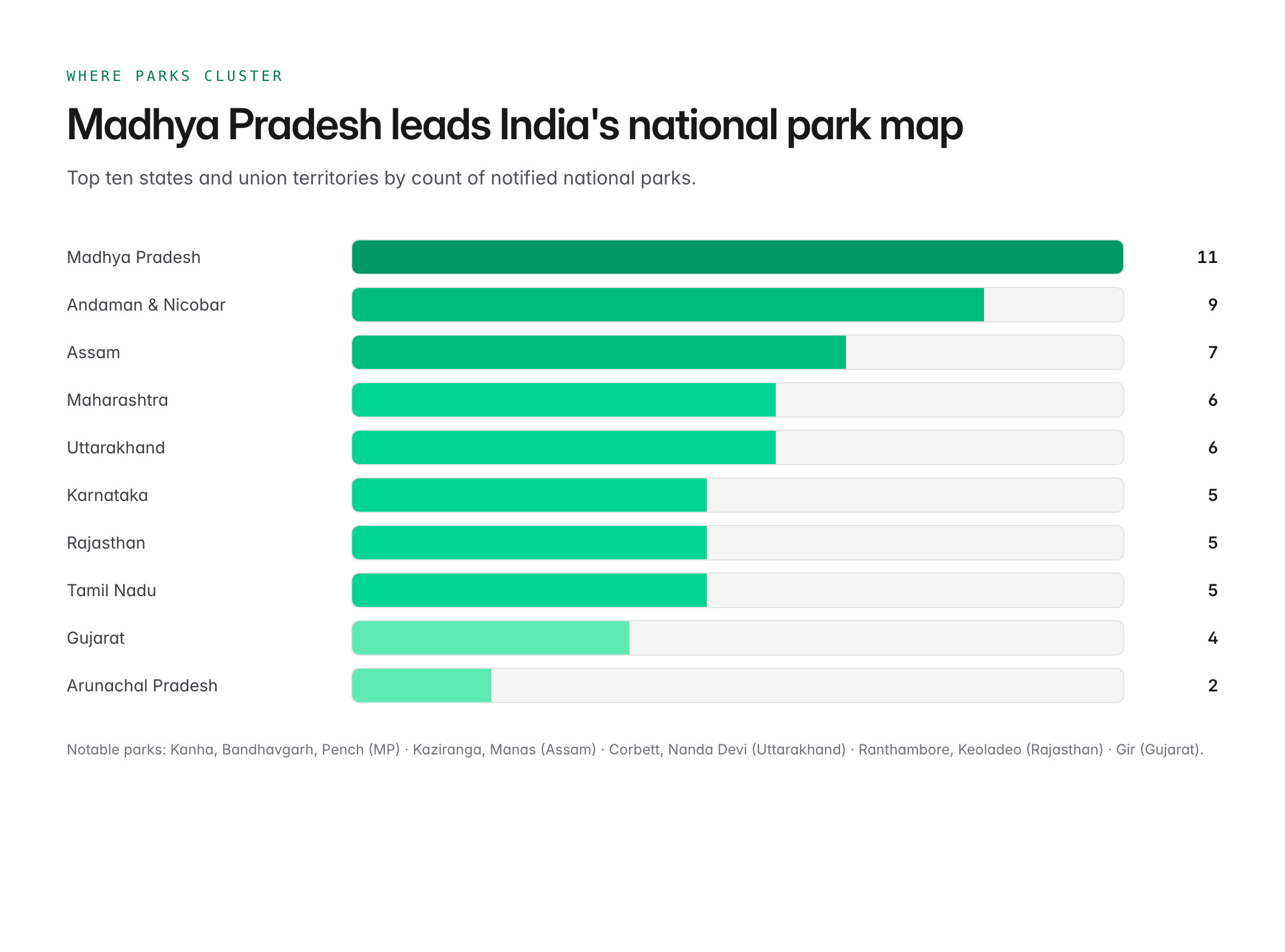
Madhya Pradesh leads with the most national parks, followed by Andaman & Nicobar Islands, which hosts a cluster of small marine and island parks.
| State/UT | Number of National Parks | Notable Parks |
|---|---|---|
| Madhya Pradesh | 11 | Kanha, Bandhavgarh, Pench, Satpura |
| Andaman & Nicobar | 9 | Mahatma Gandhi Marine, Saddle Peak |
| Maharashtra | 6 | Tadoba, Sanjay Gandhi, Gugamal |
| Arunachal Pradesh | 2 | Namdapha, Mouling |
| Assam | 7 | Kaziranga, Manas, Dibru-Saikhowa, Nameri |
| Karnataka | 5 | Bandipur, Nagarhole, Bannerghatta |
| Uttarakhand | 6 | Corbett, Nanda Devi, Valley of Flowers |
| Rajasthan | 5 | Ranthambore, Sariska, Keoladeo |
| Tamil Nadu | 5 | Mudumalai, Mukurthi, Gulf of Mannar |
| Gujarat | 4 | Gir, Marine, Blackbuck, Vansda |
Largest and Smallest National Parks
- Largest: Hemis National Park in Ladakh — about 4,400 sq km — famous for the snow leopard and high-altitude Himalayan fauna.
- Smallest: South Button Island National Park in the Andamans — just 0.03 sq km.
- Highest-altitude: Hemis and Nanda Devi both sit above 3,000 metres.
- Oldest: Jim Corbett National Park, Uttarakhand (1936).
Key National Parks and Their Flagship Species
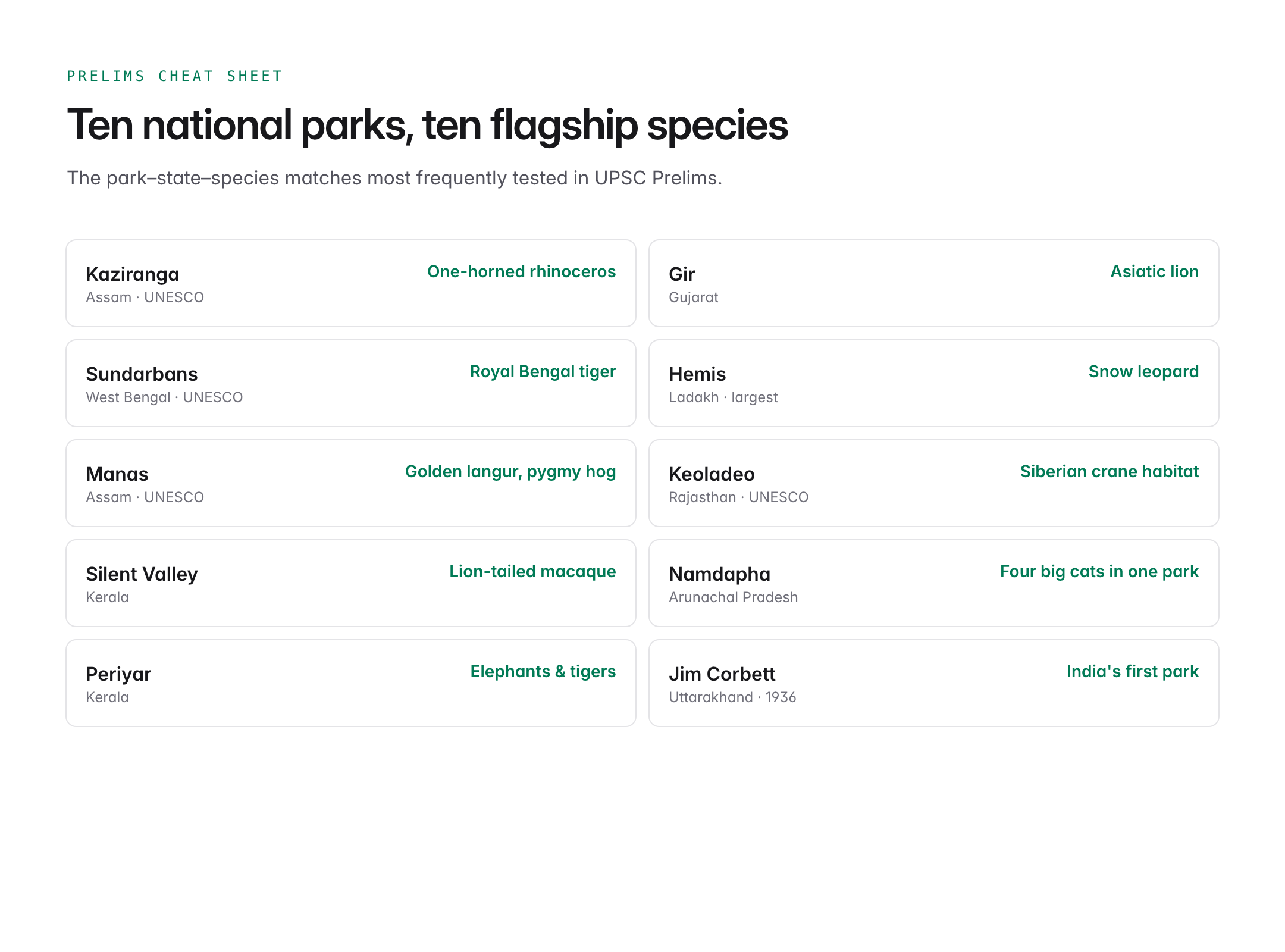
Certain parks are consistently asked in UPSC Prelims through species-habitat matching:
- Kaziranga (Assam) — one-horned rhinoceros; UNESCO World Heritage Site.
- Gir (Gujarat) — only wild habitat of the Asiatic lion.
- Sundarbans (West Bengal) — Royal Bengal tiger in mangroves; UNESCO site.
- Manas (Assam) — golden langur, pygmy hog; also a Tiger Reserve and Biosphere Reserve.
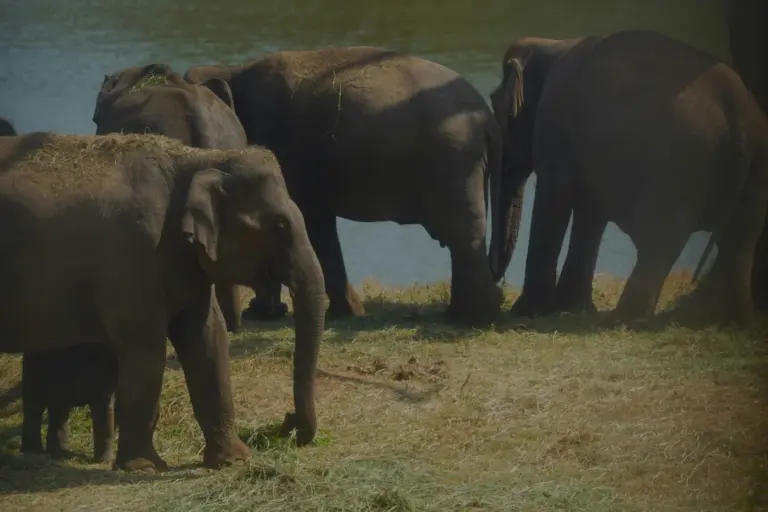
- Periyar (Kerala) — elephants and tigers.
- Keoladeo (Rajasthan) — bird sanctuary turned national park; UNESCO site; Siberian crane habitat.
- Great Himalayan (Himachal Pradesh) — UNESCO World Heritage Site.
- Silent Valley (Kerala) — lion-tailed macaque; saved by a famous 1980s environmental movement.
- Namdapha (Arunachal Pradesh) — the only park with four big cats: tiger, leopard, snow leopard, clouded leopard.
- Hemis (Ladakh) — snow leopard stronghold.
Legal and Institutional Framework
National parks fall under a layered governance structure:
- Wildlife (Protection) Act, 1972 — the constitutive statute.
- Ministry of Environment, Forest and Climate Change (MoEFCC) — apex policy body.
- National Board for Wildlife (NBWL) — chaired by the Prime Minister; clears projects in and around parks.
- State Boards for Wildlife — chaired by Chief Ministers.
- Chief Wildlife Warden — the state-level authority for permissions.
- Eco-Sensitive Zones (ESZs) — buffer areas (usually up to 10 km) notified around parks under the Environment Protection Act, 1986, where regulated activities are allowed.
Many national parks also double up as Tiger Reserves under Project Tiger (1973), administered by the National Tiger Conservation Authority (NTCA), or as Elephant Reserves under Project Elephant (1992).
Significance for Biodiversity and Society
National parks matter beyond tourism:
- In-situ conservation of flagship and umbrella species protects entire food webs.
- Ecosystem services — watershed protection, carbon sequestration, pollination, and climate regulation.
- Tribal and forest-dweller rights under the Forest Rights Act, 2006 intersect with park boundaries, creating a continuous policy debate.
- Eco-tourism revenue supports local livelihoods when managed well (e.g., Periyar model).
- Scientific research — long-term ecological monitoring of species like tigers, rhinos, and snow leopards.
Challenges include man-animal conflict, habitat fragmentation, linear infrastructure (roads, railways, canals), invasive species, and climate-driven range shifts, especially in Himalayan and coastal parks.
UPSC Relevance
Prelims focus:
- Exact total count (106) and first/oldest park (Corbett, 1936).
- Park–state–species matching: Kaziranga–Assam–rhino; Gir–Gujarat–Asiatic lion; Hemis–Ladakh–snow leopard.
- Difference between national park, sanctuary, conservation reserve, and community reserve under the Wildlife (Protection) Act, 1972.
- UNESCO World Heritage national parks: Kaziranga, Manas, Sundarbans, Keoladeo, Nanda Devi, Valley of Flowers, Great Himalayan NP.
Mains GS-III angle:
- Effectiveness of India's protected area network in halting biodiversity loss.
- Conflict between infrastructure development, tribal rights, and conservation — especially Eco-Sensitive Zone notifications.
- Role of Project Tiger and Project Elephant in landscape-level conservation.
Sample PYQ angle: "Discuss the key strategies adopted by India for in-situ conservation of biodiversity. How effective have protected areas been in achieving conservation goals?" — use national park data, Project Tiger outcomes, and current threats like linear intrusions and climate change to frame a balanced answer.
Tell Google you want more of this.
Add Anantam IAS as a preferred sourceOne tap, and this site shows up more often in your own Top Stories, AI Overviews and AI Mode. Remove it any time.