The rhinoceros is a large herbivorous mammal of the family Rhinocerotidae, recognisable by its thick, armour-like skin and one or two keratin horns. Five species survive globally, three in Asia and two in Africa, and four of them are at high risk of extinction. India is home to the Greater One-Horned Rhinoceros, also called the Indian rhino, which was once distributed across the entire Indo-Gangetic plain and is now mostly confined to a few protected areas in Assam, West Bengal, and Uttar Pradesh. Conservation interventions including the Kaziranga and Manas national parks, the Pobitora Wildlife Sanctuary, the Indian Rhino Vision 2020 programme, Project Rhino, and the RhODIS India DNA forensics initiative have helped pull the species back from the brink, and the population has grown steadily over the last several decades.
For UPSC the rhinoceros is a high-yield species topic. Prelims questions ask about the IUCN status of each of the five species, the location of the major rhino-bearing parks, and the institutions implementing conservation programmes. Mains questions cover the threats from poaching and habitat fragmentation, the role of community-based conservation, and the comparative effectiveness of African anti-poaching measures such as the rhino horn radioactive isotope labelling programme.
This guide covers all five species, the biology and habitat of the Indian rhino, the major protected areas, the conservation programmes including RhODIS India and Project Rhino, the international framework, and the standard prelims and mains hooks.
Quick Facts at a Glance
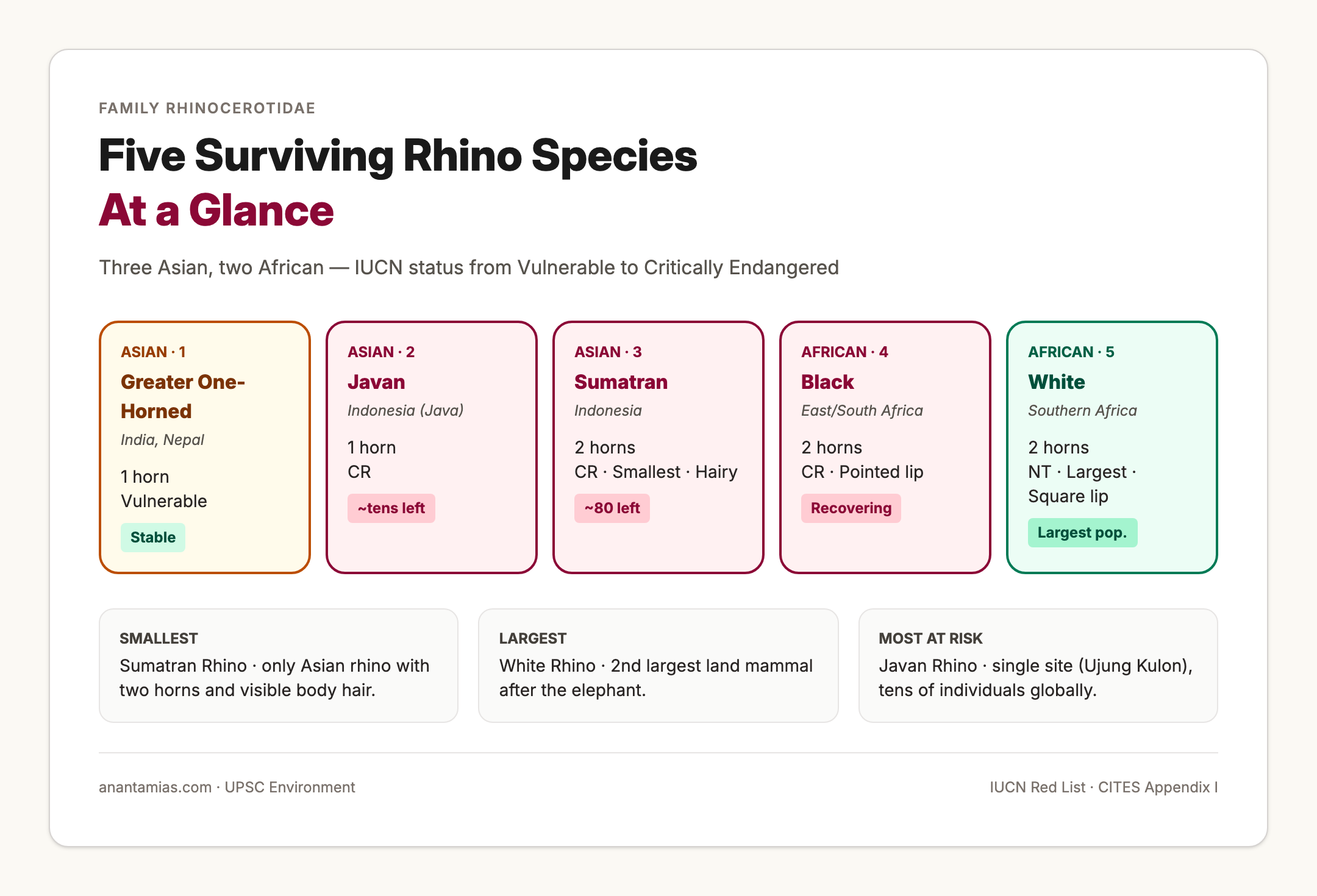
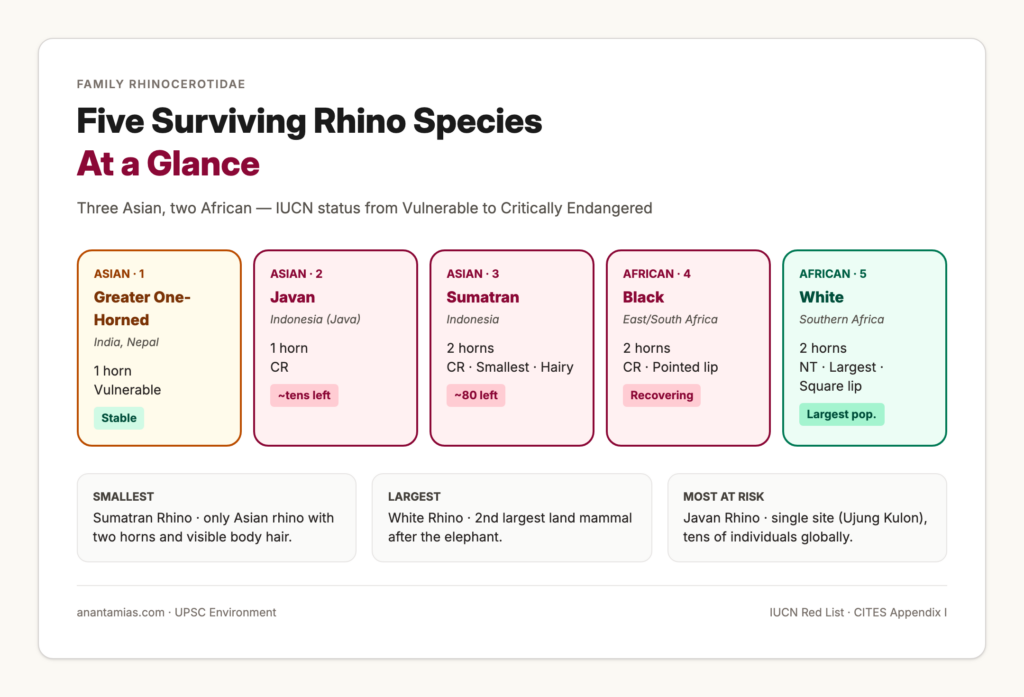
The rhinoceros family Rhinocerotidae contains five surviving species. Three are Asian: the Greater One-Horned Rhinoceros found in India and Nepal, the Javan Rhino found only in Indonesia, and the Sumatran Rhino found only in Indonesia. Two are African: the Black Rhino and the White Rhino. The Indian rhino is Vulnerable on the IUCN Red List, the Javan and Sumatran rhinos are Critically Endangered, the Black Rhino is Critically Endangered, and the White Rhino is Near Threatened. The Indian rhino is the second largest rhino after the White Rhino. The Sumatran is the smallest and the only Asian rhino with two horns and visible body hair. The Indian rhino has a single black horn made of keratin, the same protein as human hair and nails. It has poor eyesight but excellent senses of smell and hearing. It lives in tall alluvial grasslands and riverine forests. Top three Indian rhino states by population: Assam, which holds about 80 percent of the country’s rhino population, followed by West Bengal and Uttar Pradesh. Top three rhino-bearing protected areas: Kaziranga National Park, Orang National Park, and Pobitora Wildlife Sanctuary. Pobitora has the highest density of one-horned rhinos in the world, although Kaziranga has the largest absolute population. The Indian rhino is listed in Schedule I of the Wildlife Protection Act 1972 and Appendix I of CITES. World Rhino Day is observed on 22 September. RhODIS India, the Rhino DNA Indexing System, is implemented by the Wildlife Institute of India under the Ministry of Environment, Forest and Climate Change. Project Rhino is a Government of India conservation initiative for the Indian rhino.
What the Rhinoceros Is
The rhinoceros is one of the most ancient surviving large mammal lineages. Rhinos and their close relatives have been around for roughly 50 million years, and at one point the family included the Indricotherium, the largest land mammal to have ever lived. The five surviving species are a thin remnant of a once much more diverse family, kept alive in narrow geographic ranges by a combination of formal protection, habitat that humans have not yet fully cleared, and continuous anti-poaching effort.
The defining trait of the rhinoceros is the horn. Unlike the horns of cattle and antelopes, which have a bony core, rhino horns are made entirely of keratin, the same fibrous protein as human hair and fingernails. The horn grows continuously throughout the animal’s life and can regrow if cut at the base, which is the biological basis for some of the more humane horn-shaving anti-poaching practices used in Africa.
Rhinos are herbivorous and almost entirely solitary, with the partial exception of female-calf pairs. They are physically formidable, with thick skin folded into plates that gives the Indian rhino its distinctive armoured appearance, and they have surprising mobility for their size. Three of the five species sit at the top of grassland and riverine food webs in their respective ranges. Their ecological role overlaps with that of large grazing ungulates such as the Asian elephant and the wild buffalo.
Background and Historical Context
The Greater One-Horned Rhinoceros once ranged across the entire Indo-Gangetic plain, from present-day Pakistan in the west through northern India and Nepal to Bangladesh and Myanmar in the east. By the early twentieth century the species had been driven to fewer than 200 individuals across this enormous range by sport hunting under colonial rule and by the conversion of grasslands to agriculture. The first reserve specifically aimed at protecting the rhino was the Kaziranga Reserve, established in 1905 on the recommendation of Mary Curzon, then Vicereine of India, who had visited the area and been alarmed at the absence of the rhinos she had been told to expect. Kaziranga was upgraded to a national park in 1974 and to a UNESCO World Heritage site in 1985.
The Wildlife Protection Act 1972 placed the Indian rhino in Schedule I, the highest level of legal protection. Listing under CITES Appendix I in 1975 banned all international commercial trade in rhino products. Indian Rhino Vision 2020 was launched in 2005 as a partnership between the Assam Forest Department, the Bodoland Territorial Council, the World Wide Fund for Nature India, and the International Rhino Foundation, with the explicit target of growing the population to 3,000 individuals across seven protected areas in Assam by 2020.
Project Rhino, launched in 2005 by the Government of India, is the umbrella central scheme covering habitat protection, anti-poaching, and population management for the Greater One-Horned Rhino. RhODIS India, set up by the Wildlife Institute of India under the Ministry of Environment, Forest and Climate Change, gave Indian rhino conservation a forensic backbone by creating a DNA database for individual identification and trade interception.
The conservation effort has worked. India and Nepal together hold the bulk of the global Indian rhino population, which has grown from about 200 in the early twentieth century to roughly 4,000 individuals across the two countries as per latest available data, with India hosting the majority share.
Five Global Rhino Species
The Greater One-Horned Rhinoceros, Rhinoceros unicornis, is the most abundant Asian rhino. It has a single black horn and distinctive grey-brown skin folded into plates. It lives in tall alluvial grasslands and riverine forests across India and Nepal. It is classified as Vulnerable on the IUCN Red List.
The Javan Rhino, Rhinoceros sondaicus, has a single horn that is sometimes very small or absent in females. It survives only in Ujung Kulon National Park on the western tip of Java in Indonesia, with a global population in the high tens. It is Critically Endangered.
The Sumatran Rhino, Dicerorhinus sumatrensis, is the smallest of the five species and the only Asian rhino with two horns. It is also notably hairy, a feature unusual among modern rhinos. It survives only in Indonesia, in fragmented populations on Sumatra and Kalimantan. It is Critically Endangered.
The Black Rhino, Diceros bicornis, lives in eastern and southern Africa. It has two horns and a pointed prehensile lip adapted for browsing. It is Critically Endangered.
The White Rhino, Ceratotherium simum, is the largest rhino and the second largest land mammal after the elephant. It has two horns and a wide, square lip adapted for grazing. The southern subspecies has recovered to Near Threatened status under intensive protection in southern Africa. The northern subspecies is functionally extinct, with only two surviving females.
In short: the smallest is the Sumatran, the largest is the White Rhino, the only one-horned African rhino does not exist (both African rhinos have two horns), and the only two-horned Asian rhino is the Sumatran.
The Greater One-Horned Indian Rhino in Detail
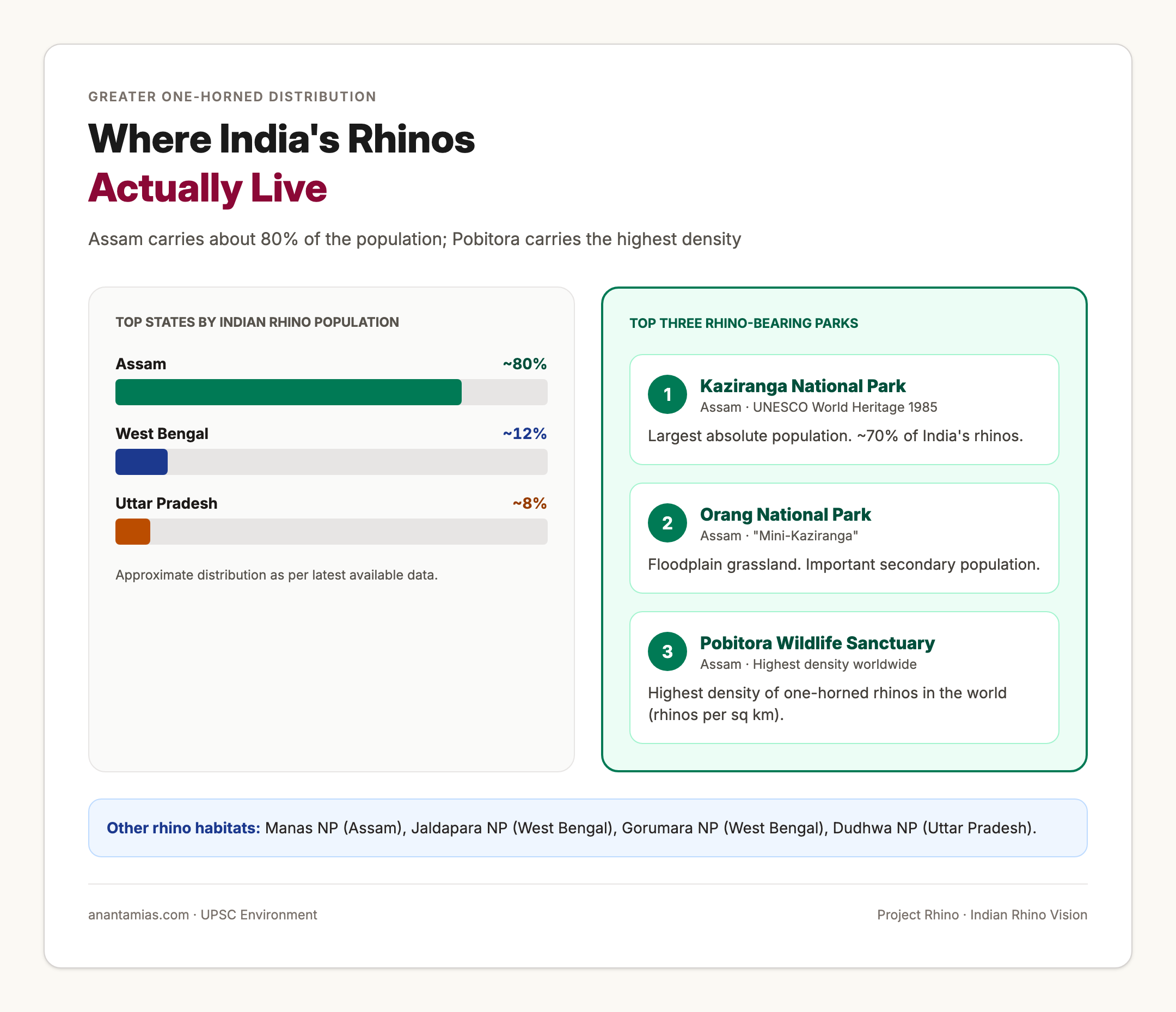
The Greater One-Horned Rhinoceros is the species that anchors Indian conservation. It has a single black horn made of keratin. Adult males weigh up to 2,500 kilograms. The skin is grey-brown with pinkish folds, giving it a plated, armoured appearance that has made it one of the most photographed wildlife subjects in India. The species has poor eyesight, which is partly why an alarmed rhino can be unpredictable, but its sense of smell and hearing are excellent.
The habitat is tall alluvial grasslands and riverine forests, particularly in floodplains where seasonal inundation regenerates the grass cover. Adults are mostly solitary, although females raise their calves alone for two to three years. Diet is almost entirely grass, supplemented with aquatic plants in the wet season.
The current Indian range is concentrated in three states. Assam holds about 80 percent of the country’s rhinos. West Bengal and Uttar Pradesh contribute the rest. The major protected areas are Kaziranga National Park in Assam, Orang National Park in Assam, Pobitora Wildlife Sanctuary in Assam, Manas National Park in Assam, Jaldapara National Park in West Bengal, Gorumara National Park in West Bengal, and Dudhwa National Park in Uttar Pradesh. Kaziranga has the largest absolute population, while Pobitora is famous as the protected area with the highest density of one-horned rhinos in the world.
Why Rhino Conservation Matters
Rhino conservation matters for three reasons. The first is intrinsic. Rhinos are large, slow-reproducing mammals at the top of their ecological niche; once they are lost, the gap left in grassland and riverine ecosystems is hard to fill. The second is symbolic. The rhino is one of India’s recognisable wildlife flagships, alongside the tiger reserves in India and the elephant, and successful rhino conservation drives broader public support for grassland and floodplain protection. The third is institutional. The institutional architecture built around the rhino, including dedicated forest battalions, DNA forensics, and joint India-Nepal anti-poaching operations, is now being adapted for other species and ecosystems.
The conservation effort also matters internationally. The Greater One-Horned Rhinoceros is the most populous Asian rhino, and the Indian and Nepalese populations are essentially the only viable population for the species. The Javan and Sumatran rhinos are too few to be self-sustaining without intensive intervention. India and Nepal are therefore stewards of the species at the global level, not just regionally.
Detailed Conservation Programmes
Project Rhino was launched in 2005 by the Government of India as the central conservation scheme for the Greater One-Horned Rhinoceros. It is implemented by the Ministry of Environment, Forest and Climate Change in partnership with state forest departments. Its three pillars are habitat protection, anti-poaching measures, and population management. Habitat protection includes grassland management, water hole maintenance, and floodplain restoration. Anti-poaching includes patrolling, intelligence networks, and the use of forensic tools. Population management includes the translocation of rhinos from high-density populations in Kaziranga and Pobitora to other parks such as Manas, where local extinction had to be reversed.
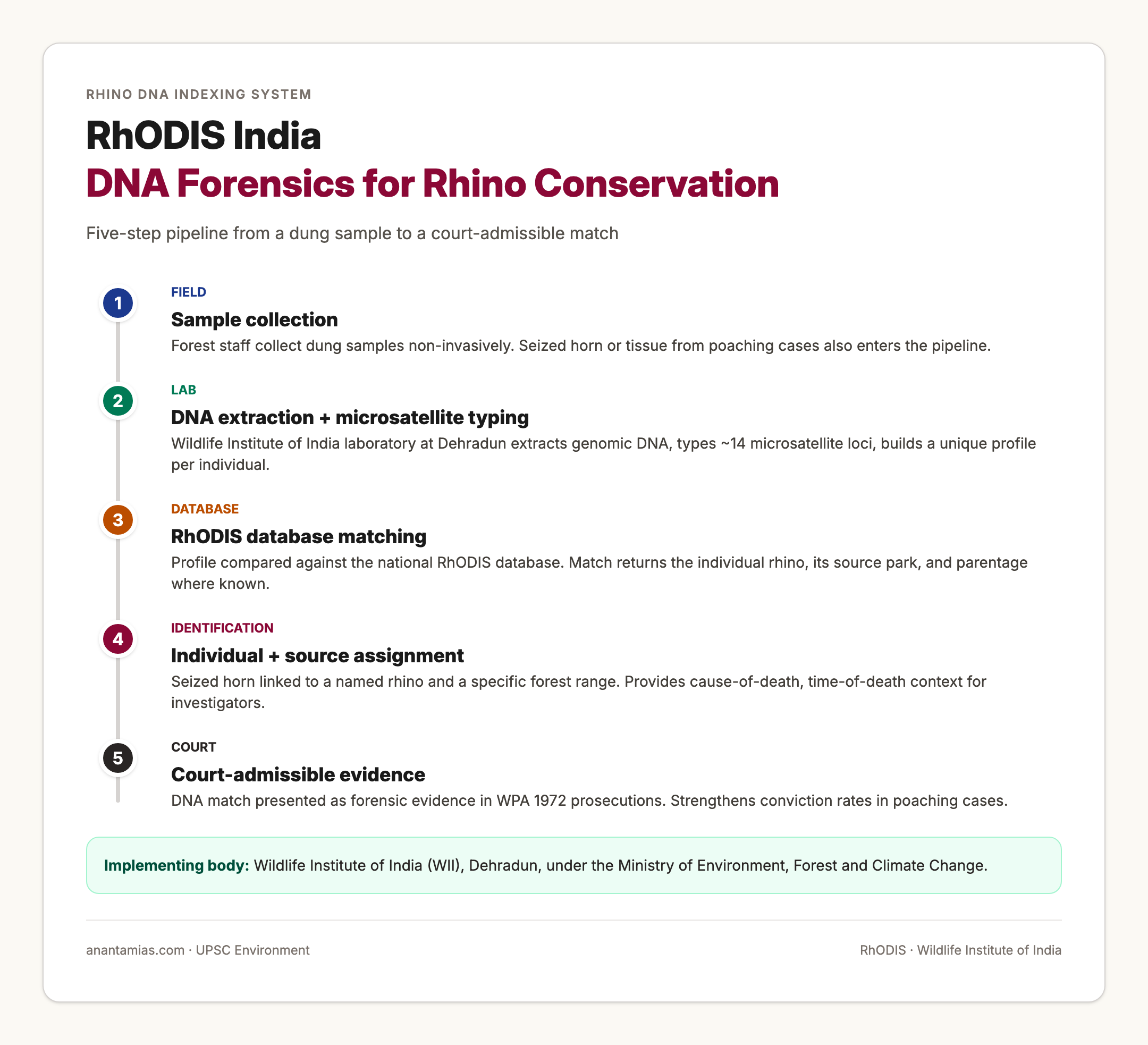
RhODIS India, the Rhino DNA Indexing System, was set up by the Wildlife Institute of India under the Ministry of Environment, Forest and Climate Change. RhODIS uses DNA fingerprinting from rhino dung samples and from seized horn or tissue to build a national database of individual rhinos. When a horn is seized, RhODIS can match the DNA profile to an individual rhino and to its source park, providing court-admissible evidence in poaching prosecutions. The programme also feeds into broader population studies, parentage analysis, and population structure mapping.
Indian Rhino Vision 2020 was the most ambitious recovery effort. Launched in 2005, it aimed to grow the rhino population in Assam to 3,000 individuals across seven protected areas by 2020. It involved coordinated translocation of rhinos from Kaziranga and Pobitora to Manas and other parks, and tight cooperation between state authorities, the Bodoland Territorial Council, and conservation NGOs. The programme is widely regarded as one of the more successful collaborative conservation interventions in India.
The Rhino Horn Radioactive Isotope Labelling Programme is a South African initiative. It involves applying trace amounts of low-grade radioactive isotopes to live rhino horns. The radiation is too low to harm the animal but is detectable at airport scanners and other border points, which deters poaching by making the horns easier to intercept and prosecute against. The Indian programme has not adopted this method, but it is frequently cited in mains-level questions on global anti-poaching innovation.
Comparative: Indian, Javan, Sumatran Rhinos
All three Asian rhinos belong to the family Rhinocerotidae but differ on every meaningful axis. The Greater One-Horned Rhinoceros is the largest of the three Asian rhinos and is found in India and Nepal, with India holding the bulk of the population. It has a single horn and Vulnerable IUCN status. The Javan Rhino is restricted to one site in Indonesia, has a single horn that is sometimes absent in females, and is Critically Endangered. The Sumatran Rhino is the smallest, has two horns, has visible body hair (the only such living rhino), and is Critically Endangered. Of the three, only the Indian rhino has a viable, growing population. The Javan and Sumatran rhinos depend on intensive captive breeding and active site protection for survival.
The contrast with the African rhinos is also revealing. The Black Rhino has been driven to roughly five thousand individuals across eastern and southern Africa, while the White Rhino, having received intensive attention especially in South Africa, has rebounded to around 16,000 to 18,000 globally. The Indian conservation story sits between these two African trajectories: not yet at the White Rhino level of recovery, but well past the early-stage population crisis that characterised the species in the early twentieth century.
Challenges Ahead
Three challenges anchor the next phase of Indian rhino conservation. The first is habitat fragmentation. The rhino-bearing parks are largely islands surrounded by intense human use, and connectivity between Kaziranga, Orang, and Manas remains limited. Annual flooding of the Brahmaputra also displaces rhinos out of the parks each monsoon, exposing them to highway accidents and poaching. The second is poaching. Demand for rhino horn in some Asian markets remains a structural pressure. RhODIS India and the new generation of forest battalions have reduced poaching incidents significantly, but the threat does not disappear. The third is human-wildlife conflict. As populations recover, rhinos move into community land, particularly during floods, and damage crops or injure people. Compensation schemes and community conservation models are required to keep public support behind the programmes.
Prelims Pointers
There are five surviving rhino species: Greater One-Horned (India and Nepal), Javan (Indonesia), Sumatran (Indonesia), Black (Africa), and White (Africa).
The Sumatran Rhino is the smallest and the only Asian rhino with two horns and visible hair.
The White Rhino is the largest rhino and is Near Threatened.
The Indian rhino is Vulnerable on the IUCN Red List, listed in Schedule I of the Wildlife Protection Act 1972, and in Appendix I of CITES.
Top three Indian states by rhino population: Assam (about 80 percent), West Bengal, Uttar Pradesh.
Top three rhino parks: Kaziranga National Park, Orang National Park, Pobitora Wildlife Sanctuary. Pobitora has the highest density of one-horned rhinos in the world.
World Rhino Day: 22 September.
RhODIS India is implemented by the Wildlife Institute of India under MoEFCC.
Project Rhino was launched in 2005 by the Government of India.
Mains Questions
Examine the role of Indian Rhino Vision 2020 and the RhODIS India programme in the recovery of the Greater One-Horned Rhinoceros population in India. (GS III, 250 words)
Discuss the principal threats facing the Greater One-Horned Rhinoceros in Assam and evaluate the effectiveness of current conservation interventions. (GS III, 250 words)
Compare the conservation strategies adopted for the Greater One-Horned Rhinoceros in India with those for the African White Rhino, including the rhino horn radioactive isotope labelling programme. (GS III, 250 words)
Why are floodplain grasslands of the Brahmaputra basin critical to rhino conservation? Discuss with reference to Kaziranga and Manas. (GS III, 150 words)
Way Forward
The way forward has three priorities. First, expand range. The current range is too narrow for a species at this population size, and translocation efforts to parks such as Manas and Dudhwa need to continue, supported by ecological corridor restoration between protected areas. Second, deepen the forensic and intelligence base. RhODIS India should be expanded to cover all rhino-bearing parks with a complete genetic database; cross-border DNA cooperation with Nepal would tighten the joint anti-poaching effort. Third, integrate community livelihoods. Compensation, community-based tourism, and shared revenue models reduce the local cost of having a large mammal population around villages and convert conservation from a state imposition into a community asset.
Frequently Asked Questions
What are the five surviving species of rhinoceros?
The five surviving species are the Greater One-Horned Rhinoceros found in India and Nepal, the Javan Rhino found in Indonesia, the Sumatran Rhino found in Indonesia, the Black Rhino found in Africa, and the White Rhino found in Africa. Three species are Asian and two are African.
Which is the largest rhinoceros?
The White Rhino is the largest rhinoceros and the second largest land mammal after the elephant. The Greater One-Horned Indian Rhino is the second largest. The Sumatran Rhino is the smallest of the five.
What is the IUCN status of the Indian rhino?
The Greater One-Horned Rhinoceros, the Indian rhino, is classified as Vulnerable on the IUCN Red List. It is also listed in Schedule I of the Wildlife Protection Act 1972 and in Appendix I of CITES, which bans international commercial trade in rhino products.
Which Indian state has the most rhinos?
Assam has the largest rhino population in India, holding roughly 80 percent of the country’s total. West Bengal and Uttar Pradesh contribute the rest.
Which national park has the highest density of one-horned rhinos in the world?
Pobitora Wildlife Sanctuary in Assam has the highest density of one-horned rhinos in the world. Kaziranga National Park, also in Assam, holds the largest absolute population of the species.
What is RhODIS India?
RhODIS India, which stands for Rhino DNA Indexing System, is a forensic database programme that uses DNA fingerprinting from rhino dung and seized horn samples to build profiles for individual rhinos. It is implemented by the Wildlife Institute of India under the Ministry of Environment, Forest and Climate Change. It is used to provide court-admissible evidence in poaching cases and to support wider population studies.
What is Project Rhino?
Project Rhino is the umbrella central conservation programme for the Greater One-Horned Rhinoceros, launched in 2005 by the Government of India. Its three pillars are habitat protection, anti-poaching measures, and population management including translocation between protected areas.
When is World Rhino Day celebrated?
World Rhino Day is observed every year on 22 September. It celebrates all five surviving species of rhinoceros and is marked by conservation organisations worldwide.
What is the rhino horn radioactive isotope labelling programme?
The rhino horn radioactive isotope labelling programme is an anti-poaching initiative implemented in South Africa. It involves applying trace amounts of low-grade radioactive isotopes to live rhino horns. The radiation is too low to harm the animal but is detectable at airport scanners and border checkpoints, making poached horns easier to intercept and prosecute.
Are rhino horns made of bone?
Rhino horns are not made of bone. They are made of keratin, the same fibrous protein that forms human hair and fingernails. The horn grows continuously through the animal’s life and can regenerate if cut at the base, which is why some humane anti-poaching strategies involve trimming horns rather than removing them surgically.
Tell Google you want more of this.
Add Anantam IAS as a preferred sourceOne tap, and this site shows up more often in your own Top Stories, AI Overviews and AI Mode. Remove it any time.