

Tribunals are quasi-judicial bodies created either by an Act of Parliament or by executive order to provide faster, expert and specialised adjudication outside the regular court system. They reduce the workload of High Courts, bring subject-matter expertise (tax, service, company law, environment) to adjudication, and give citizens a dedicated forum. For UPSC, tribunals are a recurring GS-II theme: constitutional basis, landmark cases, executive dominance concerns, and recent rationalisation.
Why tribunals
- Caseload pressure on High Courts.
- Technical subject matter (tax, company law, telecom, competition) requiring specialist adjudicators.
- Faster, less formal disposal, adhering to principles of natural justice but not strict Evidence Act.
- Accessible justice — often simpler procedure and lower cost.
Constitutional basis
Tribunals were constitutionalised by the 42nd Amendment Act, 1976 (Swaran Singh Committee recommendation), inserting Part XIV-A with two articles:
- Article 323A — Administrative Tribunals for public-service matters. Exclusive power of Parliament.
- Article 323B — Other tribunals for subjects such as taxation, land reform, election, ceiling on urban property, labour disputes. Parliament and State Legislatures can both legislate.
The Supreme Court has held that the subject matter under 323B is illustrative, not exhaustive — legislatures may create tribunals on any subject within their Seventh Schedule competence.
Administrative Tribunals Act, 1985
Enacted under Article 323A; created the Central Administrative Tribunal (CAT) and State Administrative Tribunals. CAT has jurisdiction over central government service matters; orders are appealable to the High Court.
Essentials of a tribunal vs. "trappings of a court"
| Essentials of a tribunal | Trappings of a court |
|---|---|
| Quasi-judicial body | Authority to determine cases initiated by parties |
| Under an obligation to act judicially | Sitting in public |
| Constituted by the State | Power to compel witnesses, examine on oath |
| Some "trappings of a court" | Duty to follow fundamental rules of evidence |
| Confer power to adjudicate on disputes | Imposition of sanctions — imprisonment, fine, damages; prohibitory/mandatory orders |
Major tribunals in India
| Tribunal | Act | Jurisdiction |
|---|---|---|
| Central Administrative Tribunal (CAT) | Administrative Tribunals Act, 1985 | Central government service matters |
| Income Tax Appellate Tribunal (ITAT) | IT Act, 1961 | Direct tax appeals |
| Customs, Excise and Service Tax Appellate Tribunal (CESTAT) | Customs Act, 1962 | Indirect tax appeals |
| Debt Recovery Tribunal (DRT) | RDDB Act, 1993 | Bank/FI recoveries |
| National Company Law Tribunal (NCLT) / NCLAT | Companies Act, 2013; IBC, 2016 | Company & insolvency |
| National Green Tribunal (NGT) | NGT Act, 2010 | Environmental disputes |
| Armed Forces Tribunal (AFT) | AFT Act, 2007 | Service matters of armed forces |
| Telecom Disputes Settlement and Appellate Tribunal (TDSAT) | TRAI Act, 1997 | Telecom, broadcasting, data |
| Securities Appellate Tribunal (SAT) | SEBI Act, 1992 | Securities market appeals |
| Central Excise, Sales Tax, RERA, Lok Pal Bench etc. | Subject-specific laws | Specialised |
Landmark judgments
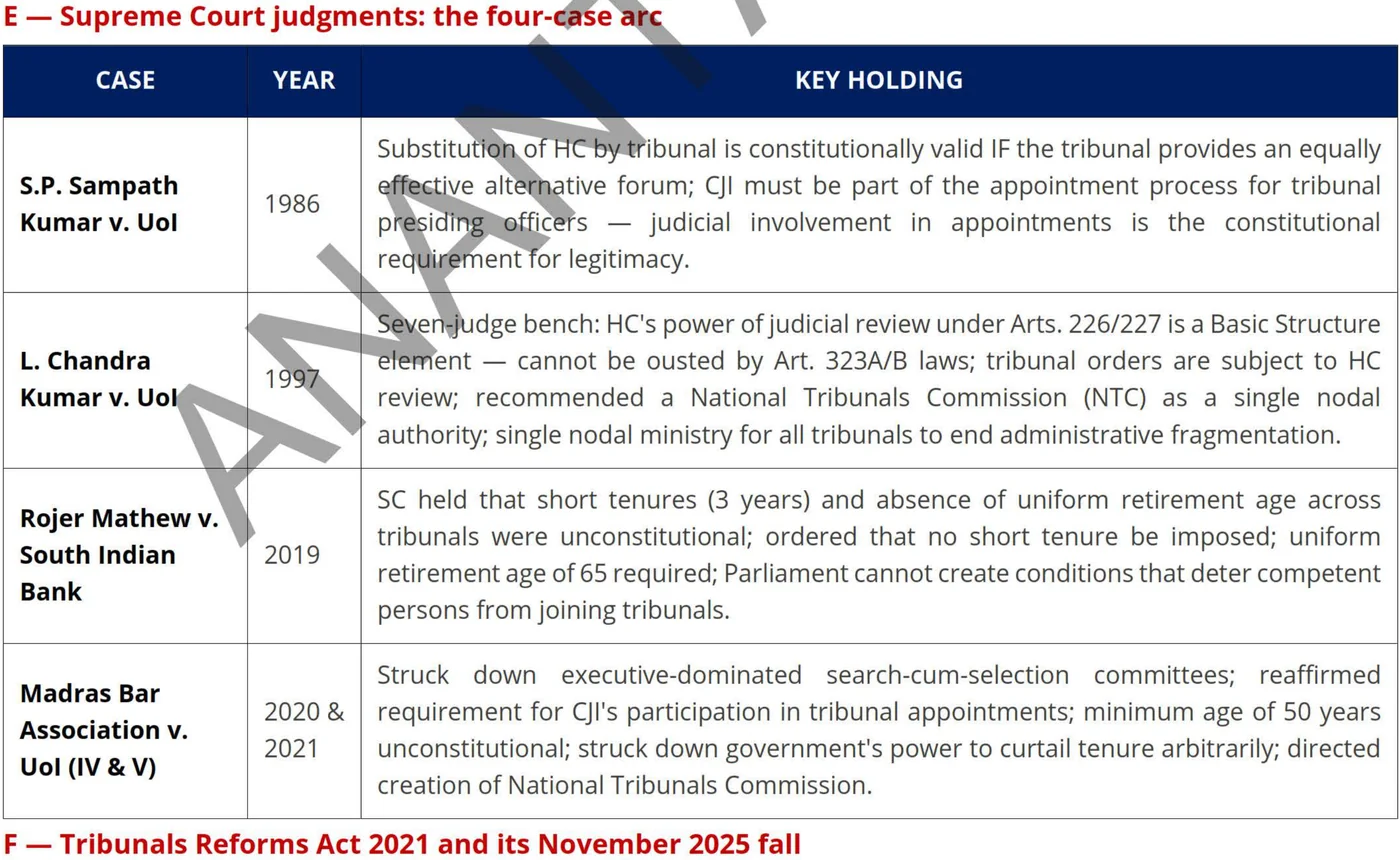
S.P. Sampath Kumar v. UoI (1987)
Upheld exclusion of High Court jurisdiction by Administrative Tribunals Act as creating an "alternative institutional mechanism" equally competent to High Courts; laid down qualifications and appointment norms.
Sakinala Harinath v. State of AP (1993)
Andhra Pradesh HC held that removing judicial review by High Courts violates the basic structure.
R.K. Jain v. UoI (1993)
Supreme Court criticised Sampath Kumar; reasserted that Article 226/227 cannot be excluded.
L. Chandra Kumar v. UoI (1997)
A 7-judge Constitution Bench landmark verdict:
- Power of High Courts under Articles 226/227 and of the Supreme Court under Article 32 is part of the basic structure; tribunals cannot oust it.
- All tribunal decisions are subject to the writ jurisdiction of the Division Bench of the jurisdictional High Court.
- Tribunals are supplemental, not substitute, forums.
- Recommended a single nodal ministry for tribunal administration.
Madras Bar Association Series (2010, 2014, 2021)
- 2010 — Validity of NCLT/NCLAT; Selection Committee should be CJI or nominee (chair with casting vote), senior SC Judge/HC CJ, plus Secretaries of Finance and Law — ensuring judicial dominance.
- 2014 — Re-affirmed the 2010 principles for all tribunals.
- 2021 — Struck down provisions of the Tribunal Reforms (Rationalisation and Conditions of Service) Ordinance, 2021 and the subsequent Act on tenure and age criteria.
Rojer Mathew v. South Indian Bank (2019)
Struck down the Tribunal, Appellate Tribunal and other Authorities (Qualifications, Experience and other Conditions of Service of Members) Rules, 2017 on grounds of executive dominance in selection committees; directed framing of new rules.
Executive dominance concerns
- Selection committees heavily weighted with executive nominees — violates judicial independence and separation of powers.
- Government as litigant — most tribunals adjudicate disputes involving the government; executive-dominated selection raises bias perception.
- Non-judicial chairpersons — makes judicial members a minority.
The SC's repeated prescription (Madras Bar Association series): CJI or nominee as chair with casting vote, senior SC judge/HC CJ, and only two executive members.
Tribunals Reforms Act, 2021
Key features:
- Abolished 9 appellate tribunals (FAT, AAC, IPAB, Film Certification Appellate Tribunal, PMLA appellate authority etc.); transferred cases to High Courts or other tribunals.
- 4-year term; age ceiling — 70 for chairperson, 67 for members.
- Minimum age 50 for appointment — controversial; criticised for excluding younger talent; the SC had earlier suggested 10-year advocates as judicial members.
- Search-cum-Selection Committee: CJI or nominee (chair, casting vote), two Secretaries, outgoing chairperson, and the Secretary of the parent Ministry.
The SC in Madras Bar Association (2021) struck down the 4-year term and age criteria; Parliament re-enacted the provisions in the 2021 Act (replacing the Ordinance).
Issues
- Pendency in tribunals — data from Finance Ministry suggests tribunals do not always reduce HC workload; NCLT, DRT and CAT themselves have heavy pendency.
- Delay in appointments — many tribunals function with vacancies; some without chairpersons.
- Executive dominance in selection.
- Reduced access post-abolition (IPAB abolition shifted IP disputes to HCs; critics argue loss of specialisation).
- Infrastructure deficit — inadequate benches, staff, and technology.
- Appellate chain — variable; direct appeal to HC for some, to SC for others.
Latest developments (2024-26)
Updated context: Tribunal reform continues to evolve; the central government's push for rationalisation has been tempered by SC interventions and pendency data.
- NCLT / NCLAT pendency — insolvency case backlogs have prompted creation of additional benches; IBBI data (2024) shows rising admission pendency.
- NGT Eastern Bench, Southern Bench vacancies periodically noted by SC.
- Tribunals Reforms — amendment proposals being discussed to refine selection committee composition.
- Central and State Administrative Tribunals integration with e-courts project; virtual hearings now routine.
- Supreme Court monitoring — the court has periodically directed the Centre to fill vacancies; compliance affidavits filed.
National Green Tribunal — a special case
The National Green Tribunal (NGT), created by the NGT Act, 2010 under Article 253, is a specialist tribunal for environmental disputes. It is headed by a retired SC judge or HC Chief Justice, with judicial and expert members. NGT has:
- Principal Bench in New Delhi and four regional benches (Pune, Bhopal, Kolkata, Chennai).
- Jurisdiction under seven environmental laws including Water Act, Air Act, Forest Conservation Act, Environment Protection Act, Biodiversity Act.
- Power to issue orders, directions, and award compensation.
- Appeals lie directly to the Supreme Court under Section 22.
NGT has become one of the most active tribunals — from the Sterlite Copper closure (2018) to construction dust in Delhi-NCR. Critics argue it sometimes strays into policy (e.g., 10-year diesel-vehicle ban in NCR); defenders point to its rights-protection role under the M.C. Mehta tradition.
Issues with tribunal system — case studies
IPAB abolition (2021) — The Intellectual Property Appellate Board was abolished; IP disputes moved to High Courts. Critics argue specialised IP adjudication has suffered; backlog has grown.
NCLT pendency (2024) — Over 21,000 cases pending; IBC's 330-day resolution timeline often missed. The Insolvency Law Committee has recommended bench expansion.
AFT disposal — Armed Forces Tribunal's decisions have reduced some service disputes but HC appeals continue to weigh the system.
Reform pathway
- Single nodal ministry (as L. Chandra Kumar urged) — a National Tribunals Commission to administer appointments, budgets and infrastructure.
- Judicial-dominant selection — strict adherence to Madras Bar Association norms.
- Eligibility — include younger advocates with 10-plus years' practice.
- Technology and infrastructure — video-conferencing, digital case management.
- Sunset clauses — evaluate whether a tribunal is achieving its mandate before renewal.
UPSC Relevance
GS-II mapping: Structure, organisation and functioning of the Judiciary; Statutory, regulatory and various quasi-judicial bodies; Separation of powers.
Prelims pointers:
- Articles 323A and 323B inserted by 42nd Amendment Act, 1976.
- Administrative Tribunals Act, 1985 — CAT, SAT.
- L. Chandra Kumar (1997) — Art 226/227 = basic structure; tribunals supplemental.
- National Green Tribunal — 2010; headquarters Delhi; four regional benches.
- NCLT and NCLAT under Companies Act, 2013.
- Tribunals Reforms Act, 2021 — abolished 9 tribunals.
- Madras Bar Association — judicial-dominant selection committee.
Mains angles:
- "Tribunals were meant to be a supplement to the judiciary, not its substitute." Examine in the light of L. Chandra Kumar and subsequent developments.
- Discuss the challenges in the functioning of tribunals in India. Suggest measures to enhance their efficacy and independence.
Related: Supreme Court of India, National Green Tribunal, Separation of Powers.
Tell Google you want more of this.
Add Anantam IAS as a preferred sourceOne tap, and this site shows up more often in your own Top Stories, AI Overviews and AI Mode. Remove it any time.






