The Indian Constitution treats reservation in local government differently from reservation in education and public employment. Articles 243D and 243T allow the State to reserve seats for Scheduled Castes and Scheduled Tribes in panchayats and municipalities on a population basis, automatically. For Other Backward Classes, the same Articles do not mandate reservation. They authorise the State Legislature to enact a law providing for OBC reservation, but they leave the decision to the State. That discretion has been the source of more than a decade of constitutional litigation.
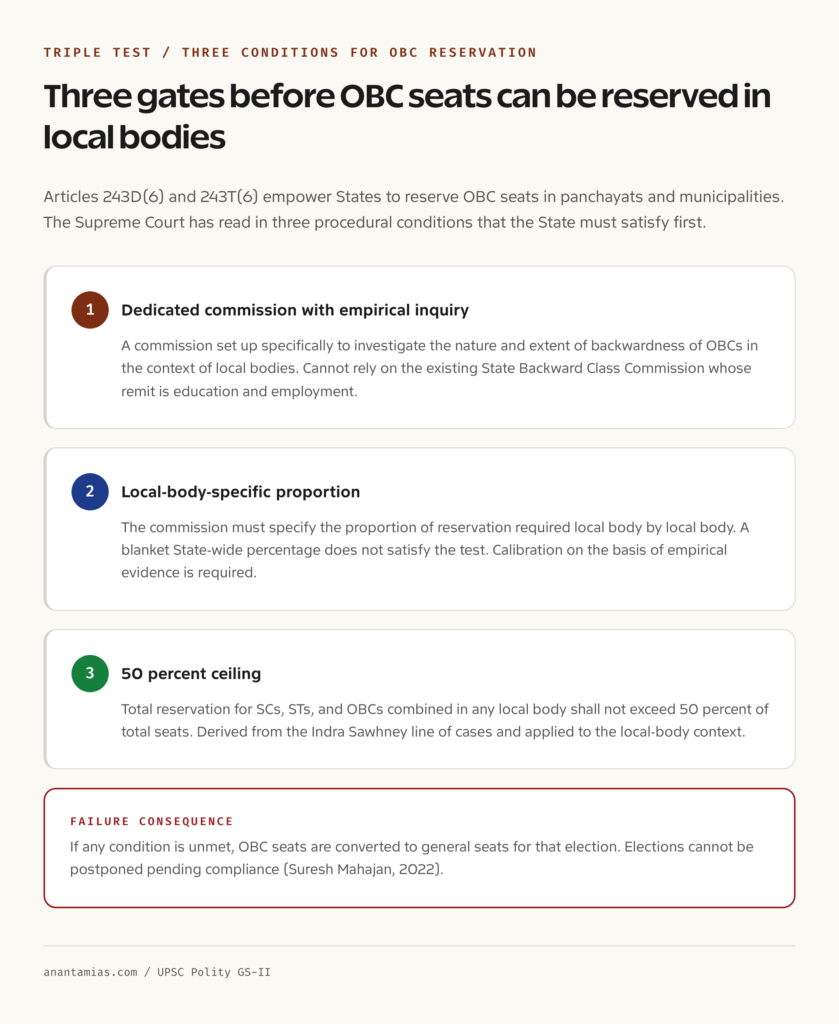
The Supreme Court has held that the discretion is not unguided. A State that wishes to reserve local body seats for OBCs must first satisfy a three-part test, popularly called the Triple Test or the Triple Condition. Without the test being satisfied, any OBC reservation is constitutionally vulnerable, regardless of the political mandate behind it. The doctrine first appeared in K. Krishna Murthy v. Union of India, 2010, and was sharpened and operationalised in Vikas Kishanrao Gawali v. State of Maharashtra, 2021.
This guide walks through the constitutional architecture of OBC reservation in local bodies, the three conditions of the Triple Test, the leading cases that built it, the recent state-level implementation experience including the Allahabad High Court’s intervention on the Uttar Pradesh draft notification, and the prelims and mains pointers for UPSC aspirants. The doctrine sits at the intersection of reservation in India, panchayati raj, and the broader law of local self-government.
Quick Facts on the Triple Test
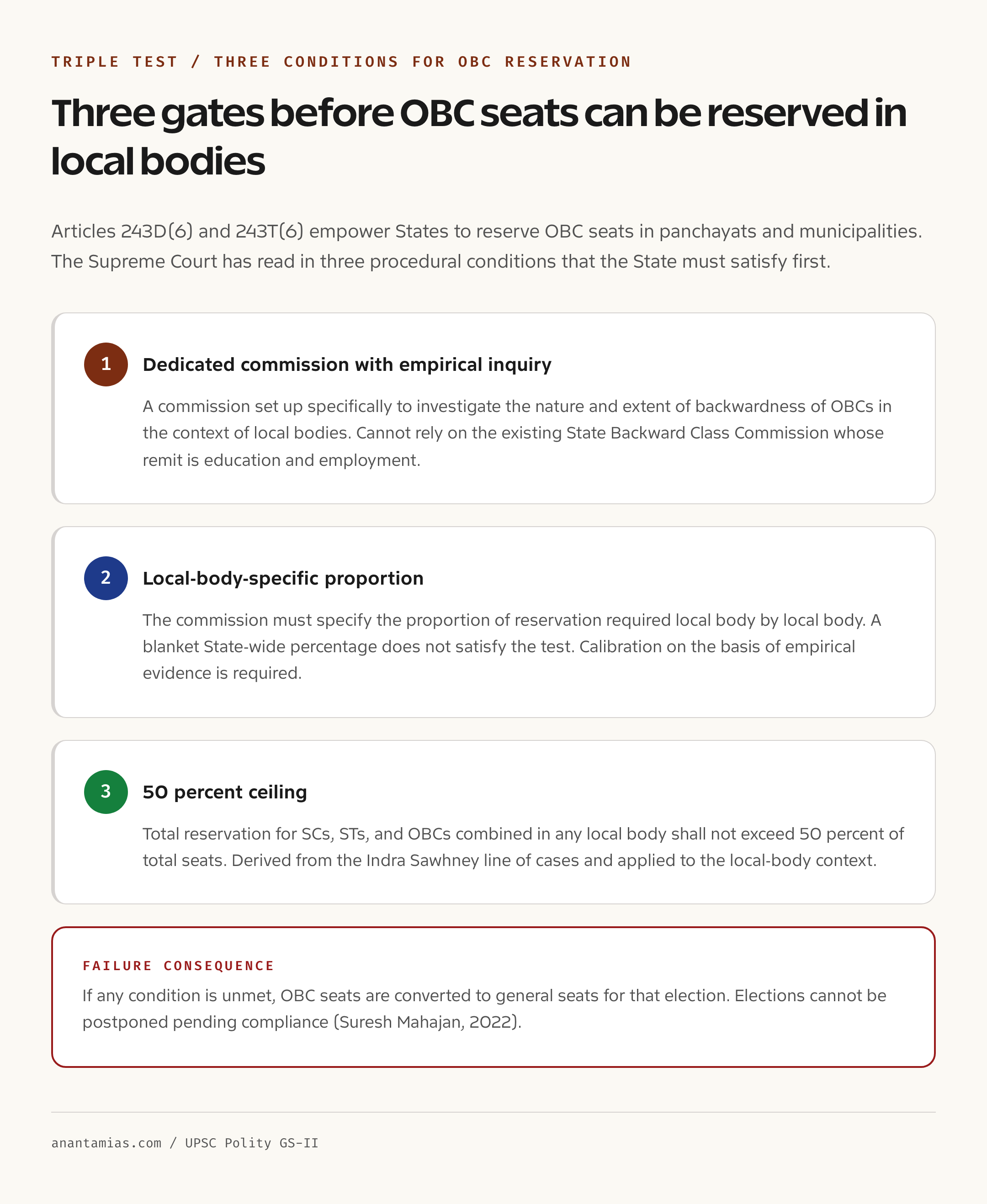
The Triple Test is a Supreme Court mandated three-condition framework that a State must satisfy before reserving panchayat or municipality seats for OBCs. The first condition is the setting up of a dedicated commission to conduct an empirical inquiry into the nature and extent of backwardness of OBCs in the context of local bodies. The second condition is the specification by the commission of the proportion of reservation required, local body by local body. The third condition is the 50 percent ceiling: the total reservation for SCs, STs, and OBCs combined in any local body shall not exceed 50 percent. The doctrine was first articulated in K. Krishna Murthy v. Union of India, 2010, and developed into the operative test in Vikas Kishanrao Gawali v. State of Maharashtra, 2021. The constitutional source is Article 243D(6) for panchayats and Article 243T(6) for municipalities.
What the Triple Test Requires
The Triple Test is the Supreme Court’s procedural answer to the question of when OBC reservation in local bodies is constitutionally valid. It is not a substantive limit on the right of the State to reserve seats. It is a procedural framework that the State must follow before exercising the right.
The first condition requires a dedicated commission. The State cannot rely on general assumptions or even on existing State Backward Class Commissions whose remit is education and public employment. The dedicated commission must conduct a rigorous, empirically grounded inquiry into the nature and extent of backwardness of OBCs specifically in the context of political representation in local government. The data, methodology, and findings must be capable of independent scrutiny.
The second condition requires the commission to specify the proportion of reservation for each level of local body. The commission cannot recommend a uniform percentage for the entire State. It must look at panchayat by panchayat, municipality by municipality, and recommend a level of reservation that reflects the empirical findings about OBC backwardness in that local body. A blanket recommendation does not satisfy this condition.
The third condition is the 50 percent ceiling. The total reservation for SCs, STs, and OBCs in any local body shall not exceed 50 percent of the total seats. The ceiling derives from the wider Indra Sawhney line of cases, which established the 50 percent rule for reservation in public employment and education. The Supreme Court has applied the same ceiling to local body reservation. Any OBC reservation that, combined with the SC and ST reservation, takes the total above 50 percent fails the test.
Background and Constitutional Context
The Seventy-Third and Seventy-Fourth Constitutional Amendments of 1992 created the modern framework for panchayats and urban local bodies in India. Article 243D was added to the Constitution to provide for reservation of seats in panchayats. Article 243T was added to provide for reservation in municipalities. Both Articles mandate reservation for SCs and STs in proportion to the population of those communities in the local body. Both Articles empower the State Legislature to make laws for OBC reservation, but neither makes the OBC reservation automatic.
The asymmetry is deliberate. The Constitution treats SC and ST reservation as a constitutional entitlement at the local body level, on the basis of the long historical record of social and political exclusion. OBC reservation is treated as a matter for legislative discretion. The State is empowered, but not obliged, to provide for it. Article 15(4) and Article 16(4), which authorise reservation in education and public employment for backward classes, do not directly govern local body reservation. The Supreme Court has held that “backwardness” in the context of local bodies is a separate inquiry, focused on political representation rather than on social and educational backwardness.
The empirical question that the Court has insisted on is therefore distinct. A community that is socially and educationally backward is not automatically politically under-represented in local bodies. The State must show, through evidence collected by a dedicated commission, that the community in question is in fact under-represented at the local body level and that reservation is the appropriate remedy. The Triple Test operationalises this empirical requirement.
The Three Conditions in Detail
The first condition, the dedicated commission, is the most demanding. The commission must be set up specifically for the purpose of inquiring into local-body backwardness. It cannot be an existing State Backward Class Commission with a different mandate. The commission must collect and analyse data on the participation, representation, and political voice of OBCs in panchayats and municipalities across the State. It must take evidence from stakeholders, conduct field surveys where necessary, and produce a report that justifies its recommendations.
The second condition, the local-body-specific proportion, is a refinement of the first. The commission’s report must do more than identify a State-wide level of OBC backwardness. It must recommend the proportion of reservation appropriate for each tier and each unit of local body. A panchayat in a district with a high concentration of OBCs may need a different level of reservation from a municipality in another district. The commission’s job is to do that calibration on the basis of empirical evidence.
The third condition, the 50 percent ceiling, is a simple arithmetic check, but it has substantial political consequences. In States where SC and ST reservation alone is already at or near the 50 percent threshold, the room for OBC reservation is limited. The State cannot lift the ceiling to accommodate political demands for higher OBC representation. Any reservation scheme that breaches the ceiling will be struck down regardless of how rigorous the commission’s empirical work was.
Why It Matters
The Triple Test matters for three institutional reasons. The first is the discipline it imposes on State law-making. Before the doctrine, States routinely provided OBC reservation in local bodies on the basis of political bargaining and broad-brush assumptions about backwardness. The Triple Test forces the State to do empirical homework before legislating. That homework, when done properly, produces a more defensible and durable reservation scheme.
The second reason is the protection of competing rights. SC and ST reservation in local bodies is a constitutional entitlement. If OBC reservation is added without empirical foundation, the combined reservation can crowd out general seats and create constitutional friction. The 50 percent ceiling, applied through the Triple Test, manages that friction by ensuring that the total reservation remains within constitutional limits.
The third reason is the integrity of the local democracy. Panchayats and municipalities are the most direct point of contact between citizens and elected representatives. Reservation policy at this level shapes political careers and community participation. The Triple Test ensures that the reservation, when provided, is grounded in evidence rather than in political opportunism.
Detailed Analysis: K. Krishna Murthy and Vikas Kishanrao Gawali
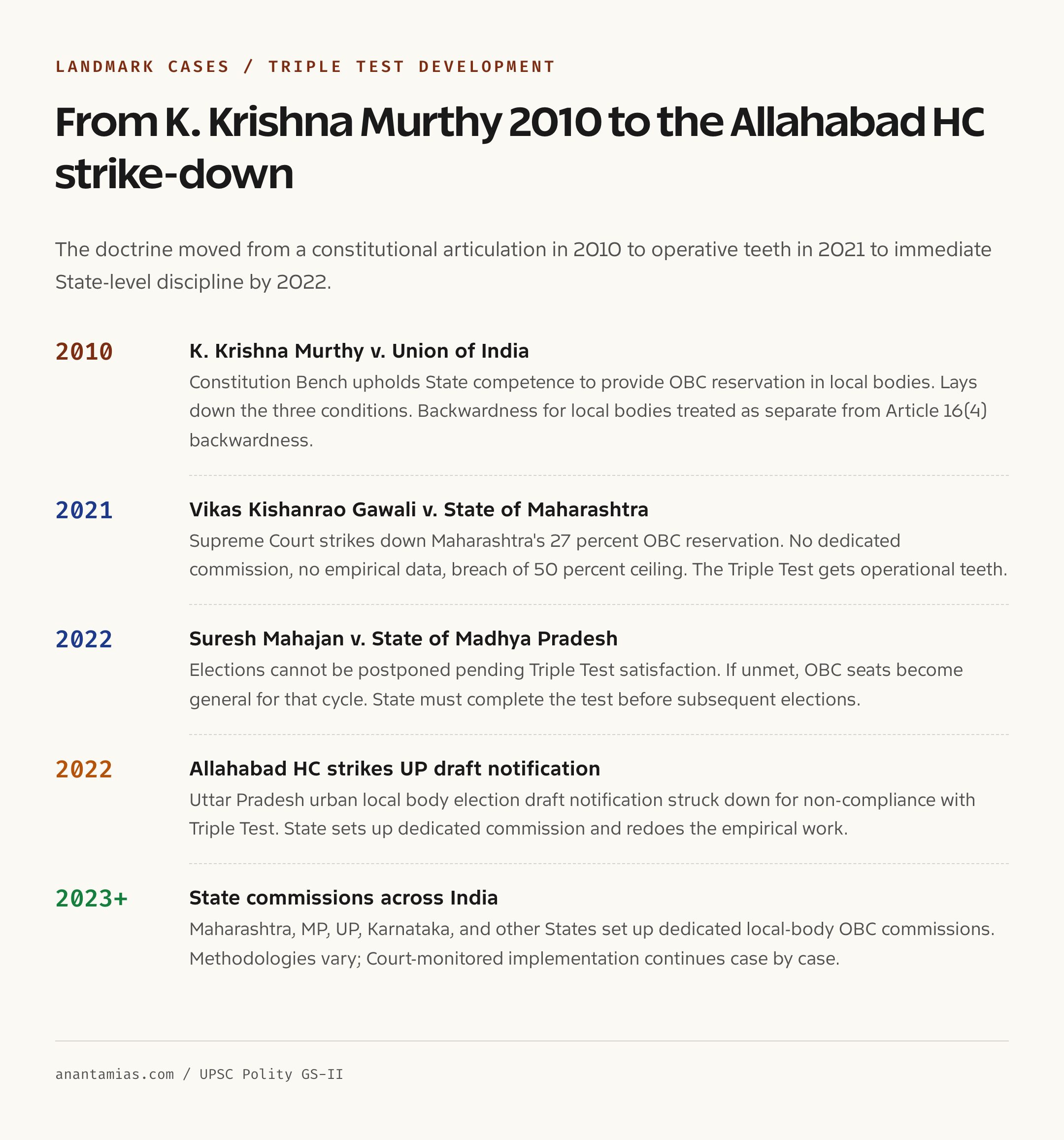
K. Krishna Murthy v. Union of India, 2010, is the foundational case. A Constitution Bench of the Supreme Court was examining the constitutional validity of OBC reservation in local bodies. The Court upheld the legislative competence of the State to provide such reservation but laid down the three conditions that the State must satisfy. The Court emphasised that “backwardness” for local bodies is a separate inquiry from “backwardness” for education and employment, and that the State must collect specific empirical data on local-body backwardness before reserving seats.
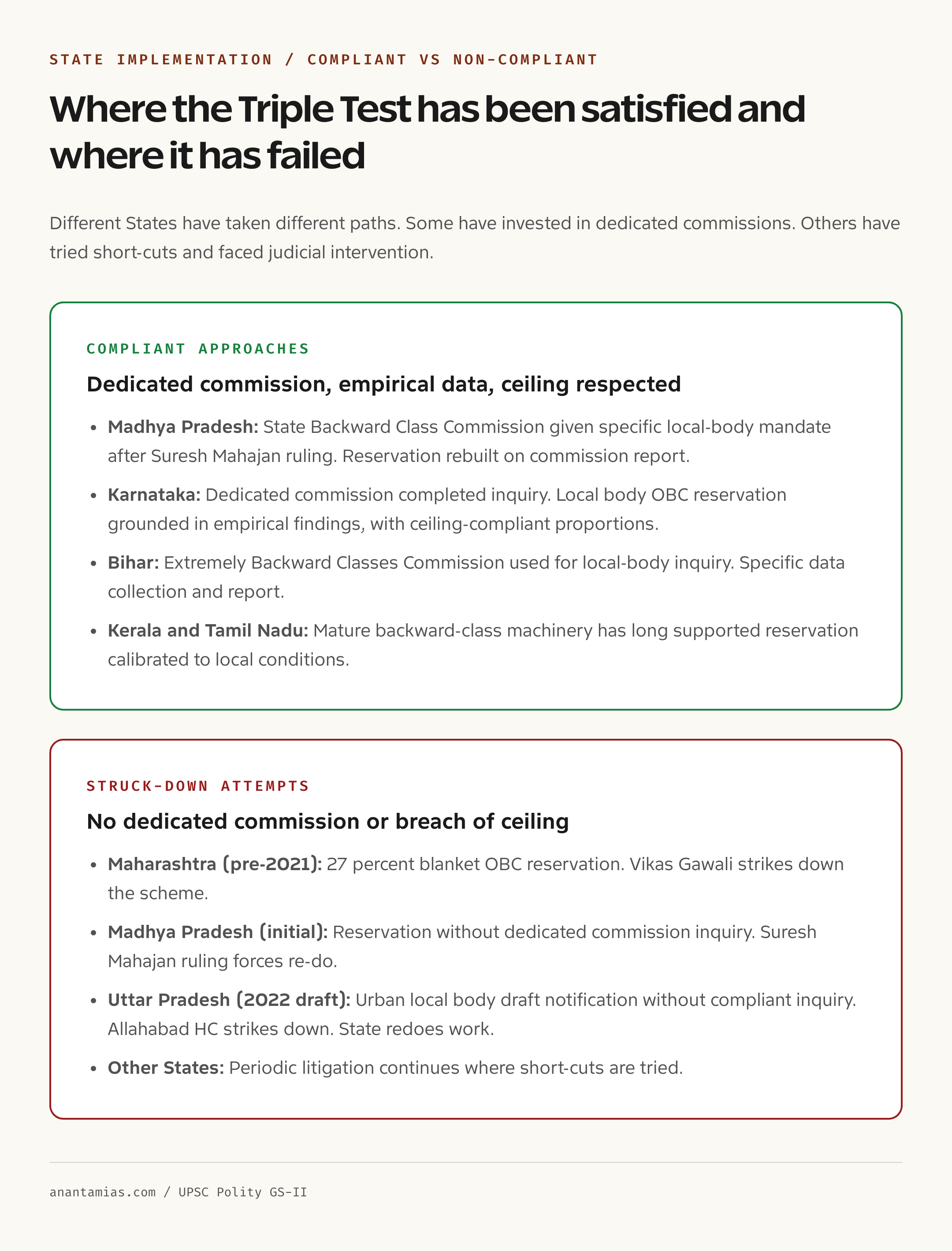
Vikas Kishanrao Gawali v. State of Maharashtra, 2021, sharpened the doctrine and gave it operational teeth. The Maharashtra government had provided 27 percent OBC reservation in local bodies under a 1994 statute. The Supreme Court found that the State had not set up a dedicated commission, had not collected the required empirical data, and had not specified local-body-by-local-body proportions. The 27 percent reservation, combined with the SC and ST reservation, also breached the 50 percent ceiling in many local bodies. The Court struck down the reservation and ordered the elections to proceed without OBC reservation until the Triple Test was satisfied.
Suresh Mahajan v. State of Madhya Pradesh, 2022, applied the Vikas Gawali framework to MP and reiterated that elections cannot be postponed pending the satisfaction of the Triple Test. The Court directed that local body elections proceed on time, and if the State has not completed the Triple Test, the OBC seats are converted to general seats for that election cycle. The political pressure to compromise the test was thus answered with a procedural rule that protected the timeliness of elections.
The Allahabad High Court applied the doctrine in 2022 to strike down the Uttar Pradesh government’s draft notification for urban local body elections. The State had not set up a dedicated commission and had not done the empirical inquiry that the test requires. The Court struck down the notification, prompting the State to set up a dedicated commission and redo the work.
Comparative Look: State Implementation
The state-level experience with the Triple Test is uneven. Bihar has used its existing Extremely Backward Classes Commission to do work that approximates the dedicated commission requirement, though the legal sufficiency of this approach has been contested. Madhya Pradesh, after the Suresh Mahajan ruling, set up a State Backward Class Commission with a specific mandate for local-body inquiry and based its subsequent OBC reservation on the commission’s report. Maharashtra, after the Vikas Gawali ruling, undertook a similar exercise, though it has been politically slow.
Karnataka and Telangana have completed their dedicated commission work and have OBC reservation in local bodies that has been judicially examined. Tamil Nadu and Kerala, with their stronger backward classes representation traditions, have managed to satisfy the test in different ways. Uttar Pradesh, after the Allahabad High Court intervention, set up a dedicated commission and conducted the inquiry before notifying urban local body elections.
The pattern across States suggests two lessons. First, the Triple Test is not impossible to satisfy, but it requires real institutional investment in empirical data collection. Second, States that try to short-cut the test through existing commissions or general data face judicial intervention and election delays. The political incentive is therefore to invest in a dedicated commission early.
Challenges and Open Questions
Three difficulties recur in Triple Test cases. The first is the methodological standard for the dedicated commission’s inquiry. The Supreme Court has not laid down a single methodology for measuring local-body backwardness. Different commissions have used different combinations of demographic data, electoral participation data, and stakeholder consultation. The legal sufficiency of each method is decided case by case.
The second difficulty is the temporal scope. The empirical data collected by the commission has a shelf life. Demographic and political conditions in a State change over time. A commission’s findings from five or ten years ago may no longer reflect the current situation. The Court has not yet articulated a clear rule on how often the inquiry must be refreshed.
The third difficulty is the interaction with the wider 50 percent ceiling debate. The Supreme Court has, in some cases, allowed reservation to exceed 50 percent under exceptional circumstances. Whether the same exceptional circumstances analysis applies at the local body level remains unresolved. Most States have stayed below 50 percent to avoid the legal risk, but the question is likely to return to the Court.
Prelims Pointers
The Triple Test is a Supreme Court mandated three-condition framework for OBC reservation in panchayats and municipalities. The three conditions are dedicated commission with empirical inquiry, local-body-specific proportion, and 50 percent ceiling. The constitutional source is Article 243D(6) for panchayats and Article 243T(6) for municipalities. The doctrine originates in K. Krishna Murthy v. Union of India, 2010, and was operationalised in Vikas Kishanrao Gawali v. State of Maharashtra, 2021. Suresh Mahajan v. State of Madhya Pradesh, 2022, made clear that elections cannot be postponed pending the satisfaction of the test. The Allahabad High Court applied the doctrine to strike down the Uttar Pradesh draft notification for urban local body elections.
A common trap statement: “Article 243D mandates OBC reservation in panchayats.” This is incorrect. Article 243D mandates SC and ST reservation; it merely empowers the State Legislature to provide for OBC reservation. Another trap: “Backwardness for local body reservation is the same as backwardness for education and employment.” This is incorrect. The Supreme Court has held that local body backwardness is a separate inquiry focused on political representation.
Mains Practice Questions
- The Triple Test is the Supreme Court’s procedural answer to the question of when OBC reservation in local bodies is constitutionally valid. Discuss the three conditions and their institutional rationale. (GS Paper 2, 250 words)
- Examine the difference between OBC reservation in education and employment under Article 16(4) and OBC reservation in local bodies under Article 243D(6) and 243T(6). (GS Paper 2, 150 words)
- The Vikas Kishanrao Gawali judgment, 2021, has reshaped the political economy of local government reservation in India. Discuss with reference to State-level implementation since 2021. (GS Paper 2, 150 words)
- Critically examine the 50 percent ceiling in the context of OBC reservation in local bodies. Should the ceiling be reconsidered for the panchayat and municipality level? (GS Paper 2, 250 words)
Way Forward
The Triple Test has put State governments on notice that local body OBC reservation requires evidence, not assertion. The most useful next steps are institutional rather than legal. The first is the creation of standing State Backward Class Commissions for Local Bodies, with their own staff, data, and methodology, so that the inquiry can be refreshed without setting up an ad hoc body each time. The second is a uniform methodology, perhaps issued by the Ministry of Panchayati Raj or the Ministry of Housing and Urban Affairs, that lays down minimum data and process standards. The third is judicial guidance on the temporal validity of the commission’s findings and on the conditions under which the 50 percent ceiling can be reconsidered.
For UPSC aspirants, the Triple Test is a useful case study in how the Supreme Court translates a broad constitutional empowerment into a specific procedural framework. The connection with SC ST provisions, the wider reservation in India jurisprudence, and the architecture of panchayati raj makes the topic a high-yield revision area for both Prelims and Mains.
Frequently Asked Questions
What is the Triple Test for OBC reservation in local bodies?
The Triple Test is a Supreme Court mandated three-condition framework. A State that wishes to provide OBC reservation in panchayats or municipalities must first set up a dedicated commission to inquire into local-body backwardness, the commission must specify the proportion of reservation for each local body, and the total reservation for SCs, STs and OBCs combined must not exceed 50 percent.
Which constitutional articles deal with OBC reservation in local bodies?
Article 243D(6) of the Constitution empowers the State Legislature to make provisions for reservation of seats in panchayats for backward classes of citizens. Article 243T(6) empowers the State Legislature to make similar provisions for municipalities. Neither Article makes the OBC reservation automatic; both leave it to the State Legislature.
Why is OBC reservation in local bodies different from reservation in education and employment?
The Supreme Court has held that u0022backwardnessu0022 for local body reservation is a separate inquiry focused on political representation, not on social and educational backwardness. A community that qualifies for OBC reservation in education and employment under Article 15(4) and Article 16(4) is not automatically entitled to reservation in local bodies. Empirical data specifically on local-body political representation is required.
What did the Vikas Kishanrao Gawali judgment of 2021 hold?
The Supreme Court struck down Maharashtra’s 27 percent OBC reservation in local bodies because the State had not set up a dedicated commission, had not collected empirical data, and had breached the 50 percent ceiling. The Court directed elections to proceed without OBC reservation until the Triple Test was satisfied.
Can a State use its existing State Backward Class Commission to satisfy the first condition?
The Supreme Court has emphasised that the dedicated commission must be set up specifically for the local body inquiry. The legal sufficiency of using an existing commission has been contested. The safest route is to constitute a dedicated commission with a specific mandate for local-body backwardness, even if it draws on the work of the existing commission.
What did the Allahabad High Court do on the Uttar Pradesh draft notification?
The Allahabad High Court struck down the State government’s draft notification for urban local body elections because the Triple Test had not been satisfied. The State subsequently set up a dedicated commission and redid the empirical work before issuing a fresh notification.
Can elections be postponed if the Triple Test has not been satisfied?
No. The Supreme Court in Suresh Mahajan v. State of Madhya Pradesh, 2022, held that elections cannot be postponed on this ground. If the State has not satisfied the test, the OBC reserved seats are converted to general seats for that election cycle. The State can complete the test for subsequent cycles.
What does the 50 percent ceiling mean in practice?
The total seats reserved for SCs, STs, and OBCs combined in any panchayat or municipality cannot exceed 50 percent of the total seats. In States where SC and ST reservation already takes a large share, the room for OBC reservation is correspondingly smaller. The ceiling is derived from the Indra Sawhney line of cases.
How does the Triple Test interact with the broader reservation jurisprudence in India?
The Triple Test is a local-body specialisation of the wider reservation jurisprudence. It uses the 50 percent ceiling from Indra Sawhney and the empirical-evidence requirement from the M. Nagaraj line of cases on SC and ST promotion reservation. The doctrine is therefore consistent with the broader judicial framework on reservation in India, while focused on the specific question of political representation in local government.
What is the practical implication for States that wish to provide OBC reservation in local bodies?
The State must invest in a dedicated commission, conduct an empirical inquiry, base the reservation on the commission’s report, and ensure the total reservation does not breach the 50 percent ceiling. Short-cuts through existing commissions or general data are likely to be struck down. The political and institutional investment is significant, but so is the legal and democratic durability of a properly grounded reservation scheme.
Tell Google you want more of this.
Add Anantam IAS as a preferred sourceOne tap, and this site shows up more often in your own Top Stories, AI Overviews and AI Mode. Remove it any time.