Ask most people what the first thousand days of a child’s life have to do with the economy, and you get a blank look. Ask an economist and you get a sharp answer: a child stunted before age two carries lower learning and lower lifetime earnings for the rest of their life, and no amount of later schooling fully undoes it. That biology is why India runs one of the largest early-childhood programmes on earth. ICDS, short for Integrated Child Development Services, has since 1975 tried to reach the child, the pregnant woman, and the nursing mother in that critical window, through a village institution you have walked past a hundred times: the Anganwadi centre.
If you have only ever seen “ICDS” as a name in a list of schemes, this is the one to actually understand, because it sits at the intersection of nutrition, health, education, and women’s welfare. Get it right and you can answer a nutrition question, a governance question, and a social-justice question with the same body of knowledge.
What is ICDS, and what does the full form mean?
ICDS stands for Integrated Child Development Services, a scheme launched on 2 October 1975 to deliver a bundled package of nutrition, health, and pre-school services to young children and their mothers. The word that carries the weight is integrated. Instead of running immunization, feeding, and pre-schooling as separate programmes that a poor family would have to chase across different offices, ICDS delivers them together, at one point, in the village.
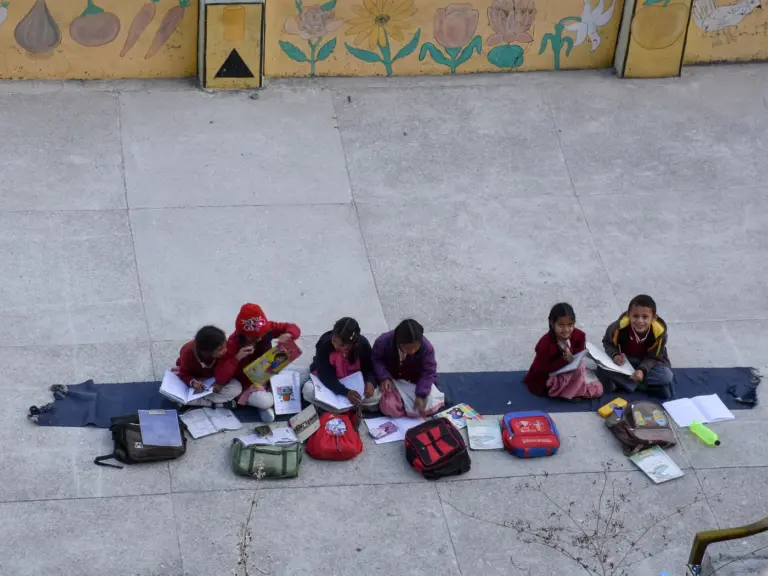
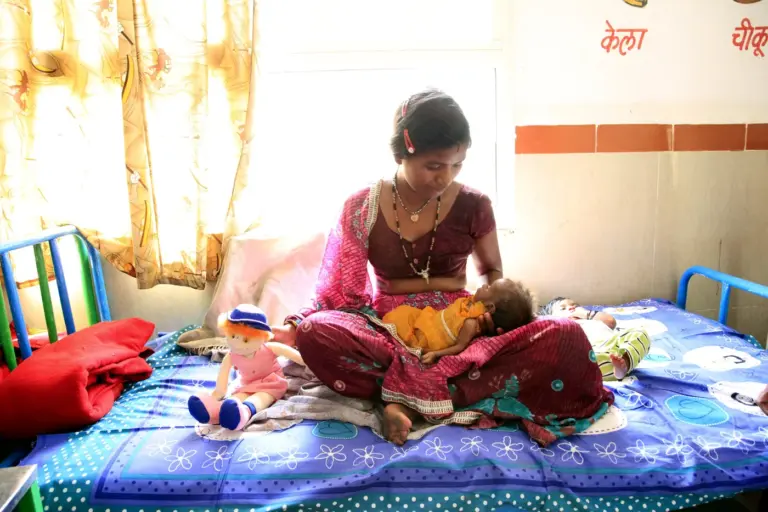
That single point is the Anganwadi, a Hindi word meaning “courtyard shelter.” It is a room, often modest, staffed by a local woman, where children come to be weighed, fed, immunized, and taught their first songs and numbers. The genius of the design is proximity: the service comes to where the child already is, which is the only way to reach a two-year-old and a nursing mother who cannot travel.
ICDS is administered by the Ministry of Women and Child Development, and it is a centrally sponsored scheme, meaning the Centre and the states share the cost and the states run it on the ground. It targets the years that matter most for a human being’s development, which is why it has survived nearly five decades of changing governments while other schemes came and went.
Who ICDS is for: the target group
ICDS is built for two overlapping groups: children aged 0 to 6 years, and pregnant women and lactating (nursing) mothers. In many areas it also reaches adolescent girls. That target list is not arbitrary. It maps almost exactly onto the first 1,000 days, from conception to a child’s second birthday, when the brain and body are forming and malnutrition does its most permanent damage.
Here is the point that trips up most people. ICDS is not a school-feeding programme. School meals for older children are a separate scheme, the Mid-Day Meal Scheme, now PM POSHAN, which starts where ICDS ends, at the school gate. ICDS owns the pre-school years; PM POSHAN owns the school years. Keeping that handover straight is half the battle, because the two schemes are constantly confused.
The pregnant-and-lactating focus also links ICDS to India’s maternity-benefit architecture. The nutrition and health education an Anganwadi worker gives an expecting mother is meant to work hand in hand with cash schemes like the PM Matru Vandana Yojana, which pays a wage-loss incentive so a poor woman can afford rest and nutrition during pregnancy.
The six services of ICDS
ICDS delivers a package of six services through the Anganwadi centre. Learn them as a set of six, because the “package” is the whole idea of the scheme, and a half-remembered list of four or five is the most common slip.
The six are: supplementary nutrition, immunization, health check-up, referral services, pre-school non-formal education, and nutrition and health education. Three of these, immunization, health check-up, and referral, are delivered in convergence with the public health system, since the Anganwadi worker is not a doctor. She is the bridge to the health machinery, not a substitute for it.
| Service | What it delivers | Main beneficiaries |
|---|---|---|
| Supplementary Nutrition (SNP) | Take-home rations and hot cooked meals to bridge the calorie-protein gap | Children 6 months-6 yrs, pregnant and lactating women |
| Immunization | Vaccination against preventable childhood diseases (with the health system) | Children 0-6 yrs, expecting mothers |
| Health check-up | Growth monitoring, antenatal and post-natal care | Children 0-6 yrs, pregnant and nursing women |
| Referral services | Sending sick or severely malnourished cases to health facilities | All beneficiaries |
| Pre-school education (PSE) | Non-formal early learning through play | Children 3-6 yrs |
| Nutrition and health education (NHED) | Counselling on feeding, hygiene and care practices | Women aged 15-45 |
Supplementary nutrition, the heart of the scheme
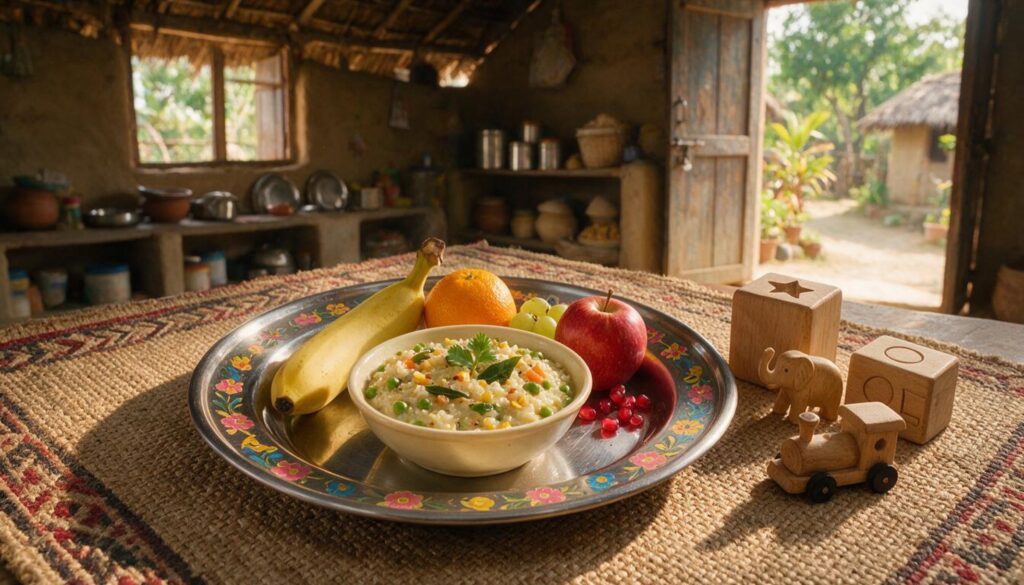
Supplementary nutrition (SNP) is what most people picture when they think of an Anganwadi: the take-home ration and the hot cooked meal. The idea is not to feed the child entirely, but to supplement the home diet enough to close the calorie and protein gap that produces stunting and wasting. This is the service that most directly attacks child malnutrition and stunting, and it is the reason ICDS is treated as a frontline nutrition intervention rather than a mere pre-school.
Health services and pre-school learning
Immunization, health check-up, and referral together make up the health arm. Growth monitoring, weighing a child month after month and plotting it, is how an Anganwadi worker catches malnutrition before it becomes an emergency, then refers the severe cases upward. Pre-school non-formal education is the school-readiness arm: songs, colors, counting, and play that prepare a three-to-six-year-old for formal schooling. Nutrition and health education rounds it off by teaching mothers the feeding and hygiene practices that make the other five services stick.
The Anganwadi worker: who actually runs it
Behind every one of those six services stands the Anganwadi Worker (AWW) and her assistant, the Anganwadi Helper (AWH). The AWW is usually a local woman with basic education, chosen from the community she serves, and she is the human face of the entire scheme. She weighs the babies, cooks or distributes the food, keeps the registers, chases the mothers who skip immunization, and teaches the pre-school class.
She does all this as an honorary worker on an honorarium, not a regular government salary, which is one of the scheme’s oldest and most contested design choices. The Anganwadi network runs on the underpaid labor of well over a million women, and the debate over their status, pay, and recognition never really goes away. The AWW belongs to the same frontline trio, alongside the ASHA and the ANM, that carries India’s grassroots public health into every village, and understanding how these three roles fit together is worth the study time.
The scale is genuinely enormous. ICDS operates through roughly 13.9 lakh Anganwadi centres across the country, staffed by around 12.7 lakh Anganwadi workers and a similar number of helpers, reaching several crore beneficiaries. Few programmes anywhere in the world touch as many young lives through as fine a network.
How ICDS became near-universal: the right-to-food case
ICDS did not always cover the whole country. For its first quarter-century it expanded in phases, and coverage was patchy, which is why one of the most important developments in the scheme’s history came not from the government but from the Supreme Court. This legal turn is a detail most notes miss, and it is exactly the kind of specific that lifts an answer.
In the long-running right-to-food case, PUCL v Union of India (2001), the Supreme Court read the right to life under Article 21 to include a right to food, and issued a series of orders directing governments to universalize ICDS: to sanction an Anganwadi in every settlement that needed one and to make the scheme a functioning entitlement rather than a discretionary programme. That is the judicial engine behind the network’s growth to nearly 14 lakh centres.
The case is a clean example of how a non-justiciable Directive Principle gets pulled into an enforceable Fundamental Right. On its own, the state’s duty to raise nutrition levels under the Directive Principles of State Policy cannot be enforced in court. But once the Court tied nutrition to Article 21, the duty acquired teeth. ICDS is one of the best illustrations in the whole syllabus of that bridge between Part IV and Part III of the Constitution, so it is worth carrying this case into any answer on either.
Saksham Anganwadi and Mission Poshan 2.0
The scheme you study today is no longer plain “ICDS” on paper. It has been restructured and folded into Mission Saksham Anganwadi and Poshan 2.0, an umbrella that the Union government created to sharpen the nutrition focus and modernize the Anganwadi. This is the update that separates a current answer from a decade-old one.
The restructuring merged three earlier schemes into one integrated mission: the Anganwadi Services (the old ICDS), the POSHAN Abhiyaan nutrition mission, and the Scheme for Adolescent Girls. The goal was to stop running overlapping nutrition programmes in parallel and instead pursue outcomes, chiefly the reduction of stunting, wasting, anaemia, and low birth weight, under a single roof. The nutrition-mission logic behind it is worth reading in full through POSHAN Abhiyaan, which supplies the outcome targets that Poshan 2.0 now carries.
Poshan 2.0 also leans hard on behaviour change and community mobilization, not just supply. The annual Poshan Maah (Nutrition Month) in September and the Poshan Pakhwada fortnight turn nutrition into a public campaign, a Jan Andolan or people’s movement, on the logic that stunting will not fall on food delivery alone if home feeding and hygiene practices do not change too. Many Anganwadis now also grow Poshan Vatikas, small nutrition gardens, to put fresh, locally grown vegetables and fruit into the supplementary meal. These are cheap interventions, and they matter because the last mile of nutrition runs through the mother’s kitchen, not the government warehouse.
“Saksham Anganwadi” refers to the upgraded centre itself: better infrastructure, clean water, LED lighting, and a nudge toward locally sourced, more diverse food to fight not just calorie deficiency but micronutrient deficiency too. That shift from filling stomachs to fixing the quality of the diet matters, because India’s nutrition problem is increasingly one of hidden hunger, a point the study of malnutrition and micronutrient deficiency makes concrete.
Poshan Tracker: the technology layer
Poshan Tracker is a mobile and web application built by the Ministry of Women and Child Development to monitor Anganwadi services in real time. Before it, the scheme ran on paper registers that were slow, easy to fudge, and impossible to audit at national scale. The app puts a smartphone in the Anganwadi worker’s hand and turns her daily work into live data.
Think of it as replacing a shelf of dusty ledgers with a dashboard the ministry can read every morning. The worker records attendance, food distribution, and above all growth monitoring, height and weight plotted against WHO standards, so that stunting and wasting can be spotted early and counted honestly. It is the same instinct that runs through India’s broader push for direct, digitally tracked delivery of health and welfare.
The technology cuts two ways, and it is worth being honest about that. Real-time tracking reduces the fudging of registers and lets planners see where malnutrition is worst. But it also loads a fresh burden of data entry onto an already overstretched honorary worker, and it works only where there is a charged phone, a signal, and a worker comfortable using it. The dashboard is only as truthful as the tired woman entering the numbers at the end of a long day.
The challenges ICDS still faces
For all its reach, ICDS carries chronic weaknesses, and naming them precisely is what separates a strong answer from a scheme-brochure one. The first is quality versus coverage: India has built the centres and hired the workers, but the food’s nutritional quality, the regularity of supply, and the actual learning in the pre-school class often fall short of the design.
The second is the worker herself. Paying more than a million women an honorarium rather than a wage, then asking them to run six services plus a data app, is a structural strain that shows up as burnout, vacancies, and turnover. The third is infrastructure: too many Anganwadis still lack their own building, clean water, or a toilet, which the Saksham Anganwadi upgrade is meant to fix but has not everywhere.
The fourth is money, and it is quieter but real. ICDS runs on a shared Centre-state financing pattern, and the supplementary-nutrition component in particular depends on states releasing their share on time. When a state’s funds are delayed, the ration stops or thins, and the child at the centre of the whole design is the one who goes without. A scheme built to attack malnutrition cannot afford irregular food supply, yet irregular supply is one of its most persistent field-level failures.
The fifth is the hardest to solve. ICDS treats undernutrition as a food-delivery problem, but stunting also flows from poor sanitation, unsafe water, maternal undernutrition, and repeated infection. A hot meal cannot fully counter a child who is losing nutrients to repeated diarrhoea from dirty water. That is why the scheme increasingly stresses convergence, linking the Anganwadi to health, sanitation, and drinking-water programmes, because nutrition is never only about the plate.
How to study ICDS for the exam
Build your notes around four blocks and you will have the whole topic. First, the basics: full form, 1975 launch, Ministry of Women and Child Development, the Anganwadi as the delivery point, and the target group of children 0-6 plus pregnant and lactating women. Second, the six services, memorized as a set, with supplementary nutrition and pre-school education as the two you can describe in a line each.
Third, the restructuring: Saksham Anganwadi and Poshan 2.0 as the umbrella, the merger of Anganwadi Services, POSHAN Abhiyaan, and the Scheme for Adolescent Girls, and Poshan Tracker as the technology layer. Fourth, the challenges and the convergence argument, which is where the analytical marks live. If you can move from the six services to the reason a hot meal alone cannot end stunting, you are answering at the level the topic rewards.
The stance worth defending is that ICDS is a delivery triumph and an outcomes underachiever. Almost no country has built a village-level early-childhood network this dense. Yet India’s stunting numbers have fallen slower than that network’s reach would predict, because the binding constraint was never the number of centres, it was the quality of the food, the sanitation around the child, and the load on the worker. An answer that credits the architecture and then locates the real gap in outcomes reads as informed rather than rehearsed.
Frequently Asked Questions
What is the full form of ICDS?
ICDS stands for Integrated Child Development Services, a scheme launched on 2 October 1975 to deliver bundled nutrition, health, and pre-school services to young children and their mothers through the Anganwadi centre.
What is an Anganwadi?
Anganwadi means “courtyard shelter.” It is the village-level centre where ICDS is delivered, run by a local Anganwadi Worker and her helper, where children are weighed, fed, immunized, and given pre-school education.
Who is the target group of ICDS?
Children aged 0 to 6 years, pregnant women, and lactating (nursing) mothers, with adolescent girls covered in many areas. The focus falls on the first 1,000 days from conception to a child’s second birthday.
What are the six services under ICDS?
Supplementary nutrition, immunization, health check-up, referral services, pre-school non-formal education, and nutrition and health education. Immunization, health check-up, and referral are delivered in convergence with the public health system.
Which ministry runs ICDS?
The Ministry of Women and Child Development, as a centrally sponsored scheme implemented by states and union territories.
What is Saksham Anganwadi and Poshan 2.0?
It is the umbrella mission that restructured ICDS by merging Anganwadi Services, POSHAN Abhiyaan, and the Scheme for Adolescent Girls, with a sharper focus on reducing stunting, wasting, anaemia, and low birth weight, and on upgrading the Anganwadi centre.
What is Poshan Tracker?
Poshan Tracker is a mobile and web application by the Ministry of Women and Child Development that monitors Anganwadi services in real time, especially the growth monitoring of children, replacing paper registers with live data.
How is ICDS different from the Mid-Day Meal Scheme?
ICDS covers the pre-school years (children 0-6, plus mothers) through the Anganwadi, while the Mid-Day Meal Scheme, now PM POSHAN, feeds school-going children at the school. ICDS ends where school begins.
Practice Questions
1. ICDS, launched in 1975, is administered by which ministry?
a) Ministry of Health and Family Welfare
b) Ministry of Rural Development
c) Ministry of Women and Child Development
d) Ministry of Education
Answer: c) Ministry of Women and Child Development
2. Which of the following is NOT one of the six services under ICDS?
a) Supplementary nutrition
b) Pre-school non-formal education
c) Old-age pension
d) Immunization
Answer: c) Old-age pension
3. The primary target group of ICDS includes:
a) Children aged 6 to 14 years only
b) Children aged 0 to 6 years and pregnant and lactating women
c) Senior citizens below the poverty line
d) Adolescent boys aged 10 to 19
Answer: b) Children aged 0 to 6 years and pregnant and lactating women
4. Mission Saksham Anganwadi and Poshan 2.0 merged which of the following?
a) ICDS, Mid-Day Meal Scheme, and Atal Pension Yojana
b) Anganwadi Services, POSHAN Abhiyaan, and the Scheme for Adolescent Girls
c) National Health Mission, ICDS, and Swachh Bharat
d) PM POSHAN, ICDS, and PM Matru Vandana Yojana
Answer: b) Anganwadi Services, POSHAN Abhiyaan, and the Scheme for Adolescent Girls
5. Poshan Tracker is best described as:
a) A cash-transfer scheme for pregnant women
b) A real-time ICT application for monitoring Anganwadi services
c) A network of nutrition rehabilitation hospitals
d) A ration-distribution card
Answer: b) A real-time ICT application for monitoring Anganwadi services
Mains-style questions
- “ICDS is a delivery triumph and an outcomes underachiever.” Critically examine this assessment of India’s flagship child-development scheme.
- Discuss the restructuring of ICDS under Mission Saksham Anganwadi and Poshan 2.0. What does the shift from calorie-focus to diet-quality signify?
- The Anganwadi worker runs six services on an honorarium. Analyze the implications of this design choice for the effectiveness and equity of ICDS.
- Why can supplementary nutrition alone not eliminate child stunting in India? Explain the case for convergence across nutrition, sanitation, and health.
- Evaluate the role of technology, particularly Poshan Tracker, in improving the governance of the Anganwadi network, and its limits.
ICDS is the bet India placed nearly fifty years ago that the cheapest way to build a productive citizen is to reach them before they turn two. The network that bet produced is extraordinary in scale, a courtyard in almost every village with a local woman keeping watch over the youngest lives. What the scheme still owes those children is not more centres but better outcomes: food worth eating, water safe to drink, and a worker paid and supported enough to make the six services more than a list. Close that gap between reach and result, and ICDS finally pays off the promise it made in 1975.
Tell Google you want more of this.
Add Anantam IAS as a preferred sourceOne tap, and this site shows up more often in your own Top Stories, AI Overviews and AI Mode. Remove it any time.