Most aspirants can name the Mid-Day Meal Scheme in one line, “free lunch in government schools,” and then freeze the moment a question asks who pays for it, what the calorie norm is, or why the Supreme Court had to get involved. That gap is exactly what this piece closes. The scheme is one of the most quietly consequential welfare programmes India runs, feeding more children on a single day than the population of most countries, and its design tells you a lot about how the Indian state actually delivers rights on the ground.
The Mid-Day Meal Scheme, officially renamed PM POSHAN (short for Pradhan Mantri Poshan Shakti Nirman) in 2021, is a centrally sponsored scheme that provides one hot cooked meal on every school day to children in government and government-aided schools. Its purpose is simple and layered at once: pull hungry children into the classroom, keep them coming back, and fix the classroom hunger that makes learning impossible on an empty stomach.
What the Mid-Day Meal Scheme actually does
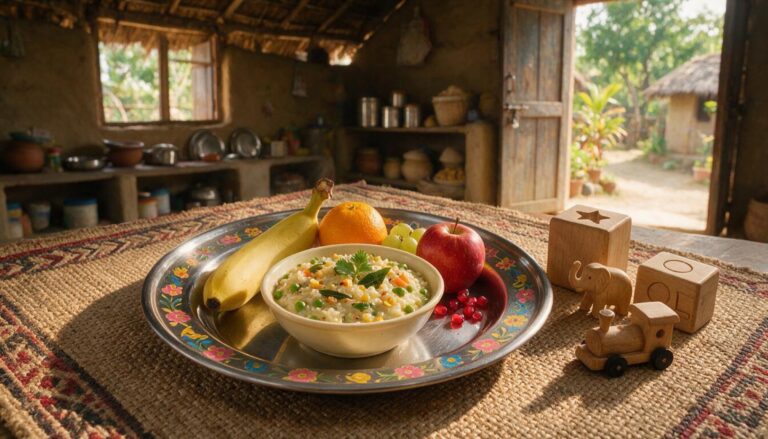
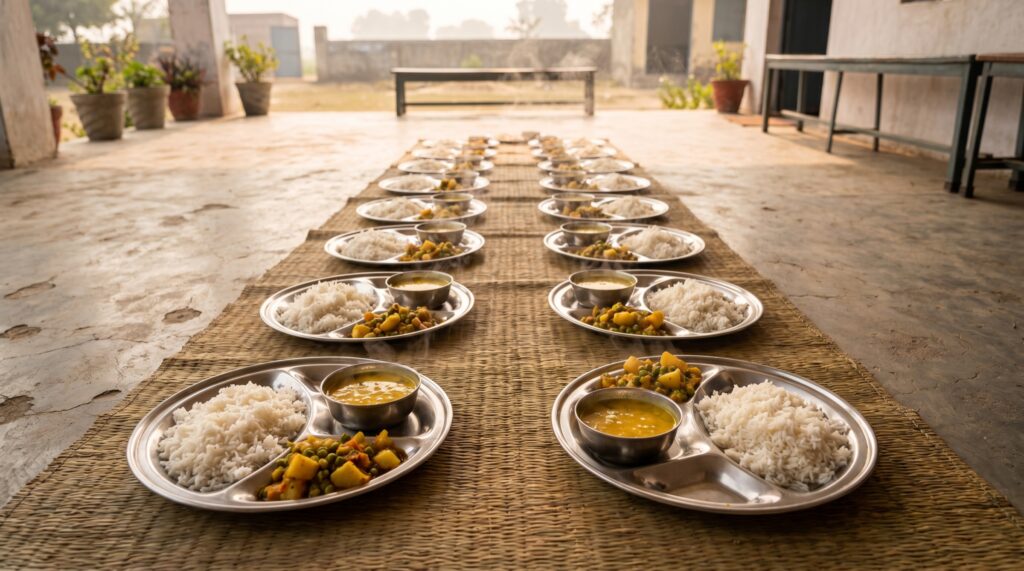
The scheme guarantees a hot cooked meal, not dry rations or cash, to every child enrolled in classes I to VIII in government, government-aided, and local-body schools. That “cooked” word is the whole point, and it was fought for in court, because a bag of grain sent home gets diverted, shared across a family, or sold, while a plate served in the schoolyard reaches the child it was meant for.
The stated aims sit on two legs. The first is educational: a free meal is a powerful nudge that raises enrolment, improves attendance, and cuts dropout, especially among girls and children from poor and marginalised homes for whom the meal is a real reason to walk to school. The second is nutritional: the meal addresses classroom hunger and protein-energy malnutrition, so a child is alert enough to learn rather than drowsy with an empty stomach. Think of it as the state buying two outcomes with one plate, a body that is fed and a mind that shows up.
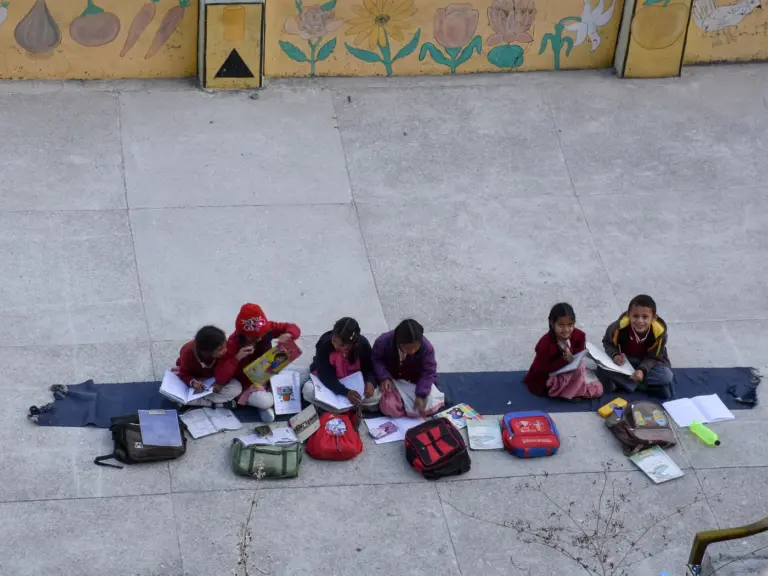
There is a quieter third benefit by design: children of every caste eat the same food, sitting together, often served by a local cook. When it works, the common meal chips at social distance. When it fails, that same table becomes the site of the scheme’s ugliest problems, which we will come to.
From a Tamil Nadu experiment to a national right
The idea did not start in Delhi. It started in Tamil Nadu, and understanding that origin explains why the state still runs one of the country’s strongest programmes.
Chief Minister K. Kamaraj introduced a school lunch scheme in Tamil Nadu in the 1960s to keep poor children in school, and in 1982 Chief Minister M.G. Ramachandran expanded it into a universal noon-meal scheme, a bold commitment that became a template. Gujarat, Kerala and a few others ran their own versions before the Centre acted.
The national programme arrived in 1995 as the National Programme of Nutritional Support to Primary Education (NP-NSPE). Here is the catch that trips up most people: in its first years the central scheme mostly distributed dry foodgrains, three kilograms of rice or wheat a month tied to attendance, not a cooked meal. The transformative shift came from the judiciary, not the executive.
In the landmark case PUCL v. Union of India (2001), the Supreme Court ordered every state and union territory to provide a cooked mid-day meal to all children in government and government-aided primary schools, and to do it within a fixed timeframe. That order converted a discretionary food subsidy into an enforceable entitlement, and it is the reason the scheme means “hot lunch” today rather than “sack of grain.” The order flowed from reading the right to food into the right to life under Article 21, reinforced by the state’s duty to raise nutrition under Article 47 of the Constitution, one of the Directive Principles of State Policy.
Two later steps completed the arc. Coverage was extended to upper primary classes VI to VIII in 2008, and in 2013 the meal became a statutory legal right under the National Food Security Act, 2013, so a child’s entitlement to a mid-day meal no longer rests on a scheme that a future government can quietly drop. It is backed by law.
PM POSHAN: the 2021 rebranding and what changed
In September 2021 the Union government renamed and repackaged the scheme as PM POSHAN (Pradhan Mantri Poshan Shakti Nirman) and approved it for the five years from 2021-22 to 2025-26. The rebranding was not just a new name on the old plate. Three design changes matter for an exam answer.
First, coverage was widened to include children of pre-primary or Bal Vatika classes in government primary schools, pulling the youngest learners into the net. Second, the scheme promoted Tithi Bhojan, where people voluntarily provide special food to children on festivals and anniversaries, and encouraged school nutrition gardens so children grow and eat fresh vegetables. Third, it pushed social audit in every district and greater use of technology to track the meal, because accountability had been the weak link.
The scheme sits under the Ministry of Education, which was called the Ministry of Human Resource Development until 2020, so if an older source says HRD, that is the same ministry. The name changed; the meal did not.
Who the scheme reaches and who cooks the meal
PM POSHAN covers roughly 11.8 crore children across about 11.2 lakh schools, which makes it, by number of beneficiaries served in a single day, one of the largest school-feeding programmes in the world. That scale is why the design matters so much: a small error in the norm or the funding, multiplied across eleven crore plates, becomes an enormous problem.
The meal is usually cooked and served by cook-cum-helpers, most of them women from the local community, and in many states through Self-Help Groups and, in some districts, large charitable kitchens that cook centrally and deliver to clusters of schools. Employing local women as Self-Help Group members does double duty: it creates village-level livelihoods and gives the community a direct stake in the meal’s quality. This is a deliberate feature, not an afterthought.
The nutritional norms you need to remember
The single most examinable fact about this scheme is the calorie and protein norm, and it splits by level. The meal for younger children is smaller than the meal for older ones, which is obvious once you say it but easy to mix up under pressure. Here is the standard the meal must meet per child per school day.
| Component (per child, per day) | Primary (Classes I to V) | Upper Primary (Classes VI to VIII) |
|---|---|---|
| Calories (energy) | 450 kcal | 700 kcal |
| Protein | 12 grams | 20 grams |
| Foodgrains (rice or wheat) | 100 grams | 150 grams |
Commit these four pairs to memory: 450 calories and 12 grams of protein for primary, 700 calories and 20 grams of protein for upper primary. These are the revised norms, raised from an earlier primary standard of 300 calories, precisely so the meal would count as real nutrition and not a token. The plate is meant to deliver adequate pulses, vegetables, oil and, where states choose, eggs, milk or fortified items, so the calorie figure is met with a balanced meal rather than a mound of plain rice.
Who runs it and who pays
PM POSHAN is a centrally sponsored scheme, which means the Union and the states share both the cost and the running of it, and the sharing ratio is a favourite of examiners because it is not uniform across the country.
The Centre supplies the foodgrains free of cost through the Food Corporation of India and shares the cooking cost, cook honoraria, transport and management with the states. For most states the split is 60:40 (Centre 60, state 40). For the North Eastern states and the Himalayan states and union territories with a legislature, the Centre bears more, at 90:10, and for union territories without a legislature it funds 100 percent. The point to carry away is that the Centre pays the majority share everywhere, and a larger share where the state’s own capacity is weaker.
Delivery, though, is the states’ job. States and union territories procure, cook, serve, monitor and audit the meal, which is why quality varies so sharply from one state to the next: same central norm, very different administrative machinery on the ground.
The problems the scheme keeps running into
A programme feeding eleven crore children daily fails visibly, and pretending otherwise helps no one, least of all in an answer that is supposed to show judgment. Three categories of problem recur.
Food quality and safety is the gravest. The scheme’s darkest day came in 2013 at Gandaman village in Chhapra, Bihar, where 23 children died after eating a mid-day meal contaminated with a pesticide that had been stored near the cooking oil. Reports of insects, spoiled grain, watered-down dal and unhygienic kitchens surface too often, a direct consequence of thin cooking budgets, poor storage and weak inspection.
Social discrimination is the second, and it is the one that betrays the scheme’s own purpose. There have been repeated instances of upper-caste parents objecting to their children eating food cooked by a Dalit cook, or of children being made to sit and eat separately by caste. A scheme designed partly to dissolve caste at the shared table sometimes reproduces it instead, which is exactly why the appointment of cooks and the seating arrangement are not trivial administrative details.
Leakage and administrative weakness round out the list: fudged attendance registers that inflate the meals claimed, delayed and meagre honoraria for cook-cum-helpers, irregular fund flow to schools, and teachers pulled away from teaching to manage cooking. The move toward social audits and technology-based monitoring under PM POSHAN is aimed squarely at these gaps, though the fixes are uneven.
How to study and apply this for the exam
Hold the scheme together as a story, not a list. The spine is: Tamil Nadu pioneers it, the Centre nationalises it in 1995 as a dry-ration scheme, the Supreme Court makes cooked meals mandatory in 2001, coverage climbs to class VIII by 2008, the Food Security Act makes it a legal right in 2013, and it becomes PM POSHAN in 2021. Six beats, in order, and you can reconstruct the entire history.
For the constitutional hooks, tie the scheme to three provisions: Article 21 (right to life, into which the right to food was read), Article 47 (state duty to raise nutrition, a Directive Principle), and Article 21A with the Right to Education Act, since a fed child is one the state can keep in school. When a question links welfare schemes to fundamental rights, this scheme is your cleanest example of a policy that operationalises a right.
For the numbers, drill only what is load-bearing: the 450 and 700 calorie norms, the 12 and 20 gram protein norms, the 60:40 / 90:10 / 100 percent funding ratios, and the 2001 PUCL judgment. In an answer, always pair a strength with a candid problem, the reach and the Chhapra tragedy, the shared table and caste discrimination, so your response reads as balanced judgment rather than a brochure.
Frequently Asked Questions
What is the Mid-Day Meal Scheme?
It is a centrally sponsored scheme that provides one free hot cooked meal on every school day to children in classes I to VIII in government, government-aided and local-body schools. It aims to boost enrolment, attendance and retention while addressing classroom hunger and malnutrition. It was renamed PM POSHAN in 2021.
What is the full form of PM POSHAN?
PM POSHAN stands for Pradhan Mantri Poshan Shakti Nirman. It is the scheme’s official name since September 2021, covering the period 2021-22 to 2025-26, and it absorbed and rebranded the earlier Mid-Day Meal Scheme.
What are the nutritional norms of the mid-day meal?
The meal must provide 450 calories and 12 grams of protein per child per day at the primary level (classes I to V), and 700 calories and 20 grams of protein at the upper-primary level (classes VI to VIII), supplied through foodgrains, pulses, vegetables and oil.
Which Supreme Court order made cooked mid-day meals mandatory?
The order in PUCL v. Union of India (2001) directed all states and union territories to provide a cooked mid-day meal to children in government and government-aided primary schools, converting the earlier dry-ration approach into a cooked-meal entitlement.
How is the cost of the scheme shared between the Centre and states?
It is a centrally sponsored scheme. The Centre and most states share the cost 60:40. For North Eastern and Himalayan states and union territories with a legislature the ratio is 90:10, and for union territories without a legislature the Centre funds it fully. The Centre also supplies foodgrains free.
Which ministry runs PM POSHAN?
The Ministry of Education runs PM POSHAN. This ministry was known as the Ministry of Human Resource Development until 2020, so older sources referring to the HRD Ministry mean the same body.
Which state pioneered the mid-day meal in India?
Tamil Nadu pioneered it. Chief Minister K. Kamaraj introduced a school lunch scheme in the 1960s, and Chief Minister M.G. Ramachandran expanded it into a universal noon-meal scheme in 1982, well before the national scheme launched in 1995.
Practice Questions
1. The Supreme Court judgment that made cooked mid-day meals mandatory was delivered in:
a) Unni Krishnan v. State of Andhra Pradesh
b) PUCL v. Union of India (2001)
c) Mohini Jain v. State of Karnataka
d) Olga Tellis v. Bombay Municipal Corporation
Answer: b) PUCL v. Union of India (2001) (which directed states to provide cooked meals in government and aided primary schools.)
2. Under PM POSHAN, the prescribed nutritional norm for a primary-level child (Classes I to V) per day is:
a) 300 calories and 8 grams of protein
b) 450 calories and 12 grams of protein
c) 700 calories and 20 grams of protein
d) 500 calories and 15 grams of protein
Answer: b) 450 calories and 12 grams of protein (the upper-primary norm is 700 calories and 20 grams.)
3. The mid-day meal was made a statutory legal right through:
a) The Right to Education Act, 2009
b) The National Food Security Act, 2013
c) The Constitution (86th Amendment) Act, 2002
d) The Juvenile Justice Act, 2015
Answer: b) The National Food Security Act, 2013 (which gives children a legal entitlement to the meal.)
4. For most states, the Centre-state cost-sharing ratio under PM POSHAN is:
a) 50:50
b) 75:25
c) 60:40
d) 90:10
Answer: c) 60:40 (it is 90:10 for North Eastern and Himalayan states, and fully central for UTs without a legislature.)
5. PM POSHAN is administered by the:
a) Ministry of Women and Child Development
b) Ministry of Health and Family Welfare
c) Ministry of Rural Development
d) Ministry of Education
Answer: d) Ministry of Education (formerly the Ministry of Human Resource Development.)
Mains-style questions
1. “The Mid-Day Meal Scheme achieves educational and nutritional goals with a single intervention.” Examine the design of the scheme in light of this claim. 2. Discuss the role of the judiciary in transforming the Mid-Day Meal Scheme from a dry-ration programme into an enforceable right to a cooked meal. 3. Analyse the recurring problems of food safety and social discrimination in the implementation of the Mid-Day Meal Scheme, and suggest measures to address them. 4. Examine how the Mid-Day Meal Scheme operationalises constitutional provisions relating to the right to life, nutrition and education. 5. Evaluate the changes introduced by the 2021 rebranding of the scheme as PM POSHAN. To what extent do they address the weaknesses of the earlier programme?
The Mid-Day Meal Scheme is the rare welfare programme where you can see a constitutional right turning into a plate of food in a village schoolyard, and that is exactly why it rewards careful study rather than one-line memorisation. Learn the six-beat history, the two calorie norms, the three funding ratios and the honest catalogue of failures, and you will be able to argue, not just recall, that a fed child in a classroom is one of the most cost-effective things a state can buy. Judge it by that standard, generous in ambition, uneven in delivery, and you will write about it the way it deserves.
Tell Google you want more of this.
Add Anantam IAS as a preferred sourceOne tap, and this site shows up more often in your own Top Stories, AI Overviews and AI Mode. Remove it any time.