Upinder Singh ancient history reading can become overwhelming if you’re preparing a short GS revision sheet from a detailed academic textbook. The book’s value is in learning how historical arguments use evidence. Reading every page without a question can bury that value under notes you won’t revisit.
I recommend it as targeted deeper reading for History optional or for a clearly identified ancient-history gap. Keep a serviceable foundation book for chronology, then use Upinder Singh to investigate a source, interpretation or debate. A GS beginner with an unread base text should delay this additional purchase.
Identify the Current Book
The title is A History of Ancient and Early Medieval India: From the Stone Age to the 12th Century, by Upinder Singh, published by Pearson. Two edition records need to be separated.
| Record | Edition Details | Practical Consequence |
|---|---|---|
| Pearson’s older first-edition product page | ISBN 9788131716779; 704 pages; copyright field 2009 | A valid identity record for that copy, not the current edition. |
| Pearson’s second-edition catalog | Copyright 2023; ISBN 9789357051484; 856 pages | Check the title page and contents before transferring references from the first edition. |
The Pearson humanities catalog identifies the second edition. The author discusses its changes in a Pearson interview, including a revised treatment of the Maurya period and the placement of the Arthashastra discussion in a later chronological chapter.
That change is a useful warning about reading historically. A text’s traditional association with a person or empire doesn’t make every passage a direct report of that empire’s everyday administration. Check how the author dates and uses it.
Set a Specific Reading Goal
You should decide what this book will add before starting a long section. Its deeper source discussions are useful when they change the explanation you can give.
Use the Indian history book guide for selection decisions. For this book, the job is narrower: improve how you connect evidence with an argument.
| Study Area | Reading Question | Output to Keep |
|---|---|---|
| Historical sources | Who created the evidence, when and for what purpose? | A source profile with a limitation |
| Archaeology | What was actually found, and what is inferred? | An observation-and-interpretation grid |
| State formation | Which sources support claims about authority? | An argument with named evidence |
| Religious and intellectual life | Is the passage describing practice, prescribing conduct or arguing an idea? | A purpose-and-context card |
| Early medieval regions | How does a regional case qualify a broad claim? | A comparison with an explicit boundary |
A source is like a message written for a particular reader: its purpose helps explain what it includes and leaves out. The comparison has limits. Historical sources can survive through copying, damage or later editing, so identifying an intended audience alone doesn’t settle their reliability.
Work Through a Land-Grant Argument
A source-based answer should identify what the evidence establishes before using it to support a wider interpretation. A grant recording a transfer is evidence of that recorded act; its wider social effect still needs investigation.
Consider this original, hypothetical practice packet. It is neither an actual inscription nor a UPSC PYQ:
- Source A: A fictional copper-plate charter records a village grant and lists revenue privileges transferred to a recipient.
- Source B: A fictional literary passage advises a ruler to honor learned recipients of gifts.
- Claim to assess: These two sources prove that every village in the region was controlled by such recipients.
Work through the packet before deciding how much the claim can bear.
| Step | What We Can Say | What We Cannot Yet Say |
|---|---|---|
| Read Source A as a record | The charter records a particular grant and specifies privileges | Every village had the same arrangement |
| Read Source B by purpose | The passage recommends conduct and values a kind of gift | Every ruler followed the recommendation |
| Compare the sources | Both make this kind of grant worth investigating | The literary passage independently proves implementation of the charter |
| Check scale | More dated, located examples would help establish distribution | Two sources establish a region-wide universal pattern |
| Check effect | Evidence about local authority, collection or disputes could clarify consequences | The recorded transfer alone reveals every recipient’s actual power |
The corrected answer is: “The packet supports the existence of a recorded grant and a literary ideal favoring gifts. It doesn’t establish that the arrangement applied to every village. Its wider distribution and effects require additional evidence.”
The reasoning doesn’t require you to reject the sources. It requires you to use each for a claim it can support. A surviving record may establish an act more securely than its representativeness.
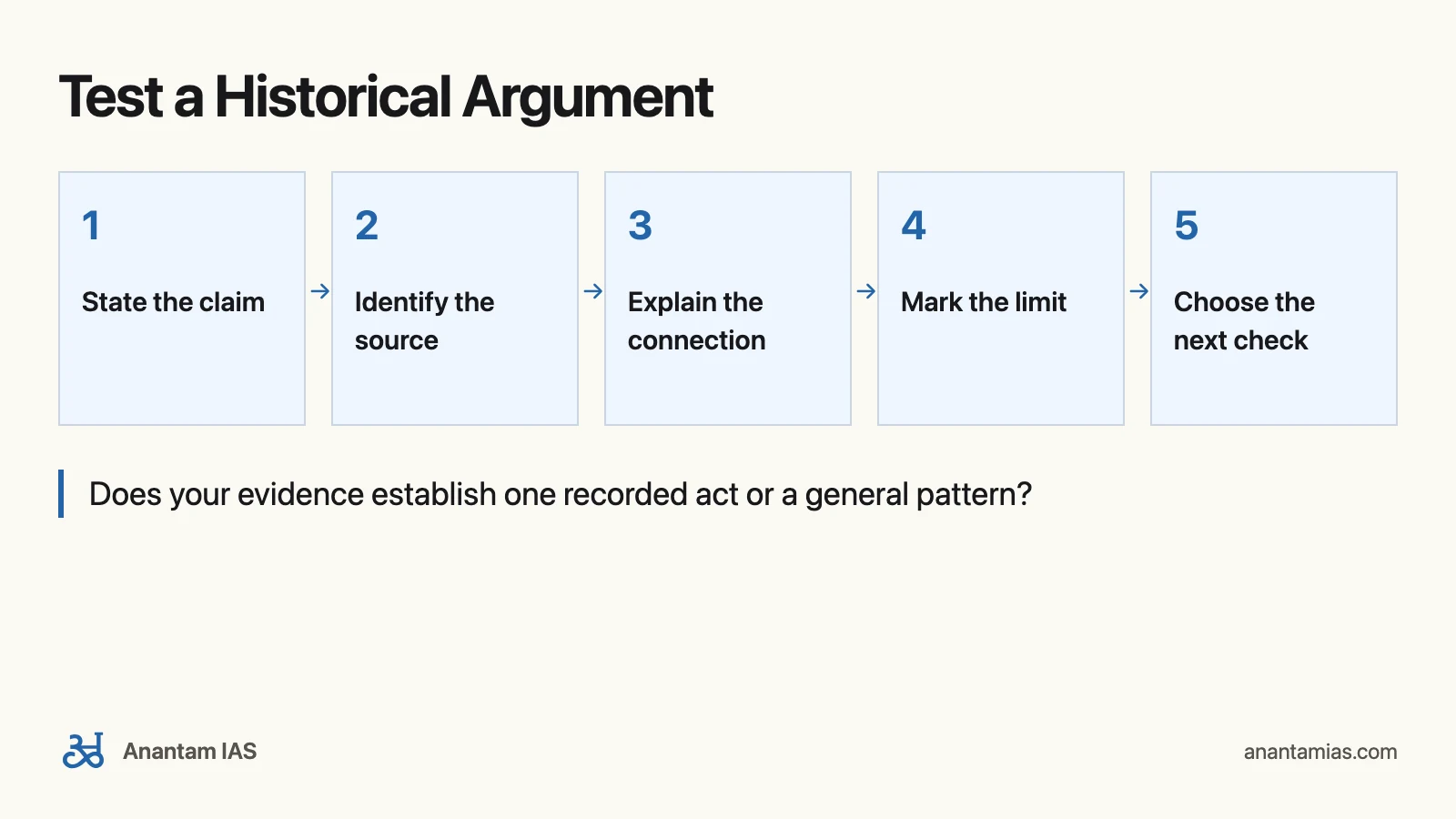
For your own reading, retain a compact worksheet:
- Claim: State the proposition precisely.
- Evidence: Identify its date, place and type where available.
- Connection: Explain why this evidence supports the claim.
- Limit: Say what it cannot establish by itself.
- Further check: Name the kind of evidence that would strengthen or challenge the interpretation.
If a debate initially feels difficult, start with those fields. You can follow an argument without copying every scholar’s position into your notes.
Read in Focused Cycles
A useful cycle begins with a question and ends with an answer you can explain. It should produce a small addition to your existing notes, not a second full set of notes on the same period.
| Stage | Task | Completion Check |
|---|---|---|
| Set the problem | Choose one syllabus topic or error from practice | Write the exact question you want resolved |
| Establish context | Revisit your chronology and basic terms | Place the evidence in a period and region |
| Read selectively | Read the relevant discussion and source material | Separate evidence from interpretation |
| Write and check | Draft an argument with a limitation | Explain the link between each claim and its evidence |
| Revisit | Test the worksheet without the book | Repair the missing link rather than recopy the chapter |
For 60 minutes, try 35 minutes reading, 15 building the argument and 10 checking. With 30 minutes, reduce the section and keep the same sequence. Allow a difficult debate to take another session.
The ancient history Prelims PYQ collection helps identify factual or inferential gaps. A deeper optional discussion should also end in written answer practice; Prelims recall alone can’t test whether your argument works.
Decide Whether You Need It
The book’s academic scope doesn’t make it compulsory for every aspirant. It also doesn’t replace the rest of History optional or provide a complete answer-writing program.
- Use it now when a specific source or debate is blocking your understanding.
- Keep the first edition if it serves your current task, while checking changes relevant to that task.
- Consider the second edition when revised discussions matter to the questions you’re studying.
- Delay buying when your current foundation text and revision are still unfinished.
Choose one argument from the next section you read. Write the evidence, the connection and the limit on the same page. That is the work that makes a detailed textbook useful.
Frequently Asked Questions
What is the exact Upinder Singh book title?
A History of Ancient and Early Medieval India: From the Stone Age to the 12th Century, by Upinder Singh, published by Pearson. Check the edition as well as the title when matching references.
What are the second-edition details?
Pearson’s catalog identifies the second edition with copyright 2023, ISBN 9789357051484 and 856 pages. The older first-edition product record lists different details and should not be used to describe the second edition.
Is this compulsory for GS beginners?
No. The guide recommends it for targeted deeper reading, particularly when a History optional source or debate needs work. A beginner should first establish chronology and revise a usable foundation text.
What does the Arthashastra edition change teach?
In Pearson’s interview, the author explains that its discussion moved from the Maurya chapter to a later chronological chapter. Readers should examine how a source is dated and used instead of assuming every passage directly describes the traditionally associated empire.
Is the land-grant exercise a real inscription?
No. The charter and literary passage are explicitly fictional practice material. They demonstrate how a recorded act and a recommendation support different claims, without posing as historical evidence or a PYQ.
How can I avoid writing another complete set of notes?
Choose one unresolved question, read the relevant section and add a claim-evidence-connection-limit worksheet to existing notes. Revisit what changed in your explanation rather than recopying the period.
Tell Google you want more of this.
Add Anantam IAS as a preferred sourceOne tap, and this site shows up more often in your own Top Stories, AI Overviews and AI Mode. Remove it any time.