If you have ever heard a public debate justified by "the greatest good for the greatest number," you have heard utilitarianism speaking. The doctrine that the rightness of an action depends entirely on its consequences — and specifically on the balance of happiness it produces — was developed by two English philosophers in the late eighteenth and nineteenth centuries: Jeremy Bentham and John Stuart Mill. Their utilitarianism remains, alongside Kantian deontology and Aristotelian virtue ethics, one of the three great traditions of modern Western moral philosophy.
For the UPSC GS IV aspirant, utilitarianism is unavoidable. Cost-benefit analysis, public health prioritisation, allocation of scarce resources, even the calculation of "developmental displacement" in dam-building — all are utilitarian in structure. This article works through the two utilitarians, their lives and key works, the development of the doctrine, the criticisms it has faced, and the use of utilitarian thinking in Indian governance.
Life and times — Jeremy Bentham (1748–1832)
Bentham was a child prodigy — reading Latin at three, attending Oxford at twelve. He trained as a lawyer but found the law's irrationality intolerable; what English law needed, he decided, was a rational reconstruction on first principles. That project consumed his life.
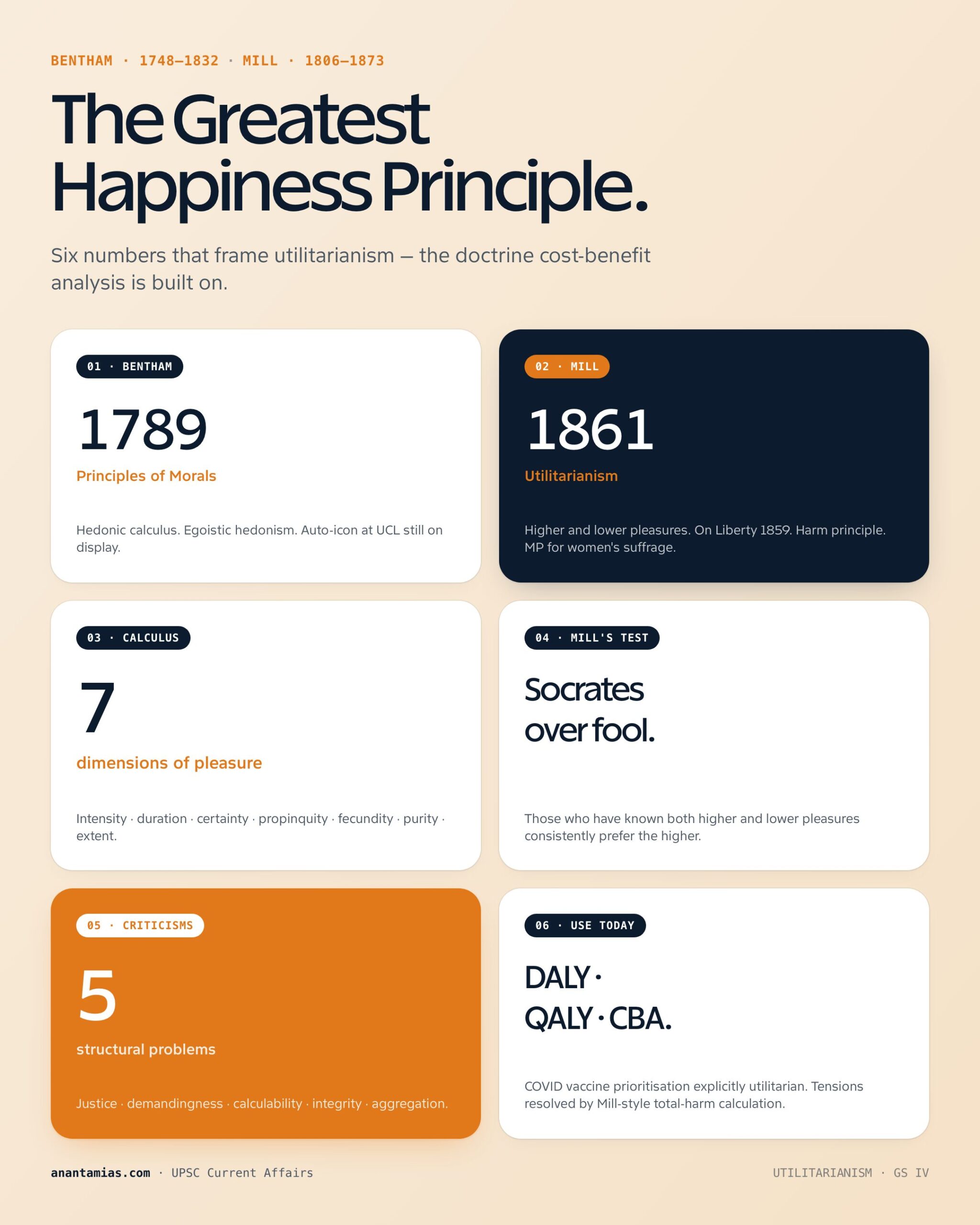
Bentham wrote on prison reform (his Panopticon design), on the law (calls for codification), on political reform (championed extension of the franchise long before it became mainstream), and most influentially on the foundations of morality. His An Introduction to the Principles of Morals and Legislation (1789) laid out classical utilitarianism in its starkest form.
He lived through the French Revolution, Napoleonic wars, and the early Industrial Revolution — a period in which inherited social and legal institutions were everywhere being questioned. His utilitarianism was a tool for the questioning.
He left his body to be preserved as an "auto-icon" at University College London, where it remains on display.
Life and times — John Stuart Mill (1806–1873)
Mill was the son of James Mill, Bentham's collaborator. He was raised to be a utilitarian — taught Greek at three, Latin at eight, formal logic at twelve, political economy at thirteen. The intellectual hothouse produced its inevitable crisis: Mill, at twenty, fell into severe depression, partly from the realisation that even achieving all the utilitarian reforms he had been raised to pursue would not, by itself, make him happy.
Mill emerged from this crisis with a richer utilitarianism — one that distinguished higher from lower pleasures, that took seriously the cultivation of character, and that placed great weight on individual liberty. His Utilitarianism (1861) and On Liberty (1859) remain foundational texts.
Mill served as a Member of Parliament; he campaigned for women's suffrage when no other major political figure would; he wrote against slavery during the American Civil War; he served on the East India Company before its dissolution.
Philosophical contributions
Utilitarianism has a deceptively simple core. The contributions of Bentham and Mill develop it in different directions.
The principle of utility
Bentham's foundational claim: an action is right insofar as it tends to promote happiness, wrong insofar as it tends to produce unhappiness. Happiness is pleasure and the absence of pain.
"Nature has placed mankind under the governance of two sovereign masters, pain and pleasure. It is for them alone to point out what we ought to do, as well as to determine what we shall do." — Jeremy Bentham
The principle is consequentialist (only consequences matter) and hedonist (pleasure is the ultimate good). This makes utilitarianism a clean, calculable, action-guiding doctrine.
Bentham's hedonic calculus
Bentham proposed that the moral worth of an action could in principle be calculated by attending to seven dimensions of the resulting pleasure or pain.
| Dimension | What it captures |
|---|---|
| Intensity | How strong is the pleasure / pain? |
| Duration | How long does it last? |
| Certainty | How likely is it to occur? |
| Propinquity | How soon does it occur? |
| Fecundity | Will it be followed by more of the same? |
| Purity | Is it free of opposite sensations? |
| Extent | How many people are affected? |
Sum the pleasures, subtract the pains, and the action with the highest net result is the right one. This is the classical "felicific calculus" — the idea that morality is, in principle, an exercise in calculation.
Bentham distinguished between egoistic hedonism (act on the basis of one's own pleasure) and altruistic hedonism (act on the basis of the general happiness). His system clearly endorsed the latter — the right action maximises happiness in aggregate, not just for the actor.
Mill's qualitative refinement
Mill accepted Bentham's foundation but found it too thin. Pleasures, he argued, differ in quality, not only in quantity. Some pleasures — those associated with the higher faculties, intellectual, aesthetic, moral — are intrinsically more valuable than the lower physical pleasures.
"It is better to be a human being dissatisfied than a pig satisfied; better to be Socrates dissatisfied than a fool satisfied." — John Stuart Mill
Mill's test for distinguishing higher from lower: those who have experienced both consistently prefer the higher. The educated person who has known both poetry and pushpin will always, given the choice, return to poetry over time.
The greatest happiness principle
In its mature form (Mill's), the principle reads: actions are right in proportion as they tend to promote the greatest happiness of the greatest number — taking into account the quality as well as the quantity of pleasure, and counting each person's happiness equally.
The egalitarian commitment is important. Each person's happiness counts as one and no more than one. This is why utilitarianism was historically a reformist doctrine: it could be used to argue against slavery, against the political exclusion of women, against the privileged treatment of aristocracies — in each case, by counting the happiness of the excluded equally with that of the included.
Mill's On Liberty
Mill's most famous political work argues that the only legitimate ground for restricting individual liberty is the prevention of harm to others — the harm principle. Society has no business regulating private conduct that affects only the actor.
This commitment to liberty has often been seen as in tension with strict utilitarianism (if restricting liberty would maximise happiness, why not?). Mill's answer is that liberty itself produces, on the long view, more happiness than its restriction — through the cultivation of character, the discovery of better ways to live, the avoidance of state tyranny.
Utilitarianism's two great traditions
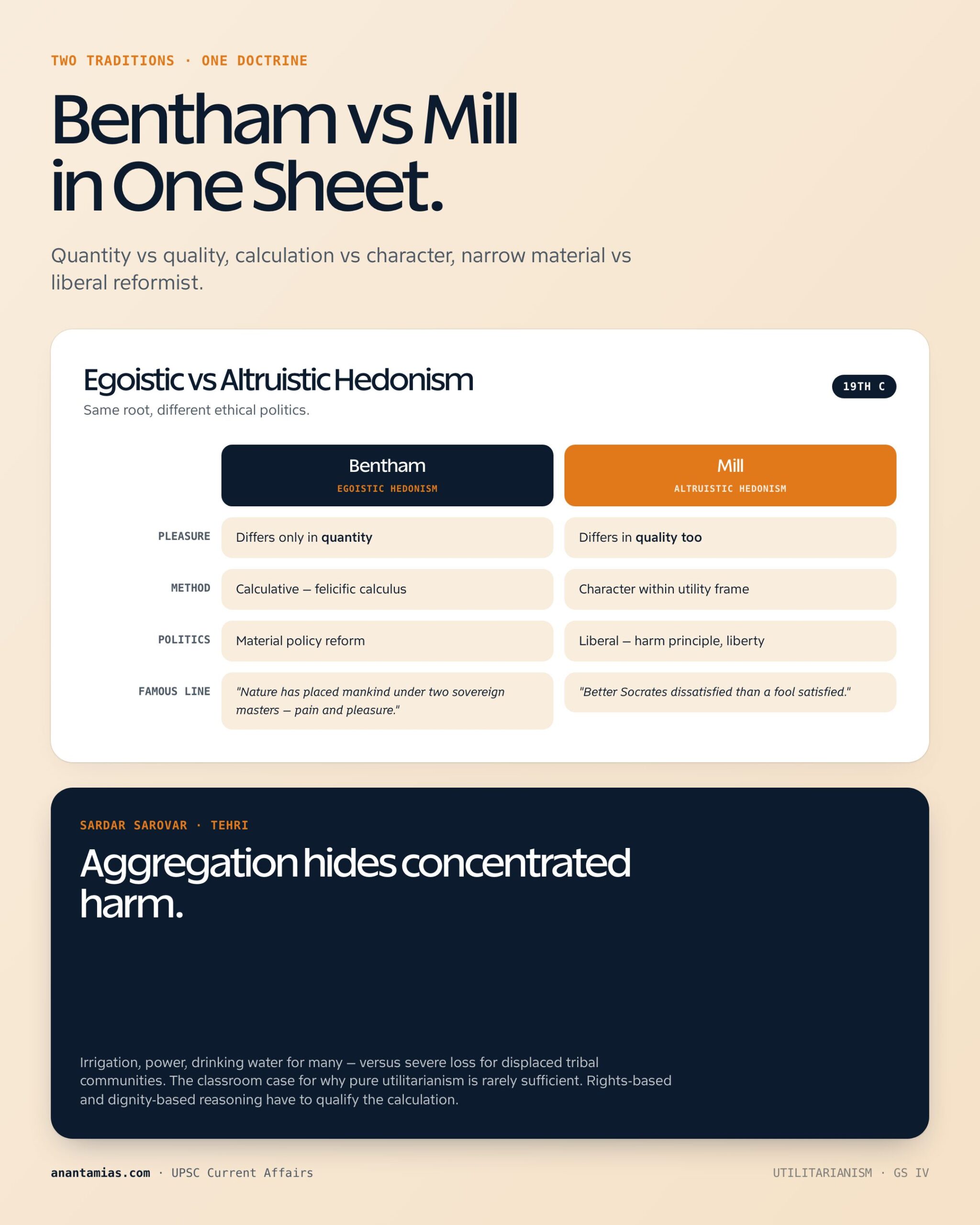
| Egoistic hedonism (Bentham) | Altruistic hedonism (Mill, in his developed form) |
|---|---|
| Pleasure of the actor / aggregate is the criterion | The general happiness, weighted equally, is the criterion |
| Quantitative — pleasures differ only in quantity | Qualitative — higher and lower pleasures |
| Calculative ethics | Character ethics within a utilitarian frame |
| Tendency toward narrow material policy | Tendency toward liberal, reformist politics |
Both belong to the same broader tradition. Both are consequentialist. Both reject deontology (Kantian "duty regardless of consequences") and reject virtue ethics (Aristotelian "right action flows from right character").
Criticisms of utilitarianism
The doctrine has faced sustained critical pressure since the nineteenth century.
- Justice problem. Utilitarianism appears to permit punishing the innocent if it produces enough happiness in others. The framing of an innocent man to prevent a riot seems wrong, but a strict utilitarian struggles to explain why.
- Demandingness. If we ought to maximise happiness, we ought to give until our marginal utility equals the recipient's — a level of self-sacrifice few can sustain.
- Calculability. The hedonic calculus assumes happiness is measurable and comparable across persons. It is not, in any precise way.
- Integrity. Bernard Williams argued that utilitarianism erodes personal integrity — it requires the actor to set aside personal commitments whenever a small aggregate gain elsewhere is on offer.
- Aggregation. Utilitarianism aggregates happiness across persons, but happiness is felt only by individuals. Trading off serious harm to one person against minor benefits to many is morally troubling.
These criticisms have driven the development of alternative consequentialisms (rule utilitarianism, preference utilitarianism, indirect utilitarianism) and of non-consequentialist alternatives (Rawlsian justice as fairness, neo-Aristotelian virtue ethics).
Two Indian case studies
Case study 1 — public-health prioritisation during COVID-19
Vaccine rollout in India proceeded on broadly utilitarian principles: highest-risk groups (healthcare workers, elderly, those with comorbidities) prioritised because vaccinating them produced the greatest reduction in mortality per dose. The DALY (disability-adjusted life year) framework used in health policy is an explicit utilitarian instrument. Tensions arose at the margin — should the highly-mobile young be prioritised because they spread the disease? — and were resolved by something like Mill's calculation of total expected harm reduction.
Case study 2 — large dam projects and developmental displacement
The Sardar Sarovar and Tehri dam projects illustrate utilitarianism's most contested use in Indian governance. The argument for the dams is utilitarian — irrigation, power, drinking water for many; the argument against (advanced by the Narmada Bachao Andolan and others) is that aggregating happiness obscures the severe, concentrated harm to displaced tribal communities. The case is a classroom illustration of utilitarianism's aggregation problem and of why pure utilitarianism is rarely sufficient — rights-based and dignity-based considerations have to qualify aggregate calculations.
Civil services application
Utilitarian thinking is built into administrative practice.
- Cost-benefit analysis. The standard tool for public investment decisions is fundamentally utilitarian.
- Public health. DALY, QALY, vaccine prioritisation — all utilitarian instruments.
- Disaster response. Triage decisions are calibrated utilitarianism with rights-based limits (for example, no abandonment of the severely injured for purely aggregate reasons).
- Welfare scheme design. Targeting beneficiaries to maximise welfare per rupee uses utilitarian logic.
The skilled civil servant uses utilitarianism as a powerful tool while recognising its limits — pairing it with rights-based and dignity-based reasoning where aggregation alone misleads.
UPSC past-year question references
- 2018 GS IV: discussion of consequentialist versus deontological ethical reasoning in case studies.
- 2017 GS IV: case study where greatest-good-of-greatest-number reasoning conflicts with individual rights.
- 2014 GS IV: discussion of the role of conscience and consequence in ethical decision-making.
- GS Paper II: cost-benefit analysis as a tool of policy evaluation.
Mains answer hook
Utilitarianism, the doctrine that an action is right in proportion as it produces happiness in the aggregate, was developed by Jeremy Bentham (egoistic hedonist) and refined by John Stuart Mill (altruistic hedonist who introduced higher and lower pleasures and the harm principle). Its strengths — clarity, calculability, egalitarian counting of happiness, reformist political implications — have made it one of the indispensable tools of modern public policy. Its weaknesses — the justice problem, the aggregation problem, the demandingness objection — are equally well-known. The mature civil servant uses utilitarian reasoning while qualifying it with rights, dignity and procedural fairness. The greatest good of the greatest number is a starting point, not the whole of ethics.
Prelims pointers
- Jeremy Bentham — 1748–1832; An Introduction to the Principles of Morals and Legislation (1789); hedonic calculus.
- John Stuart Mill — 1806–1873; Utilitarianism (1861); On Liberty (1859).
- Two types — egoistic hedonism (Bentham); altruistic hedonism (Mill).
- Greatest happiness principle — actions are right as they promote the greatest happiness of the greatest number.
- Harm principle — Mill; only harm to others justifies restriction of liberty.
- Hedonic calculus — seven dimensions: intensity, duration, certainty, propinquity, fecundity, purity, extent.
FAQ
What is the difference between Bentham’s and Mill’s utilitarianism?
Bentham held that pleasures differ only in quantity; Mill held that they differ in quality, with higher (intellectual, moral) pleasures intrinsically more valuable than lower (physical) pleasures.
Is utilitarianism the same as cost-benefit analysis?
Cost-benefit analysis is a practical instrument inspired by utilitarian thinking. Strict utilitarianism is broader — it ranges over all consequences, not just monetisable ones.
What is rule utilitarianism?
A refinement that holds we should follow rules whose general adoption produces the greatest happiness, rather than calculating each individual action. This addresses the justice problem.
Does utilitarianism support human rights?
Mill defended liberty on broadly utilitarian grounds. Strict utilitarianism does not give rights independent foundational weight, which is one of its main weaknesses for many critics.
Can a civil servant be a utilitarian?
Most civil servants are partial utilitarians — using cost-benefit analysis, weighing aggregate welfare — while qualifying utilitarian conclusions with rights-based and dignity-based considerations. This mixed methodology is, in practice, what good administration requires.
Bentham and Mill gave the modern world a powerful, sometimes uncomfortable, ethical instrument. Used wisely, it cuts through pious sentiment to ask the unglamorous question: does this actually make people's lives better? Used badly, it rationalises the sacrifice of the few for the many. The civil service that learns to use it carefully, and to know when to set it aside, has acquired one of the most useful tools in modern moral reasoning.
Tell Google you want more of this.
Add Anantam IAS as a preferred sourceOne tap, and this site shows up more often in your own Top Stories, AI Overviews and AI Mode. Remove it any time.