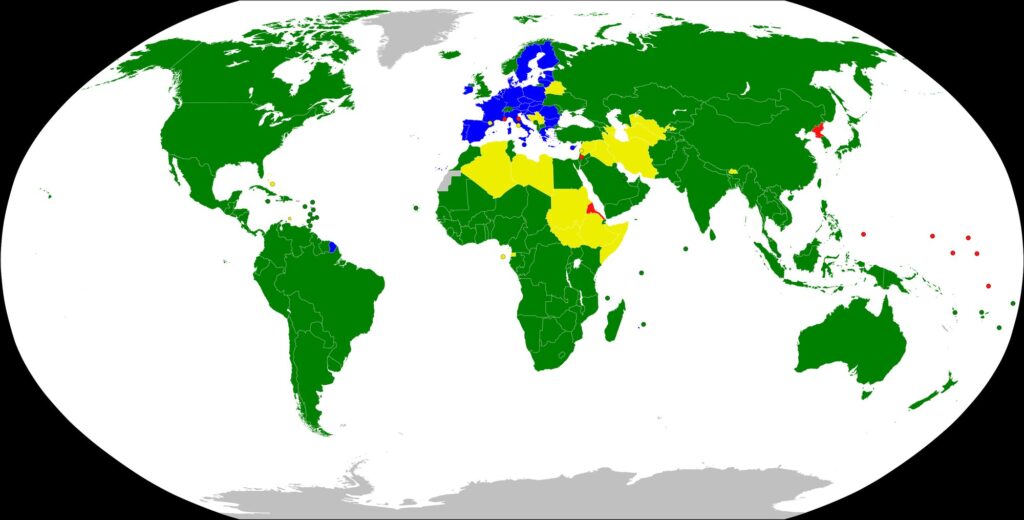
WTO stands for World Trade Organization. It's the global institution that governs international trade rules — setting the framework within which countries negotiate trade agreements, resolve disputes, and commit to open markets.
Every time India exports software services to the US, or the US accuses China of dumping steel, or a country puts tariffs on imported food — the WTO framework is the backdrop. Understanding the WTO is essential for UPSC, especially for International Relations and Economics.
WTO Full Form and Establishment
| Particulars | Details |
|---|---|
| Full form | World Trade Organization |
| Established | 1 January 1995 |
| Predecessor | GATT (General Agreement on Tariffs and Trade) |
| Headquarters | Geneva, Switzerland |
| Membership | 166 members (as of 2024) |
| Director-General | Ngozi Okonjo-Iweala (since 2021) |
| India's membership | Founding member (1 January 1995) |
From GATT to WTO: The Transition
The WTO didn't appear from nowhere. It replaced the GATT (General Agreement on Tariffs and Trade), which had governed international trade since 1947.
GATT was born from the same post-war impulse as the IMF and World Bank — the desire to build institutions that would prevent the economic nationalism and protectionist spirals that contributed to the Great Depression and World War II.
But GATT had limitations:
- It was a provisional agreement, not a formal organisation
- It covered only goods — not services or intellectual property
- Its dispute settlement was weak and easily blocked
- It had no formal enforcement mechanism
Eight rounds of GATT negotiations progressively reduced tariffs. The eighth and final round — the Uruguay Round (1986–1994) — was the most ambitious. It created the WTO.
| GATT Round | Years | Focus |
|---|---|---|
| Geneva | 1947 | Initial tariff cuts |
| Annecy, Torquay, Geneva | 1949–1956 | Further tariff reductions |
| Dillon | 1960–1961 | Tariff cuts |
| Kennedy | 1964–1967 | Anti-dumping measures |
| Tokyo | 1973–1979 | Non-tariff barriers |
| Uruguay | 1986–1994 | Created WTO; included services (GATS), IP (TRIPS) |
The Uruguay Round concluded with the Marrakesh Agreement (1994), which formally established the WTO. It came into force on 1 January 1995.
WTO Structure
The WTO has a layered governance structure:
Ministerial Conference
The highest decision-making body. It meets every two years, bringing together trade ministers from all member countries. The MC can take binding decisions on all WTO matters. Recent conferences:
| MC | Year | Location | Key Outcome |
|---|---|---|---|
| MC11 | 2017 | Buenos Aires | Impasse on agriculture; partial fisheries deal |
| MC12 | 2022 | Geneva | Agreement on Fisheries Subsidies; TRIPS IP waiver (partial) for COVID vaccines |
| MC13 | 2024 | Abu Dhabi | Contested outcomes on agriculture and e-commerce |
General Council
The day-to-day decision-making body, meeting several times a year in Geneva. Below it sit three main councils:
- Council for Trade in Goods
- Council for Trade in Services (GATS)
- Council for Trade-Related Intellectual Property Rights (TRIPS)
Director-General
Ngozi Okonjo-Iweala of Nigeria — the first African and first woman to lead the WTO — became Director-General in 2021. Her selection was controversial: the US under Trump initially blocked her appointment.
Core WTO Agreements
The WTO administers over 60 agreements. Three are central:
GATT (Goods)
The updated General Agreement on Tariffs and Trade covers trade in physical goods. Key principles:
- Most Favoured Nation (MFN): Any trade advantage given to one member must be extended to all members
- National Treatment: Imported goods must be treated the same as domestically produced goods once they've cleared customs
- Tariff Bindings: Countries commit to maximum tariff rates ("bound rates")
GATS (Services)
The General Agreement on Trade in Services covers banking, insurance, telecommunications, tourism, and professional services. India is a major beneficiary — IT services exports depend on GATS commitments by importing countries.
TRIPS (Intellectual Property)
Agreement on Trade-Related Intellectual Property Rights sets minimum standards for patents, copyrights, trademarks, and geographical indications. TRIPS is controversial in developing countries — pharmaceutical companies use TRIPS-backed patents to maintain high drug prices, limiting access in poor countries.
WTO Dispute Settlement
The WTO's dispute settlement mechanism is its most powerful feature — the "crown jewel" that GATT lacked.
How It Works
- Consultations — disputing parties try to resolve bilaterally (60 days)
- Panel stage — if talks fail, a panel of three experts hears the case
- Appellate Body — either party can appeal panel findings
- Implementation — losing party must comply or face authorised retaliation
Unlike GATT, WTO dispute rulings cannot be blocked by the losing party. This is the key reform.
The Appellate Body Crisis
Since 2019, the Appellate Body has been non-functional. The US blocked new appointments to its seven-member bench under both Obama and Trump administrations, citing concerns about judicial overreach. By December 2019, the body fell below the minimum three judges needed to hear appeals.
Without the Appellate Body, WTO dispute settlement is partially broken — a serious crisis for the multilateral trading system.
India has joined a Multi-Party Interim Appeal Arbitration Arrangement (MPIA) with the EU and other members as a workaround.
The Doha Round: The Stalled Agenda
The Doha Development Round, launched in November 2001 in Doha, Qatar, was meant to be the WTO's ninth trade round with a focus on development — helping poor countries benefit from trade liberalisation.
It was declared an "impasse" in 2008 and has never concluded. Why did it fail?
Agriculture was the core deadlock. Developing countries — led by India, China, and Brazil — demanded:
- Cuts to agricultural subsidies in the US and EU
- Protection for subsistence farmers through a Special Safeguard Mechanism (SSM)
The US and EU resisted cutting agricultural subsidies. The 2008 Potsdam talks collapsed when India and China refused to accept the proposed SSM trigger levels.
The Doha Round's failure reflects a fundamental tension: rich countries support their farmers with massive subsidies while telling poor countries to open their markets.
India's Position in the WTO
India is one of the most vocal and influential developing country voices in the WTO.
Agriculture: India defends its right to maintain Minimum Support Price (MSP) programmes and public stockholding of food grains for food security. Under WTO rules, domestic support exceeding 10% of the value of production is technically violating commitments — but India argues food security is non-negotiable.
Public Stockholding: India led negotiations for a "permanent solution" on public stockholding for food security under the Bali Package (2013) peace clause. This remains unresolved and is a live issue in every ministerial conference.
TRIPS and Pharmaceuticals: India successfully used TRIPS flexibilities (compulsory licensing) for generic medicines. India supplies affordable generic drugs to the developing world — a role deeply tied to TRIPS interpretation.
E-commerce moratorium: India and South Africa have opposed extending the moratorium on customs duties on electronic transmissions — arguing it benefits tech companies in rich countries while denying customs revenue to developing nations.
Services and Mode 4: India pushes for liberalisation of "Mode 4" services — movement of natural persons (i.e., professionals working abroad) — where India has a competitive advantage in IT and professional services.
Related: IMF Full Form: International Monetary Fund
Related: ASEAN Full Form: Association of Southeast Asian Nations
Frequently Asked Questions
What is the full form of WTO?
WTO stands for World Trade Organization. It is the international body that governs the rules of trade between nations, settled in Geneva, Switzerland, and operational since 1 January 1995.
How did GATT become the WTO?
The GATT (General Agreement on Tariffs and Trade), established in 1947, was replaced by the WTO in 1995 after the Uruguay Round (1986–1994). The WTO expanded coverage to services (GATS) and intellectual property (TRIPS) and created a binding dispute settlement mechanism.
Where is the WTO headquartered?
The WTO is headquartered in Geneva, Switzerland. Its highest body — the Ministerial Conference — meets every two years.
What is the Doha Round?
The Doha Development Round is the WTO's ninth trade negotiating round, launched in 2001 in Qatar. It aimed to make trade rules more favourable to developing countries. It reached an impasse in 2008 mainly over agricultural subsidies and has not concluded.
What is India's key concern in the WTO?
India's primary WTO concern is protecting its public stockholding programme — buying food from farmers at Minimum Support Prices and maintaining grain reserves. India argues this is essential for food security. It technically violates WTO subsidy limits, and India wants a permanent solution rather than a temporary peace clause.
Tell Google you want more of this.
Add Anantam IAS as a preferred sourceOne tap, and this site shows up more often in your own Top Stories, AI Overviews and AI Mode. Remove it any time.