IMF Full Form: International Monetary Fund
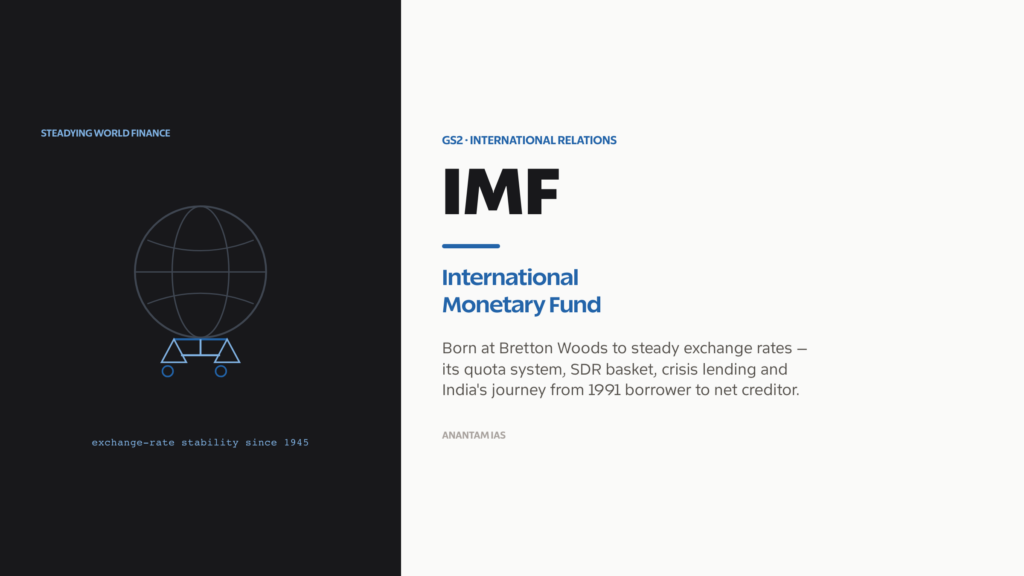
IMF stands for International Monetary Fund. It’s the global institution that provides financial stability, monitors exchange rates, offers emergency loans to countries facing balance of payments crises, and promotes international monetary cooperation.
If the World Bank builds roads and schools, the IMF steadies exchange rates and bails out economies on the brink. The two are often confused — but their mandates are distinct.
IMF Full Form and Bretton Woods Origins
The IMF was conceived at the Bretton Woods Conference — a United Nations Monetary and Financial Conference held in July 1944 at Mount Washington Hotel, Bretton Woods, New Hampshire, USA. The timing matters: World War II was still being fought, but Allied nations were already planning the post-war economic order.
The conference was driven by two giants — John Maynard Keynes (UK) and Harry Dexter White (USA). They argued about the design: Keynes wanted a supranational currency and a more powerful institution; White insisted on dollar dominance. White largely won.
| Particulars | Details |
|---|---|
| Full form | International Monetary Fund |
| Founded | December 1945 (Articles of Agreement) |
| Operative | 1 March 1947 |
| Headquarters | Washington D.C., USA |
| Membership | 191 countries (as of 2024) |
| Managing Director | Kristalina Georgieva (since 2019) |
| Annual report | World Economic Outlook (WEO) |
India is a founding member of the IMF — it signed the Articles of Agreement in December 1945.
The Bretton Woods System
The Bretton Woods conference created a system of fixed but adjustable exchange rates pegged to the US dollar, which was in turn pegged to gold at $35 per ounce. This gave the world monetary stability after the chaos of the 1930s.
But the system collapsed in 1971 when US President Nixon suspended dollar-gold convertibility — the “Nixon Shock.” Since then, the IMF has operated in a world of floating exchange rates, with a shifted mandate: surveillance, crisis lending, and capacity development rather than managing a fixed exchange rate system.
IMF Quota System: Power and Money
The IMF’s quota system is central to how it operates and how power is distributed. Every member country is assigned a quota based on its relative size in the global economy.
Quotas determine three things:
- Subscriptions — how much money a country contributes to the IMF
- Voting power — more quota means more votes
- Access to financing — countries can borrow in proportion to their quota
| Country/Group | IMF Quota Share (approx.) |
|---|---|
| United States | ~17.4% |
| Japan | ~6.5% |
| China | ~6.4% |
| Germany | ~5.6% |
| UK | ~4.2% |
| France | ~4.2% |
| India | ~2.75% |
| BRICS combined | ~15% |
| G7 combined | ~43% |
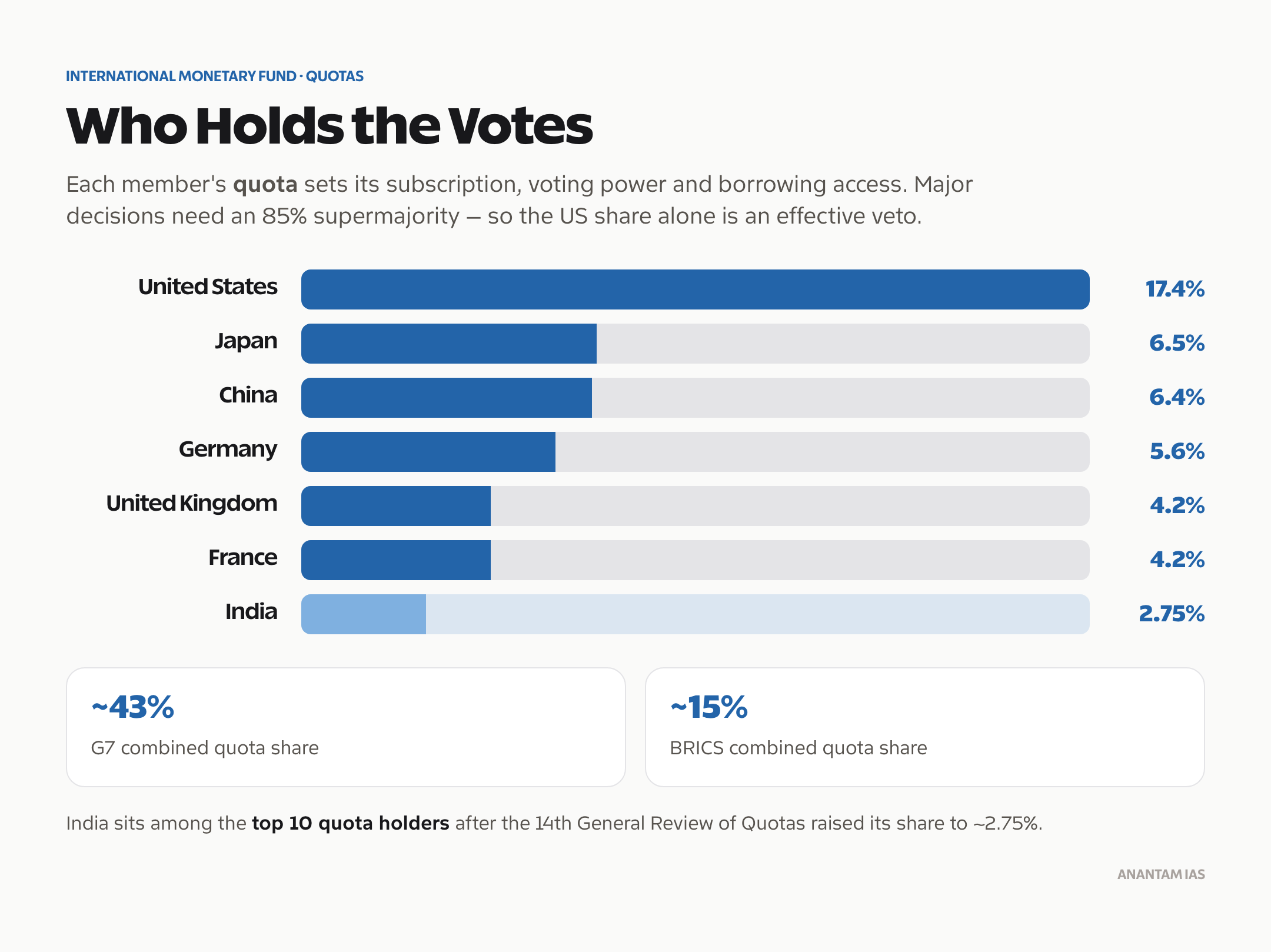
The US has over 17% of votes — giving it an effective veto on major decisions, which require 85% supermajority. This is a persistent criticism of the IMF: it reflects 1940s economic power, not today’s reality.
India’s Quota and Voting Power
India’s quota was revised upward under the 14th General Review of Quotas (2016) — a reform negotiated by emerging markets. India’s share moved to approximately 2.75%, placing it among the top 10 quota holders. India’s executive director on the IMF Board represents India (and Bhutan, Bangladesh, Sri Lanka, and others) on a constituency basis.
India has pushed for further reforms — a 16th Quota Review, which concluded in 2023, raised total quotas by 50% but didn’t shift relative shares significantly.
Special Drawing Rights (SDR)
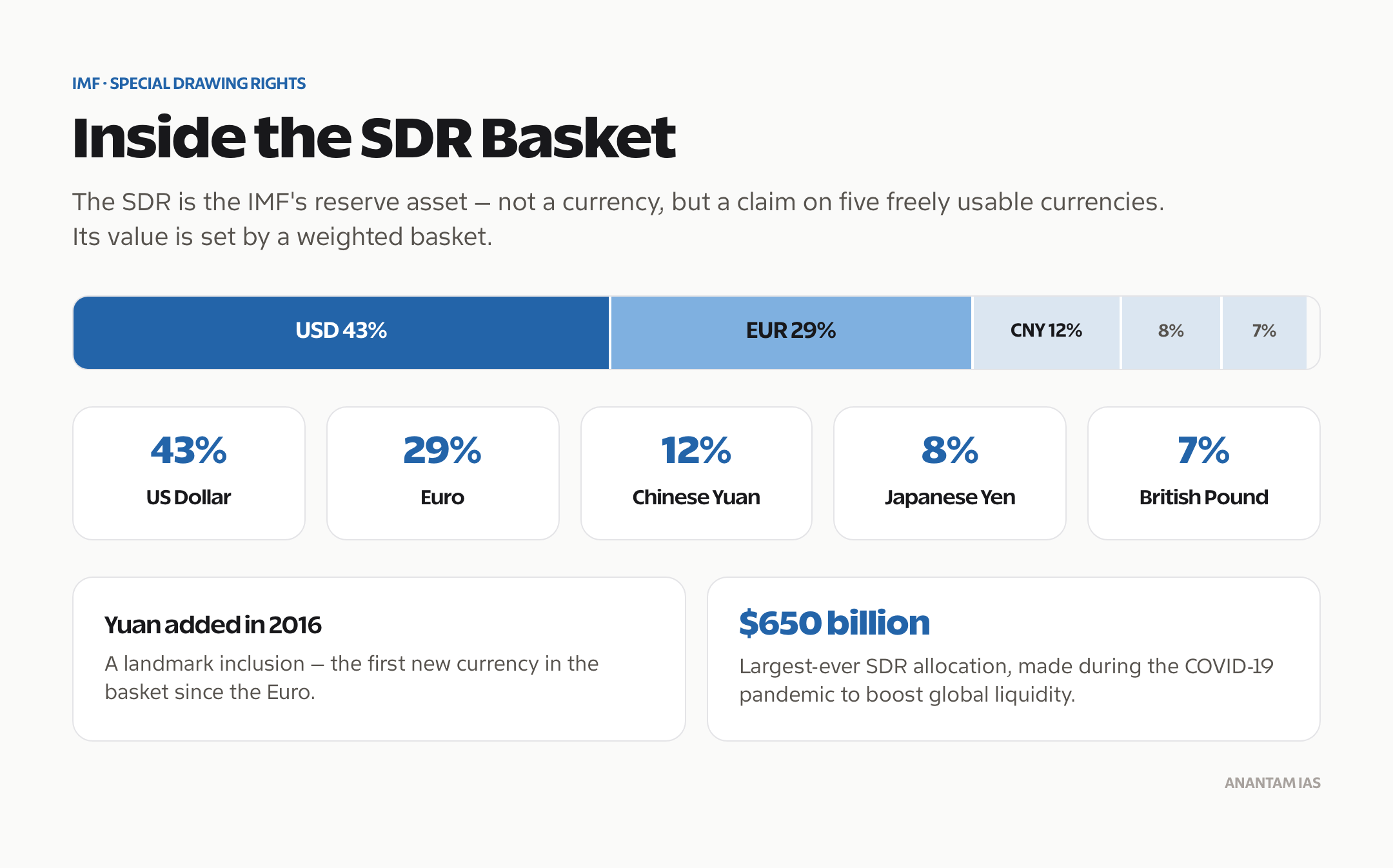
The SDR (Special Drawing Right) is the IMF’s international reserve asset — not a currency, but a claim on member countries’ freely usable currencies. It supplements member countries’ official reserves.
The SDR’s value is based on a basket of five currencies:
| Currency | Weight in SDR basket |
|---|---|
| US Dollar | ~43% |
| Euro | ~29% |
| Chinese Yuan (RMB) | ~12% |
| Japanese Yen | ~8% |
| British Pound | ~7% |
The Chinese Yuan’s inclusion in 2016 was a landmark — it marked China’s financial rise and the first addition to the basket since the Euro replaced Deutsche Mark and French Franc.
Countries can use SDRs to obtain foreign exchange from other members, pay IMF obligations, or hold as part of official reserves. During the COVID-19 pandemic, the IMF allocated $650 billion worth of SDRs (the largest ever allocation) to boost global liquidity.
IMF Lending: How It Works
The IMF lends to countries facing balance of payments (BoP) difficulties — when a country can’t meet its external payment obligations. Lending comes with conditions attached — this is called conditionality.
Main IMF Lending Instruments
| Facility | Purpose | Key Feature |
|---|---|---|
| Stand-By Arrangement (SBA) | Short-term BoP support | Most common; 12–24 months |
| Extended Fund Facility (EFF) | Medium-term structural issues | 3 years; deeper reforms required |
| Flexible Credit Line (FCL) | Precautionary; strong economies | No conditionality (for strong performers) |
| Poverty Reduction and Growth Trust (PRGT) | Low-income countries | Concessional (low/zero interest) |
| Resilience and Sustainability Trust (RST) | Climate/pandemic risks | Introduced 2022 |
Structural Adjustment Programmes (SAPs)
In the 1980s–1990s, the IMF became notorious for Structural Adjustment Programmes — conditionalities attached to loans that required recipient countries to: cut government spending, privatise state enterprises, liberalise trade, and deregulate markets.
These SAPs were heavily criticised — especially in sub-Saharan Africa and Latin America — for causing social suffering while the economic benefits were slow to materialise. Cutting healthcare and education budgets in countries already struggling with poverty drew intense humanitarian criticism.
The IMF has since revised its approach. Post-2009 reforms acknowledged that fiscal consolidation must account for social spending floors and that inequality matters for growth sustainability.
India and the IMF: 1991 Crisis
India’s most significant IMF engagement came in 1991, when India faced a severe BoP crisis — foreign exchange reserves fell to just two weeks’ worth of imports. India pledged gold reserves to the Bank of England and secured an IMF loan.
The IMF loan came with conditionalities that pushed India toward liberalisation — the 1991 New Economic Policy (LPG: Liberalisation, Privatisation, Globalisation) reforms by Finance Minister Manmohan Singh and PM Narasimha Rao emerged partly from this pressure. India repaid the IMF loan ahead of schedule.
Since then, India has not needed to borrow from the IMF and has moved to being a net creditor — a source of funds for the IMF rather than a borrower.
IMF Surveillance: Monitoring the Global Economy
Beyond lending, the IMF conducts Article IV Consultations — annual bilateral discussions with each member country to assess economic health, policies, and risks. The findings are published and closely watched by financial markets.
The IMF also publishes:
- World Economic Outlook (WEO) — global growth forecasts, twice yearly
- Global Financial Stability Report (GFSR) — financial system risks
- Fiscal Monitor — government fiscal positions globally
These publications move markets. When the IMF revises India’s growth forecast up or down, it signals to international investors.
Recent IMF Reforms and Debates
Governance reform: Emerging markets have long pushed for greater voting rights to reflect their economic weight. The 2016 quota reforms (14th Review) doubled overall quotas and shifted 6% of quota share toward emerging markets. But critics say more is needed.
Gender lens: The IMF has increasingly incorporated gender into its analysis — arguing that closing gender gaps in labour force participation would significantly boost growth.
Climate: The Resilience and Sustainability Trust (RST, 2022) allows the IMF to channel SDRs from wealthy nations to vulnerable countries for climate adaptation.
China concern: IMF Article IV consultations with China have become politically charged — debates over yuan undervaluation, capital account management, and debt diplomacy through Belt and Road Initiative.
WTO Full Form: World Trade Organization
G20 and India: Presidency, Outcomes and Significance
Frequently Asked Questions
What is the full form of IMF?
IMF stands for International Monetary Fund. It’s the global financial institution that promotes monetary cooperation, exchange rate stability, and provides loans to countries facing balance of payments crises.
When and where was the IMF founded?
The IMF was conceived at the Bretton Woods Conference in July 1944 in New Hampshire, USA. It formally came into existence in December 1945 when the Articles of Agreement were signed.
What is SDR in the IMF?
SDR stands for Special Drawing Right — the IMF’s international reserve asset. Its value is based on a basket of five currencies: US Dollar, Euro, Chinese Yuan, Japanese Yen, and British Pound. It is not a currency itself but a claim on member currencies.
What is India’s quota in the IMF?
India holds approximately 2.75% of IMF quotas, placing it among the top 10 members. India’s quota was increased in the 2016 (14th General Review) reforms. India is now a net creditor to the IMF rather than a borrower.
What are Structural Adjustment Programmes?
Structural Adjustment Programmes (SAPs) were conditions attached to IMF loans in the 1980s–90s, requiring countries to cut spending, privatise, and liberalise trade. They were widely criticised for causing social hardship. The IMF has since reformed its conditionality approach.
Tell Google you want more of this.
Add Anantam IAS as a preferred sourceOne tap, and this site shows up more often in your own Top Stories, AI Overviews and AI Mode. Remove it any time.