Disclosure: this guide contains Amazon affiliate links. As an Amazon Associate, Anantam IAS earns from qualifying purchases — at no extra cost to you.
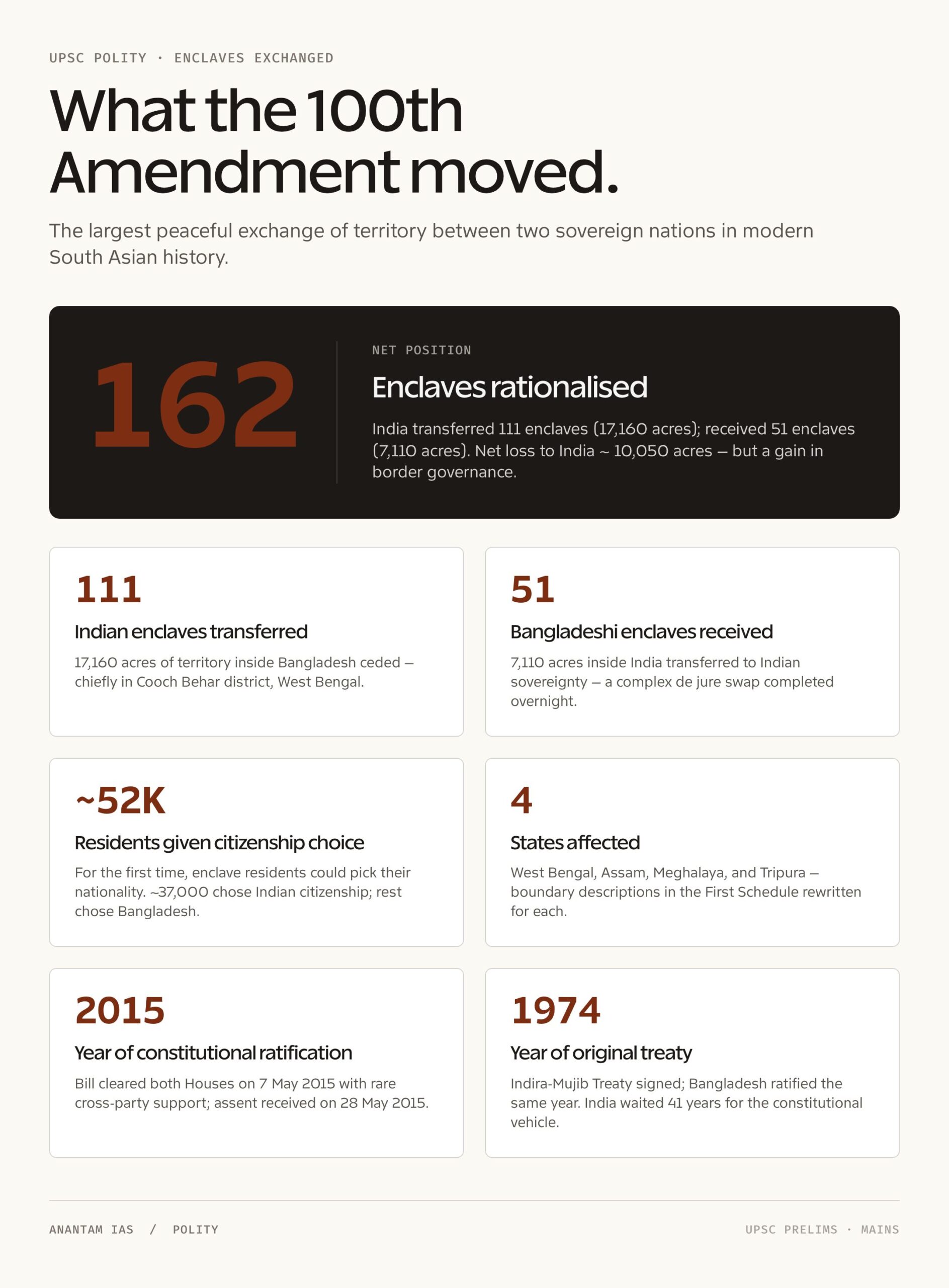
The 100th amendment act of indian constitution is the only constitutional amendment in independent India that changed India’s territorial map through a treaty with a neighbour. It implemented the long-pending India–Bangladesh Land Boundary Agreement (LBA), exchanged 162 enclaves between the two countries, and ended a 41-year border anomaly. Most aspirants stop at “border amendment” and miss the structural facts — it amended the First Schedule, affected four states (West Bengal, Assam, Meghalaya, Tripura), and required ratification under Article 368(2) because state boundaries were touched. The Modi government pushed it through in May 2015 with rare cross-party support. Here’s the full read — provisions, articles affected, the Indira–Mujib backstory, and the citizenship outcome for around 50,000 enclave residents.
What is the 100th Amendment of Indian Constitution?
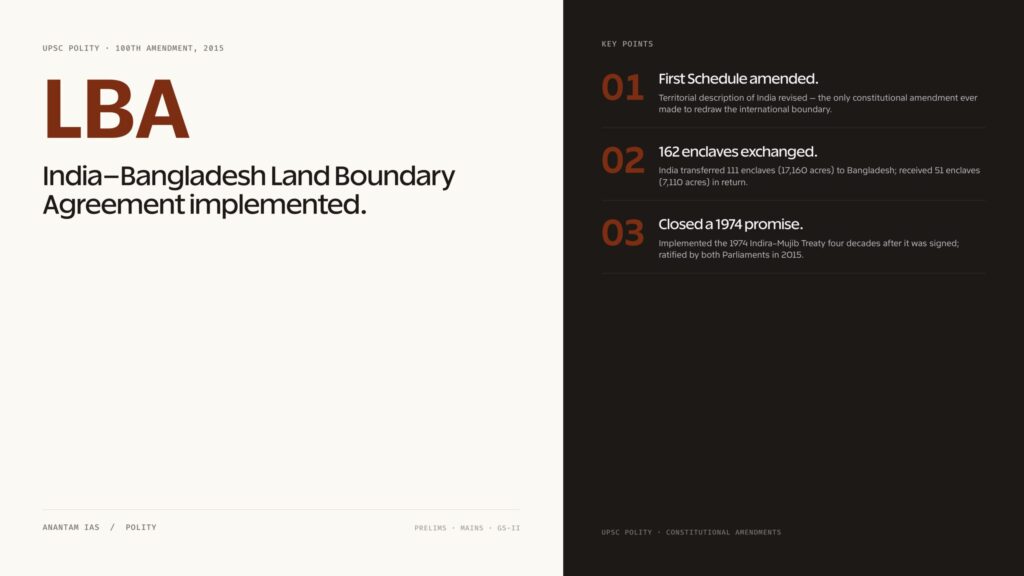
The Constitution (One Hundredth Amendment) Act, 2015 gave constitutional effect to the Land Boundary Agreement (LBA) of 1974 — also known as the Indira–Mujib Agreement — and its 2011 Protocol between India and Bangladesh. The Act amended the First Schedule of the Indian Constitution to give and receive territories with Bangladesh in respect of the states of Assam, West Bengal, Meghalaya, and Tripura.
The Bill was introduced as the Constitution (One Hundred and Nineteenth Amendment) Bill, 2013, but lapsed. It was reintroduced and passed by Rajya Sabha on 6 May 2015 and Lok Sabha on 7 May 2015 — both Houses approved it unanimously. It received Presidential assent from Pranab Mukherjee on 28 May 2015.
Three quick facts for revision:
- 100th Amendment — 2015 — implemented the India–Bangladesh Land Boundary Agreement (LBA, 1974) and its 2011 Protocol.
- First Schedule — amended in respect of Assam, West Bengal, Meghalaya, and Tripura.
- 162 enclaves exchanged — India received 51 Bangladeshi enclaves; Bangladesh received 111 Indian enclaves. Implementation completed at midnight on 31 July 2015.
Why was the 100th Amendment passed?
OK, let’s set the backstory… because without the 1947 partition mess, none of this makes sense.
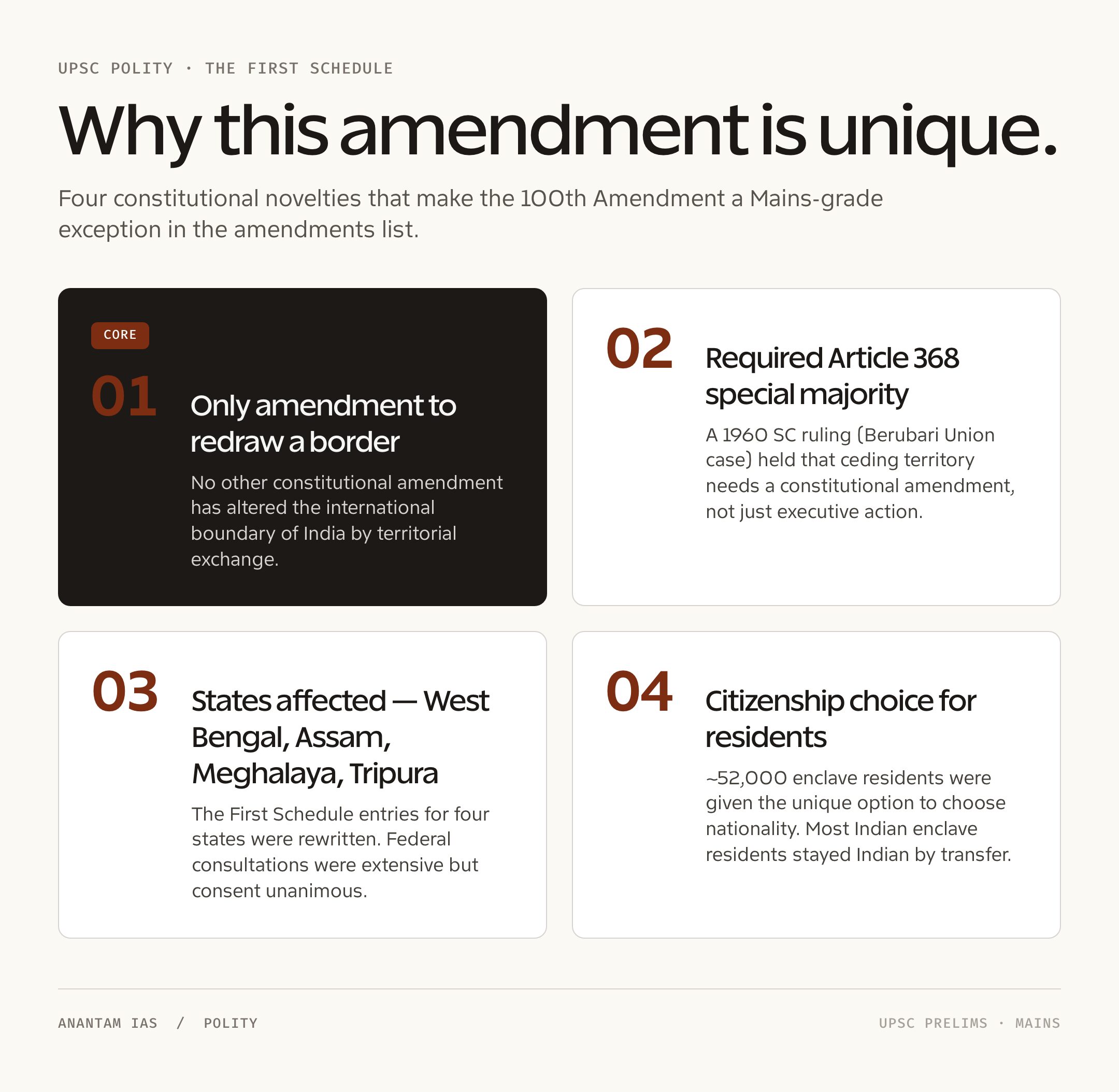
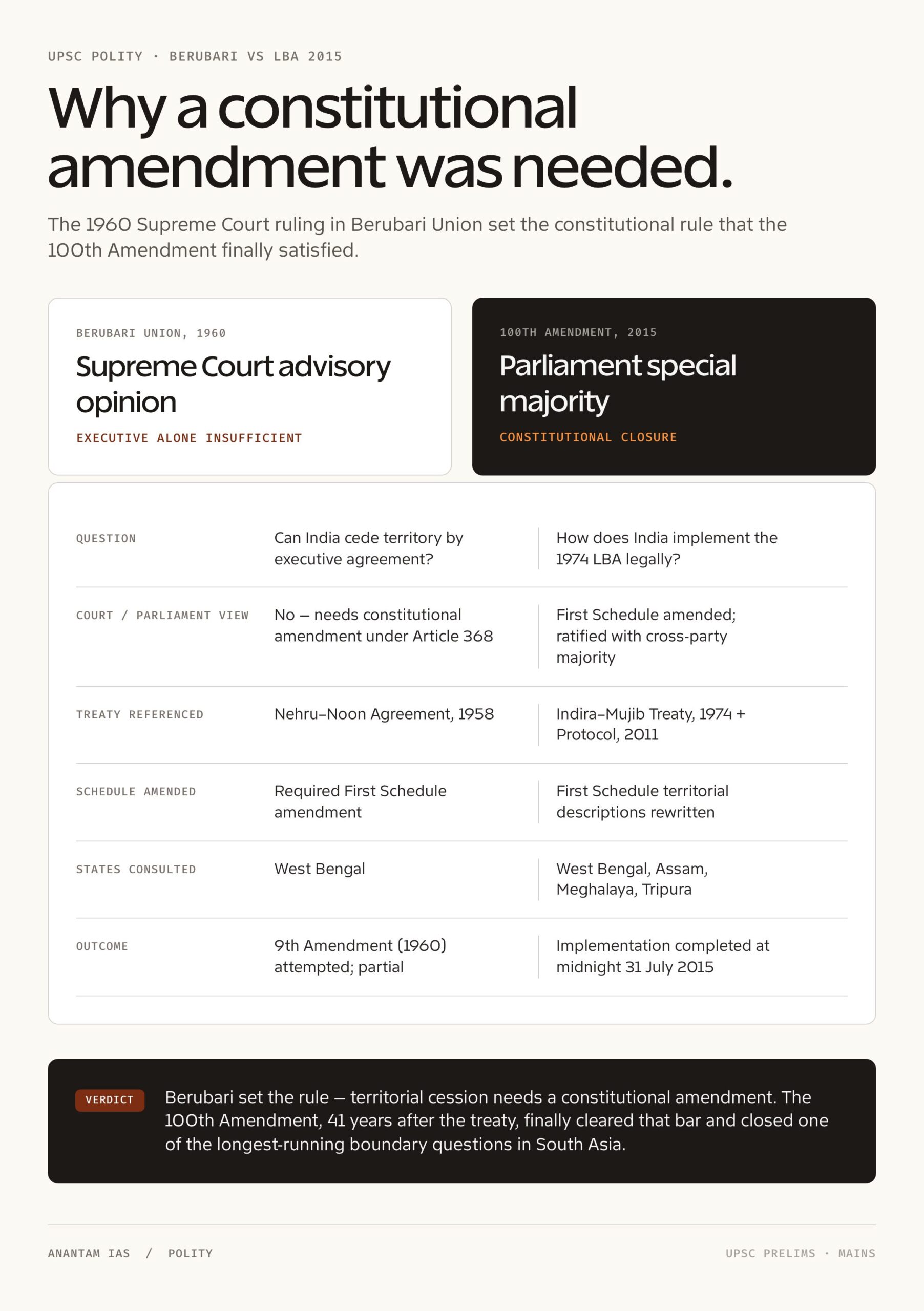
When British India was partitioned, the Radcliffe Boundary Commission left a strange legacy along the eastern frontier: pockets of one country’s territory entirely surrounded by the other. The 1958 Nehru–Noon Agreement tried to fix this. The Berubari Union case (1960) blocked it… the Supreme Court held that ceding territory needed a constitutional amendment, leading to the 9th Amendment, 1960.
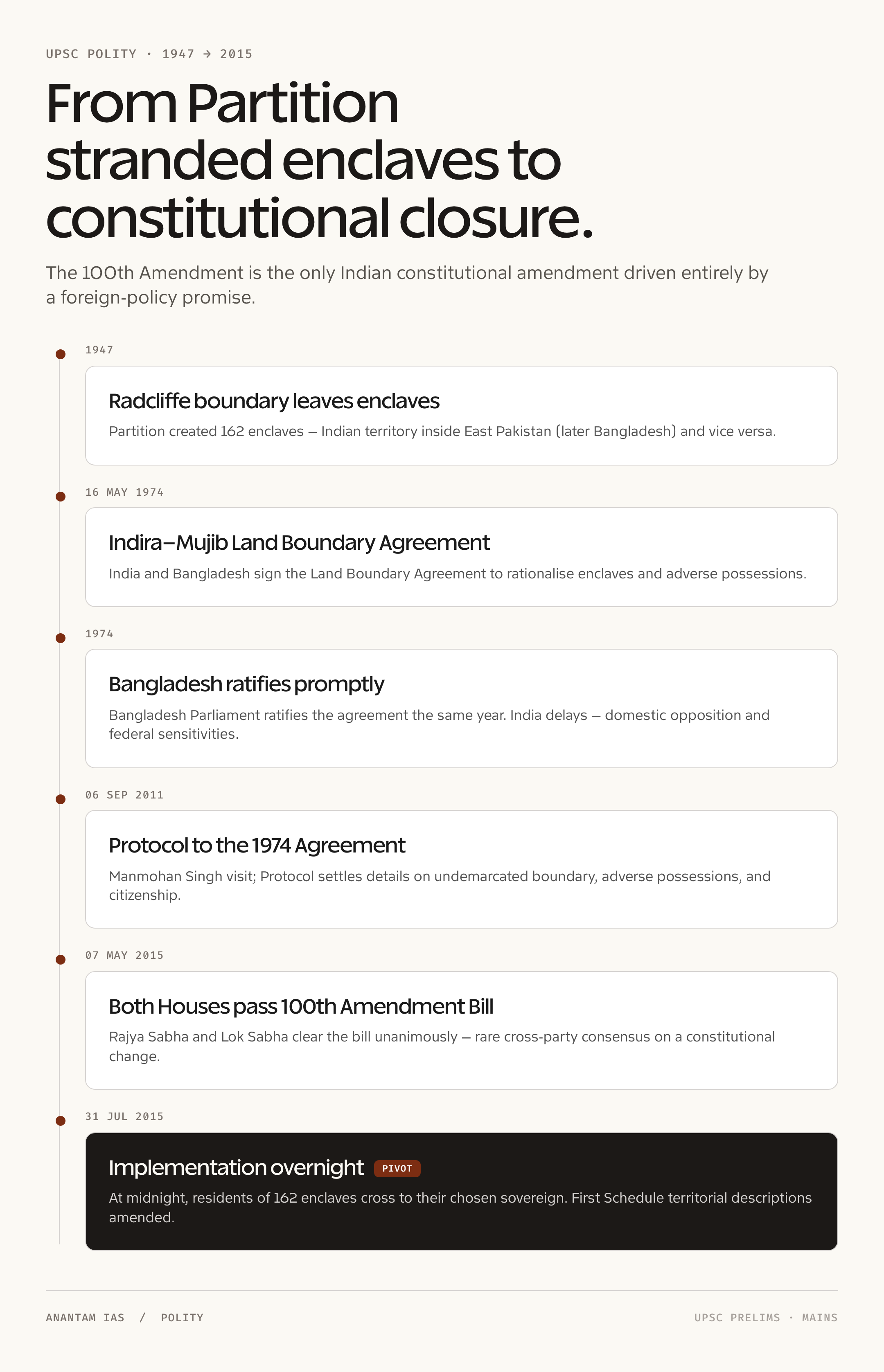
But the larger anomaly remained. In 1974, Prime Minister Indira Gandhi and Bangladesh’s Sheikh Mujibur Rahman signed the Land Boundary Agreement to swap enclaves and settle the boundary. Bangladesh ratified it in 1974. India didn’t. For 41 years it stayed in legal limbo.
The story in five steps:
- 16 May 1974 — Indira Gandhi and Sheikh Mujibur Rahman sign the LBA in Delhi.
- 1974 — Bangladesh ratifies the LBA.
- 2011 — Manmohan Singh signs the LBA Protocol with Sheikh Hasina, refining maritime and land boundaries.
- 2013 — UPA introduces the 119th Constitution Amendment Bill; lapses with the 15th Lok Sabha.
- 6–7 May 2015 — Modi government’s reintroduced Bill passes both Houses unanimously; assent on 28 May 2015.
For the broader bilateral context, see India–Bangladesh Relations.
What did the 100 amendment of indian constitution change?
The 100th amendment of indian constitution is short — only three sections in the Act — but each affects the constitutional structure differently. Here’s the precise impact.
1. First Schedule of the Constitution — territorial changes
The amendment altered the entries for four states in the First Schedule, which lists the territories of states and union territories. The changes:
- West Bengal — boundary changes affecting Cooch Behar district, where most of the enclaves were located.
- Assam — a small adjoining-land adjustment along the Bangladesh border.
- Meghalaya — boundary changes in the Jaintia Hills and East Khasi Hills border areas.
- Tripura — boundary changes affecting parts of the southern district.
For the full set of 12 Schedules of the Constitution, see the linked guide. The First Schedule is the only one that maps the country.
2. Acquisition and transfer of territory
The amendment authorised:
- Transfer to Bangladesh of 111 Indian enclaves located inside Bangladesh, totalling about 17,160 acres.
- Acquisition from Bangladesh of 51 Bangladeshi enclaves located inside India, totalling about 7,110 acres.
- Settlement of adverse possession lands — areas under one country’s effective control but technically the other’s territory.
Net effect for India: about 10,050 acres net transfer to Bangladesh, but with the gain of clear sovereign borders.
3. Ratification by states — Article 368(2) procedure
Because the amendment changed state territories under the First Schedule, it required ratification under the proviso to Article 368(2). However, the constitutional arrangement followed was the standard amendment route — special majority of each House of Parliament with the consent of the affected state legislatures expressed through a resolution.
In practice: West Bengal’s resolution support came through a separate parliamentary statement, and Assam, Meghalaya, and Tripura had earlier expressed concurrence. The unanimous Parliament vote made this politically painless.
The enclaves — the human story
Honestly, this is the part that turns a dry constitutional amendment into a UPSC essay-grade story. Around 50,000 to 51,000 people lived in these enclaves before 2015. They had no electricity. No schools. No police. No legal access to the country surrounding them… they couldn’t leave their enclave to reach their own country without crossing the surrounding country.
The LBA gave them three things:
- A choice — residents of transferred enclaves could choose either Indian or Bangladeshi citizenship.
- Recognised identity — for the first time since 1947, they had a documented legal nationality.
- Public services — schools, electricity, healthcare, ration cards became accessible.
By the survey deadline:
- About 14,864 residents of the 111 ex-Indian enclaves transferring to Bangladesh chose to remain Indian; they relocated across the border to West Bengal.
- The remaining residents in the 51 ex-Bangladeshi enclaves (now in India) became Indian citizens by default.
The transfer of people was completed on 30 November 2015.
Articles affected and parliamentary procedure
| Constitutional element | Effect of 100th Amendment |
|---|---|
| First Schedule | Amended for Assam, West Bengal, Meghalaya, Tripura |
| Article 368(2) proviso | Triggered — state boundary change route |
| Article 1 (Union and its territory) | Indirectly affected — Union territory altered |
| 9th Amendment, 1960 (Berubari context) | Earlier precedent for territorial amendment |
| Citizenship Act, 1955 | Applied to enclave residents who chose Indian citizenship |
For the wider amendment scheme, see Amendments to the Indian Constitution.
Why this matters for UPSC
Three exam zones to know cold:
- Prelims — Year (2015), date of assent (28 May 2015), states affected (four — Assam, West Bengal, Meghalaya, Tripura), Schedule amended (First Schedule). UPSC asked a related question in CSE Prelims 2017.
- Mains GS Paper II — Federalism / GS Paper III — Internal Security — “Examine the constitutional and strategic significance of the India–Bangladesh Land Boundary Agreement, 2015.” A ready 15-marker.
- Mains GS Paper II — International Relations — “Discuss the impact of the 2015 LBA on India–Bangladesh bilateral relations.” Another standard ask.
Look, examiners love this exact framing: “How does the 100th Amendment demonstrate the use of Article 368 for territorial settlement?” Answer with: First Schedule, ratification under proviso to 368(2), Berubari precedent, 1974 LBA, unanimous parliamentary vote.
I’ve watched aspirants conflate this with the 9th Amendment of 1960… they’re related but separate. The 9th Amendment dealt with the Berubari Union exchange following the 1958 Nehru–Noon Agreement. The 100th Amendment dealt with the 1974 Indira–Mujib LBA. Honestly, different decades, different territories, same constitutional route.
Common misconceptions
Myth 1: “The 100 amendment of indian constitution gave Indian territory to Bangladesh.” Half-true. It was a swap. India transferred 111 enclaves (about 17,160 acres) to Bangladesh and received 51 enclaves (about 7,110 acres) from Bangladesh. Net land transfer to Bangladesh was about 10,050 acres — but India settled the entire eastern boundary, which was the strategic gain.
Myth 2: “The amendment was opposed by all parties.” Wrong. It was passed unanimously by both Houses on 6–7 May 2015 — a rare cross-party consensus. Earlier opposition (during 2013 attempts) had faded by 2015.
Myth 3: “The 100th amendment of indian constitution amended Article 1.” Wrong. It amended the First Schedule, not Article 1 directly. Article 1 simply lists “the States” — the contents of that list are in the First Schedule. The amendment changed the descriptions in the First Schedule.
Myth 4: “Enclave residents had no choice — they were forcibly transferred.” Wrong. Each adult resident was given the choice of Indian or Bangladeshi citizenship. About 14,864 residents from the 111 ex-Indian enclaves chose to stay Indian and relocated to West Bengal.
Myth 5: “The LBA was Modi’s idea.” Wrong. The LBA was signed in 1974 by Indira Gandhi and Sheikh Mujibur Rahman. The 2011 Protocol was signed by Manmohan Singh. The Modi government passed the constitutional amendment in 2015… implementation, not authorship.
How to revise this in 30 minutes
Source priority for Mains-grade depth:
- Laxmikanth — *Indian Polity — Chapter on amendments and territorial provisions.
- NCERT — *India and the Contemporary World, Part II — for the 1947 partition context.
- PRS Legislative Brief — Constitution (One Hundredth Amendment) Act, 2015.
- Indian Express explainers on LBA implementation (June–November 2015 archives).
- Library of Congress Global Legal Monitor, “Bangladesh; India: Decades-Long Border Dispute Resolved Through Implementation of Land Swap Agreement,” August 2015.
Make a one-page note with: 1974 LBA, 2011 Protocol, First Schedule, four states, 162 enclaves, 51 Bangladeshi + 111 Indian, 28 May 2015 assent, 31 July 2015 transfer, citizenship choice. That’s any 10-marker.
Frequently Asked Questions
When was the 100th Amendment of Indian Constitution passed?
Rajya Sabha passed it on 6 May 2015 and Lok Sabha on 7 May 2015. President Pranab Mukherjee gave assent on 28 May 2015.
Which Schedule of the Constitution did the 100th Amendment change?
The First Schedule, which lists the territories of Indian states and Union territories. Entries for Assam, West Bengal, Meghalaya, and Tripura were modified.
What was the Land Boundary Agreement of 1974?
It was the Indira–Mujib Agreement signed on 16 May 1974 between India and Bangladesh to settle the inherited 1947 boundary anomalies — including the exchange of enclaves and adverse possession lands.
How many enclaves were exchanged under the 100th Amendment?
A total of 162 enclaves: India received 51 Bangladeshi enclaves (about 7,110 acres) and transferred 111 Indian enclaves (about 17,160 acres) to Bangladesh.
Which Indian states were affected by the 100 amendment of indian constitution?
Four states — Assam, West Bengal, Meghalaya, and Tripura. Most of the enclaves were in West Bengal’s Cooch Behar district.
What happened to the people living in the enclaves?
Around 50,000 enclave residents were given a one-time choice between Indian and Bangladeshi citizenship. About 14,864 chose Indian citizenship and relocated to West Bengal. The transfer was completed on 30 November 2015.
Did the 100th Amendment require state ratification?
Yes. Because it altered state territories under the First Schedule, it required the procedure under the proviso to Article 368(2). The affected states had given their concurrence; Parliament passed the amendment unanimously.
How is the 100th Amendment different from the 9th Amendment of 1960?
The 9th Amendment, 1960, implemented the Nehru–Noon Agreement of 1958, dealing with the Berubari Union exchange. The 100th Amendment, 2015, implemented the Indira–Mujib LBA of 1974 and its 2011 Protocol. Both used Article 368 to alter the First Schedule, but they covered different territories and different decades.
Tell Google you want more of this.
Add Anantam IAS as a preferred sourceOne tap, and this site shows up more often in your own Top Stories, AI Overviews and AI Mode. Remove it any time.